Great Lakes - PGDM & PGPM Admissions 2027
Globally Recognized by AACSB (US) & AMBA (UK) | 18 LPA Avg. CTC for PGPM 2026


From securing a 99.91 percentile in CAT in her very first attempt, getting into IIM Bangalore, graduating with a place on the Director’s Merit List to finally securing a position in her dream company McKinsey, Riddhi Dugar’s MBA journey is nothing short of phenomenal. But behind this success lies the years of meticulous planning and the consistent effort. A commerce graduate, Riddhi, decided to pursue an MBA while still in school and approached CAT preparation with a clear focus on building strong fundamentals, analysing mock tests and working consistently on her weaker areas. Among the IIM calls she received, she chose IIM Bangalore because of her lifelong dream to work in the consulting sector. In IIM Bangalore despite the low phases, she remained actively involved in student-led activities, earning international exposure through an exchange programme at the University of St. Gallen, and secured a place among the top 5% of her batch. Her long-standing interest in consulting eventually led her to McKinsey, where her internship further strengthened her decision to pursue consulting as the starting point of her career.
LATEST: IIM Bangalore Admission 2027 Criteria is OUT !!
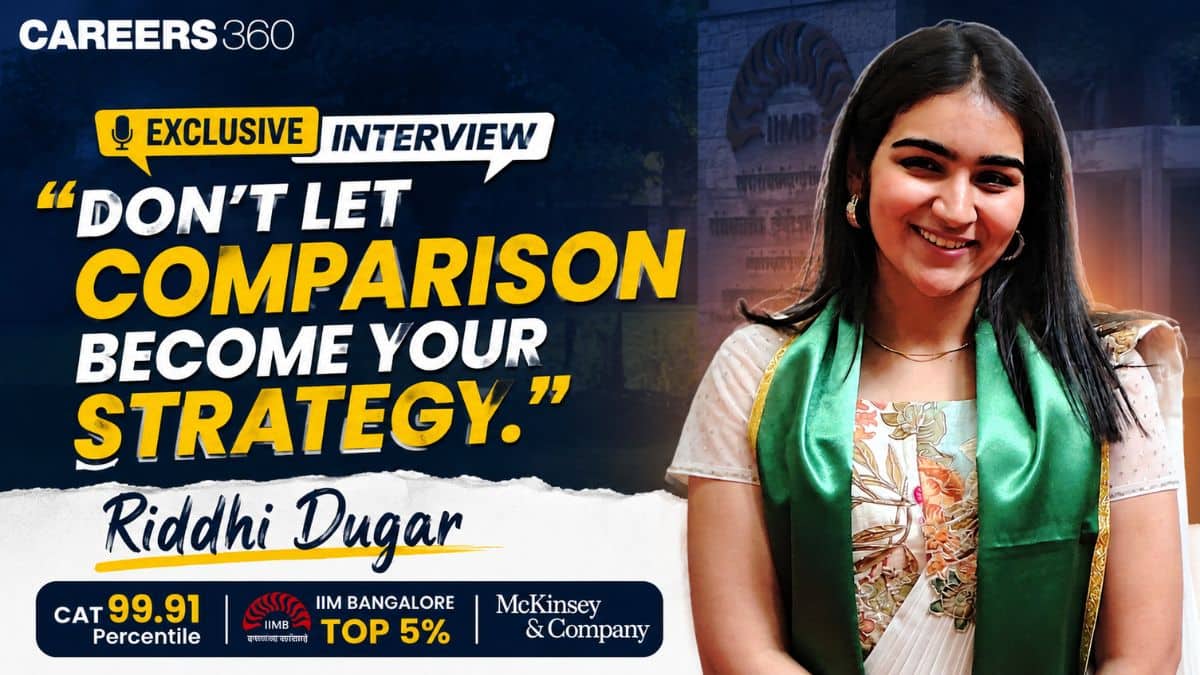
In this Careers360 interview, Riddhi Dugar talks about her CAT preparation strategy, including how she prepared for the exam while pursuing her graduation, her approach to Quantitative Aptitude, mock-test analysis and the importance of consistency. She also shares insights into the IIM Bangalore admission, life at IIMB, the challenges of coming from a non-engineering background, her international exchange experience and the skills she developed during her MBA.
Riddhi: I actually decided that I wanted to pursue an MBA when I was still in school. Even at that stage, I had started thinking about the career options that a B.Com could lead to, and I felt that the scope of a B.Com by itself was fairly limited for the kind of career I wanted. I wanted broader exposure to business, strategy and management, and an MBA seemed like the natural next step. So, by the time I entered college, an MBA was already something I was working towards. My B.Com then became a strong foundation rather than the end goal.
Riddhi: I gave myself about a year for CAT preparation and divided it quite simply: first finish the CAT syllabus properly, and then spend significant time on CAT mocks and analysis. For the first part, my focus was on building fundamentals and completing the entire CAT syllabus rather than jumping straight into difficult questions. Once I had covered the syllabus, I shifted increasingly towards CAT mocks, because CAT is as much about speed, selection and accuracy as it is about knowing concepts. The biggest thing I would emphasise is not just taking mocks, but analysing them. Every mock test helped me understand where I was losing time, which questions I should have attempted and where I was making avoidable mistakes.
Riddhi: My stronger areas were Verbal Ability and Data Interpretation, while Quantitative Aptitude required significantly more effort. Because Quant was my weaker area, I deliberately spent much more time there. I practised extensively and worked through the entire Sarvesh Kumar notebook. The goal wasn't just to solve questions but to make sure that the underlying concepts became comfortable enough that I could recognise the right approach quickly during CAT. I think that is an important part of CAT preparation: don't spend all your time polishing your strengths. Identify the section that can move your overall score the most and work on that.
Riddhi: Quant was definitely the most challenging section for me. I approached it through volume and consistency. I worked through concepts, solved a large number of questions and repeatedly revisited areas where I was making mistakes. Completing the Sarvesh Kumar notebook was an important part of that process. At the same time, I didn't neglect my stronger sections. For those, the focus was on maintaining speed and accuracy. I think the right approach is to strengthen your weakness without allowing your strengths to deteriorate.
Riddhi: For me, the CAT preparation was planning ahead rather than trying to do everything every day. I knew that CAT preparation was a long-term goal, so I tried to be consistent throughout the year instead of leaving everything to the last few months. I also continued with academics, internships and extracurriculars because I didn't want CAT preparation to completely take over college. It was really about prioritising based on what needed attention at a particular point in time. Some weeks academics took priority, while at other points CAT preparation needed more time. The important thing is to accept that balance doesn't mean giving everything equal time. It means making deliberate choices about where your time goes.
Riddhi: Of course. I think the MBA Admission first term is a shock for almost everybody. You come from an environment where you may have been among the top students, and suddenly you are surrounded by people who are equally, if not more, accomplished and extremely intelligent. It can be quite humbling. The IIM Bangalore summer internship preparation period is another intense phase, especially when you are waiting for shortlists and seeing other people get opportunities before you do. It is very easy to let those things affect your confidence. What helped me was taking things step by step and, most importantly, not getting influenced too much by peers. Everyone's journey at a B-school looks different. You have to focus on your own next step rather than constantly comparing your progress with someone else's.
Riddhi: The biggest difference in the IIM interview I noticed was that IIM Bangalore's process felt much more holistic. There was a strong focus on understanding the candidate as a person, including the SOP and the overall story behind your profile. At several other B-schools interviews, the process was more heavily centred around academics, current affairs and testing your knowledge. Those are important as well, but I felt IIM Bangalore made a more deliberate effort to understand the person beyond just their academic performance. That experience also made me realise why it is important to have a coherent understanding of your own journey. You should know why you made the choices you did and what you learned from them.
Riddhi: There were several reasons, but one of the biggest was IIM Bangalore's strong focus on consulting, which was the career path I had already decided I wanted to pursue. Beyond that, I think IIM Bangalore is one of the most well-balanced business schools. You get academic rigour, strong peer learning, excellent career opportunities, student-led activities and international exposure. I wanted an MBA that would give me more than just a placement outcome, and I felt IIM Bangalore offered that balance particularly well.
Riddhi: For the IIM Interview, I prepared by revising my undergraduate subjects, staying updated with current affairs and, most importantly, knowing my own profile extremely well. I went through my resume and experiences carefully because almost anything on your application can become a question. I think one common mistake is preparing answers so rigidly that they start sounding rehearsed. Another is not being able to explain something on your own CV in depth. If you have written about an internship, achievement or leadership role, you should be able to explain exactly what you did and what you learned. And finally, don't try to give an answer simply because you think it is what the interviewer wants to hear. A well-reasoned, genuine answer is usually much stronger.
Riddhi: Throughout my life,I have been indulging myself in several co-curricular activities. Among them, Debating probably had the biggest impact on my personality. It taught me how to think on my feet, articulate a point clearly and, equally importantly, listen to an opposing argument before responding. My internships and leadership roles then taught me how to apply those skills in real situations. They helped me understand that communication isn't just about speaking well; it is also about being structured, understanding your audience and getting people aligned. I think the combination of these experiences shaped the way I approach both professional and personal situations today.
Riddhi: Yes, I always aspired to work in consulting. My current firm was actually my dream company for a very long time, so consulting was something I had a clear interest in even before joining IIM Bangalore. What attracted me was the combination of problem-solving, variety and the learning curve. I liked the idea of being able to work on different business problems and learn about different industries rather than specialising very early in one narrow area.
Latest: BLACKI IIM Median Salary Only Increased 3.7 % in last three years
Riddhi: The IIM Bangalore exchange was one of the experiences that most broadened my perspective. I was studying and living alongside people from many different nationalities, so even everyday conversations exposed me to very different ways of thinking. It made me realise how much our assumptions are shaped by our own environment. Whether it was business, culture or even something as simple as how people approach work and relationships, there wasn't always one right way of doing things. I came back much more comfortable with different perspectives and much more aware of the importance of cultural context when working with people from different backgrounds.
Riddhi: I got the opportunity through IIM Bangalore's international exchange programme. International exposure is a fairly common part of the IIM Bangalore experience, and there are multiple partner institutions that students can apply to. I went to the University of St. Gallen, and one of the things I really valued was the diversity of the exchange cohort. IIM Bangalore also has international students coming to campus-around 100 students come to IIMB every year as exchange students. So the international exposure isn't limited to the people who go abroad; you also get to experience it on campus. I think that is one of the underrated benefits of an MBA. You can learn a lot simply from being around people who have grown up and worked in very different environments.
Riddhi: If I had to pick one chapter rather than one specific moment, my exchange at the University of St. Gallen would be among the most memorable. It was a completely different environment and gave me the opportunity to build friendships with people from many countries while experiencing a new academic and cultural setting. Within IIM Bangalore itself, though, some of my favourite memories are actually the student-led activities and the people I met. The friendships and shared experiences are what make the two years much more than just academics and placements.
Riddhi: I think the biggest skills are communication, prioritisation, resilience and stakeholder management. You constantly work with people who have different personalities and working styles, often under very tight deadlines. You learn how to disagree without making it personal, how to communicate when you don't have all the answers, and how to prioritise when everything seems urgent. You also develop a much stronger understanding of yourself-your strengths, your weaknesses and the kind of environment in which you perform best.
Riddhi: Yes, definitely. I continued being involved in co-curricular activities at IIM Bangalore, particularly through the Student Media Cell, where I worked on content, social media and student-led initiatives. That experience was very important because it gave me a completely different form of learning outside the classroom. I got to work with students with different perspectives, manage creative projects and take ownership of things where there wasn't a predefined answer. I would encourage students not to view extra curriculars as a distraction from an MBA. If managed well, they can actually become one of the most valuable parts of the experience.
Riddhi: Coming from a commerce background, I did experience a learning curve in some of the more quantitative courses. There were definitely people around me who had a stronger technical foundation, so I had to put in additional effort in certain areas. But I never saw that as something that should define my experience. As a woman in a very competitive environment, I also think confidence is extremely important. You are surrounded by very accomplished people, and it can be easy to second-guess yourself. I learned to be comfortable with my own perspective and to speak up even when I knew there were people in the room who were more experienced or technically stronger in a particular area. Overall, I found the diversity of backgrounds at IIM Bangalore to be one of its strengths. Everyone brings something different to the table.
Also Know: IIM Udaipur Breaks Tradition: Women Form 66% of MBA Batch, Non-Engineers Outnumber Engineers
Riddhi: I would say consistency more than any particular strategy. I tried to stay on top of academics throughout the term rather than relying on last-minute preparation. At the same time, I didn't stop doing everything else. I continued with extra curriculars and other activities, which helped me stay balanced. The biggest lesson for me was that you don't need every single day to be perfect. You just need to consistently put in the work and keep improving.
Riddhi: Yes, McKinsey was absolutely the right place for me to start my career. The people were one of the biggest reasons-the calibre of the teams is incredibly high, and you are constantly surrounded by extremely brilliant people who push you to learn and improve. I was also drawn to the exposure. At a relatively young age, you get the opportunity to work on important business problems and interact with clients at very senior levels. That kind of exposure accelerates your learning tremendously. My internship gave me a glimpse of that environment, and it confirmed that this was the kind of learning curve and professional environment I wanted at the beginning of my career.
Riddhi: First, give yourself enough time. I prepared over a year, and that allowed me to finish the syllabus properly before moving into intensive mock practice. Second, don't underestimate mock analysis. Taking a mock is only half the job; understanding why you lost marks is where the real improvement happens. Third, don't get intimidated by other people's preparation. Everyone has a different starting point and a different pace. Stay consistent, focus on your own gaps, and take the preparation one step at a time. If I had to summarise my CAT journey in one line: be consistent, analyse your mistakes, and don't let comparison become your strategy.

On Question asked by student community
If by B-category you mean management/private quota MBBS seats, the cutoff is very different from government-quota MBBS.
In Tamil Nadu, management-quota MBBS seats are available in self-financing/private medical colleges through the state counselling process. The closing rank varies significantly between colleges and counselling rounds. The 2025 counselling data shows that
Hello Student,
With a CAT 2025 percentile of 98.25, you have a good chance of receiving calls from several IIMs, particularly newer IIMs. However, IIM Ahmedabad , Bangalore , Calcutta , and Lucknow generally require higher percentiles for General-category candidates. Calls also depend on sectional percentiles, academics, work experience, and
Hello Aspirant,
Yes, you can access CAT preparation resources, including mock tests, practice questions, previous-year papers, and study material. Explore the CAT preparation resources and test series using the link below:
https://bschool.careers360.com/download/ebooks-and-sample-papers?exam=45
Hope this Helps!
Hello CAT Aspirant!
If you mean the CAT ( Common Admission Test) EWS certificate, the important point is whether the certificate is valid and issued in the prescribed format, rather than simply the language used on it.
Yes, a Hindi EWS certificate can generally be accepted for CAT, provided it
Directions for question:
The bar-graph given below shows the foreign exchange reserves of Nepal (in million Rupees) from 2014 to 2021. Answer the following questions based on the graph :

Question:
What was the percentage increase (rounded to the nearest integer, if deemed necessary) in the foreign exchange reserves in

Globally Recognized by AACSB (US) & AMBA (UK) | 18 LPA Avg. CTC for PGPM 2026
75+ years of legacy | #1 Entrance Exam | Score accepted by 250+ BSchools
6-Hour Masterclass to help you score 99+ percentile in CAT 2026
Test centres are available in 70+ cities across India | 75,000+ aspirants apply for the NMAT exam | Accepted by 58+ institutions like NMIMS, KJSIM, ISB, SPJIMR and Great Lakes.
Registration Start: 3 August 2026 | Last Date to Apply: 15 September 2026 (till 5 PM)
AACSB Accredited | 40 LPA-Highest CTC | Scholarships worth 10 CR