Great Lakes - PGDM & PGPM Admissions 2027
Globally Recognized by AACSB (US) & AMBA (UK) | 18 LPA Avg. CTC for PGPM 2026


What if the biggest mistake in your MBA entrance preparation isn't what you're studying, but how you're deciding what to study? An analysis of CAT, XAT, SNAP and CMAT papers from the last five years reveals that while the syllabus has remained largely unchanged, the exams have quietly shifted the skills they reward. From recurring high-weightage topics to the changing shape of the questions and exam-specific demands, these trends give valuable insights for aspirants. Adding to this shifting picture, SNAP has now introduced a brand-new section, Ethics, Morality and Values, worth 10 marks, a change that breaks from five years of relatively stable section structure and is worth factoring into any pattern-based strategy.
This Story also Contains
This article will help you know about detailed insights of Past Year Question Papers Analysis of different MBA exams, and will also help you strategise your preparation.
The common belief: Finish the syllabus.
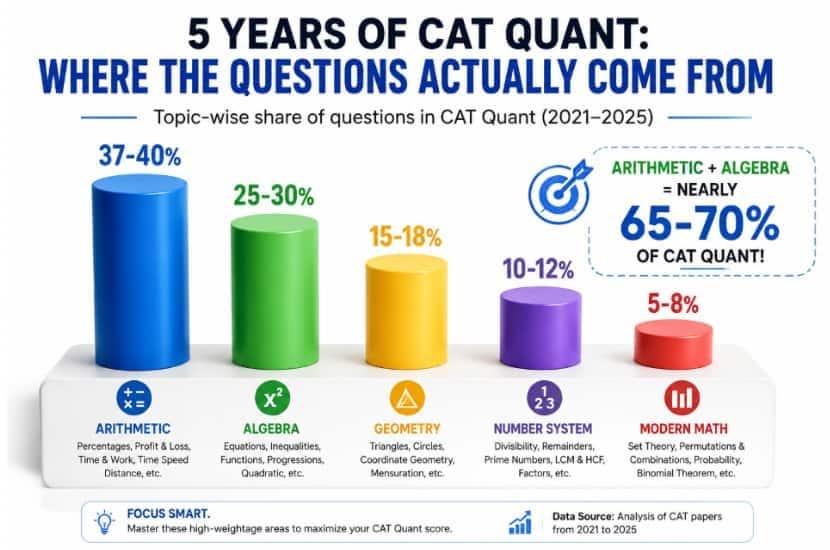
What the data shows: Across recent CAT papers, Arithmetic (35-40%) and Algebra (20-25%) together account for roughly 60-65% of the Quant section, making them the highest-return preparation areas. Reading Comprehension consistently contributes around two-thirds of VARC, while XAT has kept Decision Making as a core section every year. SNAP, meanwhile, has held a stable three-section structure for years, until now, with the newly added Ethics, Morality and Values section breaking that consistency for the 2026 cycle.
Instead of spreading effort evenly across 25 to 30 topics, the papers seem to suggest that a rather small cluster of ideas continues to create most scoring opportunities.
Exam | Five-Year Observation | What It Means |
CAT | Arithmetic + Algebra consistently contribute nearly two-thirds of QA | High preparation ROI lies in mastering these first. |
CAT | Reading Comprehension contributes nearly 65-70% of VARC | Daily reading and inference skills remain non-negotiable. |
XAT | Decision-making has remained a standalone, high-weightage section | DM preparation cannot be postponed until after CAT. |
SNAP | It usually favours the candidates who have high speed. For 2026, a new Ethics, Morality and Values section (10 marks) has been added, breaking a five-year pattern of a stable three-section structure. | Faster execution often matters more than advanced difficulty, but candidates must now also budget time and preparation for a section with no historical data. |
CMAT | Balanced section-wise distribution has remained largely stable | Ignoring one section directly impacts the overall score. |
Insight: The CAT syllabus and CAT exam pattern hasn't changed dramatically, but the return on studying different topics isn't equal.
Insight
The CAT syllabus and CAT exam pattern hasn't changed dramatically, but the return on studying different topics isn't equal.
Ready for CAT 2026? Attempt the latest CAT mock tests and see how your preparation compares: CAT Free 2026 Mock Test
Most aspirants prepare for four exams with one strategy.
The last five years suggest the exams aren't selecting the same type of candidate.
Exam | What the Paper Consistently Rewards | Evidence from Recent Papers |
CAT | Question selection under pressure | Variable QA and DILR difficulty means that choosing the right questions increasingly determines the percentile. |
Judgement and structured thinking | Decision Making remains unique to XAT and carries significant weight every year. | |
Processing speed (and, from 2026, values-based judgement too) | Paper design continues to favour quick decision-making over lengthy calculations. The newly added Ethics, Morality and Values section now also tests how candidates reason through ethical scenarios, a dimension the paper hasn't rewarded in previous years. | |
Consistency | Stable section distribution rewards balanced preparation rather than specialisation. |
The papers suggest that these exams are measuring different cognitive strengths, not merely testing the same syllabus differently.
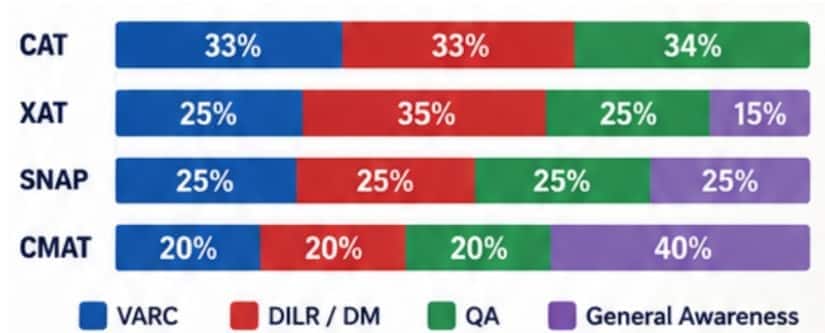
Section-wise Weightage Trends
You can practice with Past 10 years CAT Question Papers with Solution
You can practice with Past 10 years CAT Question Papers with Solution
Below is a brief description of how these MBA entrance exams have been in past few years:
Balanced across the whole lot of sections, so doing steady preparation tends to beat trying too hard to over-focus on just one thing, you know. It's more about consistent effort than about going wildly specialised.
specialised.
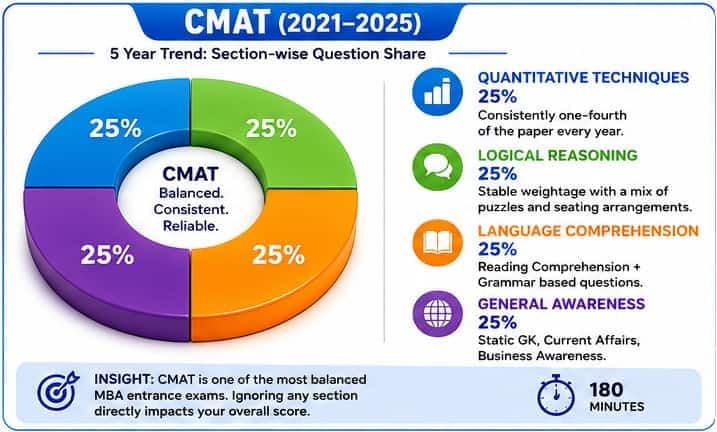
Aiming for CMAT 2026? Test your preparation with a balanced CMAT mock covering every section: CMAT Free Mock Test
This one favours speed and also accuracy more than taking a long time to solve, so managing your time becomes a real deciding factor in the end.
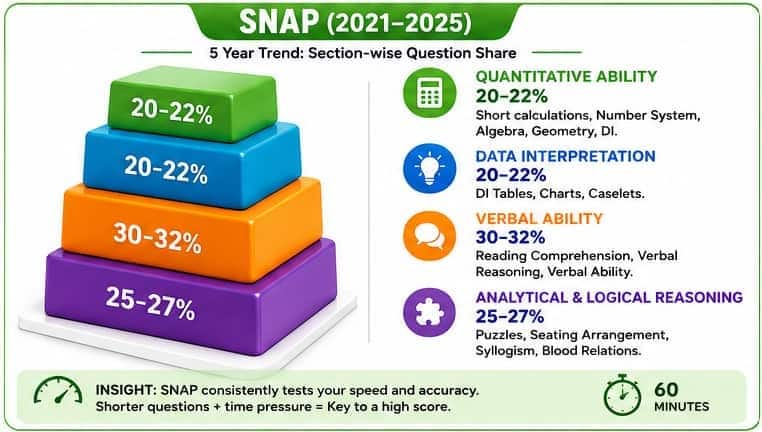
Targeting SNAP 2026? Take a speed-focused mock and improve your time management: SNAP Free Mock Test
It emphasises speed over complexity, making balanced performance across all sections more effective than relying on just one strong area. That steadiness is what keeps scores higher.
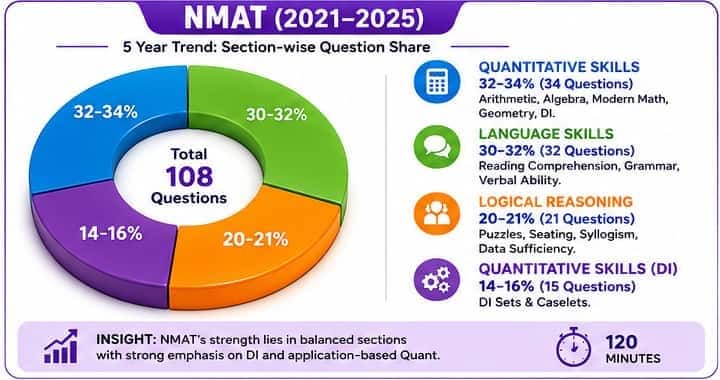
Preparing for NMAT 2026? Attempt an NMAT-style mock to build speed and accuracy: FREE Online NMAT Mock Test
Here it’s not only about aptitude, but it also leans into analytical thinking and decision-making, plus Verbal Ability often ends up splitting the top candidates from everyone else.
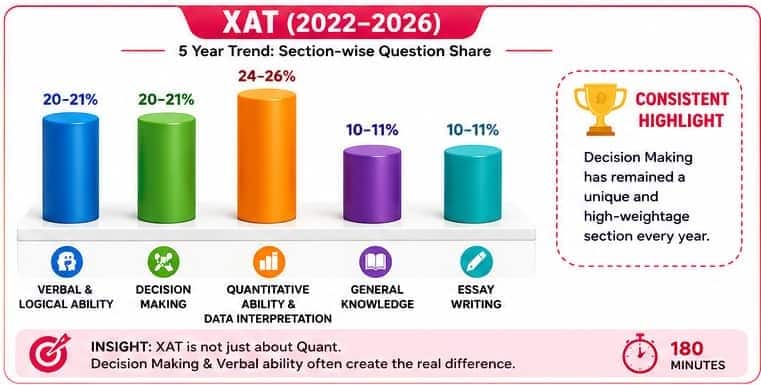
Planning for XAT 2027? Practice with XAT-level questions and strengthen your Decision Making skills: FREE Online XAT 2026 Mock Test
One of the strongest patterns emerging from recent papers is the growing importance of attempt efficiency.
Consider CAT:
Arithmetic contributes 35-40% of Quantitative Aptitude.
Reading Comprehension contributes nearly two-thirds of VARC.
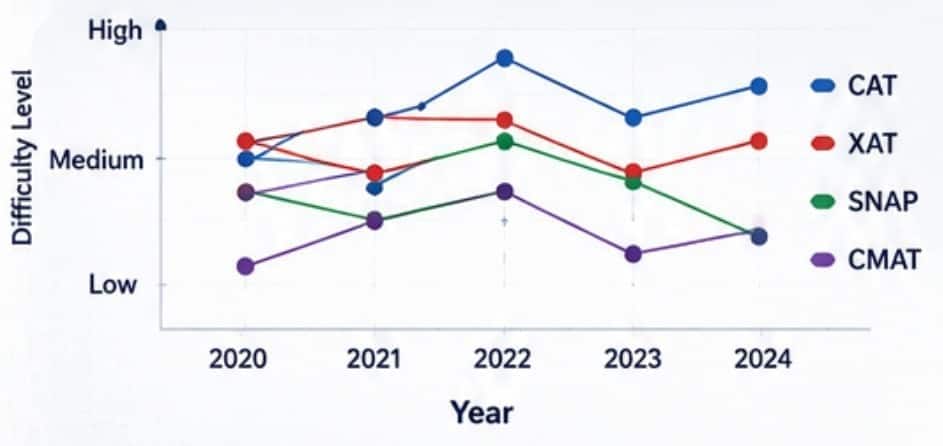
Data Interpretation and Logical Reasoning difficulty fluctuates significantly across years.
Negative marking continues to penalise poor question selection.
This changes the preparation equation.
Instead of maximising attempts, top performers increasingly maximise:
High-confidence attempts
Section navigation
Time allocation
Decision quality
Want to learn about conversions and comparisons? Learn in detail about Baby IIM Salary 2026: Is the IIM Tag Still Enough? 6 of 9 IIMs Report
The five-year trend tells a more nuanced story.
Examples observed across recent years:
CAT's DILR has shown the greatest year-to-year variation in difficulty.
QA remains Arithmetic-heavy, but topic distribution within the remaining questions changes regularly.
Reading Comprehension passage themes continue to diversify.
XAT is bringing in new decision-making situations while still keeping the same section.
SNAP keeps adjusting the speed of the paper now and then, but it doesn't really alter its main aim. That said, 2026 marks SNAP's most significant structural change in five years, with the addition of the Ethics, Morality and Values section, arguably the biggest single-year shift among all four exams covered here.
Test centres are available in 70+ cities across India | 75,000+ aspirants apply for the NMAT exam | Accepted by 58+ institutions like NMIMS, KJSIM, ISB, SPJIMR and Great Lakes.
AACSB Accredited | 40 LPA-Highest CTC | Scholarships worth 10 CR
Insight: Candidates who prepare for patterns often struggle. Candidates who prepare for uncertainty adapt faster. SNAP aspirants in particular should treat this year's Ethics, Morality and Values addition as a live example of this principle, since there is no past data to fall back on, adaptability matters more than pattern-matching for this section.
Looking across CAT, XAT, SNAP and CMAT, three preparation shifts consistently align with exam trends.
Data-Backed Shift | Why It Matters |
Prioritise preparation ROI | A limited number of topics repeatedly contribute the largest share of questions. |
Build exam-specific strategies | Each exam consistently rewards a different skill set. |
Analyse decisions, not just scores | Modern MBA entrance exams increasingly differentiate candidates through question selection and execution rather than conceptual knowledge alone. |
Stay alert to structural changes | SNAP's 2026 addition of Ethics, Morality and Values shows that even "stable" exams can shift with little warning, aspirants should build in some buffer for adapting to new sections. |
Five years of papers point to one conclusion: MBA entrance exams haven't become exponentially tougher, they've become better at rewarding strategic preparation. Aspirants who recognise recurring patterns, understand where the highest-scoring opportunities lie, and adapt to changing paper dynamics gain an advantage long before the exam day arrives. SNAP's newly introduced Ethics, Morality and Values section is a timely reminder that even the most stable-seeming exams can evolve, and the aspirants who adapt fastest to such changes are usually the ones who benefit most.
Frequently Asked Questions (FAQs)
The main trend is consistency in the highest-weighted topics. Arithmetic, Algebra, Reading Comprehension, and DILR continue to show significant weightage, and now question selection plus accuracy matter more than just attempting the maximum number of questions.
Not completely. Yes, there is syllabus overlap, but XAT asks for Decision Making, SNAP is more about swift execution, and CMAT expects a balanced game plan across every section.
Arithmetic and Algebra have contributed significantly in Quant, pretty consistently, while Reading Comprehension remains the major chunk inside VARC.
Not exactly. Recent papers suggest that unpredictability is growing more than the overall difficulty level, so adaptability has turned into a key skill to build.
At least the last five years of official papers should be reviewed. This helps map recurring topics, section-wise trends, and how the question pattern keeps evolving.

On Question asked by student community
Hello CAT Aspirant!
If you mean the CAT ( Common Admission Test) EWS certificate, the important point is whether the certificate is valid and issued in the prescribed format, rather than simply the language used on it.
Yes, a Hindi EWS certificate can generally be accepted for CAT, provided it
If you have already received your final MA result and have technically completed the degree , but you are only waiting for the revaluation outcome, you would generally be considered a graduate rather than someone whose master's degree is still completely in progress. However, CAT has specific instructions about qualification
If you mean CAT (Common Admission Test) preparation, you can practise with previous-year CAT papers. IIM has a collection of CAT papers from 2017 to 2025, covering VARC, DILR and Quant across different slots, along with solutions and explanations. Solving the recent papers first can help you understand the current
Hello Student,
Yes, you can apply for CAT with an EWS certificate issued in Hindi, provided it is issued by the competent authority and follows the required format. However, CAT applicants need a Central-level EWS certificate, not merely a state-level EWS certificate. Since you are from Uttar Pradesh, ensure your
Hey there,
If you mean your MBA counselling seat-allotment letter, the exact download process depends on the counselling authority.
Usually:
Directions for question:
The bar-graph given below shows the foreign exchange reserves of Nepal (in million Rupees) from 2014 to 2021. Answer the following questions based on the graph :

Question:
What was the percentage increase (rounded to the nearest integer, if deemed necessary) in the foreign exchange reserves in

Globally Recognized by AACSB (US) & AMBA (UK) | 18 LPA Avg. CTC for PGPM 2026
75+ years of legacy | #1 Entrance Exam | Score accepted by 250+ BSchools
6-Hour Masterclass to help you score 99+ percentile in CAT 2026
Test centres are available in 70+ cities across India | 75,000+ aspirants apply for the NMAT exam | Accepted by 58+ institutions like NMIMS, KJSIM, ISB, SPJIMR and Great Lakes.
Registration Start: 3 August 2026 | Last Date to Apply: 15 September 2026 (till 5 PM)
AACSB Accredited | 40 LPA-Highest CTC | Scholarships worth 10 CR