IBSAT 2026-ICFAI Business School MBA/PGPM 2027
AACSB Accredited | 40 LPA-Highest CTC | Scholarships worth 10 CR


Want to know how prepared you are for IBSAT 2026? A mock test can reveal it better than hours of revision. The IBSAT official mock tests for 2026 are now out, and candidates can check them in this article. Regular mock practice helps identify weak areas, improve speed and accuracy, strengthen time management, and become familiar with the actual exam pattern. With IBSAT 2026 expected in the last week of December 2026, this article covers official mock test details, exam pattern insights, mock-taking strategies, performance analysis, and practical preparation tips.
This Story also Contains
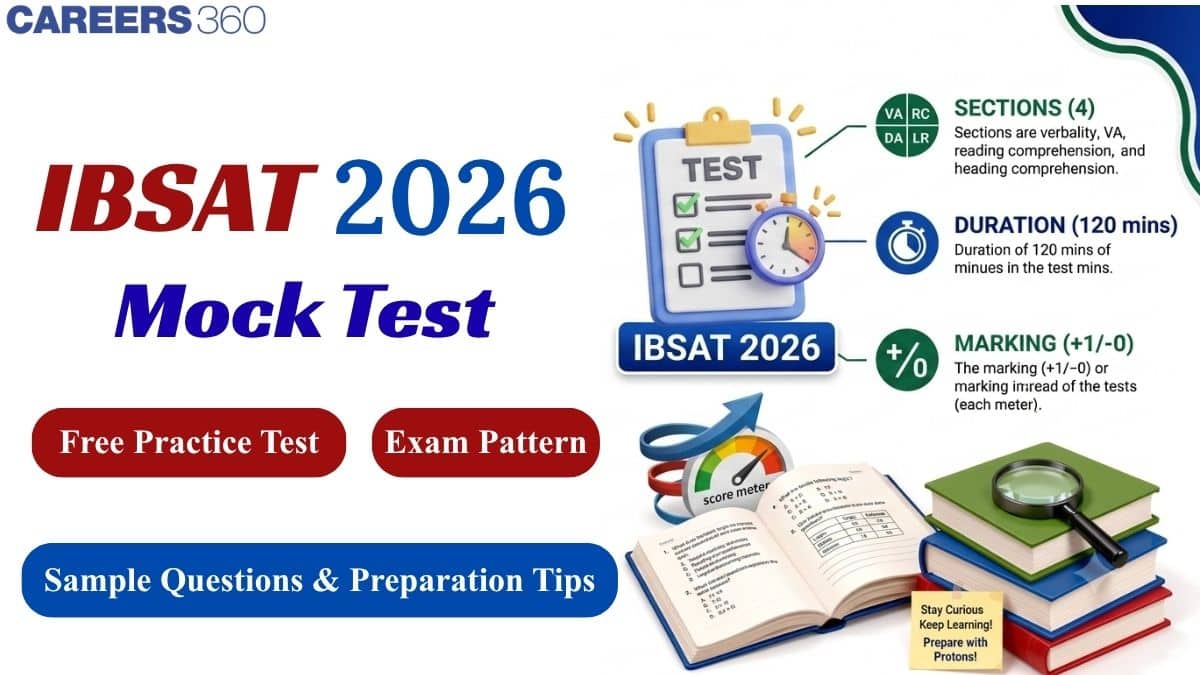
The IBSAT Mock Test 2026 is meant to mimic the real exam conditions , so that candidates can check how ready they are for the actual test. It provides a clear picture of the IBSAT exam pattern, type of questions, and time management techniques required to succeed.
With fewer than six months before the IBSAT exam , IBSAT preparation is at an all time peak right now. Before starting the IBSAT examination prep, it’s crucial to really get a firm grip on the exam format and curriculum. This can help candidates figure out how to shape their IBSAT preparation. Here is a link to access the mock test.
Attempt our Free IBSAT Mock Test 2026
The Official IBS National Mock Test 2026 is a free, all-India practice test organised by ICFAI to help candidates experience an IBSAT-like exam environment. You can attempt the IBSAT 2026 Official National Mock Test below by clicking on the provided link. Before starting the test, candidates need to select their preferred mock test date. The test helps you understand the IBSAT exam pattern, assess your preparation level, receive performance feedback, and compare your performance with other candidates across India.
Title | Link |
Official IBSAT 2026 mock test |
Parameters | Details |
Exam Name | IBSAT(ICFAI Business School Aptitude Test) |
Conducting Body | ICFAI Business School |
Exam Duration | 120 minutes |
Exam Type | MCQ-based (Multiple Choice Questions) |
Format | Computer-Based Test (CBT) |
Question Format | Multiple Choice Questions (MCQs) |
Marking Scheme | +1 |
Negative Marking | No |
Number of Questions | 140 questions |
The syllabus of the IBSAT exam feels huge and it is split into four parts, like verbal ability, reading comprehension, quantitative aptitude, and data Interpretation plus data adequacy. The whole IBSAT 2026 exam syllabus in detail is given below:
IBSAT Sections | IBSAT Syllabus Topics |
Verbal Ability | Usage of Parts of speech, tenses, and conditionals |
Quantitative Ability | Algebra |
Reading Comprehension | This section will include a passage from which 30 questions will be asked. |
Data Adequacy and Data Interpretation | Cause and Effect |
The topic-wise question division can help the candidates understand the weightage of each topic asked in the IBSAT exam and, therefore, will be helpful in understanding the topics that the candidates must target to achieve the maximum IBSAT score. Given below is the topic-wise question division of the IBSAT exam.
IBSAT Exam Sections | No. of Questions |
Reading Comprehension | 30 |
Data Interpretation and Data Adequacy | 30 |
Quantitative Ability | 30 |
Verbal Ability | 50 |
Total | 140 |
IBSAT mock tests are an essential component of a successful preparation strategy. A lot of candidates just zoom through completing the syllabus and then they kind of forget the whole mock tests side, and this can cap their results during the real exam. Doing mock test practice regularly, it really helps, candidates get a feel for how the exam goes, plus it sharpens time handling, points out the weaker pockets, and builds that needed confidence so they can attempt the IBSAT 2026 exam with less stress.
When candidates take mock tests again and again, they start to understand the IBSAT setup properly , like how questions are spread, the sectional weightage, and the overall difficulty. That way on exam day there are fewer surprises, and they feel more ready.
Time management is probably one of the biggest deal in management entrance exams. If you attempt IBSAT mock tests with time limits, candidates learn how to divide time between sections, and how to finish the full paper inside the given duration.
Mock tests give really useful feedback. After checking results, candidates can spot what they do well, and then invest extra focus on the topics where improvement is needed.
By practicing consistently through mock tests, candidates get faster at solving questions while still keeping accuracy intact. This is especially important because IBSAT is strongly speed based , so both pace and correctness matter together.
Just doing mock tests isn’t really enough. Candidates have to use them in a kind of smart way, so they can get better at what they’re doing, and boost their probability of scoring well in IBSAT 2026.
Take the mock test in a calm area, with no interruptions, no distractions and so on. Try to keep the official exam time exactly as it is, and avoid unnecessary pauses, because that’s how the real exam will feel.
Before you even start a mock, candidates should read up on the exam layout properly - like the question count, the sectional breakdown, and the way scoring works. When this is clear, it becomes easier to shape a proper approach for attempting.
Candidates should decide earlier how they’ll tackle the full paper. Some people might want to begin with their best section, so they build momentum quickly, while others may go strictly in the same sequence as the exam. Having a preset plan can make the whole process more efficient, and less confusing later.
The learning process starts once the mock test is finished, candidates should sit back and look at how they did, spot the repeated slip ups, re check the wrong answers, and make a small action plan for better results next time. Regular mock test practice along with a deep performance analysis can really raise a candidate’s odds of landing a strong score in the IBSAT 2026 exam.
The sample questions provide an idea of what the candidates can expect on the actual IBSAT exam. The IBSAT sample questions are an important part of the candidate's IBSAT preparation. Topic-wise IBAT mock test sample questions are given below for the candidate's reference.
Directions: In the following questions, each word is followed by five options. Choose the option that is the closest synonym of the given words. While choosing your answer, keep in mind the finer distinctions in the meaning and usage of certain words.
1. FURTIVE
(a) Spicy
(b) Secretive
(c) Palpable (d)
Fruitful
(e) Alien
Correct Answer: (b) Secretive.
The word "furtive" means done in a quiet and secretive way to avoid being noticed. It often implies a sense of slyness or stealth. The correct synonym must capture this essence of secrecy and stealth.
Let's analyze the options:
(a) Spicy: This word relates to flavor and has no connection to secrecy or stealth.
(b) Secretive: This word means inclined to conceal feelings and intentions or not disclose information, aligning perfectly with the meaning of "furtive."
(c) Palpable: This word means capable of being touched or felt; easily perceptible, which is unrelated to secrecy.
(d) Fruitful: This word means productive or conducive to producing in abundance, and does not imply secrecy or stealth.
(e) Alien: This word means foreign or unfamiliar, which does not capture the essence of being secretive.
Thus, the closest synonym to "furtive" is "secretive," making the correct answer (b) Secretive.
2. EMULATE
(a) Appear
(b) Impose
(c) Imitate
(d) Operate
(e) Collect
Correct Answer:(c) Imitate.
The word "emulate" means to match or surpass (a person or achievement), typically by imitation. It involves copying someone or something to equal or exceed them.
Let's analyse the options:
(a) Appear: This word means to become visible or come into sight, which is not related to imitation or copying.
(b) Impose: This word means to force something to be accepted or put in place, which does not involve imitation.
(c) Imitate: This word means to take or follow as a model or to copy, which aligns perfectly with the meaning of "emulate."
(d) Operate: This word means to control the functioning of a machine, process, or system, which is unrelated to imitation.
(e) Collect: This word means to gather together, which does not involve imitation.
Thus, the closest synonym to "emulate" is "imitate," making the correct answer (c) Imitate.
Directions: In the following questions, each word is followed by five options. Choose the option that is the closest antonym of the given words. While choosing your answer, keep in mind the finer distinctions in the meaning and usage of certain words.
3. FABRICATE
(a) Aggravate
(b) Establish
(c) Destroy
(d) Foster
(e) Electrify
Correct Answer: (c) Destroy.
The word "fabricate" means to invent or concoct something, typically with deceitful intent, or to construct or manufacture something. The correct antonym should represent the opposite action of creating or inventing.
Let's analyze the options:
(a) Aggravate: This word means to make a problem or offense worse or more serious, which does not relate directly to creating or inventing.
(b) Establish: This word means to set up or lay the groundwork for something, which can also involve creating, so it is not an antonym.
(c) Destroy: This word means to put an end to the existence of something by damaging or attacking it, which is the opposite of creating or constructing.
(d) Foster: This word means to encourage the development or growth of something, which is not the opposite of fabricating.
(e) Electrify: This word means to charge with electricity or to excite intensely, which does not relate to creating or inventing.
Thus, the closest antonym to "fabricate" is "destroy," making the correct answer (c) Destroy.
Directions: In the following questions, the first two words are related in a particular manner. You have to choose a word from the options so that a new pair of words is formed where the relation is the same as that of the first pair of words. You are required to consider the secondary meaning of certain words while choosing an answer.
4. Pack: Wolves:: Shoal :
(a) Locusts
(b) Fish
(c) Chicken
(d) Books
(e) Passengers
Correct Answer: (b) Fish:
The relationship between the words "Pack" and "Wolves" is that a pack is a group of wolves. Similarly, "Shoal" refers to a group of fish. To complete the analogy, we need to find a word that represents a group similar to how "wolves" is represented in relation to "pack."
Let's analyse the options:
(a) Locusts: A group of locusts is called a swarm, not a shoal.
(b) Fish: A shoal is a group of fish, so this matches the analogy perfectly.
(c) Chicken: A group of chickens is called a flock, not a shoal.
(d) Books: A group of books is typically called a collection and is not related to a shoal.
(e) Passengers: A group of passengers is not related to a shoal; they are often referred to collectively as a group of passengers.
Directions: Fill in the blanks with the words that best fit the meaning of the sentence as a whole.
5. Indian policies should ________ on social justice and on inclusive growth and development, which in the long term will provide greater ________ for all its people.
(a) depend … safety
(b) focus … security
(c) count … confidence
(d) direct … protection
(e) build … delight
Correct Answer: (b) focus … security.
"Indian policies should ________ on social justice and on inclusive growth and development, which in the long term will provide greater ________ for all its people."
Let's break it down:
The first blank needs a word that indicates the emphasis or concentration of Indian policies. The best fit here is "focus," as it means to direct attention or effort toward something.
The second blank needs a word that describes the benefit or outcome resulting from focusing on social justice and inclusive growth. "Security" fits well because it refers to a state of being free from danger or threat, which is a desirable outcome for all people.
Thus, the complete sentence is: "Indian policies should focus on social justice and on inclusive growth and development, which in the long term will provide greater security for all its people."
Therefore, the correct answer is (b) focus … security.
Directions: In the following questions, each sentence is divided into four parts (a), (b), (c), and (d). Find out which part of the sentence contains an error. If there is no error, mark your answer as (e)
6. While the Indian Constitution guarantees / (a) equality for women, / (b) legal protection has little effect / (c) in the face of prevailing culture. (d) No error (e)
Correct Answer: (b) Legal protection has little effect
To clarify the error in the sentence:
(a) "While the Indian Constitution guarantees" — This part is correct.
(b) "equality for women," — This part is correct.
(c) "Legal protection has little effect" — This part contains an error. The subject "legal protection" is singular, so it should be "has" instead of "have."
(d) "in the face of prevailing culture." — This part is correct.
The error is in part (c), where it should be "legal protection has little effect" instead of "legal protection has little effect."
Directions: In the following questions, different parts of a sentence/passage have been jumbled. Choose the option that represents the best sequence to make the sentence/passage coherent and meaningful. Ignore punctuation marks.
7. P: This is only possible by means of a complete revolution in our thinking
Q: We have to get over the transitional period and become a modern, industrial state
R: We must spread scientific thinking on a massive scale
S: Encourage people to give up superstitions and backward feudal ideas
(a) SQPS
(b) QPSR
(c) SPQR
(d) QPRS
(e) QRPS
Correct Answer: (e) QRPS
Here’s the logical flow:
Q: "We have to get over the transitional period and become a modern, industrial state." — This introduces the need for progress and modernity.
R: "We must spread scientific thinking on a massive scale." — This suggests that spreading scientific thinking is necessary to achieve the modern state mentioned in Q.
P: "This is only possible by means of a complete revolution in our thinking." — This explains how spreading scientific thinking will lead to a revolution in thinking.
S: "Encourage people to give up superstitions and backward feudal ideas" — This provides specific actions (giving up superstitions and feudal ideas) that are part of the revolution in thinking mentioned in P.
Directions: Each passage is followed by questions based on its content. Answer the questions based on what is directly stated in each of the passages or can be inferred from it.
Millions of children in India cannot, for a variety of reasons, be protected by their parents and adult family members. They may be dead, or alcoholic, or violent and abusive, or in jail, or lost, or have abandoned their child. The parents may also be themselves destitute, homeless, gravely ill, or disabled, and therefore unable to care for their children without support. The child, who has no home or settled place or abode and any ostensible means of subsistence maybe at risk in other ways as well: due to riots, natural disasters, war and militant conflict; disabilities and incurable terminal ailments, with no one who can support or look after the child; when a child is grossly abused or tortured; is inducted into drug abuse or trafficking; child marriage and child labor. In all such situations, it is the State that is both morally and legally responsible to protect, nurture, and raise each child. However, at present, the State in India invests minuscule resources in child protection. India today is a youthful nation: 19 percent of the children in the world live within its boundaries, and more than one-third of the population is below 18 years. Accounting for the largest number of children in work, and the second largest number of children affected by HIV, India arguably has the highest number of children facing exploitation and neglect in the world. But the investment in child protection was a shocking 0.034 per cent of the budget. Traditionally, public authorities have tried to accomplish their duty of protecting children who are at risk mainly by locking away large numbers of these children in State-run, closed institutions for many years until the child grows to adulthood, and soon after the child comes of age, by abruptly discharging the child without any further support into the larger society. Private and religious charities also sometimes run orphanages for such children, but they are usually run on similar custodial principles of raising the child in confined and overly disciplined environments. For children who conflict with the law, there are statutory ‘special homes’ to which they are usually confined in conditions similar to jails. For many years, these children also shared adult jails, and many illegally continue to do so. It is both absurd and heartless for children to be locked up only because they have no one to protect them. It is argued that this is done for the sake of the child: if the child were free in the community, the State would be unable to protect the child from abuse, and therefore she is locked up for her own good. This is quite illogical. The State must find ways to protect the child who is in need of care in ways that respect the child’s right to a happy and free childhood, while at the same time ensuring her protection, and her rights to food, education, health care, recreation, love, and security.
1. According to the passage, ‘special homes’ are statutorily run for
(a) Children who are gravely ill or disabled
(b) Orphans and children affected by natural disasters and riots
(c) Children with incurable terminal ailments
(d) Destitute children and children who are addicted to drugs
(e) Juvenile delinquents
Correct Answer: (e) Juvenile delinquents
Explanation: The passage states that "For children who conflict with the law, there are statutory ‘special homes’" which are intended for juvenile delinquents.
2. It is evident from the passage that all these institutions are devoid of
(a) Requisite facilities
(b) Minimum infrastructure
(c) Safety arrangements
(d) Love and affection
(e) Community interaction
Correct Answer: (d) Love and affection
Explanation: The passage criticizes the current system for lacking emotional care, noting that children are often placed in institutions devoid of "love and affection."
3. It becomes an obligation for the State to take moral and legal responsibility in the case of children
(a) Who are badly abused
(b) Whose parents are seriously ill
(c) Who are orphaned or abandoned
(d) Whose parents are destitute and homeless
(e) All the above
Correct Answer: (e) All the above
Explanation: The passage mentions various situations where the State should take moral and legal responsibility for children, including those who are abused, orphaned, abandoned, or have parents who are destitute or homeless.
4. Pick out the true statement.
(a) India accounts for the largest number of children engaged in work
(b) The author feels that it is quite reasonable to keep the neglected children in jails to ensure their safety
(c) Orphanages run by private charities do not enforce strict discipline on the inmates
(d) A huge amount in the Indian budget is reserved for child protection
(e) Compared to the rest of the countries in the world, India has the lowest number of children who are affected by HIV
Correct Answer: (a) India accounts for the largest number of children engaged in work
Explanation: The passage mentions India has the highest number of children facing exploitation and neglect, including a large number engaged in work.
5. Pick out the word which is a close synonym of ‘ostensible’ as used in the passage.
(a) Apprehensive
(b) Rigid
(c) Contemptible
(d) Apparent
(e) Unreal
Correct Answer: (d) Apparent
Explanation: "Ostensible" means something that appears to be true or real but may not actually be. "Apparent" is a close synonym.
6. . It may be inferred from the passage that it is the right of every child to have a/an
(a) Luxurious life
(b) Special identity in the society
(c) Individual status
(d) Happy and free childhood
(e) Free access to higher education
Correct Answer: (d) Happy and free childhood
Explanation: The passage highlights the right of every child to a "happy and free childhood" alongside other basic rights.
7. What is the central theme of this passage?
(a) It recommends that State-run institutions should be run on the same lines and follow the model of religious charities
(b) It makes a comparative study of state-run homes and orphanages run by private organizations
(c) It concludes a study based on ‘children’s jails’
(d) It critically analyses the deplorable conditions in State-run homes
(e) It focuses on the child, who needs State support
Correct Answer: (e) It focuses on the child, who needs State support
Explanation: The central theme of the passage is the need for improved State support and protection for children in various difficult situations.
1. In a group of 100 people, 56 speak Hindi, 42 speak English, and 8 speak neither Hindi nor English.
How many can speak English only?
(a) 57
(b) 61
(c) 72
(d) 87
(e) 99
Correct Answer: (a) 57
The correct option is A. The number of people speaking only English is 57.
Let X be the set of people who speak English.
Let Y be the set of people who speak French.
X - Y represents the set of people who speak English but not French.
Y - X represents the set of people who speak French but not English.
X ∩ Y represents the set of people who speak both French and English.
Given:
The number of people who speak English (n(X)) is 72.
The number of people who speak French (n(Y)) is 43.
The number of people who speak either English or French or both (n(X ∪ Y)) is 100.
Now,
The number of people who speak both French and English (n(X ∩ Y)) is calculated as:
n(X ∩ Y) = n(X) + n(Y) - n(X ∪ Y)
= 72 + 43 - 100
= 115 - 100
= 15
Therefore, the number of people who speak both French and English is 15.
The number of people who speak only English (n(X - Y)) is calculated as:
n(X - Y) = n(X) - n(X ∩ Y)
= 72 - 15
= 57
Therefore, the number of people speaking only English is 57.
2. Pipe A can fill an empty tank in 45 minutes and pipe B can empty it in one hour. If pipe A is opened at 10:00 AM and pipe B at 10:15 AM, by what time does the tank get filled?
Correct Answer: (b) 12:15 PM
(a) 12:00 PM
(b) 12:15 PM
(c) 12:30 PM
(d) 1:00 PM
(e) 1:30 PM
Pipe X can fill the tank in 45 minutes, so it fills at a rate of 1/45 of the tank per minute.
Pipe Y can empty the tank in 60 minutes, so it empties at a rate of 1/60 of the tank per minute.
Pipe X has been open for the entire time from 10:00 AM to 10:15 AM, which is a total of 15 minutes. During this time, pipe X fills 15/45 = 1/3 of the tank.
Now, when both pipes are working together, the net rate of filling the tank is given by the difference of their individual rates:
1/45 - 1/60 = 1/180
So, the combined rate at which the tank is filled is 1/180 of the tank per minute.
Now, we need to find out how long it will take for this combined rate to fill the remaining 2/3 of the tank (since 1/3 has already been filled by pipe X).
To do this, we simply divide the remaining amount of the tank to be filled (2/3) by the rate at which it is being filled (1/180).
Therefore, the time required to fill the remaining 2/3 of the tank is (2/3) / (1/180) = 120 minutes.
Adding 120 minutes to 10:15 AM, the tank will be filled by 12:15 PM.
3. Find the greatest number that will divide 49, 147, and 322 to leave the same remainder in each case.
9
5
7
8
Correct Answer: a.9
When two numbers are divided by another number and have the same remainder, their difference must produce a remainder of zero. Use this concept to solve the question.
According to the question,
The differences will be,
⇒ 147 – 49 = 98
⇒ 322 – 147 = 175
⇒ 322 – 49 = 273
The set of numbers {98, 175, 273}
Now HCF of {98, 175, 273}
⇒ 98 = 7 × 7 × 2
⇒ 175 = 5 × 5 × 7
⇒ 273 = 13 × 7 × 3
The HCF of {98, 175, 273} is 7
Hence, the correct answer is 7.
4. On dividing a certain number by 363, we get 17 as the remainder. What will be the remainder when the same number is divided by 11?
7
8
6
9
Correct Answer: c.6
Given that, on dividing a certain number by 363, we get 17 as the remainder.
Let the number be 363x+17
The number = 33x(11)+1(11) + 6
The number = 11(33x+1) + 6
So, the remainder when the given number is divided by 11 is 6.
Hence, the correct answer is 6.
5. A person borrowed INR 2,000 at 5% annual simple interest repayable in 3 equal annual instalments. What will be the annual instalment?
INR 730 10/63
INR 840 10/63
INR 640 11/63
INR 250 10/63
Correct Answer: a. INR 730 10/63
P = INR 2,000
Rate = 5%
Time = 3 years
Instalment = (A × 100) / (N × 100 + ((N-1) + (N-2) + ..... + 1) × R)
where, A = Amount, R = Rate, N = Number of Years
Simple Interest = (P × R × T) / 100 = (2000 × 5 × 3) / 100 = 300
Amount = 2000 + 300 = INR 2300
Instalment = (2300 × 100) / (3 × 100 + (2 + 1) × 5)
= 46000 / 63 = 730 10/63
Hence, the correct answer is INR 730 10/63.
6. The salaries of Rida and Riya are in the ratio of 3: 5, respectively. If the salary of each one is increased by Rs. 5,000, then the new ratio becomes 5: 7. What is Riya’s present salary?
Rs. 12,500
Rs. 7,500
Rs. 2,500
Rs. 10,000
Correct Answer: a. Rs. 12,500
Let the present salaries of Rida and Riya be 3x and 5x, respectively. According to the question, (3x + 5000) : (5x + 5000) = 5: 7.
This gives us:
21x + 35000 = 25x + 25000
4x = 10000
x = 2500
Therefore, the salary of Riya is 5x = 12500.
Hence, the correct answer is Rs. 12500.
7. In a right-angled triangle PQR, right-angled at Q, the length of the side PR is 17 units, the length of the base QR is 8 units, and the length of the side PQ is 15 units. If ∠RPQ = sinα, then sinα + cosα is:
18/17
23/17
21/17
15/17
Correct Answer: B. 23/17
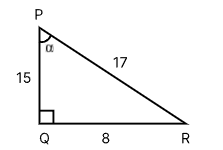
Given, triangle PQR is right-angled at Q with angle RPQ = α. PR is 17 units, QR = 8 units, and PQ = 15 units.
sin(α) + cos(α)
= QR/PR + PQ/PR
= 8/17 + 15/17
= 23/17
Hence, the correct answer is 23/17.
In each of the following problems, there is one question and two statements I and II given below the question. You have to decide whether the data given in the statements is sufficient to answer the question. Read all the statements carefully and find which of the statements is/are sufficient to answer the given question. Choose the correct alternative in each question:
A. If the data in the statement I alone is sufficient to answer the question.
B. If the data in statement II alone is sufficient to answer the question.
C If data either in statement I alone or statement II alone are sufficient to answer the question.
D. If data in both statements I and II together are necessary to answer the question.
1. Question: What will be the compound interest on a sum after 3 years?
Statements:
I. The compound interest on the sum at 5% per annum for 2 years is Rs. 12.50 more than the simple interest.
II. The difference between compound interest and simple interest on the sum for 3 years at 5%per annum is Rs. 38.125.
1. Question: What is the average daily wage of a worker who works for five days; he made Rs. 80 on the first day?
Statements
I. The worker made a total of Rs. 400 for the first four days of work.
II. The worker made 20% more each day than he did on the previous day.
Correct Answer:- B
Explanation:-
Statement I just tells us the total of Rs. 400 for the first four days of the work, so the average daily wages for the five days cannot be determined. Statement II states that the worker made 20 % more each day, and we know that he earns Rs. 80 on the first day, so we can calculate the wages for five days and hence the average. Hence, statement II alone is sufficient to answer.
2. Question: Three men, A, B, and C, invest Rs. 4,700 for a business. A invests Rs. 700 more than B, and B invests Rs. 500 more than C. C invests for 14 months. How much profit will A receive?
Statements:
I. Total profit at the end of the year is Rs. 840,
II. A and B subscribed their money in a business for 8 and 9 months respectively,
Correct Answer:- D
∵A+B+C=Rs.4,700⇒(c+1200)+(c+500)+c=4700⇒c=Rs⋅1,000
From the statement, I alone cannot answer the question, as we don't know for what time money is invested. Similarly, from statement II alone, we cannot answer the question, as we don't know the total profit to be shown. But using both statements together, we can answer the question.
3. Question: In what ratio should pure and adulterated fruit juices be sold to make a profit of 10% by selling the mixture at Rs. 14/litre?
Statements:
I. Pure juice is sold at Rs. 18 per litre to get a profit of 20%.
II. Adulterated juice is sold at Rs. 15 per litre to get a profit of 25%.
Correct Answer:- D
CP of mixture =141⋅1=Rs.12⋅72/L
From statement I alone or statement II alone cannot answer the question.
Using both statements together, we can answer the question.
 CP of pure juice =1812=Rs.15/L
and CP of adulterated juice =151⋅25=Rs.⋅12/L
Now, using alligation, we can answer the question.
4. Question: What is the code for 'is' in the code language?
Statements:
I. In the code language, ' lo ki ju' means 'apple is red'.
II. In the same code language, 'tu ki ma' means 'banana is yellow'.
Correct Answer:- D
From both I and II, we can conclude that the code for 'is' in the code language is 'ki'.
5. Question: What is Aditi's height?
Statements:
I. Aditi, Neha, and Ria are all of the same height.
II. The total height of Neha, Ria, and Sia is 150 cm, and Sia is as tall as Neha and Ria combined.
Correct Answer:- D
As given in statements I and II, we have: A = N = R, N + R + S = 150, and S = N + R.
Substituting N + R = S into N + R + S = 150, we have: 2S = 150 or S = 75.
Thus, N + R = 75 and N = R. So, N = R = 37.5. Thus, A = 37.5.
Study the bar graph below and answer the questions that follow:
6. 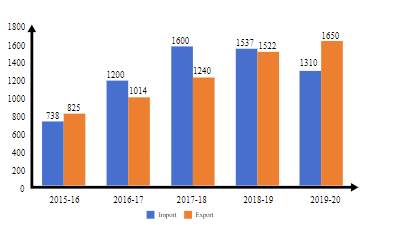
The import and export of a country (in lakhs rupees) during a certain period is given in the following bar graph. Read the bar graph carefully and answer the following question.
During which year was the difference between imports and export is minimal?
2018 - 19
2019 - 20
2016 - 17
2017 - 18
Correct answer: A. 2018 - 19
.Import in 2015-16 = 738
Export in 2015-2016 = 825
Difference between import and export in 2015-16 = 87
Import in 2016-17 = 1200
Export in 2015-2016 = 1014
Difference between import and export in 2016-17 = 86
Import in 2017-18 = 1600
Export in 2017-2018 = 1240
Difference between import and export in 2017-18 = 360
Import in 2018-19 = 1537
Export in 2018-2019 = 1522
Difference between import and export in 2018-19 = 15
Import in 2019-20 = 1310
Export in 2019-2020 = 1650
Difference between import and export in 2015-16 = 340
So, the Year 2018-19 has the minimum required difference.
Hence, the correct answer is 2018-19
7. What is the average of exports during the given period of time?
Rs.1,250.2 lakhs
Rs.1,240.0 lakhs
Rs.1,248.2 lakhs
Rs.1,115.4 lakhs
Correct answer: A. Rs. 1,250.2 lakhs
Total export of the country = 825 + 1014 + 1240 + 1522 + 1650 = 6251
Total number of years = 5
Average export = Total export / Number of years
Average export = 6251 / 5
Average export = 1250.2
Hence, the answer is Rs. 1250.2 lakhs.
Various reputed management exam preparation books written by experts are available to aid students during their IBSAT mock test preparation. A collection of the best books for comprehensive IBSAT preparation is listed below:
Book Title | Authors |
How to Prepare for Quantitative Aptitude for the CAT | Arun Sharma |
Quantitative Aptitude for CAT | Nishit Sinha |
Quantitative Aptitude Quantum CAT | Sarvesh Verma |
Logical Reasoning and Data Interpretation for the CAT | Nishit K. Sinha |
A Modern Approach to Logical Reasoning | R.S. Aggarwal |
Quantitative Aptitude for Competitive Examinations | Abhijit Guha |
Data Interpretation & Data Sufficiency | Ananta Ashish |
Are you in need of additional resources that could take your IBSAT preparation to the next level? If so, look no further; Careers360 has designed a set of ebooks to help candidates tackle all the challenges put forth by various management entrance exams. The download links are attached to each book in the table below:
Title | Download Link |
Know all about IBSAT 2026 | |
IBSAT 2026 Mock Test with Answer Key PDF | |
IBSAT 2026 Preparation Tips PDF | |
IBSAT 2026 Sample Papers |
Frequently Asked Questions (FAQs)
It's a practice test designed to simulate the actual IBSAT exam, covering all sections like verbal ability, reading comprehension, and numerical aptitude.
Yes, regular mock test practice helps identify weak areas and improves accuracy and confidence.
It's recommended to take at least 5-7 mock tests to effectively analyze your performance, build speed, and improve accuracy.
Practising under timed conditions trains you to complete all sections efficiently during the actual exam.
Yes, they simulate the exam environment, making you more comfortable and less nervous on test day.
Set up a quiet environment, understand the test structure, and plan a strategy for attempting the sections.
Analyze your answers, learn from mistakes, and focus on improving weak areas after each test.

On Question asked by student community
Hello student
Here are some preferred books for IBSAT exam preparation:
*Quantitative Aptitude:*
1. "Quantitative Aptitude for Competitive Examinations" by R.S. Aggarwal
2. "Quantum CAT" by Sarvesh K. Verma
*Data Interpretation and Logical Reasoning:*
1. "Data Interpretation and Logical Reasoning" by Arun Sharma
2. "Logical Reasoning and Data Interpretation" by
Hi,
IBS Aptitude Test is a test to find out your aptitude in the area of IBS. It helps you understand how well you handle stress and anxiety, how much you can cope with pain and discomfort, what are your strengths and weaknesses. The test is designed for people who
Hello,
IBSAT 2021 is scheduled on December 25, 2021 and December 26, 2021. The examination will be conducted in online mode. You do not have to book the slot to attend IBSAT 2021 examination. The examination center, date and time will be allotted to you and it will be given
IBSAT is a home proctored exam and it will held in the last week of December. You should check your admit card and email that whether you have received login credentials or not. In order to give this exam you must have username and password. At the test day they
Hello Aspirant.
Hope you are doing well.
NMAT = The National Medical Admission Test (NMAT) in Philippines is a national level examination pre-requisite by the applicant for entry to any medical school in the Philippines.
MAT = Management Aptitude Test, commonly known as MAT exam is conducted by the All

Globally Recognized by AACSB (US) & AMBA (UK) | 18 LPA Avg. CTC for PGPM 2026
75+ years of legacy | #1 Entrance Exam | Score accepted by 250+ BSchools
6-Hour Masterclass to help you score 99+ percentile in CAT 2026
AACSB Accredited | 40 LPA-Highest CTC | Scholarships worth 10 CR
400+ Recruiters | Highest CTC 25 LPA | Average CTC 8 LPA | 92% Placements in 2025 | Ranked as Platinum Institute | Awarded Best Business School of the Year
Among top 6% B-Schools globally to be accredited by AACSB | Highest Package-35 LPA