Great Lakes - PGDM & PGPM Admissions 2027
Globally Recognized by AACSB (US) & AMBA (UK) | 18 LPA Avg. CTC for PGPM 2026


Taking CAT preparation using the previous years’ question papers as a single source is a good approach if one knows their basics well. The analysis of papers from the years 2021 to 2025, for the three sections, shows a pattern. The questions range from the same topics that keep recurring every year, like Quantitative Aptitude’s Arithmetic and Algebra, Data Interpretation and Logical Reasoning’s arrangements, games, and puzzles, charts, and distribution, and Verbal Ability’s RC passages and verbal reasoning questions. Therefore, one must know their preparation level in these topics to attempt the CAT 2026 exam, which is scheduled to take place on November 29, 2026.
This Story also Contains
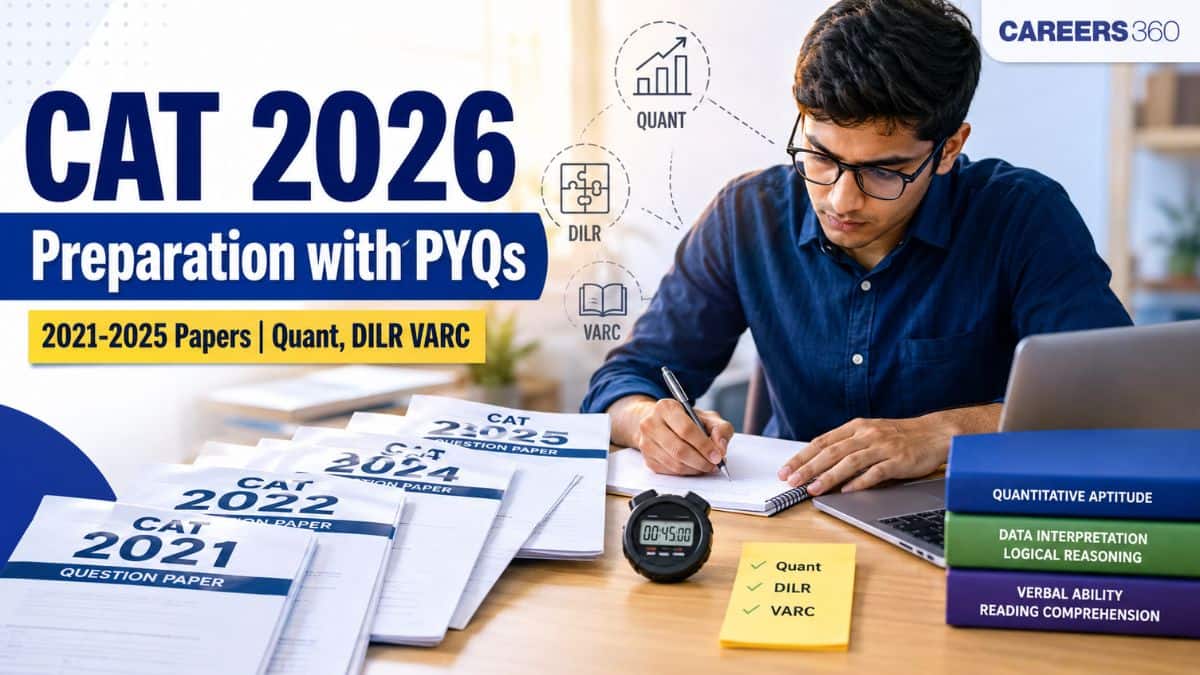
Yes, CAT previous year papers can form the core of your preparation, especially when you analyse the approach behind every question rather than simply solving it.
The 2021-2025 papers have covered significant quantitative aptitude topics, diverse DILR set types and recurring VARC question types, giving students a good idea of how CAT questions are being framed.
PYQ benefit | What you learn |
Question patterns | How CAT frames familiar concepts |
Difficulty | What exam-level questions look like |
Time management | How long different questions take |
Question selection | Which questions deserve your time |
Error analysis | Why your approach succeeds or fails |
Revision | Which concepts need repeated practice |
The key point: PYQs should be treated as an analysis tool, not just a question bank.
The 2021-2025 papers show that CAT continues to test familiar concepts while changing the context and reasoning required. This makes understanding the application of a concept more important than memorising standard question formats.
Section | Areas observed in recent papers | Main skill |
Quant | Arithmetic, Algebra, Geometry, Number System | Concept application |
DILR | Arrangements, games, charts, tables, networks | Set selection |
VARC | RC, Para Jumbles, Summary, Odd One Out | Comprehension and elimination |
For example, recent Quant questions include population changes, mixtures, averages, boats, work, trains, logarithms and profit-and-loss situations.
This is why analysing PYQs can reveal more than simply checking your score.
You can start practising with Past 10 years CAT Question Papers with Solutions
For Quant, classify every question by topic, approach, time and error type. This helps you identify whether your preparation gap is conceptual or related to speed and question selection.
Parameter | Example |
Topic | Percentages |
Sub-topic | Successive percentage change |
Time taken | 2:40 minutes |
Approach | Algebra |
Accuracy | Correct |
Faster approach? | Yes |
Reattempt | After 3-4 days |
A recent question, for instance, asks for the lowest possible population after a percentage decrease and subsequent increase, with an integer constraint on the percentages.
The lesson: a question may appear to test one topic but actually require multiple skills.
For Quant, the best way to use CAT previous year questions is to identify the concept behind each question.
Consider a question involving population:
A town has a population of 100,000 in 2020. Its population decreases by
At first glance, this looks like a percentage question. But solving it requires you to combine:
Percentage change
Algebraic representation
Integer constraints
Minimum-value reasoning
This is precisely the type of insight that CAT previous-year questions provide.
Solve the question without checking the solution.
Record the time taken.
Identify the underlying concept.
Compare your method with the shortest logical approach.
Reattempt the question after a few days.
Practise five years of actual CAT Quant questions to understand recurring concepts, question framing and difficulty across slots.
Download now: CAT Quant PYQs: 2021–2025
In DILR, PYQs should train you to answer one question before solving the set: “Should I attempt this set?”
The recent papers include arrangements, games, tables, networks, distributions and multi-condition caselets.
A 2025 set involves four people moving around seven numbered chairs over several turns, with multiple conditions determining their positions.
Instead of only solving it, analyse:
What to check | Question to ask |
Entry point | Which condition gives the strongest starting point? |
Representation | Can I draw a table or diagram? |
Complexity | How many cases are possible? |
Progress | Am I getting closer after each condition? |
Selection | Would I attempt this in CAT? |
The DILR preparation material also stresses identifying which sets to attempt, which to leave and how to allocate time.
Your goal is therefore not to solve every set; it is to become better at selecting workable sets.
Solve five years of CAT DILR questions to understand recurring set structures, approaches and changing difficulty levels.
Download now: CAT DILR PYQs: 2021–2025
VARC PYQs are particularly useful for understanding CAT's approach to inference, elimination and comprehension.
The 2021-2025 papers include Reading Comprehension, Para Jumbles, Para Summary, Odd One Out and other Verbal Ability questions.
Question type | What to check |
Main idea | Did I identify the central argument? |
Inference | Is my answer supported by the passage? |
Detail | Did I locate the relevant information? |
Para Summary | Does the option capture the complete idea? |
Para Jumble | Are the sentences logically connected? |
Odd One Out | What connects the remaining sentences? |
A 2025 RC passage, for example, discusses complex systems, randomness and heavy-tailed events before asking questions based on the passage's ideas and implications.
Do not analyse only the correct answer. Analyse why the other options fail.
CAT VARC PYQs (2021–2025): Practise authentic CAT VARC questions covering Reading Comprehension, Para Jumbles, Para Summary, Odd One Out and more.
Download now: CAT VARC PYQs: 2021–2025
Your level of preparation plays a significant role in deciding whether you should rely on PYQs for your practice or not. Students who have a strong-foundation can use PYQs as their primary practice resource, whereas, students with a weak-foundation must utilise PYQs alongside targeted-conceptual-practice.
Preparation level | Best approach |
Beginner | Concepts + topic-wise PYQs |
Intermediate | Concepts + mixed PYQs |
Strong fundamentals | PYQs as primary practice |
Advanced | Timed PYQs + full-paper analysis |
If a PYQ exposes a gap in Algebra, Geometry or another topic, revise that concept and return to the relevant questions.
The practical cycle is:
Learn → Solve → Analyse → Reattempt → Test under time pressure
Identify frequently tested Quant concepts and use them to prioritise your CAT 2026 preparation.
Download now: CAT Quant: 10 Most Repeated Concepts
The 2021-2025 papers provide a five-year practice window across VARC, DILR and Quant, with questions from three slots in each year.
Stage 1: Topic wise practice
You can start with individual topics like Arithmetic, Algebra, RC, arrangements or tables,
Stage 2: Year-wise practice
Now that you have got comfortable with individual topics, move on to year-wise practice. This is probably the most important step as this will expose you to different variations of questions in different slots of different years.
Stage 3: Timed practice
Track attempts, accuracy, time per question and your selection decisions.
Stage 4: Reattempt
Return to difficult questions after a few days and check whether your approach has improved. The Quant and DILR preparation material specifically recommends independent attempts, mistake analysis and reattempting difficult questions.
For CAT 2026, you must solve the complete PYQ from 2021-2025 range as it will give you an insight into the questions of all 3 sections for the last 5 years.
But do not look at the number of questions you solved; the metric to measure your performance is different.
Instead of tracking | Track this |
Questions completed | Accuracy |
Hours spent | Average solving time |
Papers finished | Questions selected correctly |
Solutions viewed | Questions solved independently |
Attempts | Improvement after reattempt |
The aim is to learn from each paper to improve the decision-making abilities of an aspirant.
The difference between PYQs and mocks is that the former lets you know how CAT has asked question while the latter lets you practice on unfamiliar sets and gets you accustomed to the real CAT scenario.
CAT PYQs | Mock Tests |
Actual CAT questions | Simulated CAT questions |
Best for pattern analysis | Best for exam simulation |
Helps identify recurring concepts | Tests adaptability |
Useful for topic-wise practice | Useful for overall score analysis |
Builds familiarity with CAT framing | Builds stamina and time management |
A balanced CAT preparation strategy should therefore use PYQs as the foundation and mocks as the performance-testing layer.
Test your preparation in an exam-like environment and evaluate your speed, accuracy and question-selection strategy.
Take the mock now: CAT Free Mock Test
Yes, CAT previous year papers can be the core preparation for an exam-oriented approach.
By analyzing CAT 2021-2025, it is evident that some areas are repeated by being presented through different contexts and requiring different reasoning processes. This pattern is noticeable in Quant, DILR, as well as VARC.
You can follow this cycle:
solve → analyse → record mistake → reattempt → practice under time constraint
That is how you can make use of previous year CAT papers to form a comprehensive CAT PYQ strategy 2026.
Frequently Asked Questions (FAQs)
PYQ can be aspirants’ primary practice source if someone has command over fundamentals; however, beginners must combine PYQ with specific topic learning.
To prepare for CAT 2026, it is recommended to solve CAT PYQ from 2021 to 2025, which will give you comprehensive preparation of VARC, DILR, and Quants over five years.
While it is not possible to find two exactly same questions in a row, some concepts and patterns can be repeated; hence, CAT PYQ can be beneficial.
There is no sure-shot strategy to get 99 percentile, so one cannot say whether PYQ would be sufficient to crack CAT or not. However, PYQ can definitely give one an insight into what the exam requires. Apart from that, percentile is dependent on various factors like accuracy, time, selection of questions, concept, etc., and sometimes even luck during the exam, so mocks can also be useful.
You should start solving PYQ only when you are confident with a certain topic, which might vary for every aspirant. Later, you should practice PYQs for that particular section in a timed manner. And when you feel like you have achieved a good level of preparedness, you can move on to full-length papers.

On Question asked by student community
If you have already received your final MA result and have technically completed the degree , but you are only waiting for the revaluation outcome, you would generally be considered a graduate rather than someone whose master's degree is still completely in progress. However, CAT has specific instructions about qualification
If you mean CAT (Common Admission Test) preparation, you can practise with previous-year CAT papers. IIM has a collection of CAT papers from 2017 to 2025, covering VARC, DILR and Quant across different slots, along with solutions and explanations. Solving the recent papers first can help you understand the current
Hello Student,
Yes, you can apply for CAT with an EWS certificate issued in Hindi, provided it is issued by the competent authority and follows the required format. However, CAT applicants need a Central-level EWS certificate, not merely a state-level EWS certificate. Since you are from Uttar Pradesh, ensure your
Hey there,
If you mean your MBA counselling seat-allotment letter, the exact download process depends on the counselling authority.
Usually:
With a Telangana state merit rank of 10,953, admission to MBBS Category A in Hyderabad Muslim minority colleges is generally very difficult. However, you may have a better chance for BDS Category A, depending on the year's cutoff and seat availability.
Directions for question:
The bar-graph given below shows the foreign exchange reserves of Nepal (in million Rupees) from 2014 to 2021. Answer the following questions based on the graph :

Question:
What was the percentage increase (rounded to the nearest integer, if deemed necessary) in the foreign exchange reserves in

Globally Recognized by AACSB (US) & AMBA (UK) | 18 LPA Avg. CTC for PGPM 2026
75+ years of legacy | #1 Entrance Exam | Score accepted by 250+ BSchools
6-Hour Masterclass to help you score 99+ percentile in CAT 2026
Test centres are available in 70+ cities across India | 75,000+ aspirants apply for the NMAT exam | Accepted by 58+ institutions like NMIMS, KJSIM, ISB, SPJIMR and Great Lakes.
Registration Start: 3 August 2026 | Last Date to Apply: 15 September 2026 (till 5 PM)
AACSB Accredited | 40 LPA-Highest CTC | Scholarships worth 10 CR