Great Lakes - PGDM & PGPM Admissions 2027
Globally Recognized by AACSB (US) & AMBA (UK) | 18 LPA Avg. CTC for PGPM 2026


VARC is an important section of the CAT examination and accounts for 1/3rd of the total weightage. The section in the CAT exam has questions from topics like Reading Comprehension, Grammar, jumbled sentences and more. However, amongst all, RC accounts for the maximum number of questions in CAT. As per trends, the pattern of VARC has not changed a lot for the last five years. However, today, questions in CAT VARC are more focused towards inference, deducing the author’s POV and logical interpretation.
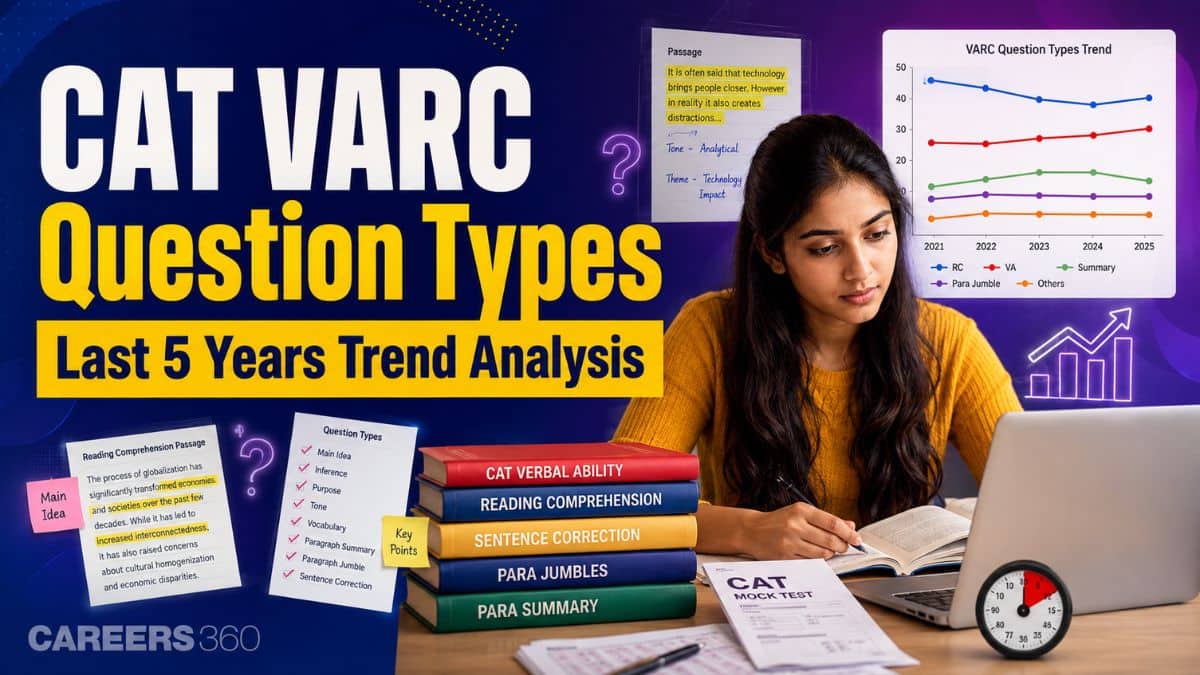
In this article, we present you with a detailed analysis of previous year CAT VARC questions.
Particular | Details |
Section Name | Verbal Ability and Reading Comprehension (VARC) |
Exam Mode | Computer-Based Test (CBT) |
Total Questions | 24 |
Reading Comprehension (RC) | 16 Questions (4 passages × 4 questions each) |
Verbal Ability (VA) | 8 Questions |
Sectional Time Limit | 40 Minutes |
Question Types | MCQs and TITA (Type in the Answer) |
Marking Scheme | +3 for every correct answer, -1 for every incorrect MCQ, No negative marking for TITA questions |
Major RC Question Types | Inference, Main Idea, Author's Tone, Fact-Based, Assumption, Application |
Major VA Question Types | Para Summary, Para Jumbles, Odd One Out, Sentence Placement (varies slightly by year) |
RC Weightage | Approximately 67% of the VARC section (16/24 questions) |
VA Weightage | Approximately 33% of the VARC section (8/24 questions) |
Difficulty Level | Moderate to Difficult, with greater emphasis on analytical reading and critical reasoning in recent years |
An analysis of CAT VARC question papers from 2021 to 2025 shows that Reading Comprehension passages have gradually shifted from testing explicit factual details to testing analytical and inferential skills. The most common type of question was inference, followed by main idea, fact/detail, and author's tone.
According to last year's paper analysis, the CAT VARC question types were mainly based on questions on assumptions and applications. However, strengthening/weakening the argument was relatively less frequent but appeared to be among the most challenging.
Question Type | Frequency Trend | Difficulty | Approx. Questions in RC |
Inference Questions | Very High | High | 4–5 |
Main Idea / Central Theme | High | Moderate | 2–3 |
Fact / Detail Questions | Moderate | Easy to Moderate | 1–2 |
Author's Tone / Purpose | Moderate | Moderate to High | 1–2 |
Assumption / Application | Low to Moderate | High | 1 |
Strengthen / Weaken Argument | Low | High | 0–1 |
Vocabulary in Context | Low | Easy | 0–1 |
As per analysis of last 5 years, the following were the major themes that appeared in the CAT exam over the years.
CAT RC Topic | Approx. Frequency (No. of Passages) | Trend |
Philosophy | 10 | Very High |
Science & Biology | 8 | High |
Sociology & Social Issues | 7 | High |
History & Culture | 5 | Moderate |
Economics & Business | 5 | Moderate |
Literature & Arts | 4 | Moderate |
Psychology | 4 | Moderate |
Technology & AI | 3 | Low to Moderate |
Environment & Climate | 2 | Low |
Politics & Public Policy | 2 | Low |
Candidates can understand what kind of CAT verbal ability questions were asked over the years from the section below.
Q1. The passage given below is followed by four summaries. Choose the option that best captures the essence of the passage.
Zombie cells may contribute to age-related chronic inflammation: this finding could help scientists understand more about the aging process and why the immune system becomes less effective as we get older. Zombie or "senescent" cells are damaged cells that can no longer divide and grow like normal cells. Scientists think that these cells can contribute to chronic health problems when they accumulate in the body. In younger people, the immune system is more effective at clearing senescent cells from the body through a process called apoptosis, but as we age this process becomes less efficient. As a result, there is an accumulation of senescent cells in different organs in the body, either through increased production or reduced clearance by the immune system. The zombie cells continue to use energy though they do not divide, and often secrete chemicals that cause inflammation, which if persistent for longer periods of time can damage healthy cells leading to chronic diseases.
Aging leads to less effective apoptosis, and therefore zombie cells start to accumulate in the body, causing inflammation, which accelerates aging and leads to chronic diseases.
A younger person's immune system is healthy and is able to clear the damaged cells, but as people age, the zombie cells resist apoptosis, and start accumulating in the body.
Senescent "zombie" cells are inactive or malfunctioning cells that can be found throughout the body.
Dead cells accelerate chronic inflammation weakening the immune system and lead to aging. (CAT 2025)
Q2. The passage given below is followed by four alternate summaries. Choose the option that best captures the essence of the passage.
Cartographers design and create maps to communicate information about phenomena located somewhere on our planet. In the past, cartographers did not worry too much about who was going to read their maps. Although some simple "usability" research was done—like comparing whether circle or bar symbols worked best—cartographers knew how to make maps. This has changed now, however, due to all kinds of societal and technological developments. Today, map readers are more demanding—mostly because of the tools they use to read maps. Cartographers, who are also influenced by these trends, are now more interested in seeing if their products are efficient, effective, and appreciated.
New technological developments have prompted cartographers to experiment with their maps by applying these new innovations.
Modern mapmakers evaluate a map's effectiveness efficiency and satisfaction of the user through a series of experiments.
Today, cartographers also need to look into the usability of maps because of the new technological developments.
Maps are being used for a variety of reasons and therefore map readers have become more demanding.
Q3. Five jumbled up sentences (labelled 1, 2, 3, 4 and 5), related to a topic, are given below. Four of them can be put together to form a coherent paragraph. Identify the odd sentence and key in the number of that sentence as your answer.
Animals have an interest in fulfilling their basic needs, but also in avoiding suffering, and thus we ought to extend moral consideration.
Singer viewed himself as a utilitarian, and presents a direct moral theory concerning animal rights, in contrast to indirect positions, such as welfarist views.
He argued for extending moral consideration to animals because, similar to humans, animals have certain significant interests.
The event that publicly announced animal rights as a legitimate issue within contemporary philosophy was Peter Singer's Animal Liberation text in 1975.
As such, we ought to view their interests alongside and equal to human interests, which results in humans having direct moral duties towards animals. (CAT 2024)
Q1. Five jumbled sentences (labelled 1, 2, 3, 4, and 5), related to a topic, are given below. Four of them can be put together to form a coherent paragraph. Identify the odd sentence out and key in the number of that sentence as your answer.
1. The profound emotional impact of music has inspired ongoing research into its relationship with emotions.
2. Music is a universal phenomenon that utilizes a myriad brain resources.
3. This inherent connection to musical expression is deeply intertwined with human identity and experience.
4. The proclivity to create and appreciate music is ubiquitous among humans, permeating daily life across diverse societies.
5. Engaging with music is among the most cognitively demanding tasks a human can undergo, and it is identified across cultures. (CAT 2025)
Q2. Five jumbled up sentences (labelled 1, 2, 3, 4 and 5), related to a topic, are given below. Four of them can be put together to form a coherent paragraph. Identify the odd sentence and key in the number of that sentence as your answer.
1. The UK is a world leader in developing cultivated meat and the approval of a cultivated pet food is an important milestone.
2. If we're to realise the full potential benefits of cultivated meat the government must invest in research and infrastructure.
3. The first UK applications for cultivated meat produced for humans remain under assessment with the Food Standards Agency.
4. The previous UK government had been looking at fast-tracking the approval of cultivated meat for human consumption.
5. It underscores the potential for new innovation to help reduce the negative impacts of intensive animal agriculture. (CAT 2024)
Q1. The given sentence is missing in the paragraph below. Decide where it best fits among the options 1, 2, 3, or 4 indicated in the paragraph.
Sentence: While taste is related to judgment, with thinkers at the time often writing, for example, about "judgments of taste" or using the two terms interchangeably, taste retains a vital link to pleasure, embodiment, and personal specificity that is too often elided in post-Kantian ideas about judgment—a link that Arendt herself was working to restore.
Paragraph: ____(1) ____. Denneny focused on taste rather than judgment in order to highlight what he believed was a crucial but neglected historical change. ____(2) ____. Over the course of the seventeenth century and early eighteenth century, across Western Europe, the word taste took on a new extension of meaning, no longer referring specifically to gustatory sensation and the delights of the palate but becoming, for a time, one of the central categories for aesthetic—and ethical—thinking. ____(3) ____. Tracing the history of taste in Spanish, French, and British aesthetic theory, as Denneny did, also provides a means to recover the compelling and relevant writing of a set of thinkers who have been largely neglected by professional philosophy. ____(4) ____.
Option 3
Option 4
Option 1
Option 2
(CAT 2025)
The VARC section of the CAT exam has witnessed very few changes in terms of pattern over the past 5 years (2021-2025).
The pattern of Reading Comprehension (RC) continues to dominate over VA (Verbal Ability) and thus holds a greater weightage in the VARC section. However, the number of questions in RC that were directly answerable from the passage has decreased significantly. The questions now test the inference and reasoning skills of the candidates in addition to testing the basic understanding.
The questions in the RC section now involve more of inference based questions along with author’s tone and intent based questions, along with fewer factual data based questions. Also, the passages were taken from a wider variety of sources like philosophy, science, literature, history, social issues, and contemporary topics.
The verbal ability section continues to have questions from the same topics that it has always had. These include Para Summary, Para Jumbles, Odd One Out, and Sentence Placement. However, the questions are now driven more by logic and coherence than testing grammar and English language skills. Thus, for the CAT 2026 exam, it is important for a candidate to develop better reading skills while being able to understand what is being read thoroughly and logically.
In order to do that, the candidate must focus on developing the habit of reading articles from varied topics, especially those mentioned above. Also, the candidate must solve the previous year’s VARC questions to enhance their ability to infer and comprehend what they read.
Also Read, How Paper Setters Pick CAT RC
Reading Comprehension (RC) accounts for a significant share of the CAT VARC section, making time management essential for maximising your score. Since passages vary in length and difficulty, using the right strategy helps you attempt more questions accurately. Planning your approach, avoiding lengthy passages when necessary, and keeping track of time can improve both speed and accuracy during the exam.
Set aside around 8-10 minutes for each RC passage, including reading and answering the questions. Avoid spending too much time on a single passage, as it can affect your attempts in the remaining section.
Quickly scan all the passages and begin with the one that seems most familiar or easier to understand. Solving easier passages first builds confidence and helps secure quick marks.
Avoid reading every sentence in detail. Focus on identifying the main idea, author's tone, arguments, and conclusion. This reduces rereading and helps answer questions more efficiently.
If a question requires excessive analysis, mark it for review and move ahead. Spending several minutes on one question can reduce the number of overall attempts.
Reserve 3-5 minutes at the end of the CAT VARC section to revisit marked questions, verify answers, and eliminate obvious mistakes instead of rushing through the final questions.
Reading Comprehension (RC) accounts for nearly two-thirds of the CAT VARC section. While reading speed is important, selecting the correct option depends more on logical evaluation than intuition. Here are three effective approaches that can improve RC accuracy.
The elimination technique is one of the safest ways to solve CAT RC questions. Instead of searching for the correct answer immediately, eliminate options that are clearly incorrect.
Common reasons to eliminate an option include:
It introduces information not mentioned in the passage.
It exaggerates the author's point using words like always, never, or completely.
It contradicts the passage.
It is only partially correct and misses the main idea.
It sounds logical but does not answer the question asked.
After removing the incorrect choices, compare the remaining options carefully. In many CAT RC questions, two options appear similar, but only one aligns perfectly with the author's viewpoint.
Every correct CAT RC answer has textual support. Instead of relying on memory or personal opinion, go back to the relevant part of the passage and look for evidence.
This approach works well for:
Factual questions
Inference-based questions
Author's opinion questions
Purpose and tone questions
Read the lines surrounding the relevant paragraph and ask yourself whether the option is directly supported or reasonably inferred from the passage. If you cannot justify an option using the text, it is probably incorrect.
Many CAT RC questions test whether you understand the author's central argument rather than isolated facts. Before answering, identify:
What is the main idea of the passage?
What is the author's stance—supportive, critical, neutral, or analytical?
Why has the author written this passage?
When evaluating options, choose the one that best reflects the author's overall viewpoint instead of a statement taken out of context. This approach is especially useful for questions on the main idea, title, author's tone, and the purpose of the passage.
Based on analysis of CAT question papers, I have observed that the difficulty of a question is more dependent on the type of question than the topic.
For Reading Comprehension, Fact and vocabulary based questions are easy, whereas inference, author's tone, assumption and main idea questions are challenging.
In the case of Verbal Ability, Para Summary is the most scoring question and Sentence Placement is easy in the recent papers.
Para Jumble is moderately difficult as we need to understand the structure of the paragraph without the help of options. Similarly, Odd One Out can be tricky at times.
The passages are getting more abstract with diverse topics such as philosophy, social sciences, music, literature and scientific research and so on. So, understanding becomes more critical than ever.
An analysis of CAT VARC papers from 2021 to 2025 shows that the section has remained consistent in its overall structure while gradually becoming more reasoning-intensive.
Reading Comprehension continues to dominate the section, with passages drawn largely from philosophy, social sciences, science, literature, history, and contemporary issues.
Across the five years, inference, main idea, author's tone, and passage summary questions appear more frequently than direct factual questions, indicating that CAT increasingly tests analytical reading over memorisation.
In Verbal Ability, Para Summary, Para Jumbles, Odd One Out, and Sentence Placement have remained the core question types with only minor variations in distribution.
Candidates preparing for the CAT VARC section must adhere to the following table to get exam-centric ebooks for their exams. We have prescribed the resources to help candidates with their basic understanding and question practice.
500+ Idioms And Phrases List With Meanings & Examples For MBA Entrance Exams | |
CAT VARC: 3000+ Most Important English Words | |
300+ Phrasal Verbs List for CAT Exam, Types With Examples & Practice Questions. Download Pdf | |
CAT 2026 Verbal Ability and Reading Comprehension (VARC) Study Material PDF | |
Avoid These Common CAT RC Mistakes to Boost your VARC Score | |
CAT VARC PYQs- Complete 5-Year Question Bank (2021 - 2025) PDF | |
8 Expert-Curated Philosophy Editorials with CAT-Style Questions |
Frequently Asked Questions (FAQs)
Inference-based questions are among the most frequently asked question types in CAT RC. These questions require candidates to understand the author's argument and draw a conclusion that is supported by the passage. Candidates should also practise main idea, factual, tone and purpose-based questions.
CAT RC passages cover a wide range of subjects. Philosophy, science, sociology, history and economics are among the recurring themes. Candidates should also practise passages based on literature, psychology, technology, social issues and other diverse subjects.
The overall CAT VARC structure has remained broadly similar, with 24 questions in the section. However, the questions have increasingly focused on inference, interpretation and understanding the author's viewpoint rather than relying only on directly stated information.
The major Verbal Ability question types include Para Summary, Para Jumbles, Odd One Out and Sentence Placement. The distribution of these question types can vary across different CAT years and slots.
CAT 2026 aspirants should solve VARC questions from the last five years to understand the types of questions asked in the exam. They should give special attention to inference, main idea, tone and purpose-based RC questions, while also practising all major VA question types. Reading editorials and articles from different subjects and taking sectional mocks can further improve comprehension and question-solving skills.

On Question asked by student community
Hey there,
If you mean your MBA counselling seat-allotment letter, the exact download process depends on the counselling authority.
Usually:
With a Telangana state merit rank of 10,953, admission to MBBS Category A in Hyderabad Muslim minority colleges is generally very difficult. However, you may have a better chance for BDS Category A, depending on the year's cutoff and seat availability.
Hello Dear Student,
Based on your All India Rank (AIR) of 31198 as a General category Female with Bihar domicile, your chances of securing an MBBS seat in a Government Medical College (GMC) are highly realistic but require a careful counselling strategy.
While your rank is slightly outside the traditional
Hello Dear Student,
You can directly pursue an MBA now; you do not need to do a BBA first. A bachelor's degree in any discipline is the only foundational requirement. Born in 1988, your age is not a formal barrier for management education, but your choice of program format matters
Hello,
Yes, MBBS and BDS seats are available through Kendriya Sainik Board Secretariat (KSB) for wards of categories of Defence personnel. You can check more at ksb.gov.in/admission-mbbs-bds-colleges.htm.htm
Directions for question:
The bar-graph given below shows the foreign exchange reserves of Nepal (in million Rupees) from 2014 to 2021. Answer the following questions based on the graph :

Question:
What was the percentage increase (rounded to the nearest integer, if deemed necessary) in the foreign exchange reserves in

Globally Recognized by AACSB (US) & AMBA (UK) | 18 LPA Avg. CTC for PGPM 2026
75+ years of legacy | #1 Entrance Exam | Score accepted by 250+ BSchools
13-hour master class to help you score 99+ percentile in CAT 2026
Registration Start: 3 August 2026 | Last Date to Apply: 15 September 2026 (till 5 PM)
AACSB Accredited | 40 LPA-Highest CTC | Scholarships worth 10 CR
Get Real CAT-like Experience | Attend Mock Test on 8th & 9th August 2026 | Timings: 8:30 AM | 12:30 PM | 4:30 PM