Great Lakes - PGDM & PGPM Admissions 2027
Globally Recognized by AACSB (US) & AMBA (UK) | 18 LPA Avg. CTC for PGPM 2026


Electronic music, legal responsibility, economic inequality, craftsmanship - what do these have to do with an MBA entrance exam? If you solved CAT VARC PYQs, you probably asked yourself the same question. The answer lies in how CAT paper setters think. They don’t pick the passages because it’s on trending topics or loaded with vocabulary - they pick them to check certain mental skills in a very specific way.
This Story also Contains
CAT 2026 notification has been released, and the exam is scheduled for November 29, 2026; the final Sunday of November. This is the time to boost your preparation. Once you understand how CAT paper setters pick passages, you'll stop chasing predicted topics and start preparing the way the exam actually demands. By the end of this article, you'll know exactly why certain passages repeatedly appear in CAT - and how you can use that insight to gain an edge over other aspirants.
One of the first things students notice while solving previous CAT papers is the variety of Reading Comprehension topics. Instead of business or management, passages often discuss subjects like sociology, behavioural science, history, or environmental policy.
This isn't done to confuse candidates.
It's done to create a level playing field.
If CAT only selected business-related articles, candidates from commerce or management backgrounds would naturally have an advantage. By choosing unfamiliar yet readable topics, the exam ensures that every candidate depends on comprehension rather than prior knowledge.
While the subjects keep changing every year, the objective behind the passages remains remarkably consistent.
Changing Topics | Constant Skill Being Tested |
Philosophy | Critical Thinking |
Psychology | Inference |
Economics | Argument Analysis |
History | Author's Tone |
Sociology |
Notice what's missing from the table.
The difficulty of the subject.
That's because CAT passage selection isn't based on how difficult a topic sounds. It's based on whether the passage allows the examiner to test multiple reasoning skills through a single piece of writing.
Passage Type | Slot 1 | Slot 2 | Slot 3 | Total |
Science & Research | 4 | 8 | 0 | 12 |
Humanities | 8 | 4 | 8 | 20 |
Economics / Business | 4 | 0 | 4 | 8 |
Technology | 0 | 4 | 0 | 4 |
Society / Public Policy | 0 | 0 | 4 | 4 |
Rank | Topic / Domain | Questions |
1 | Humanities (Arts, Culture, Literature, Philosophy, Language) | 16 |
2 | Science & Research | 12 |
3 | Economics / Business | 8 |
4 | Technology / AI | 4 |
5 | Society / Public Policy | 4 |
Although the exact selection process is confidential, analysing previous CAT papers reveals a clear pattern.
Paper-setters don't ask,
"Is this topic difficult enough?"
Instead, they ask,
"Can this passage generate strong Reading Comprehension questions?"
The best CAT RC passages usually contain:
A clear central argument
Multiple viewpoints
Logical flow of ideas
Evidence supporting opinions
Scope for inference and interpretation
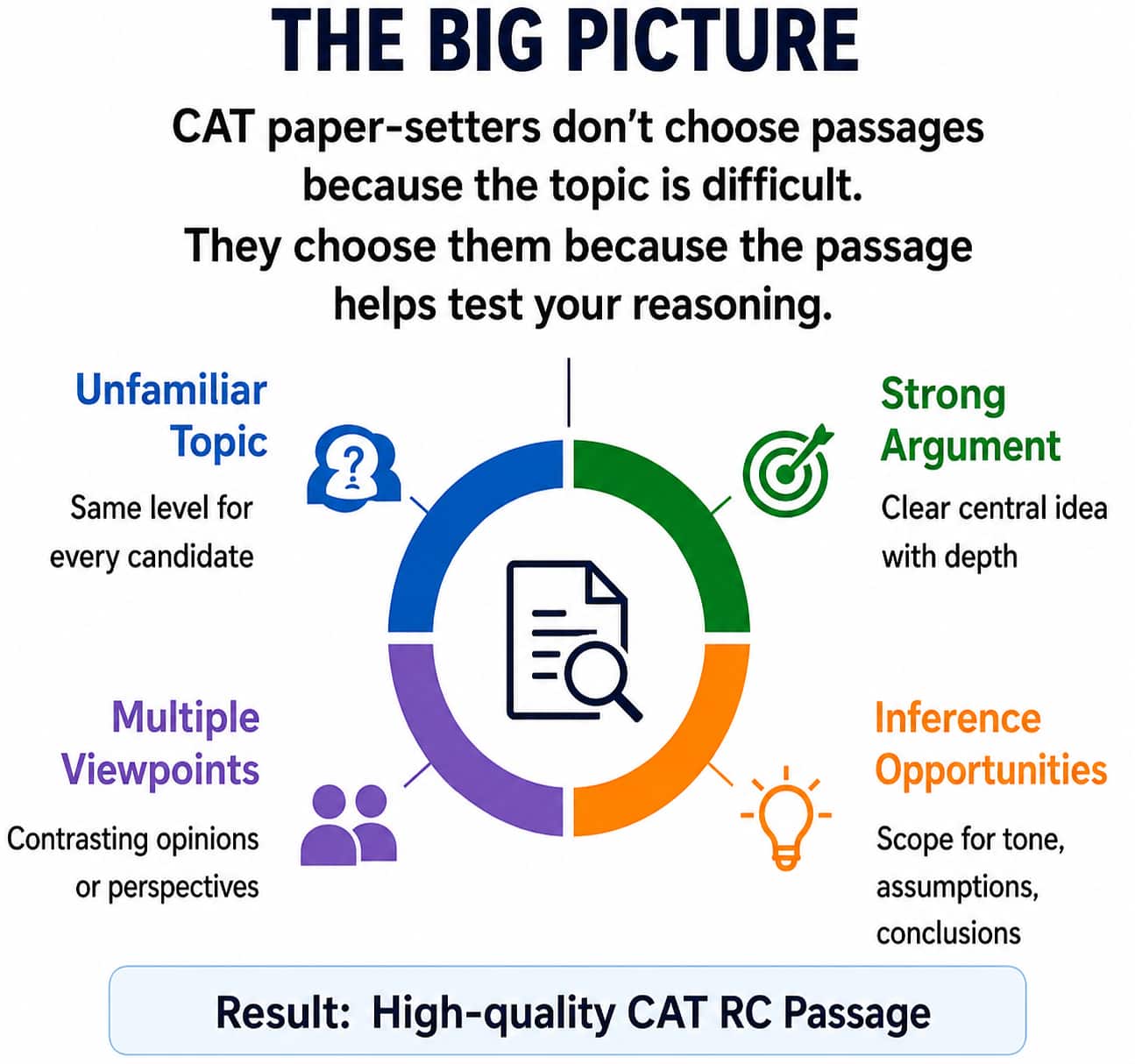
A passage with these characteristics naturally allows questions on the author's tone, assumptions, conclusions and main idea.
That's exactly what CAT wants to evaluate.
Key Observation
A passage with simple language but layered arguments is often more valuable than one filled with difficult vocabulary.
Check our detailed CAT 2025 Slot by Slot Master Weightage Matrix PDF to learn more about which sections RC passages dominated.
Paper-Setters Prefer | Usually Avoid |
Analytical discussions | Pure factual reports |
Contrasting viewpoints | Simple storytelling |
Opinion-backed arguments | Memory-based content |
Scope for inference | Direct question-answer formats |
Logical reasoning | Step-by-step explanations |
Look closely at the left column.
None of these factors depends on the topic itself.
Whether the passage discusses philosophy, artificial intelligence or climate change is almost irrelevant. What matters is whether the writing encourages critical thinking and supports different types of inference-based questions.
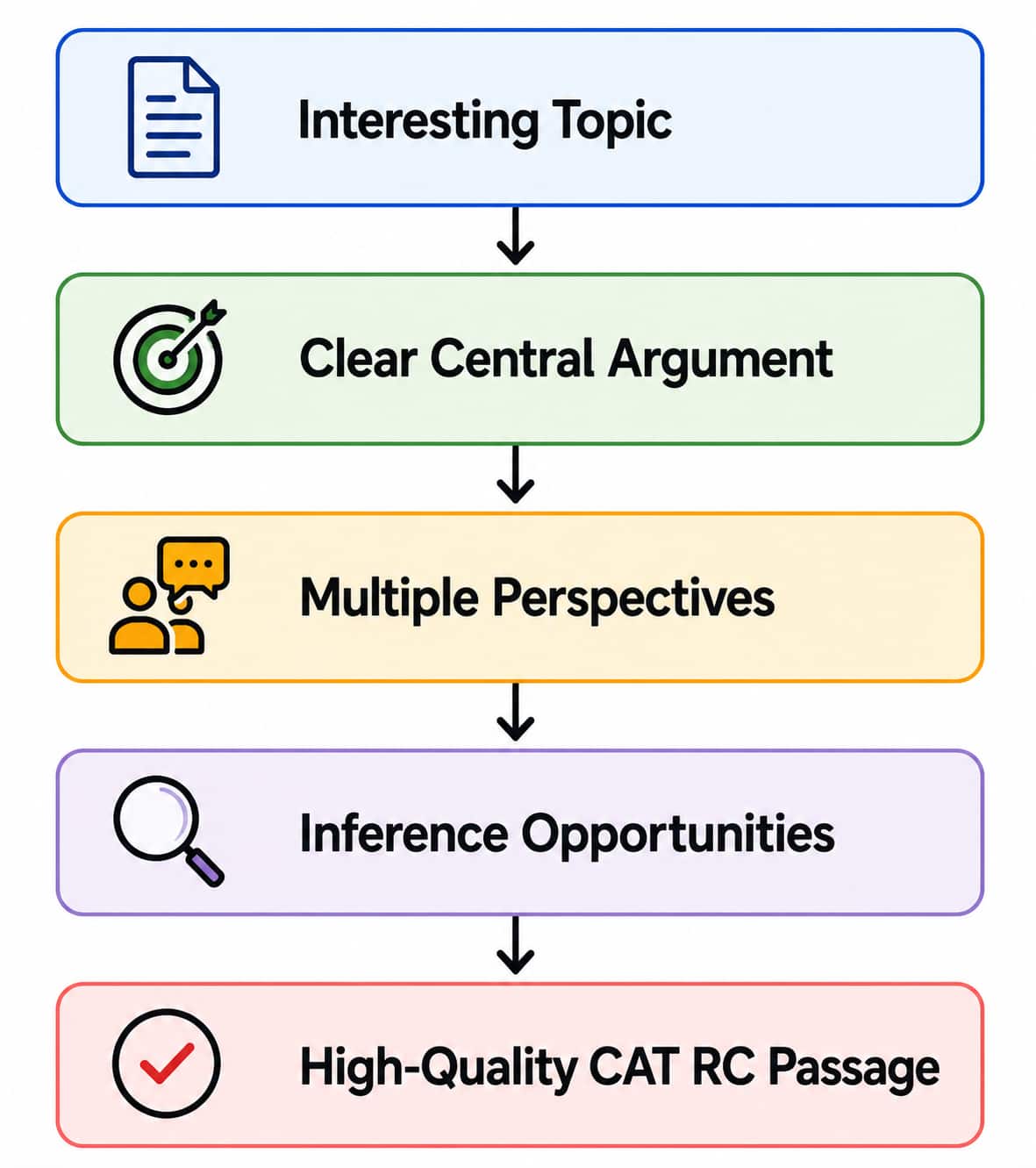
Once you recognise this pattern, you'll stop trying to predict next year's topics and start preparing for the skills that actually matter.
Common Mistake
Many aspirants prepare topic-wise because they believe recent CAT trends reveal what may appear next. In reality, CAT repeats reasoning patterns, not subjects.
Understanding that difference is one of the biggest breakthroughs in CAT 2026 Reading Comprehension preparation.
Most students prepare for Reading Comprehension by solving one passage after another. While practice is essential, if you just go on solving RCs without actually understanding the examiner's mindset, you tend to improve more slowly.
The better approach is to ask a different question before attempting every passage:
Ask Yourself
"If I were the CAT paper-setter, what questions could I create from this passage?"
The moment you begin reading with this perspective, you'll naturally start identifying the author's argument, supporting evidence, contrasting opinions and hidden assumptions-all of which frequently appear in CAT RC questions.
A common misconception is that CAT rewards candidates who read faster or know more difficult words.
That's only a small part of the picture.
Most Students Prepare For | CAT Actually Tests |
Difficult vocabulary | Understanding arguments |
Reading speed | Logical interpretation |
General knowledge | Passage-based reasoning |
Subject expertise | Critical thinking |
Memorising facts | Drawing valid inferences |
Key Takeaway
Improving your RC score isn't about becoming an expert in every topic. It's about becoming comfortable analysing unfamiliar ideas.
Once you understand how CAT paper-setters pick passages, your preparation naturally becomes more focused.
Instead of chasing every possible topic, build the skills that remain constant across every CAT paper.
Make these habits part of your daily routine.
Read one high-quality editorial or long-form piece every day.
Before you even look at the questions, try to figure out what the author’s main point is, the central thesis.
Then notice how each paragraph kind of slots into the larger discussion.
Also practise cutting away options that are only partly correct but not fully backed by the passage, even if they look tempting at first, because the text matters.
Spend more time analysing mistakes than simply counting correct answers.
Quick Insight
One thoroughly analysed RC passage teaches more than five passages solved without reviewing your mistakes.
No single website can guarantee CAT-like passages, but regularly reading analytical content helps you become comfortable with unfamiliar writing styles.
Consider reading articles related to:
Philosophy
Psychology
Economics
Sociology
Artificial Intelligence
Climate and Sustainability
History and Culture
Public Policy
The objective isn't to master these subjects.
It's to become comfortable reading arguments outside your comfort zone.
Learn with 8 Expert-Curated Philosophy Editorials with CAT-Style Questions
Even serious aspirants unknowingly repeat mistakes that slow their progress.
Mistake | Better Alternative |
Reading only to find answers | Read to understand the author's reasoning. |
Focusing only on vocabulary | Focus on arguments, tone and assumptions. |
Solving many RCs without review | Analyse every incorrect answer carefully. |
Common Mistake
Many aspirants blame low scores on difficult passages. In reality, the biggest issue is often choosing options that sound correct instead of those that are completely supported by the passage.
Understanding how CAT paper-setters pick passages removes one of the biggest myths surrounding CAT VARC.
The exam isn't trying to surprise you with unusual subjects. It's trying to measure how effectively you analyse unfamiliar information, identify the author's intent and draw logical conclusions under time pressure.
That small shift in perspective can completely transform your CAT VARC preparation and help you approach every CAT RC passage with greater confidence.
Frequently Asked Questions (FAQs)
CAT paper-setters select passages that contain strong arguments, multiple viewpoints and enough scope to create inference, tone and reasoning-based questions instead of testing subject knowledge.
No. You can answer each question from what’s given in the passage; prior knowledge is neither expected nor rewarded.
Because these areas naturally bring up debates, different stances and analytical reasoning, so they work well for checking critical thinking plus inference-type skills.
Keep reading analytical pieces, try to grasp what the author is arguing, then go through every silly mistake carefully. Also practise more questions that need inference, not only those that test vocabulary.
Not in a dependable way. The topics shift every year, but the core reasoning skills are mostly the same. So building those skills is much better than trying to predict specific subjects.
The CAT 2026 exam will be held on Nov 29, 2026.

On Question asked by student community
Hey there,
If you mean your MBA counselling seat-allotment letter, the exact download process depends on the counselling authority.
Usually:
With a Telangana state merit rank of 10,953, admission to MBBS Category A in Hyderabad Muslim minority colleges is generally very difficult. However, you may have a better chance for BDS Category A, depending on the year's cutoff and seat availability.
Hello Dear Student,
Based on your All India Rank (AIR) of 31198 as a General category Female with Bihar domicile, your chances of securing an MBBS seat in a Government Medical College (GMC) are highly realistic but require a careful counselling strategy.
While your rank is slightly outside the traditional
Hello Dear Student,
You can directly pursue an MBA now; you do not need to do a BBA first. A bachelor's degree in any discipline is the only foundational requirement. Born in 1988, your age is not a formal barrier for management education, but your choice of program format matters
Hello,
Yes, MBBS and BDS seats are available through Kendriya Sainik Board Secretariat (KSB) for wards of categories of Defence personnel. You can check more at ksb.gov.in/admission-mbbs-bds-colleges.htm.htm
Directions for question:
The bar-graph given below shows the foreign exchange reserves of Nepal (in million Rupees) from 2014 to 2021. Answer the following questions based on the graph :

Question:
What was the percentage increase (rounded to the nearest integer, if deemed necessary) in the foreign exchange reserves in

Globally Recognized by AACSB (US) & AMBA (UK) | 18 LPA Avg. CTC for PGPM 2026
75+ years of legacy | #1 Entrance Exam | Score accepted by 250+ BSchools
6-Hour Masterclass to help you score 99+ percentile in CAT 2026
Registration Start: 3 August 2026 | Last Date to Apply: 15 September 2026 (till 5 PM)
AACSB Accredited | 40 LPA-Highest CTC | Scholarships worth 10 CR
Get Real CAT-like Experience | Attend Mock Test on 26th & 27th September 2026 | Timings: 8:30 AM | 12:30 PM | 4:30 PM