XAT- Xavier Aptitude Test 2027
75+ years of legacy | #1 Entrance Exam | Score accepted by 250+ BSchools


Scoring 230 in NMAT and securing admission to the core MBA programme at SBM NMIMS Mumbai was an outcome that Kavish Panwala, a BBA Finance graduate from Surat, Gujarat, did not expect. A fresher without CFA or work experience, he appeared for nine MBA interviews and converted all the colleges, eventually choosing SBM NMIMS Mumbai. His journey included interviews at IIFT, IIM Amritsar, and Great Lakes, with IIFT being his toughest interview. A first-time MBA entrance test taker, he started preparing in the second year of college, initially struggled with VARC, and relied heavily on mock analysis to improve. Before NMAT, he had prepared extensively for CAT, attempting around 80–90 mocks and analysing each one in detail. After an uncertain CAT experience, he shifted his focus to SNAP and NMAT.
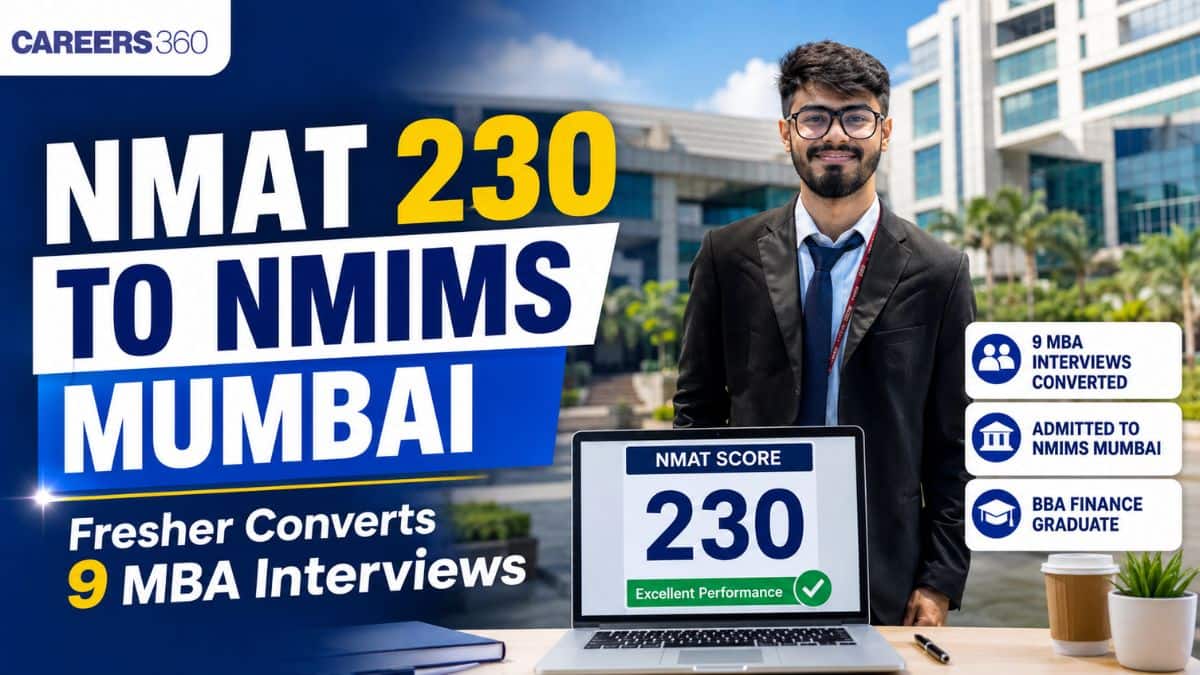
In this Careers360 interview, he shares his NMAT and NMIMS experience, nine MBA interview lessons, and the CAT and SNAP preparation strategies that shaped his journey.
Start early if you have a weak area.
Build concepts before chasing mocks.
Mocks become more useful when analysed.
Don't let one exam determine your journey.
Accept Setbacks and work on betterment.
Prepare for interviews beyond academics.
Don't judge an interview by how it felt.
Consistency matters more than perfection.
Careers360: You converted multiple B-schools. How did you evaluate your options?
Kavish: Of course, NMIMS was the best college I converted to, so there wasn't much confusion regarding most of the options. The main confusion was with IIFT Kolkata because I was waiting to see whether I would eventually convert to the Delhi campus.
I paid the fees for IIFT Kolkata, but the waitlist movement for the Delhi campus eventually stopped. By that time, my NMIMS programme had already started, so I continued with NM Mumbai.
Careers360: What made you choose SBM NMIMS Mumbai over your other B-schools? What factors mattered the most to you while making the final choice?
Kavish: The most important factor is the legacy of NM Mumbai. Its location in the financial capital aligns with my domain interest as well. Also, the proximity to my hometown was one of the factors. NM Mumbai was a clear choice for me over the other options I had in terms of placements, culture, and location. Thus, there was not much of a dilemma for me.
Careers360: What are you most excited about at SBM NMIMS Mumbai? What are your expectations from the MBA programme?
Kavish: I have already kick-started my journey here at NMIMS and am already feeling quite the toil. After coming here, I have realised the brand value of NMIMS and that everything I have heard about it was absolutely true.
There are many case competitions as well as companies that come exclusively for NMIMS, which gives it an upper edge and opens the door to multiple opportunities for me and makes me feel privileged.
Whatever I had heard about MBA life is also a reality. The late-night struggles and sleepless nights are also true. I am truly excited about what lies ahead of me. Also, the average age group of people at NMIMS is 25, so being surrounded by such an experienced and diverse group of people also makes this experience enriching
Careers360: You attended nine MBA interviews. How did you prepare for them?
Kavish:I was able to convert all the colleges for which I received calls. Some of them I converted at the main campuses, and for others, I converted secondary campuses. My strategy was to collect all information about basic general knowledge and current affairs and make notes. I also prepared hygiene questions and got them verified by my mentor. I used to go through each and every note at least once a day so that I could get a hold of it and develop confidence while speaking. Preparing relentlessly and consistently for interviews and attending mock GDs and personal interviews helps a lot. On the day of the interviews, I just kept my notes ready and went through them.
Careers360: Which was the most challenging MBA interview you faced?
Kavish: Among all the interviews, the IIFT interview was the most challenging for me.
The interview panel consisted of three members. As a fresher with a relatively low CAT score, I was questioned extensively about my academics and application form. The panel also asked several questions related to undergraduate studies.
However, I was able to handle the interview calmly, and the effort eventually paid off, as I converted IIFT Kolkata.
Careers360: As a fresher, what do you think made you and your profile stand out?
Kavish: I had great academics, firstly, which is 9/9/8. Secondly, I had a great knowledge base in finance. I was able to display my clarity in finance and my willingness to deep-dive more into it. I also showed genuine interest by leading and starting the Finance Club of my college. Good communication also plays a role as well.
Careers360: What Questions Were Asked in the MBA Interviews?
Kavish:The interviews started with common questions such as introductions before moving into different areas depending on the candidate's profile and the college. Current Affairs were the most prominent questions in all interviews. Many questions were asked around the Budget, government policies, and important personalities, including ministers and the SEBI Chairperson.
His finance background also became a major discussion point during interviews. During the NMIMS interview, several questions revolved around finance and the stock market, areas in which he already had considerable interest and preparation.
Careers360: When did you start preparing for MBA entrance exams, and why did you start in your second year of college?
Kavish:I started my MBA journey in the second year of my undergraduate college because I come from a non-mathematics background and felt that I would need more time to prepare. I wanted to build my concepts gradually rather than rushing through the preparation. CAT was also my first attempt at an MBA entrance examination.
Careers 360: What was your CAT preparation strategy? Which sections required the most attention?
Kavish:For CAT, the first thing I would recommend is being thoroughly prepared with the content. I focused mainly on Arithmetic and Algebra because they form a major part of the paper. For the other concepts, I focused on understanding the basics well enough to solve straightforward questions if they appeared in the paper.
VARC was initially quite difficult for me. I worked on developing reading and comprehension habits, and with consistent effort, I was eventually able to make it one of my strongest sections.
For DILR, I realised that it was largely a game of set selection. Initially, I focused on solving one set in every mock. Once I gained confidence through multiple mocks, I gradually tried to solve more. In the later stages, I focused on giving more and more mocks and sectional tests.
Careers360: What changes did you make after the CAT exam that helped you perform better in the SNAP and NMAT exams?
Kavish: After my CAT exam, I was not confident enough about my results, but I did not let that hover over my mind. I took a break for a day and started preparing consistently for other OMETs because my SNAP exam was in a week’s time, followed by NMAT. So, I didn’t want to lose my momentum. Compared to CAT, I found the other exams a bit on the easier side, so I gained confidence as well.
I think in my CAT exam, I had loaded myself with a lot of unnecessary pressure and workload, which I relieved during my other tests. This helped me become more productive and perform better.
Careers360: What strategy or factor contributed the most to your success in the MBA journey?
Kavish: So, I would never say that I was already very good at this examination. Instead, I would say that it was a constant series of failures for me in this journey.
However, the biggest factor in this journey would be consistent determination and the willingness to come out of this struggle every time I faced multiple failures, and I consider this one of my biggest challenges. I have seen phases of being among the least scorers in my classes and among the highest as well. But the ability to show up every day, no matter how exhausted and demotivated you feel, helps you do wonders.
JUST DON’T LOSE HOPE! KEEP PREPARING.
Careers360: How important were mocks in your preparation?
Kavish: Mocks were extremely important for me. I gave around 80–90 mocks during the entire preparation period. I would suggest that a non-engineering candidate attempt at least 50 mocks.
But he said that only giving mocks are not important. The analysis after the mock is equally important. Every mock helped me understand my mistakes, identify areas where I was losing time, and improve my question-selection strategy.
Careers360: Your mock scores were sometimes among the highest and sometimes among the lowest in your class. How did you deal with that inconsistency?
Kavish: During those phases, I realised that I could not allow one mock score to determine my confidence. Whenever I got a low score, I tried to understand what went wrong instead of simply getting demotivated.
The biggest factor for me was consistency. The ability to show up every day, no matter how exhausted or demotivated you feel, can help you do wonders.
Careers360: You missed some good colleges by a small margin: SIBM Pune, SCMHRD and IIFT Delhi. How did that make you feel, and how did you overcome it?
Kavish: I felt that I needed some improvement, but I accepted it gracefully. It helped me to know myself better. I just accepted my failures and kept preparing, thinking that whatever happens will be best for me. I missed SIBM Pune and SCMHRD by just 0.5 percentile. Yes, it felt bad, but I kept going and had hope that something would happen.
Careers360: How did travelling to different cities for interviews shape your experience?
Kavish: Good question. Nobody asks this question, but these new experiences make this journey even better. I had to travel a lot while managing my college as well. I travelled around seven times out of nine; the others were online interviews. There were days when I was travelling every alternate day and still going to college the next day.
On every trip, I had the opportunity to meet a variety of people and interact with them. I made many friends from multiple cities as well. So, it was overall an enriching experience.
Careers360: There were many highs and lows in your CAT journey. How did you deal with the lows? What made you keep going when your efforts didn’t equate to the results?
Kavish: Yes, of course, it feels like a toil when, even after working so hard, I didn’t even get the average marks of the class. But that never made me give up. I used to think of it as a challenge: no matter what, I would show up each and every time and never run away from giving my 100 percent.
Whenever I used to get a setback, I would just relax and take a break, go out with my friends to calm my mind and get some fresh air, and start working at the same pace the next day. All these things have only made my journey memorable now.
Thinking about those days still gives me that thrill that I can go through any phase and still come out with bright colours.
Careers360: If someone is starting their CAT, NMAT and SNAP journey today, what should their preparation roadmap look like?
Kavish: As the CAT exam is around the corner, the only main concern right now should be to give as many mocks as possible, despite any low scores or high scores for that matter. Analyse the mocks properly and revise. Be thorough with your basic content right now.
I would say don’t prepare right now for the OMETs. Just focus on CAT first and, from around October, gradually start giving NMAT and SNAP mocks as per the schedule. Don’t overburden yourself with a lot of stuff. Just be patient and keep going.
Don’t take OMETs casually. They can be your saviour if CAT betrays you.

On Question asked by student community
Dear Yashwant,
Please check the Last Date to Apply for NMAT Colleges here:
NMAT Colleges Last Date to Apply 2026–28: Deadlines, Fees & Complete List of NMAT Accepting Colleges
With an NMAT score of 194, you are in a good position to secure admission to several decent management schools (around the 30-41 percentile range). Top choices for this score include various campuses of Amity University, ITM Business School, ISBR Business School, and SRM University.
Attaining an NMAT score of 225 marks with sectional marks for VARC and QA around 73 marks, and LR at 79 marks, places you in a strong position for colleges like NMIMS Bengaluru, NMIMS Navi Mumbai, NMIMS Hyderabad, NMIMS Indore, KJ Somaiya, TAPMI, and more.
Hi there,
With an NMAT score of 216 (LR 76, VA 74, QA 66), you have a wide range of good options for admission. You can consider schools where your score is at par with the scores of admitted students, such as NMIMS campuses in Mumbai, Bangalore, and Hyderabad, Xavier
HELLO,
Here are some good MBA Colleges that you can target with an NMAT score around 204:-
1.SVKM's Narsee Monjee Institute of Management Studies (NMIMS), Hyderabad and Navi Mumbai
2.SDA Bocconi Asia Center, Mumbai
3.ICFAI Business School (IBS), Hyderabad
4.SOIL Institute of Management, Gurgaon
5.Great Lakes Institute of Management
6.Alliance

Globally Recognized by AACSB (US) & AMBA (UK) | 18 LPA Avg. CTC for PGPM 2026
75+ years of legacy | #1 Entrance Exam | Score accepted by 250+ BSchools
6-Hour Masterclass to help you score 99+ percentile in CAT 2026
400+ Recruiters | Highest CTC 25 LPA | Average CTC 8 LPA | 92% Placements in 2025 | Ranked as Platinum Institute | Awarded Best Business School of the Year
1 Exam accepted by 17 Top Symbiosis Institutes for 29 MBA programmes.
Among top 6% B-Schools globally to be accredited by AACSB | Highest Package-35 LPA