
Search Colleges, Exams, Schools & more


Login
IIM to Shark Tank: 10 MBA Graduates Who Built India’s Biggest Startups
#MBA
From IIM classrooms and corporate careers to companies that reshaped how India shops, travels, eats and buys services.
This Story also Contains
- 10 MBA graduates behind some of India’s biggest startup stories
- 1. Falguni Nayar - Nykaa
- 2. Peyush Bansal - Lenskart
- 3. Supam Maheshwari - FirstCry
- 4. Abhiraj Bhal - Urban Company
- 5. Sahil Barua - Delhivery
- 6. Vipul Parekh - BigBasket
- 7. Sriharsha Majety - Swiggy
- 8. Deep Kalra - MakeMyTrip
- 9. Sachin Bansal and Binny Bansal - Flipkart
- 10. Karan Bajaj - WhiteHat Jr
- 1. A degree can open doors, but it cannot validate an idea
- 2. The best opportunities often sit inside ordinary problems
- 3. Scale is an operating challenge
- 4. Careers before startups can be valuable
- 5. Shark Tank changed how founders are seen
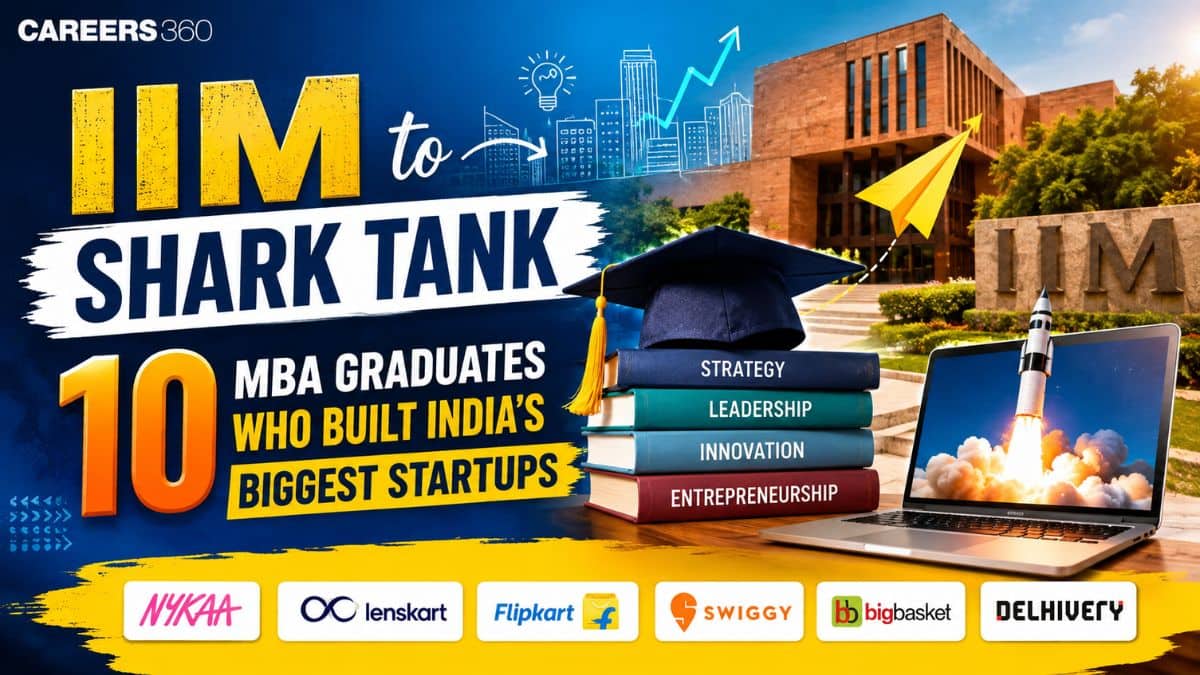
India’s startup story is often told through products, funding rounds and billion-dollar valuations. But behind many of those businesses are founders who spent years learning how organisations work before deciding to build one themselves. A surprising number came through India’s premier management institutes, especially the IIMs.
That does not mean an MBA is a ticket to entrepreneurship. It is not. What the journeys of these founders show is something more useful: business school can provide exposure to markets, finance, operations, strategy and people - but the decisive move still comes when a founder spots a problem worth solving and accepts the uncertainty of building a company.
The “Shark Tank” reference is deliberate, but not literal for every name on this list. Some of these founders became familiar faces on Shark Tank India, while others built their reputations far away from the television spotlight. Together, they show how wide the MBA-to-founder path can be.
10 MBA graduates behind some of India’s biggest startup stories
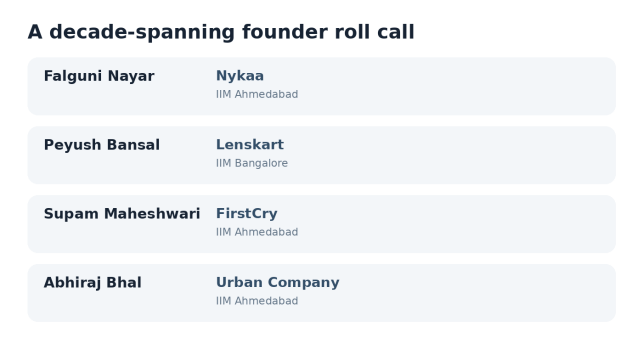
1. Falguni Nayar - Nykaa
Falguni Nayar’s story is one of the clearest examples of an experienced professional turning business knowledge into a consumer brand. An IIM Ahmedabad alumna, Nayar founded Nykaa after a long career in investment banking. The company began by focusing on beauty and personal care, a category where Indian consumers were increasingly looking for choice, authenticity and convenience.
What made Nykaa stand out was not simply the decision to sell cosmetics online. The business built trust around a category in which authenticity matters, while combining content, commerce, private labels and an expanding physical presence. Nayar later became one of the most recognisable entrepreneur-investors on Shark Tank India.
Her journey is especially relevant to MBA aspirants because it challenges the idea that entrepreneurship has to begin immediately after college. Sometimes, the experience accumulated before founding a company becomes part of the founder’s unfair advantage.
2. Peyush Bansal - Lenskart
Peyush Bansal, an IIM Bangalore alumnus, took a fragmented eyewear market and built a consumer technology company around it. Lenskart combined online discovery with an expanding offline store network, while investing heavily in technology, supply chain and customer experience.
Bansal’s public profile grew further through Shark Tank India, where he became one of the show’s most recognisable sharks. But the more interesting part of his founder story predates television: the business had to solve a practical retail problem - making eyewear easier to discover, buy, fit and replace.
For management students, Lenskart is a useful case study in omnichannel thinking. A digital-first company did not have to remain digital-only; the physical network became part of the customer proposition.
3. Supam Maheshwari - FirstCry
Supam Maheshwari, an IIM Ahmedabad alumnus, built FirstCry around a market that has a powerful combination of repeat purchases, trust and fragmented retail: products for babies and children. The business grew from an online marketplace into a much broader retail ecosystem.
FirstCry’s journey illustrates another side of entrepreneurship: operational complexity. A large catalogue is only useful when inventory, fulfilment, customer acquisition and physical distribution work together. Maheshwari’s earlier entrepreneurial experience helped him approach the category with a scale-up mindset rather than treating it as a simple online store.
The lesson for MBA aspirants is straightforward: a startup may begin with a website or an app, but a large consumer business is ultimately an operations problem too.
4. Abhiraj Bhal - Urban Company
IIM Ahmedabad alumnus Abhiraj Bhal co-founded Urban Company, originally known as UrbanClap, with the ambition of making home services more organised and predictable. The model connected customers with service professionals for categories ranging from beauty and cleaning to repairs and maintenance.
Urban Company’s challenge was harder than building a marketplace that simply matched two sides. The company worked on selection, training, standardisation, tools, pricing and service delivery. In other words, it tried to control enough of the experience to make an informal category feel more like a dependable consumer service.
Bhal’s own account of the journey highlights experimentation and multiple changes to the operating model before the company settled on the categories and processes that could scale. That is a useful reminder that the first version of a startup is rarely the final one.
The IIM advantage: useful, but not magical
There is a temptation to look at a list like this and conclude that the IIM brand created the founders. The evidence does not support such a simple explanation. The founders came from different backgrounds, industries and career paths, and their companies required very different capabilities.
What an MBA can offer is a toolkit. Finance can help a founder understand unit economics. Strategy can help frame competitive choices. Operations can help turn an attractive idea into a repeatable process. Marketing can help a product find its audience. And a strong peer network can become a source of co-founders, employees, customers and investors.
But none of those advantages replaces product-market fit. The strongest founder stories on this list are built around a customer problem first and credentials second.
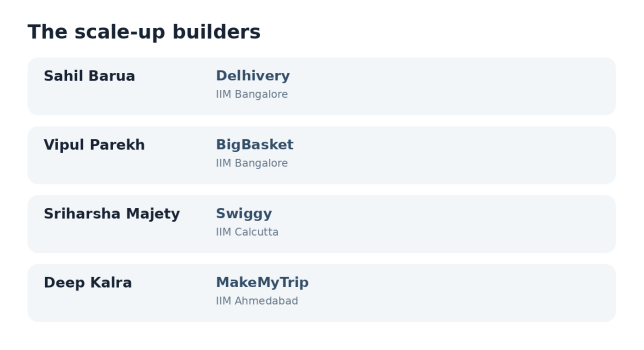
5. Sahil Barua - Delhivery
Sahil Barua, an IIM Bangalore alumnus and gold medallist, co-founded Delhivery after working in consulting. The company tackled one of the less glamorous but most important pieces of India’s e-commerce boom: logistics.
As online retail expanded, merchants needed more than a website. They needed warehousing, fulfilment, transportation, tracking and reliable last-mile delivery. Delhivery built infrastructure around that requirement and became a major logistics technology company.
Barua’s journey is a classic example of an MBA skill translating into entrepreneurship: seeing an emerging market not only through the consumer-facing product, but through the infrastructure required to make that market work.
6. Vipul Parekh - BigBasket
IIM Bangalore alumnus Vipul Parekh co-founded BigBasket and took on one of retail’s toughest categories: groceries. His entrepreneurial journey also included an earlier e-commerce venture, giving him experience with online retail before BigBasket was launched.
Groceries are fundamentally different from many e-commerce categories because frequency, freshness, inventory, delivery economics and local assortment all matter. BigBasket’s growth therefore depended on building a supply chain and fulfillment operation alongside the customer-facing platform.
IIM Bangalore itself highlights Parekh’s role as BigBasket’s co-founder and his long involvement in entrepreneurship. His story shows the value of learning from one venture and carrying those lessons into the next.
7. Sriharsha Majety - Swiggy
Sriharsha Majety, from IIM Calcutta’s 2011 PGDM batch, co-founded Swiggy after an earlier venture. Swiggy grew into one of India’s leading food delivery and quick-commerce businesses, changing consumer expectations around convenience and delivery speed.
The interesting part of Majety’s story is the combination of technology and operations. Food delivery looks like a simple app interaction to a customer, but behind it sits a network involving restaurants, delivery partners, routing, demand forecasting and customer support.
For MBA students, Swiggy is a reminder that some of the most difficult startup problems are hidden behind apparently simple consumer experiences.
8. Deep Kalra - MakeMyTrip
Deep Kalra, an IIM Ahmedabad alumnus, founded MakeMyTrip and helped establish online travel as a mainstream consumer category in India. His company entered a market where customers had historically depended heavily on agents and offline processes.
Travel is a trust-heavy purchase. Customers want accurate information, competitive prices and confidence that a booking will actually work. Building that confidence at scale required technology, partnerships and a deep understanding of consumer behaviour.
Kalra’s journey also demonstrates that an internet business can be transformative even when the underlying product - a flight, hotel room or holiday - already existed. The innovation can lie in how people discover, compare and purchase it.
9. Sachin Bansal and Binny Bansal - Flipkart
Sachin Bansal and Binny Bansal are IIM Ahmedabad graduates who co-founded Flipkart in 2007. Their company became one of the defining businesses of India’s e-commerce era, helping move online shopping from an emerging idea to a mass-market habit.
Flipkart’s early years were filled with problems that were uniquely Indian: consumer trust, cash on delivery, logistics, payments and the challenge of persuading customers to buy products they could not physically inspect first.
Their story is important because it shows how entrepreneurship often involves solving several unglamorous problems simultaneously. The winning idea is rarely just “put shopping online”; it is the collection of systems that makes online shopping work for millions of people.
10. Karan Bajaj - WhiteHat Jr
Karan Bajaj, an IIM Bangalore alumnus, founded WhiteHat Jr. with a focus on teaching children to create technology. The edtech company became one of the most visible Indian online learning businesses before being acquired by Byju’s.
WhiteHat Jr.’s rise reflected a broader change in Indian households: parents were increasingly willing to pay for online learning outside the traditional school system. The business also showed how quickly an education product can scale when content, instructors, technology and marketing are combined.
Its later trajectory also offers an important founder lesson: rapid growth and a large acquisition are not the end of the story. Sustainable businesses still have to keep proving the value they deliver to customers.
What these 10 founders teach MBA aspirants
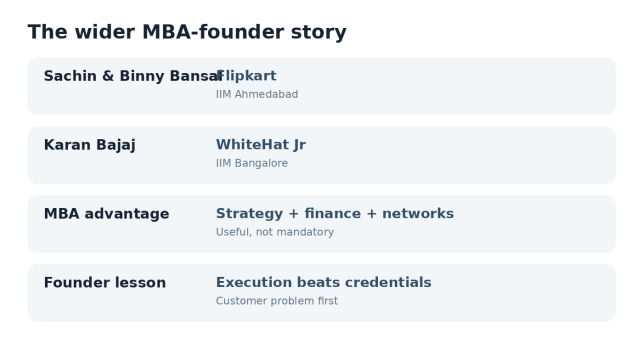
1. A degree can open doors, but it cannot validate an idea
An IIM credential can create credibility and access, but customers do not buy a product because its founder went to a prestigious business school. Every company on this list had to earn adoption in the real market.
2. The best opportunities often sit inside ordinary problems
Groceries, eyewear, home repairs, logistics, travel and children's education are not futuristic concepts. They are everyday needs. The opportunity came from redesigning how those needs were served.
3. Scale is an operating challenge
At startup size, founders can solve problems personally. At scale, they need systems. Warehouses, service standards, technology platforms, hiring processes, quality control and customer support become as important as the original idea.
4. Careers before startups can be valuable
Several founders on this list had meaningful careers before they became entrepreneurs. Consulting, investment banking, private equity and other professional experiences can sharpen a founder’s understanding of markets and organisations. There is no single correct age or career stage for starting a company.
5. Shark Tank changed how founders are seen
Shark Tank India has made entrepreneurship more visible to a mainstream audience. Founders who once appeared mainly in business newspapers or investor meetings can now become household names. But television is only the visible layer. The harder work happens before and after the pitch: building a product, finding customers, hiring people and managing cash.
IIM to Shark Tank: what comes next?
The most useful takeaway from these founders is not that MBA graduates have a special formula for building billion-dollar companies. They do not. The stronger takeaway is that management education and entrepreneurship can complement each other when classroom frameworks are used to solve real problems.
From Nykaa and Lenskart to Delhivery, BigBasket, Swiggy, MakeMyTrip and Flipkart, these businesses grew because their founders understood a market, took risks and kept adapting. Some later stepped into the Shark Tank spotlight; others remained better known for what they built than for what they said on television.
For today’s MBA aspirant, that distinction matters. The goal is not to become a shark simply because it sounds impressive. The goal is to become good enough at identifying a problem, building a solution and scaling it that investors, customers and eventually the market have a reason to take notice.
Quick snapshot
Founder(s) | Startup | B-school | Known for |
Falguni Nayar | Nykaa | IIM Ahmedabad | Beauty and retail |
Peyush Bansal | Lenskart | IIM Bangalore | Omnichannel eyewear |
Supam Maheshwari | FirstCry | IIM Ahmedabad | Baby and kids retail |
Abhiraj Bhal | Urban Company | IIM Ahmedabad | Home services |
Sahil Barua | Delhivery | IIM Bangalore | Logistics |
Vipul Parekh | BigBasket | IIM Bangalore | Online grocery |
Sriharsha Majety | Swiggy | IIM Calcutta | Food delivery and quick commerce |
Deep Kalra | MakeMyTrip | IIM Ahmedabad | Online travel |
Sachin & Binny Bansal | Flipkart | IIM Ahmedabad | E-commerce |
Karan Bajaj | WhiteHat Jr | IIM Bangalore | Edtech |
Sources and fact-check notes
This article uses institutional alumni pages and published educational-business references for founder education and company associations. Company size, valuation and operating metrics can change over time; the article intentionally avoids presenting old valuation figures as current facts.
IIM Ahmedabad Endowment Fund - alumni profiles and Deep Kalra
IIM Bangalore - Alumni Innovators
IIM Bangalore - Distinguished Alumni Awards, Vipul Parekh
IIM Calcutta Archives - Sriharsha Majety
Articles
Upcoming Bschool Exams

Certifications By Top Providers
Explore Top Universities Across Globe
Popular Courses and Specializations
Popular Branches
Popular Courses
- MBA in Rural Management Course, Eligibility, Admission, Fees, Colleges, Syllabus, Subjects, Career
- B.Tech in Power System Engineering: Courses, Fees, Jobs, Scope
- B.A. Italian - Course, Eligibility, Admission, Syllabus, Scope
- Post Graduate Diploma in Accommodation Operation: Course, Exams, Fees, Colleges, Career
- B.A. Social Work - Course, Eligibility, Syllabus, Colleges, Fees, Career Scope
List of MBA colleges
Browse Bschool Colleges by State
Questions related to MBA
On Question asked by student community
Have a question related to MBA ?
Hello Student, whether C in assignment and D in exams means pass or fail depends on your university's grading and minimum-component requirements. Some MBA programmes require a minimum overall grade, while others may require separate passing marks in examinations. Since your LMS already shows grades but the official grade card
Hello Student,
Yes, dedicated MBA in Event Management programmes are available in India. Some options include:
- Gujarat University, Ahmedabad – MBA in Event Management
- MLCU, Shillong – MBA in Event Management
- ARNI University, Himachal Pradesh – MBA in Event Management
- Parul University, Vadodara – MBA in Tourism & Event Management
Dear Student,
When choosing a college for an MBA, compare the university based on recognition and accreditation status, fees, curriculum, placements, faculty, location, and entrance requirements. Both institutes offer the best MBA programme, but the choice depends on your interest and career goals. You can compare these institutes on different
Hello, you can check the Karnataka MBA seat matrix for college-wise and category-wise seat details through Karnataka PGCET counselling. You can find the latest Karnataka PGCET MBA seat matrix and counselling details here: https://bschool.careers360.com/articles/karnataka-pgcet-mba-counselling
Hey there,
If your TG/TS ICET rank is 11,156 and you want an MBA college in Hyderabad, you still have several realistic options. Your category matters a lot.
Based on recent cutoff trends:
| College | Recent closing rank/trend | Chance at 11,156 |
|---|---|---|
| AV College of Arts, Science & Commerce | ~11,332 | Borderline–Good |
| Dr. |

Study Resources, Applications and Opportunities
Globally Recognized by AACSB (US) & AMBA (UK) | 18 LPA Avg. CTC for PGPM 2026
XAT- Xavier Aptitude Test 2027
Apply75+ years of legacy | #1 Entrance Exam | Score accepted by 250+ BSchools
Career Launcher Race To 99%ile In CAT 2026 - Phase 03
Enquire6-Hour Masterclass to help you score 99+ percentile in CAT 2026
ISBR Business School PGDM Admissions 2027
Apply400+ Recruiters | Highest CTC 25 LPA | Average CTC 8 LPA | 92% Placements in 2025 | Ranked as Platinum Institute | Awarded Best Business School of the Year
Symbiosis MBA - SNAP 2026
Apply1 Exam accepted by 17 Top Symbiosis Institutes for 29 MBA programmes.
NMAT by GMAC 2026
ApplyTest centres are available in 70+ cities across India | 75,000+ aspirants apply for the NMAT exam | Accepted by 58+ institutions like NMIMS, KJSIM, ISB, SPJIMR and Great Lakes.