IBSAT 2026-ICFAI Business School MBA/PGPM 2027
AACSB Accredited | 40 LPA-Highest CTC | Scholarships worth 10 CR


Even the best SNAP preparation can be affected by avoidable mistakes on exam day, such as carrying incorrect documents or arriving late at the test centre. With SNAP 2026 scheduled for December 13, 19 and 26, 2026, candidates should understand the official exam-day requirements well in advance. Registrations are scheduled from August 21 to November 25, 2026, while the result is expected on January 12, 2027. This article covers SNAP 2026 exam-day guidelines, including documents required, reporting instructions, dress code, prohibited items, test-centre procedures and last-minute tips.
This Story also Contains
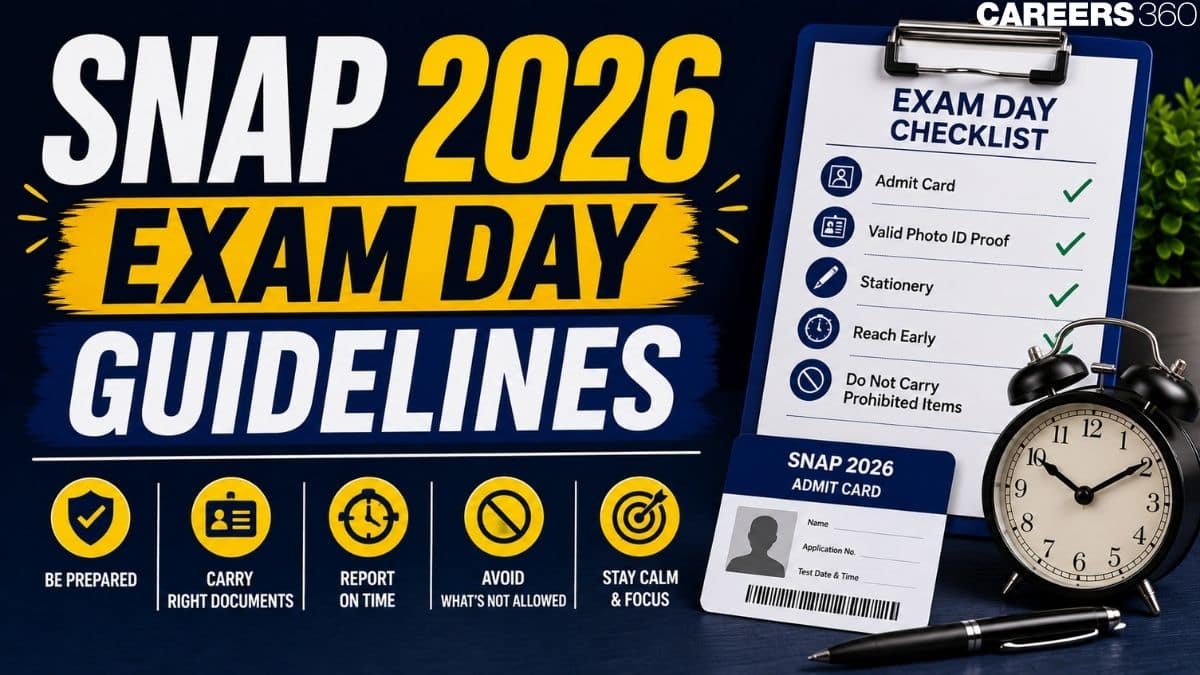
The SNAP 2026 test will be conducted in computer-based (CBT) mode across exam centres throughout the country. Candidates will appear for the test at the exam centre mentioned in their SNAP 2026 admit card. Therefore, candidates should carefully go through the instructions and exam-day guidelines mentioned on the SNAP admit card 2026.
You might be interested in: SNAP Cutoff
The SNAP 2026 exam pattern has been revised with the addition of a new Ethics, Morality and Values (EMV) section. The total examination duration and number of questions remain unchanged at 60 minutes and 60 questions.
| Section | Questions | Marks |
|---|---|---|
| General English | 10 | 10 |
| Ethics, Morality and Values (EMV) | 10 | 10 |
| Analytical & Logical Reasoning | 20 | 20 |
| Quantitative, Data Interpretation & Data Sufficiency | 20 | 20 |
| Total | 60 | 60 |
Each correct answer carries 1 mark, while 0.25 marks are deducted for every incorrect answer.
The new EMV section focuses on applied situational judgement rather than deep abstract philosophy. Candidates should be familiar with topics such as fairness, justice, integrity, honesty, accountability, rights, workplace dilemmas, corporate social responsibility and professional conduct.
Read all the instructions carefully. Some of them will also be printed on the SNAP admit card 2026.
Candidates must download the SNAP admit card 2026 and take a colour printout of the same. Black-and-white copies will not be accepted.
Candidates will have to arrive at the assigned SNAP test centre as per the time mentioned on the SNAP 2026 admit card. They must paste the latest passport-size coloured photograph on the SNAP exam admit card 2026 at the provided block.
Along with the SNAP admit card, candidates are required to bring an original and valid ID proof to the test centre. Any one of the following ID proofs will be accepted for SNAP 2026:
Aadhaar Card
Voter ID Card
Driving Licence
Passport
PAN Card
Test centres are available in 70+ cities across India | 75,000+ aspirants apply for the NMAT exam | Accepted by 58+ institutions like NMIMS, KJSIM, ISB, SPJIMR and Great Lakes.
75+ years of legacy | #1 Entrance Exam | Score accepted by 250+ BSchools
Candidates must ensure that the test invigilator stamps their SNAP hall ticket.
As part of the identification process, candidates' photographs will be captured at the examination centre.
Candidates are advised to keep their SNAP 2026 admit card safe for the further selection process. No duplicate SNAP admit card will be issued later.
Candidates should avoid carrying unnecessary belongings because there is no facility for keeping personal items inside the examination centre.
The following items are not allowed inside the examination hall:
Laptops
Cameras
Mobile phones
Beepers
Calculators
Smartwatches
Earphones
Other electronic gadgets
Books, notes and other study materials should also not be carried into the examination hall.
Also check: SNAP Answer Key
Candidates appearing for the SNAP exam should keep the following points in mind.
Candidates should report to the examination centre on or before the time mentioned on the SNAP admit card 2026.
They should keep all documents ready for verification at the entrance of the SNAP 2026 test centre.
Candidates should adhere to the security guard's announcements and instructions.
Candidates will have to show their SNAP exam admit card 2026 and original ID proof to the security guard.
For details about test-centre locations, candidates can check the SNAP 2026 Test Centres.
Candidates should stand on the floor marks while waiting for their turn.
The barcode on the SNAP admit card will be scanned by the volunteer using a barcode reader.
The lab number will be provided by the volunteer present at the SNAP exam test centre.
Candidates should not indulge in any form of malpractice during the test, as they will be under CCTV surveillance.
In case of any technical glitch, candidates should not panic. They should immediately inform the invigilator in the lab about the issue.
After completing the examination, candidates should follow the instructions given by the examination staff.
The rough sheet should be dropped in a separate drop box kept in the lab.
Quick link: SNAP Exam Analysis
Following the official exam-day guidelines can help candidates avoid unnecessary stress and ensure a smooth examination experience. Before leaving for the exam centre, make sure you are familiar with what you should and should not do on the day of the SNAP 2026 examination.
Reach the exam centre well before the reporting time to complete security and biometric verification without rushing.
Carry your SNAP 2026 Admit Card along with a valid original photo ID proof.
Verify your allotted seat and system before the examination begins.
Carefully listen to and follow all instructions given by the invigilators.
Read the on-screen instructions before starting the exam.
Manage your time wisely and attempt questions strategically.
Stay calm and maintain confidence throughout the examination.
Report any technical issue immediately to the invigilator.
Do not carry mobile phones, smartwatches, calculators, earphones or any other electronic gadgets.
Do not reach the exam centre after the reporting time, as late entry may not be permitted.
Do not bring books, notes or any study material into the examination hall.
Do not communicate with other candidates during the examination.
Avoid any unfair means or malpractice, as it may lead to disqualification.
Do not spend excessive time on one difficult question.
Avoid panic if you encounter unfamiliar questions; move ahead and return later if time permits.
| Do's | Don'ts |
|---|---|
| Reach the exam centre early. | Arrive after the reporting time. |
| Carry the admit card and valid photo ID. | Forget mandatory documents. |
| Follow the invigilator's instructions. | Ignore examination guidelines. |
| Verify your allotted seat and system. | Sit at an incorrect workstation. |
| Stay calm and manage your time effectively. | Panic over difficult questions. |
| Report technical issues immediately. | Try to solve technical problems on your own. |
| Attempt questions strategically. | Spend too much time on a single question. |
| Follow all examination rules. | Carry prohibited items or engage in unfair practices. |
The final week should focus more on logistics, revision and exam strategy than on learning completely new concepts. Candidates should ensure that all mandatory documents are ready and that they are comfortable with the revised four-section paper.
Make sure you know the distribution of all four sections:
General English – 10 questions
Ethics, Morality and Values – 10 questions
Analytical & Logical Reasoning – 20 questions
Quantitative, Data Interpretation & Data Sufficiency – 20 questions
This will prevent confusion when you encounter the new EMV section in the examination.
Attempt mocks that reflect the 60-question, 60-minute structure. This will help you practise switching between sections and manage the revised paper effectively.
Instead of solving a large number of new questions, revise recurring mistakes from your mock tests and practice sessions.
Decide how you will handle lengthy, unfamiliar or time-consuming questions. The objective should be to maximise your score rather than attempting every question without considering accuracy.
The revised SNAP pattern requires candidates to manage four sections within the same 60-minute duration.
The new EMV section contains 10 questions. Candidates should not ignore it while planning their overall exam strategy.
Practise situational questions before the exam so that you can quickly identify the ethical issue and evaluate the available choices.
If a question requires excessive time, move ahead and return to it later if possible. This is particularly important for lengthy reasoning puzzles and complex quantitative questions.
Since every incorrect answer carries a 0.25-mark penalty, avoid making random guesses. Use elimination and logical reasoning when attempting questions where you are uncertain.
Many candidates lose valuable time or face unnecessary difficulties due to avoidable mistakes on exam day. Preparing for these situations in advance can help you stay focused and perform confidently.
Always keep a printed copy of your admit card ready a day before the examination.
Ensure that your original identity proof is valid and matches the details mentioned on your admit card.
Plan your travel in advance and keep extra time for traffic or unexpected delays.
Follow the reporting time and security procedures mentioned on the admit card carefully.
Leave electronic gadgets, study materials and other restricted items at home whenever possible.
Skip lengthy questions initially and return to them later if time permits.
Spend a few minutes understanding the on-screen instructions before beginning the test.
Reviewing your previous mistakes can help you avoid repeating them in the actual examination.
Stick to the approach that worked well during your mock tests.
The final few hours before the examination should be used to stay relaxed and mentally prepared rather than learning new concepts.
A good night's sleep helps improve concentration, decision-making and problem-solving ability during the examination.
Choose a balanced meal before leaving for the exam centre. Avoid skipping breakfast or consuming heavy, oily foods that may make you uncomfortable.
Arrange all required documents, including your admit card and photo ID, the night before the examination.
Check the exam centre location beforehand and leave early, keeping additional travel time for unexpected traffic or delays.
Drink enough water before leaving for the exam centre, but avoid excessive intake immediately before the examination.
Do not compare your preparation with other candidates or attempt to learn new topics just before entering the examination hall.
If you wish to revise, go through short notes, formulas, vocabulary lists, EMV concepts and other key concepts instead of studying entirely new topics.
Even if a few questions seem difficult, remain composed and focus on maximising your overall score through smart question selection and effective time management.
The night before the examination, candidates should focus on logistics and light revision instead of attempting to learn new concepts.
SNAP 2026 Admit Card
Original valid photo ID
Latest passport-size coloured photograph
Exam centre details
Travel route
Essential permitted items
Candidates should check the admit card once again for any centre-specific instructions.
SNAP 2026 preparation books are valuable resources for exam success. They offer comprehensive coverage of the syllabus and provide practice questions with detailed explanations, which help strengthen understanding. These books also provide strategies for tackling different question types and improving time management.
| Book Title | Author(s) |
|---|---|
| How to Prepare for Data Interpretation for the CAT | Arun Sharma |
| Logical Reasoning and Data Interpretation for the CAT | Nishit K. Sinha |
| Data Interpretation and Data Sufficiency | Ananta Ashisha |
| How to Prepare for Verbal Ability and Reading Comprehension for the CAT | Arun Sharma and Meenakshi Upadhyay |
| 30 Days to a More Powerful Vocabulary | Wilfred Funk & Norman Lewis/Simon & Schuster |
| How to Prepare for Verbal Ability and Reading Comprehension for the CAT | Sharma and Upadhyay |
| High School English Grammar and Composition | Wren & Martin |
| How to Prepare for Quantitative Aptitude for the CAT | Arun Sharma |
| NCERT Mathematics Books (Class 6 to 10) | NCERT |
| PSC for VA for CAT | Nishit Sinha |
| Quantitative Aptitude Quantum CAT | Sarvesh Sharma |
| Quantitative Aptitude for Competitive Examinations | Abhijit Guha |
| CAT Data Interpretation and Logical Reasoning | Gautam Puri |
Candidates are strongly encouraged to download and study the preparation materials provided by Careers360, including previous years' question papers, sample papers and mock tests for the SNAP exam. These resources can enhance final preparation.
| Title | Download Link |
|---|---|
| SNAP Sample Paper, SNAP Preparation Course & Study Material | Download Now |
| SNAP 2026 Preparation Tips PDF | Download Now |
| SNAP Paper with Answer Key | Download Now |
| SNAP 2014 Solved Paper | Download Now |
| SNAP 2013 Solved Paper | Download Now |
Before leaving for the examination centre, candidates should quickly check the following:
Admit Card: Colour printout ready.
Photo ID: Original and valid.
Photograph: Latest passport-size coloured photograph as required.
Exam Centre: Location checked in advance.
Travel: Route and additional travel time planned.
Prohibited Items: Electronic gadgets and study material left at home.
Exam Pattern: Revised four-section structure understood.
EMV: Familiarity with the new 10-question section.
Mock Strategy: Previous mistakes reviewed.
Sleep: Adequate rest before the examination.
Frequently Asked Questions (FAQs)
For the SNAP exam, candidates should wear simple clothing like T-shirts, shirts, and trousers. Avoid clothes with metallic items such as buttons, zippers, or hooks. Head-coverings are not allowed unless required for religious reasons, in which case a simple headscarf or turban is permitted. Accessories like goggles, sunglasses, bracelets, or rings are also not allowed. Female candidates are advised to choose comfortable attire, like a plain top with pants or a kurta, and to avoid metal-containing clothing.
For the SNAP exam, you need to carry a valid ID proof (like an Aadhar card, passport, or driver's license) and your SNAP 2026 admit card. Make sure both documents are original and in good condition.
No, watches are not allowed in the SNAP exam, as electronic items are strictly prohibited. It's best to leave all electronic devices at home or in a secure place before entering the exam hall.
No, you cannot wear earrings or any other jewelry in the SNAP exam. All types of jewelry are prohibited to avoid any issues during security checks.
The SNAP exam is 1 hour long. During this time, you'll need to answer questions across various sections, so it's important to manage your time effectively.
A SNAP score between 40 to 45 is considered good as it can fetch 90 to 95 SNAP percentile. Whereas, a SNAP score between 45 to 49 may correspond to the 94 to 97 percentile.
The SNAP test is expected to be held on the 8th, 15th and 21st of December and will be conducted at 80 centres all over the country. The exact address can be browsed on your accept card.
Make sure to print your admit card in color; black and white copies will not be accepted.
No, personal belongings cannot be taken into the test center. Kindly keep it at home to limit issues.
In the case of lateness, it is quite possible that the test may not be conducted, hence the importance of being punctual cannot be overemphasized.

On Question asked by student community
You can find all the information here:
CAT- https://bschool.careers360.com/articles/cat-exam-dates
SNAP- https://bschool.careers360.com/articles/snap-exam-dates
Dear Student,
SIBM Nagpur SNAP 2025 Cutoff is expected to be on higher side this year, around 93+ percentile if we look at the trends of the previous years. As per the SNAP 2025 score vs percentile, to match the SIBM Nagpur SNAP 2025 cutoff one need to score around
Hi Student
Getting 70 percentile in the SNAP examination is well within the range of SSBF Pune. You can register and apply for admission to the college. Click on the link below to learn more about the admission process, dates, fees, etc.
Hello candidate,
SIBM Pune over the years has been known for its holistic development of students . SIBM Pune courses include MBA, MBA Executive and MBA Innovation and Entrepreneurship programmes in various specialisations.
Symbiosis Centre for Management and Human Resource Development, Pune was established in 1993. Admission to SCMHRD Pune
Yes, you can definitely prepare better for the SNAP Quantitative Ability section by keeping a complete formula list with you. Instead of memorising everything randomly, it helps to organise formulas chapter-wise so you can revise faster.
Here is a useful formula list for the SNAP Quant section:
1. Arithmetic
•

Globally Recognized by AACSB (US) & AMBA (UK) | 18 LPA Avg. CTC for PGPM 2026
75+ years of legacy | #1 Entrance Exam | Score accepted by 250+ BSchools
6-Hour Masterclass to help you score 99+ percentile in CAT 2026
Test centres are available in 70+ cities across India | 75,000+ aspirants apply for the NMAT exam | Accepted by 58+ institutions like NMIMS, KJSIM, ISB, SPJIMR and Great Lakes.
Registration Start: 3 August 2026 | Last Date to Apply: 15 September 2026 (till 5 PM)
AACSB Accredited | 40 LPA-Highest CTC | Scholarships worth 10 CR