
Search Colleges, Exams, Schools & more


Login
SNAP vs CAT vs XAT: Which MBA Entrance Exam Should You Prioritise?
If you are preparing for an MBA entrance exam, then you might be confused about which exam to prioritise among the top exams, namely SNAP, CAT and XAT. All three exams are held for admission to MBA programs, but they vary in terms of colleges, difficulty level and subjects too. Adding to the mix, SNAP has recently introduced a brand-new section, Ethics, Morality and Values, worth 10 marks, which shifts its syllabus balance and makes the comparison with CAT and XAT even more relevant this year. So, if you are wondering which of the three exams you should prioritise, then do check out our guide on SNAP vs CAT vs XAT.
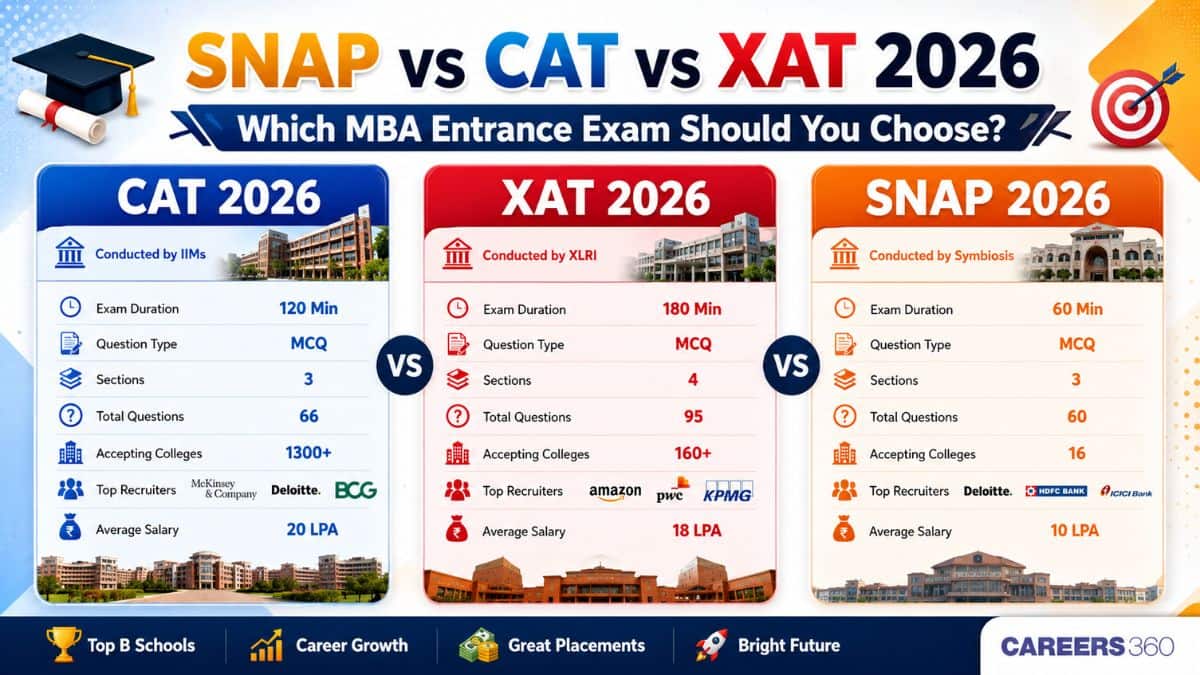
In this article, we have discussed the major differences between the three exams in terms of syllabus, preparation and even difficulty level.
SNAP vs XAT vs CAT: At a Glance
Particulars | CAT | XAT | SNAP |
Conducting Body | Indian Institutes of Management (IIMs) | XLRI Jamshedpur | Symbiosis International (Deemed University) |
Exam Frequency | Once a year | Once a year | Once a year (multiple test attempts allowed) |
Exam Duration | 120 minutes | 180 minutes | 60 minutes |
Number of Questions | 68 (may vary slightly) | Approximately 95 | 60 |
Sections | VARC, DILR, QA | Verbal & Logical Ability, Decision Making, Quantitative Ability & DI, General Knowledge | General English, Analytical & Logical Reasoning, Quantitative/DI/Data Sufficiency, Ethics, Morality and Values (New) |
Negative Marking | Yes | Yes | Yes |
Top Institutes Accepting Scores | IIMs, FMS Delhi, SPJIMR, MDI Gurgaon, IITs | XLRI, XIM University, IMT Ghaziabad, TAPMI, Great Lakes | SIBM Pune, SCMHRD, SIIB, SIBM Bengaluru, SIOM |
Exam Date | November 29, 2026 | January 03, 2026 | Yet to be announced |
SNAP 2026 Update: SNAP has added a fourth section, Ethics, Morality and Values, comprising 10 questions worth 10 marks. To accommodate this, question weightages in the General English and Analytical/Logical Reasoning sections have been redistributed. The exam continues to run for 60 minutes with 60 total questions.
XAT vs CAT vs SNAP: Key Differences
While CAT, XAT, and SNAP are all popular MBA entrance exams, they test candidates differently and open doors to different business schools. The table below highlights the major differences that matter while deciding which exam to take.
Comparison Factor | CAT | XAT | SNAP |
Primary Admission Target | IIMs and top B-schools like FMS, MDI, SPJIMR | XLRI and XAT-participating B-schools | Symbiosis International institutes |
Best Suited For | Students with strong conceptual understanding and problem-solving skills | Students with analytical thinking and decision-making ability | Students who can solve questions quickly under time pressure and are comfortable with values-based reasoning |
Most Challenging Aspect | High competition and percentile requirements | Decision Making section and longer exam | Limited time makes speed the biggest challenge; the new Ethics, Morality and Values section adds an untested variable |
Preparation Overlap | Shares most of its syllabus with XAT and SNAP | Similar to CAT but requires additional preparation for Decision Making and GK | Shares Quant, Reasoning, and English with CAT but demands more speed practice, plus new prep for Ethics, Morality and Values |
Ideal Preparation Duration | 8–12 months | 8–12 months (plus extra time for DM and GK) | 3–6 months if basics are already covered, with added time to build familiarity with the new Ethics section |
Mock Test Strategy | Focus on accuracy and sectional analysis | Practice full-length mocks with Decision Making | Take timed mocks to improve speed and question selection; since Ethics, Morality and Values has no prior-year papers, rely on general awareness and values-based reasoning practice |
Admission Preference | Best for candidates targeting a wide range of premier B-schools | Best for aspirants focused on XLRI and institutes accepting XAT scores | Best for candidates aiming exclusively for Symbiosis MBA programmes |
Who Should Prioritise It? | Aspirants aiming for the highest-ranked MBA colleges in India | Candidates comfortable with analytical and case-based questions | Candidates looking for a shorter exam with multiple test opportunities and comfort with ethics/values-based questions |
CAT vs XAT vs SNAP Comparison: Syllabus
Candidates can have a quick look at the table below to get a comparison between the syllabus of CAT, XAT and SNAP.
Section | CAT | XAT | SNAP |
English | Reading Comprehension, Para Jumbles, Para Summary, Odd One Out | Reading Comprehension, Critical Reasoning, Vocabulary, Grammar, Para Completion | Reading Comprehension, Grammar, Vocabulary, Synonyms & Antonyms, Idioms & Phrases, Sentence Correction |
Logical Reasoning | Included with DILR through sets and caselets | Logical Reasoning integrated with Verbal section | Separate section covering Coding-Decoding, Blood Relations, Directions, Series, Critical Reasoning, Seating Arrangement |
Data Interpretation | Dedicated DILR section with tables, charts and caselets | Combined with Quantitative Ability | Included with Quantitative Aptitude and Data Sufficiency |
Quantitative Aptitude | Arithmetic, Algebra, Geometry, Number System, Modern Maths | Arithmetic, Algebra, Geometry, Number System, Modern Maths (generally higher difficulty) | Arithmetic, Algebra, Geometry, Number System, Modern Maths (comparatively easier) |
Decision Making | Not Asked | Ethical dilemmas, business scenarios, managerial caselets | Not Asked |
General Knowledge | Not Asked | Current Affairs, Business, Economy, Static GK | Not Asked |
Ethics, Morality and Values | Not Asked | Not a separate section (embedded within Decision Making) | New dedicated section (10 questions, 10 marks): covers ethical reasoning, values, integrity, workplace and business morality |
Unique Focus | Reading comprehension and DILR-based analytical thinking | Decision Making, Critical Reasoning and GK | Grammar, Vocabulary, Speed-based Reasoning, Data Sufficiency, and now Ethics/Values-based reasoning |
Worth noting: While XAT has long tested ethical dilemmas and managerial scenarios within its Decision Making section, SNAP's new Ethics, Morality and Values section is a standalone, dedicated section — a first among CAT, XAT and SNAP in this exact format.
Which MBA Entrance Exam Is Easier?
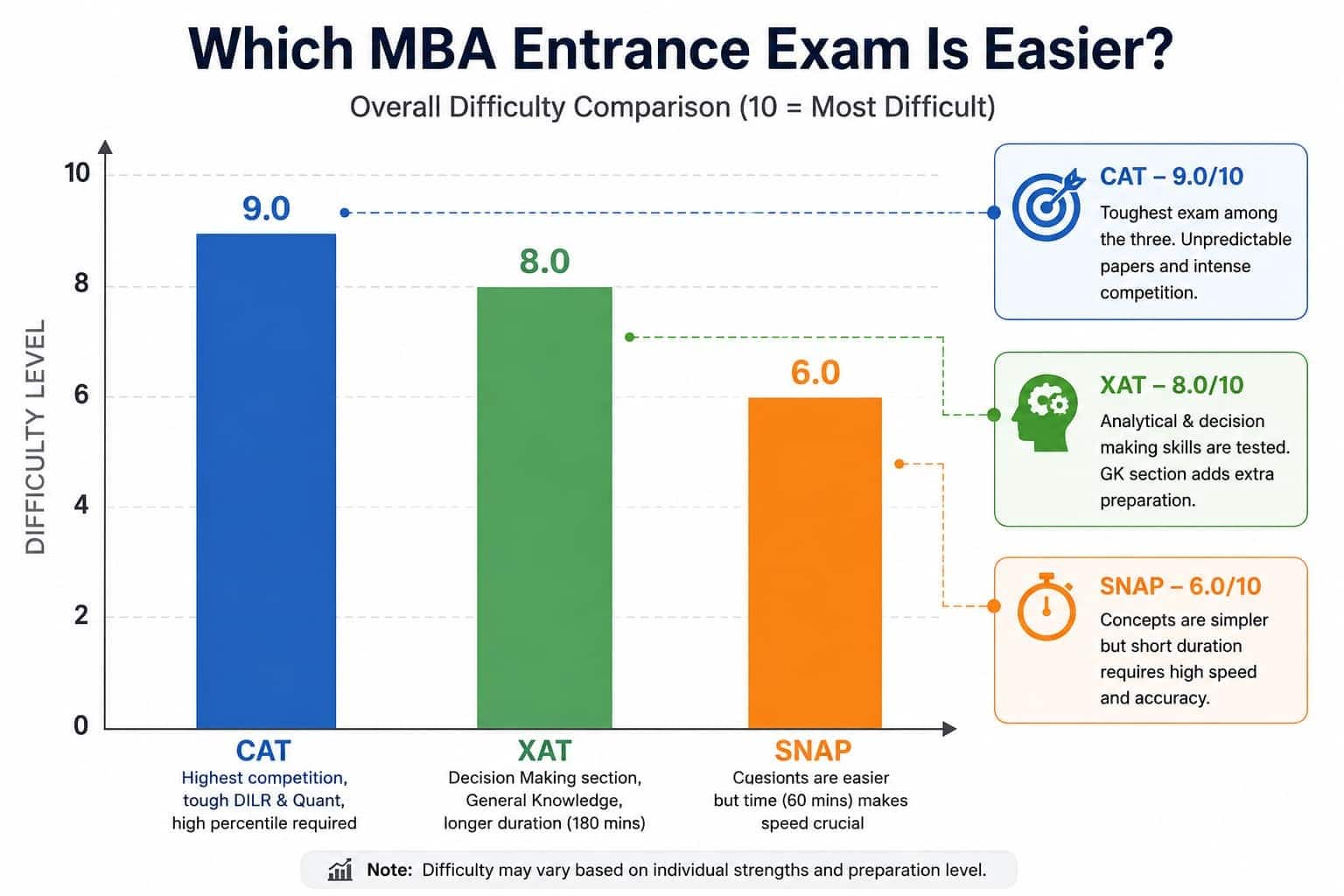
There is no single answer to which MBA entrance exam is the easiest because the level of difficulty depends on the exam pattern, question type, and competition level. CAT is generally considered the toughest due to its high competition and unpredictable question sets. XAT is slightly less competitive than CAT but becomes challenging because of its Decision Making section and General Knowledge. SNAP, meanwhile, has traditionally been seen as the most approachable of the three on conceptual difficulty, but the addition of the Ethics, Morality and Values section for 2026 introduces a new, untested variable that candidates should not overlook while preparing.
Here is a quick overview of the major differences between the three:
Also Read: Why CAT toppers struggle in the XAT?
Can You Prepare for CAT, XAT and SNAP Together?
Yes, you can, because these exams have overlapping syllabi. The key common subjects are Quantitative Aptitude, Logical Reasoning, Data Interpretation, and English. Candidates usually begin their exam preparation with the CAT exam to develop conceptual clarity. Later, they focus only on Decision Making and GK for the XAT exam. The syllabus of SNAP and CAT is similar, so preparation for the former largely requires practising with mock tests — though candidates should now also set aside time to build a working knowledge of ethics, values and moral reasoning for SNAP's newly added section, since it isn't covered by CAT or XAT preparation.
CAT vs XAT vs SNAP Comparison: Number of Attempts
Candidates can have a look at the total attempts for all three exams below.
Particular | CAT | XAT | SNAP |
Attempts Per Year | 1 | 1 | Up to 3 (subject to official notification) |
Best Score Considered | Single score | Single score | Best of all valid attempts is considered for merit ranking |
Flexibility | Low | Low | High |
Suitable For | Candidates confident in one attempt | Candidates targeting XLRI and XAT colleges | Candidates who want multiple opportunities to improve their score |
CAT vs XAT vs SNAP Comparison: Normalisation Factor
Here is a quick look at the normalisation factor applicable to the CAT, XAT, and SNAP exams.
Particular | CAT | XAT | SNAP |
Multiple Exam Slots | Yes (3 slots) | No | Yes (Multiple tests) |
Normalisation Applied | Yes | No | Yes |
Purpose of Normalisation | To adjust for differences in difficulty across slots | Not required as the exam is held in a single session | To ensure fairness across multiple SNAP attempts |
Conducting Body | IIMs | XLRI Jamshedpur | Symbiosis International (Deemed University) |
CAT vs XAT vs SNAP Comparison: ROI Factor
CAT leads the comparison as it provides access to the Indian Institutes of Management (IIMs) along with several other premier B-schools such as FMS Delhi, SPJIMR, MDI Gurgaon, and IIFT. These institutes consistently offer high average placement packages.
Parameter | CAT (Top IIMs) | XAT (XLRI) | SNAP (SIBM Pune) |
Approximate MBA Fees | ₹20–30 lakh | ₹25–32 lakh | ₹24–28 lakh |
Average Placement Package | ₹30–38 LPA | ₹29–32 LPA | ₹26–29 LPA |
Typical ROI | Excellent | Excellent | Very Good |
Best For | Highest long-term career growth and salary potential | Strong ROI with excellent industry reputation | Good ROI with comparatively lower competition than CAT |
CAT vs XAT vs SNAP Comparison: Top Colleges
Qualifying the CAT exam enables candidates to get admission to top IIMs and B-schools. XAT and SNAP have a more limited scope, and their scorecards are accepted by only some institutions.
Exam | Top MBA Colleges Accepting Scores | Approximate Intake |
CAT | IIM Ahmedabad, IIM Bangalore, IIM Calcutta, FMS Delhi, SPJIMR, MDI Gurgaon, IIT Bombay (SJMSOM), IIT Delhi (DMS), IIFT, IMI New Delhi and 1,300+ B-schools | 8,000+ IIM seats; 25,000+ seats across CAT-accepting institutes |
XAT | XLRI Jamshedpur, XIM University, IMT Ghaziabad, TAPMI, Great Lakes, FORE School of Management, GIM, LBSIM and 250+ institutes | 8,000+ seats across XAT-accepting institutes |
SNAP | SIBM Pune, SCMHRD Pune, SIIB, SIDTM, SIOM, SIBM Bengaluru, SIMS and other Symbiosis institutes | 2,500+ seats across Symbiosis institutes |
CAT vs XAT vs SNAP Comparison: Difficulty Level
The question paper alone does not determine the difficulty level of an MBA entrance examination. Instead, it is the competition level and percentile that determines the cut-off marks of these exams. Out of the three, CAT is considered the toughest due to its intense competition and high cut-off marks. XAT is known for analytical, decision-making-based questions, and SNAP has traditionally focused more on aptitude and speed — though the newly added Ethics, Morality and Values section is expected to make SNAP marginally more demanding in 2026 for candidates unfamiliar with values-based reasoning.
Comparison Factor | CAT | XAT | SNAP |
Top Colleges | 21 IIMs, FMS Delhi, SPJIMR, MDI Gurgaon, IITs, IMI, TAPMI and 1,300+ B-schools | XLRI Jamshedpur, XIM University, IMT Ghaziabad, Great Lakes, FORE School, GIM, LBSIM and 250+ institutes | SIBM Pune, SCMHRD Pune, SIIB, SIDTM, SIOM, SIBM Bengaluru and other Symbiosis institutes |
Competition Level | Highest (3.5–4 lakh+ applicants every year) | High (1.4–1.6 lakh+ applicants) | Moderate to High (80,000–1 lakh+ applicants) |
Quantitative Aptitude | Highest difficulty; lengthy calculations, mixed concepts and challenging DILR integration | Difficult; concept-driven with a greater focus on Algebra and Arithmetic | Moderate; calculation-intensive but comparatively straightforward questions |
VARC Difficulty | Reading Comprehension passages are lengthy and inference-based; para jumbles and summaries require strong comprehension | RC passages are longer and denser than CAT; vocabulary and Critical Reasoning increase difficulty | Comparatively easy; grammar, vocabulary and short RC passages dominate the section |
Logical Reasoning | Integrated with Data Interpretation through complex caselets and puzzle-based sets | Logical Reasoning plus Decision Making makes this section more analytical | Separate Logical Reasoning section with easier questions but high speed requirement |
Ethics, Morality and Values | Not applicable | Embedded within Decision Making, not a standalone section | New standalone section (10 marks); no prior-year papers available, adding an element of unpredictability |
Unique Challenge | Unpredictable DILR sets and extremely high percentile requirement | Exclusive Decision Making section and General Knowledge | Completing all questions within just 60 minutes, now including a brand-new Ethics, Morality and Values section |
Difficulty of Securing Top College | Very High due to limited IIM seats and 99+ percentile requirements | High because XLRI has limited seats and a competitive selection process | Moderate; admission depends mainly on SNAP score and GE-PI-WAT performance for Symbiosis institutes |
Typical Cut-off for Flagship Institutes | IIM Ahmedabad, Bangalore, Calcutta: 99–99.8+ percentile; FMS Delhi: 99+ percentile | XLRI BM/HRM: 95–96+ percentile (varies by programme and category) | SIBM Pune: 97–98.5+ percentile; SCMHRD: 95–97+ percentile |
GD/PI/Final Selection | Most institutes conduct PI; many IIMs have replaced GD with WAT + PI. Academics, work experience and diversity also carry significant weight | XLRI and most XAT colleges conduct Group Discussion/Group Exercise (or equivalent), Essay (where applicable), and Personal Interview | Symbiosis institutes conduct GE (Group Exercise), PI (Personal Interview), and WAT (Written Ability Test) after SNAP results |
Conclusion
Choosing between CAT, XAT, and SNAP depends on your MBA goals rather than the difficulty of the exam. If you are aiming for the widest range of top-ranked B-schools, CAT is the best choice, as its scores are accepted by 21 IIMs and more than 1,300 MBA colleges, including FMS Delhi, SPJIMR, MDI Gurgaon, and IIFT. It also offers the strongest return on investment, with top IIMs reporting average placement packages of ₹30–38 LPA.
Since nearly 75–80% of the CAT syllabus overlaps with XAT and SNAP, aspirants targeting multiple top MBA colleges should ideally prepare for CAT first. After this, they should supplement their preparation with Decision Making and GK for XAT, and mock tests plus focused reading on Ethics, Morality and Values for SNAP, to maximise their chances of admission — especially since SNAP's new 10-mark section has no previous-year pattern to lean on.
Frequently Asked Questions (FAQs)
Q: Which MBA entrance exam is the easiest among CAT, XAT, and SNAP?
A:
In terms of ease of questions, SNAP is considered to be on the lower end of the difficulty level. While, questions in CAT are unpredictable and GK and Decision Making section of XAT makes it tough.
Q: Can I prepare for CAT, XAT, and SNAP at the same time?
A:
Yes. Around 75-80% of the syllabus is the same. One can first prepare for CAT and then work on XAT's decision-making and general knowledge, and practice more for the SNAP.
Q: Which exam has the highest competition?
A:
CAT has the highest competition level as around 3.5 lakh candidates appear for it annually. However, XAT and SNAP have a low competition level, and its scorecard is also not accepted by every college.
Q: Which exam offers admission to the best MBA colleges?
A:
Almost every B School from IITs to IIMs accept the CAT scorecard. While XAT and SNAP offer admission to their respective parent colleges and others.
Q: Which MBA entrance exam should I take if I am weak in Quantitative Aptitude?
A:
SNAP is a better option because its Quant section is comparatively easier than CAT and XAT.
Articles
Related Stories
|
Upcoming Bschool Exams

Certifications By Top Providers
Explore Top Universities Across Globe
Popular Courses and Specializations
List of colleges accepting XAT
Browse Bschool Colleges by State
Questions related to XAT
On Question asked by student community
Have a question related to XAT ?
You can find all the information here:
CAT- https://bschool.careers360.com/articles/cat-exam-dates
SNAP- https://bschool.careers360.com/articles/snap-exam-dates
You can check the XIMB XAT Cutoff 2026 to determine the percentile for non-domicile female candidates.
The IRMA XAT 2026 cutoff is expected to be in the range of 55 to 60 percentile for ST category candidates. At an XAT score of 47 percentile, it is unlikely to get a PI call for the IRMA MBA admission 2026.
Assuming the candidate is from the general category with a decent academic profile, sectional scores, and work experience can get PI calls from XLRI, Jamshedpur, XIMB, GIM, Goa, SPJIMR, and more. You can refer to XAT college predictor for more information.

Study Resources, Applications and Opportunities
Globally Recognized by AACSB (US) & AMBA (UK) | 18 LPA Avg. CTC for PGPM 2026
XAT- Xavier Aptitude Test 2027
Apply75+ years of legacy | #1 Entrance Exam | Score accepted by 250+ BSchools
Career Launcher Race To 99%ile In CAT 2026 - Phase 03
Enquire6-Hour Masterclass to help you score 99+ percentile in CAT 2026
NMAT by GMAC 2026
ApplyTest centres are available in 70+ cities across India | 75,000+ aspirants apply for the NMAT exam | Accepted by 58+ institutions like NMIMS, KJSIM, ISB, SPJIMR and Great Lakes.
Common Admission Test 2026 (CAT 2026)
ApplyRegistration Start: 3 August 2026 | Last Date to Apply: 15 September 2026 (till 5 PM)
IBSAT 2026-ICFAI Business School MBA/PGPM 2027
ApplyAACSB Accredited | 40 LPA-Highest CTC | Scholarships worth 10 CR
XAT Notifications
Never miss XAT update
Get timely XAT updates directly to your inbox. Stay informed!