Great Lakes - PGDM & PGPM Admissions 2027
Globally Recognized by AACSB (US) & AMBA (UK) | 18 LPA Avg. CTC for PGPM 2026


If you ask most XAT aspirants which section decides their percentile, they'll say Quant or Verbal. They're wrong. The section that actually separates a 90 percentiler from a 99 percentiler is Decision Making (DM), the one section no other MBA entrance exam tests.
This Story also Contains

Quant rewards practice. Verbal rewards vocabulary and reading speed. But Decision Making rewards judgment, and judgment is much harder to fake on exam day. This is exactly why it becomes the tie-breaker between "good students" and "top rankers."
The Xavier Aptitude Test (XAT) is one of the important MBA entrance exams to get admission in top MBA colleges in India. With the exam notification out and the exam scheduled for January 3, 2027, candidates must understand the uniqueness of the Decision Making (DM) section of the XAT exam.
Must Read: Why XAT Feels Tougher Than CAT
The XAT exam pattern has four different sections divided into two parts. Each section tests different skills and abilities. The XAT exam is divided into two parts. Part one comprises VALR, DM, and QA&DI with a total time of 170 minutes. Part 2 has General Knowledge with a total time of 10 minutes.
Section | Important Topics | Number of Questions (Approx.) |
|---|---|---|
The VA&LR section will encompass critical & analytical reasoning, reading comprehension (including poems, cartoons & passages, etc.), vocabulary, English grammar, and other related exercises such as para jumbles, cloze tests, etc. | 26 | |
Decision Making (DM) | The DM section will present scenarios drawn from both personal and professional lives. Candidates will be required to apply critical thinking, problem-solving skills, and prioritization to make informed decisions. | 21 |
In this section, the questions are designed to assess the quantitative aptitude of candidates who possess a foundational understanding of arithmetic, algebra, geometry, mensuration, modern Maths, etc. The questions on DI are about clear interpretation, summarization, and insightful analysis of the data. | 28 | |
General Knowledge (GK) | In the GK section, 08 questions will focus on static GK, while the remaining 12 will delve into current affairs. | 20 |
Total | — | 95 |
The above table has been fetched from xatonline.in, which is the official XAT website. The exam is divided into two parts. Part 1 includes VALR, DM, and QA&DI. Part 2 comprises General Knowledge that needs to be completed in 10 minutes.
Must Download, XAT 2027: July GK Capsule
Every XAT aspirant has done multiple Quant problems and RC passages by the time they sit for the exam. That preparation is fairly standardised (as per the exam) across coaching institutes, and DM books are also available in the market. Decision Making is different - there's no fixed formula, no shortcut trick, and no way to "mug up" your way through it.
The section tests three things at once:
Analytical skills: Whether you can read a business situation and pull out the facts that matter.
Ethical judgment: Whether you can balance company interest with fairness to people involved.
Decision-making ability: Whether you can pick the most balanced option, not the most extreme one.
As it blends logic with judgment, two equally "smart" students can score very differently here. That's the gap top rankers exploit
Also Check: XAT 2027 Topic Wise Weightage Analysis
Based on XAT question papers (2024–2026), here's the structure aspirants should prepare for:
21 questions, spread across 6–7 case-lets
Each case-let consists of 3–4 questions built around one scenario
It comes under Part 1 of the exam, along with VA-LR and QA-DI
+1 mark for a correct answer, −0.25 for a wrong answer (GK has no negative marking)
No sectional time limit in PART 1 of the XAT exam. One can manage the time according to their time management strategy
The above pointers can be summarised as:
Feature | Details |
|---|---|
Total questions | 21 |
Number of case-lets | 6–7 |
Questions per case-let | 3–4 |
Marking (correct) | 1 |
Marking (wrong) | −0.25 |
Unattempted penalty | −0.10 beyond 8 free skips |
Section time limit | None (included in Part 1) |
Good attempt | 16–17 questions |
Decision Making section in the XAT exam usually has fewer questions compared to the VALR and QA &DI section; hence, aspirants underestimate this section. As very few candidates take it seriously, it is usually here that the largest percentile changes occur. Deep analysis, regular practice, and giving mock tests will help crack the XAT in the first attempt too.
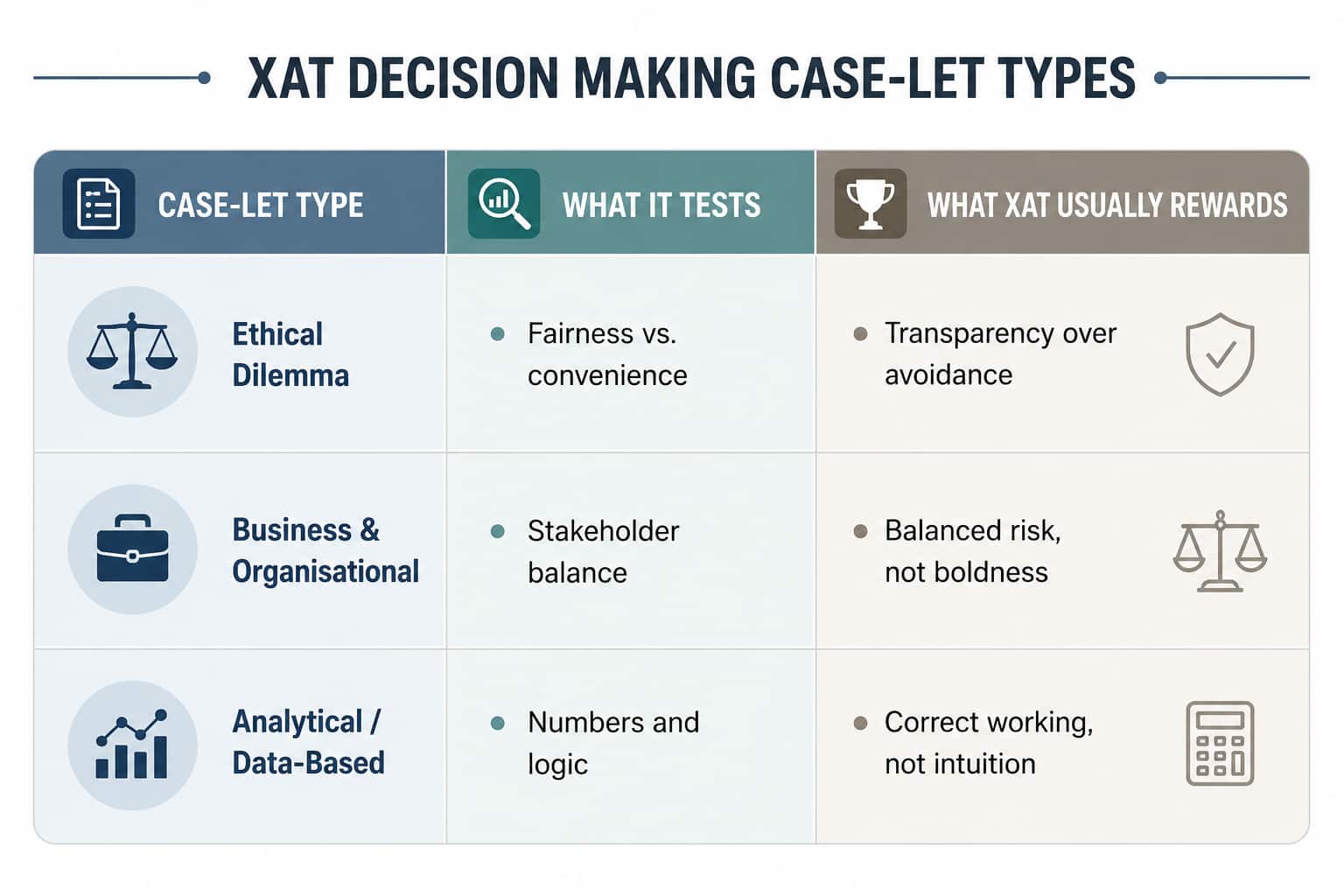
Looking at XAT Decision Making papers from the last few years, almost every case-let falls into one of three repeating patterns.
1. Ethical Dilemma Case-lets: In these, the "right thing to do" is at odds with the "convenient thing to do". One classic example: a manager finds out that one of his/her employees has been over-inflating sales figures to meet targets and must decide on reporting, giving a private warning, or overlooking it. XAT always favours the option that favours fairness and transparency over the option which favours arguments.
2. Business/Organisational Decision Case-lets: These evaluate your ability to reconcile the interests of stakeholders-an organisation deciding on whether to go for the introduction of a potentially risky new product or a business school considering a proposal made by two departments having competing interests. The trap here is choosing the "bold" option. XAT normally favours the one with the best risk-benefit balance.
3. Analytical /Data-based Case-lets: They are fewer in number but appear almost every year in the form of situations related to safety, sales target, resource allocation, etc., in which case you need to go through the numbers to make a sound judgment. These types behave more like Quant.
Practice XAT previous Year Questions to understand the question types asked. Practice them and enhance your decision-making skills.
Average students will go through the case and choose whatever option "seems right" to them. Top rankers adopt a systematic approach as follows:
Go through the case to know the facts of the matter, and not your assumptions or thoughts on it. Identify who is involved and what their interests are.
Identify the stakeholders. All the case-lets have stakeholders with conflicting interests, and you need to identify them before you consider any option.
Figure out the ideal solution. What would be the ideal solution of the case?
Ignore extreme options right away. Options involving firing anyone, ignoring the issue, or being extreme will be incorrect in all cases.
Choose the most balanced and realistic option and not the most assertive one.
It only takes a few seconds once you make this approach a habit. Once you have mastered this technique, you can ace the DM section in the XAT exam. Do not forget to take mock tests.
Based on previous year’s cut-off and percentile trends, attempting all 21 questions from the DM section is not required-it could even harm you with reduced accuracy. An overall good benchmark to have:
16-17 successful attempts with high accuracy is counted as a successful attempt.
13-15 right answers are enough to place you above the 90th percentile of this part.
Correct Answers (out of 21) | Approximate Percentile Band |
|---|---|
8–10 | 70–80th |
11–13 | 85–90th |
13–15 | 90–95th |
16+ | 95th and above |
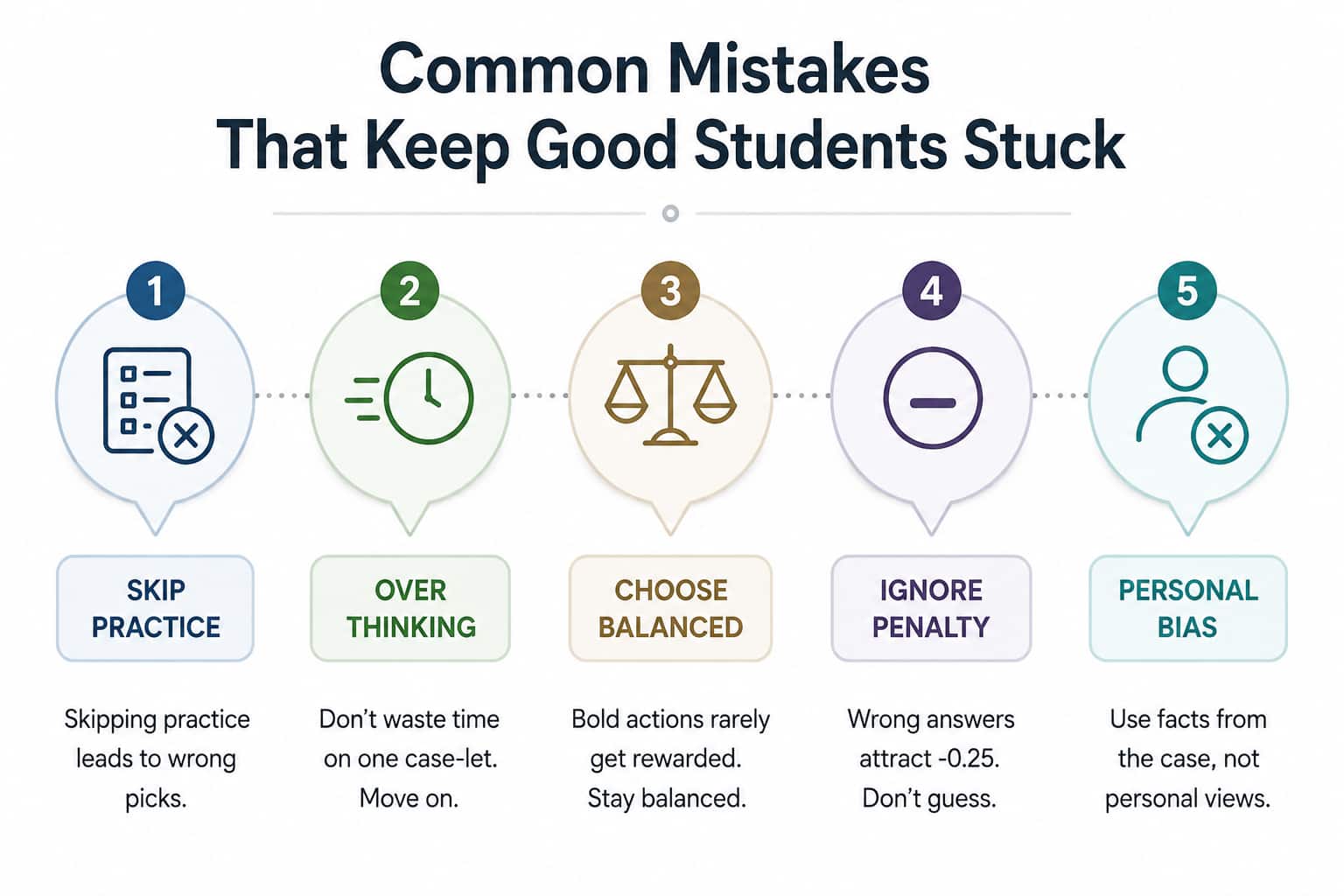
Treating DM as "common sense," so skipping practice entirely. Intuition without pattern-recognition from PYQs still leads to wrong picks. So analytical and judicious answer selection is advisable.
Overthinking and running out of time on one case-let. DM rewards pacing-mark and move on if a case-let isn't clicking. Don't waste time thinking about one question.
Choosing the "boldest" answer over the balanced one. XAT rarely rewards drastic action. One needs to follow a balanced approach while answering.
Ignoring negative marking. With −0.25 per wrong answer, guessing randomly on DM hurts more than skipping.
Bringing personal opinion into the answer. XAT wants a decision based on the facts given in the case, not what you'd personally do in real life. Avoid personal and emotional inputs.
A good score in Quant and Verbal would make sure that you get into the race. But in Decision Making, every PYQ teaches how XAT thinks. It would ensure how far you go in the race. Those students who see DM as a skill that can be developed by recognizing PYQ patterns and following a well-defined 5-step process would always make it to the top B-schools of India through the XAT 2027 exam.
If you're preparing for XAT 2027, start your Decision Making practice now, not in the last month. It's the one section where consistent practice still gives you an edge most of your competition won't have.
Frequently Asked Questions (FAQs)
Generally, 21 DM questions are asked in this section.
No. Decision Making along with VALR and QA&DI is in Part 1 of the XAT exam. Total time for this part is 170 minutes.
XAT DM is not tough but different from CAT LR. While CAT LR requires logical reasoning skills, XAT DM tests the ability of candidates to take ethical decisions and balance stakeholders.
One needs to solve around 16 to 17 questions in the XAT DM section, which depends on the difficulty level of that year’s exam. But accuracy matters much more than solving all the questions.

On Question asked by student community
You can find all the information here:
CAT- https://bschool.careers360.com/articles/cat-exam-dates
SNAP- https://bschool.careers360.com/articles/snap-exam-dates
You can check the XIMB XAT Cutoff 2026 to determine the percentile for non-domicile female candidates.
The IRMA XAT 2026 cutoff is expected to be in the range of 55 to 60 percentile for ST category candidates. At an XAT score of 47 percentile, it is unlikely to get a PI call for the IRMA MBA admission 2026.
Assuming the candidate is from the general category with a decent academic profile, sectional scores, and work experience can get PI calls from XLRI, Jamshedpur, XIMB, GIM, Goa, SPJIMR, and more. You can refer to XAT college predictor for more information.

Globally Recognized by AACSB (US) & AMBA (UK) | 18 LPA Avg. CTC for PGPM 2026
75+ years of legacy | #1 Entrance Exam | Score accepted by 250+ BSchools
6-Hour Masterclass to help you score 99+ percentile in CAT 2026
Test centres are available in 70+ cities across India | 75,000+ aspirants apply for the NMAT exam | Accepted by 58+ institutions like NMIMS, KJSIM, ISB, SPJIMR and Great Lakes.
Registration Start: 3 August 2026 | Last Date to Apply: 15 September 2026 (till 5 PM)
AACSB Accredited | 40 LPA-Highest CTC | Scholarships worth 10 CR