Great Lakes - PGDM & PGPM Admissions 2027
Globally Recognized by AACSB (US) & AMBA (UK) | 18 LPA Avg. CTC for PGPM 2026


Arithmetic, Data Interpretation, and Reading Comprehension were among the most tested areas in the XAT 2026 question paper, but if you look at the complete weightage analysis, there were a few other important trends too. While a couple of those more traditional, high-weightage topics stayed in the same lane, others were represented a bit less. So here’s a detailed XAT 2026 topic-wise weightage analysis to help you get a clearer view of which topics dominated the exam and also how you should prioritise your XAT preparation strategy.
This Story also Contains
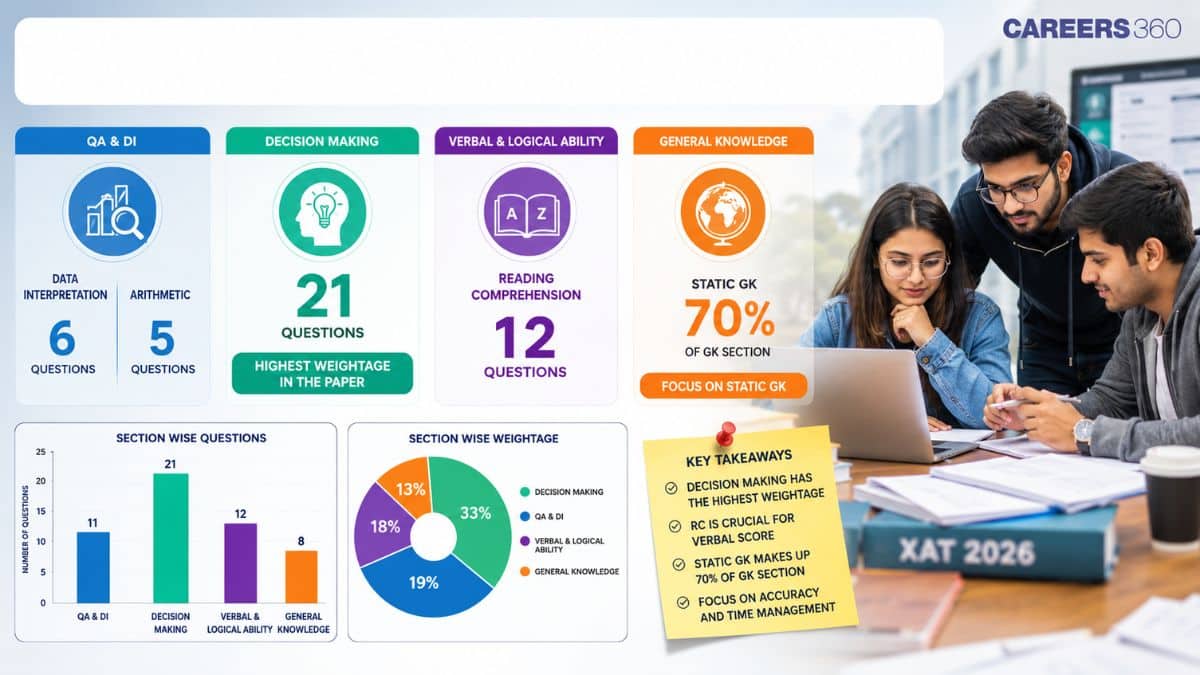
For a detailed breakdown, start evaluating with XAT 2026 Master Analysis PDF: Topic-wise Question Distribution
The XAT 2026 paper had 95 questions, spread out over four sections. In each part, they were checking a different skill set, from quantitative aptitude and decision making to verbal reasoning, plus general awareness too.
Section | Questions |
Quantitative Aptitude & Data Interpretation | 28 |
Decision Making | 21 |
Verbal & Logical Ability | 26 |
General Knowledge | 20 |
Total | 95 |
Overall, the distribution looked balanced, with quantitative aptitude, along with verbal ability, got the biggest chunk of questions, while decision-making remained the one differentiator of the XAT exam.
In the QA-DI section, there were seven big topics, and Data Interpretation with Arithmetic ended up getting the highest weightage.
Topic | Total Questions |
Arithmetic | 5 |
Geometry & Mensuration | 4 |
Number System | 3 |
Modern Math | 4 |
Algebra | 3 |
Trigonometry | 1 |
Data Interpretation | 6 |
Total | 28 |
Topic | Subtopic | Total |
Geometry | Circles & Circumference | 2 |
Geometry | Right Triangle / Area | 1 |
Geometry | Geometry Construction | 1 |
Arithmetic | 2 | |
Arithmetic | 2 | |
Arithmetic | 1 | |
Number System | 1 | |
Number System | Prime Factorization | 1 |
Number System | Prime Numbers | 1 |
Modern Math | Set Theory | 1 |
Modern Math | Probability | 1 |
Modern Math | Integer Solutions | 1 |
Modern Math | Permutations & Arrangements / Logic | 1 |
Algebra | 1 | |
Algebra | Functions & Recurrence | 1 |
Algebra | Algebraic Equations / Volume | 1 |
Trigonometry | Heights & Distances | 1 |
Data Interpretation | Sunburst Chart (Caselet) | 6 |
Topic | Questions | Weightage |
Data Interpretation | 6 | 21.4% |
Arithmetic | 5 | 17.9% |
Geometry & Mensuration | 4 | 14.3% |
Modern Math | 4 | 14.3% |
Number System | 3 | 10.7% |
Algebra | 3 | 10.7% |
Trigonometry | 1 | 3.6% |
Key Insights
In the QA-DI part, Data Interpretation somehow ended up with the top number of questions (6) among everything.
Arithmetic stayed the most important single Quant subject, with 5 questions.
Geometry, Modern Math, Algebra and Number System all got solid representation, like it shows broad syllabus coverage instead of leaning on only a couple of chapters.
The Decision Making section was made up of 21 questions, split evenly across seven business caselets.
Topic | Total Questions |
Business Decision Making | 3 |
Human Resource Management | 3 |
Ethics & Corporate Governance | 3 |
Operations & Resource Allocation | 3 |
Sales & Marketing | 3 |
Finance & Investment Decisions | 3 |
Public Policy & Social Decision Making | 3 |
Total | 21 |
Case | Theme | Questions |
Case 1 | Business Strategy & Management | 3 |
Case 2 | Human Resource Management | 3 |
Case 3 | Ethics & Corporate Governance | 3 |
Case 4 | Operations & Resource Planning | 3 |
Case 5 | Sales, Customers & Marketing | 3 |
Case 6 | Financial Decision Making | 3 |
Case 7 | Public Administration & Social Issues | 3 |
Theme | Questions | Weightage |
Business Strategy | 3 | 14.3% |
Human Resource Management | 3 | 14.3% |
Ethics & Corporate Governance | 3 | 14.3% |
Operations Management | 3 | 14.3% |
Sales & Marketing | 3 | 14.3% |
Finance | 3 | 14.3% |
Public Policy & Social Issues | 3 | 14.3% |
Unlike a few earlier years when certain themes took over, XAT 2026 stayed balanced in every managerial domain. So this hints that candidates should gear up for a mixture of business circumstances, rather than only zeroing in on ethics or corporate governance.
In the VALR section, reading comprehension kept dominating; then critical reasoning came right after.
Topic | Total Questions |
Reading Comprehension | 12 |
Critical Reasoning | 5 |
Para Jumbles | 3 |
Vocabulary | 3 |
Grammar & Usage | 3 |
Total | 26 |
Passage | Questions |
RC 1 | 4 |
RC 2 | 4 |
RC 3 | 4 |
Total | 12 |
Subtopic | Total |
Critical Reasoning | 5 |
Para Jumbles | 3 |
Vocabulary | 3 |
Grammar & Usage | 3 |
Topic | Questions | Weightage |
Reading Comprehension | 12 | 46.2% |
Critical Reasoning | 5 | 19.2% |
Para Jumbles | 3 | 11.5% |
Vocabulary | 3 | 11.5% |
Grammar & Usage | 3 | 11.5% |
Nearly 46% of the section was dedicated to Reading Comprehension, making it the most important verbal topic. But then, the rest of the questions were spread out in a fairly equal way across reasoning and the language-based topics, so this reinforced that you need balanced preparation.
In General Knowledge, there was more focus on Static GK than on Current Affairs.
Topic | Total Questions |
Current Affairs | 6 |
Economy & Business | 3 |
History | 2 |
Geography | 2 |
Science & Technology | 2 |
Polity & Government | 2 |
Sports | 1 |
Awards, Books & Personalities | 2 |
Total | 20 |
Subtopic | Total |
Current Affairs | 6 |
Economy & Finance | 3 |
Indian History | 1 |
World History | 1 |
Indian Geography | 1 |
World Geography | 1 |
Science & Technology | 2 |
Indian Polity | 2 |
Sports | 1 |
Awards & Honours | 1 |
Books / Personalities | 1 |
Category | Questions | Weightage |
Current Affairs | 6 | 30% |
Static GK | 14 | 70% |
Static GK contributed around 70% of the whole section; questions were spread all over history, geography,y economy, political science and some other domains too.
Data Interpretation showed up as the highest weighted theme in QA-DI, while Arithmetic stayed the most dominant part within Quant overall.
Reading Comprehension covered almost half of the VALR segment
Decision Making kept an even say-equal weightage across seven distinct business themes.
Static GK was way more than Current Affairs, like a clear advantage there.
In the end, the paper leaned on concepts from across the entire syllabus, so full preparation matters a lot more than only picking a few topics or being selective.
The XAT 2026 topic-wise weightage analysis shows that the exam keeps rewarding candidates who have a strong conceptual hold across all the sections. In a way, yes, high-weightage topics like Arithmetic, Data Interpretation, Reading Comprehension and Decision Making definitely need more focus, but aspirants shouldn’t completely ignore the lower-weightage areas. A balanced preparation plan, considering the latest XAT section-wise weightage, is the most sensible way to score well in the exam.
Frequently Asked Questions (FAQs)
Data Interpretation seemed to carry the most weight in the QA-DI section; it had 6 questions, and then Arithmetic was next with 5 questions.
In XAT 2026, the Decision-Making part came with 21 questions, which were split into 7 caselets, and each caselet had three questions.
Reading Comprehension turned out to be the major chunk; it contributed 12 out of the 26 questions in the VALR section.
Yes, probably. Static GK had 14 questions, whereas Current Affairs had 6 questions, so Static GK clearly had the higher weightage.
Looking at the XAT 2026 paper, aspirants should prioritise Arithmetic, Data Interpretation, Geometry, Modern Math, Algebra, and Number System, but don’t treat it like a shortcut; make sure you don’t skip full syllabus coverage or end up leaving out anything important.

On Question asked by student community
You can find all the information here:
CAT- https://bschool.careers360.com/articles/cat-exam-dates
SNAP- https://bschool.careers360.com/articles/snap-exam-dates
You can check the XIMB XAT Cutoff 2026 to determine the percentile for non-domicile female candidates.
The IRMA XAT 2026 cutoff is expected to be in the range of 55 to 60 percentile for ST category candidates. At an XAT score of 47 percentile, it is unlikely to get a PI call for the IRMA MBA admission 2026.
Assuming the candidate is from the general category with a decent academic profile, sectional scores, and work experience can get PI calls from XLRI, Jamshedpur, XIMB, GIM, Goa, SPJIMR, and more. You can refer to XAT college predictor for more information.

Globally Recognized by AACSB (US) & AMBA (UK) | 18 LPA Avg. CTC for PGPM 2026
75+ years of legacy | #1 Entrance Exam | Score accepted by 250+ BSchools
6-Hour Masterclass to help you score 99+ percentile in CAT 2026
Test centres are available in 70+ cities across India | 75,000+ aspirants apply for the NMAT exam | Accepted by 58+ institutions like NMIMS, KJSIM, ISB, SPJIMR and Great Lakes.
Registration Start: 3 August 2026 | Last Date to Apply: 15 September 2026 (till 5 PM)
AACSB Accredited | 40 LPA-Highest CTC | Scholarships worth 10 CR