Great Lakes - PGDM & PGPM Admissions 2027
Globally Recognized by AACSB (US) & AMBA (UK) | 18 LPA Avg. CTC for PGPM 2026


The XAT General Knowledge section can feel hard to guess because the questions might be drawn from current affairs, business, economics, science, history, awards, sports, and a few other things too. The XAT exam is scheduled for January 03, 2027, so candidates will need a selective preparation style, not just memorising everything and anything that comes up in the news. Once you understand the GK syllabus and you also notice which areas keep coming back, you can get a better hold on the way questions show up; then, with consistent practice of sample questions, it starts becoming simpler to decide what to prioritize for your preparation.
This Story also Contains
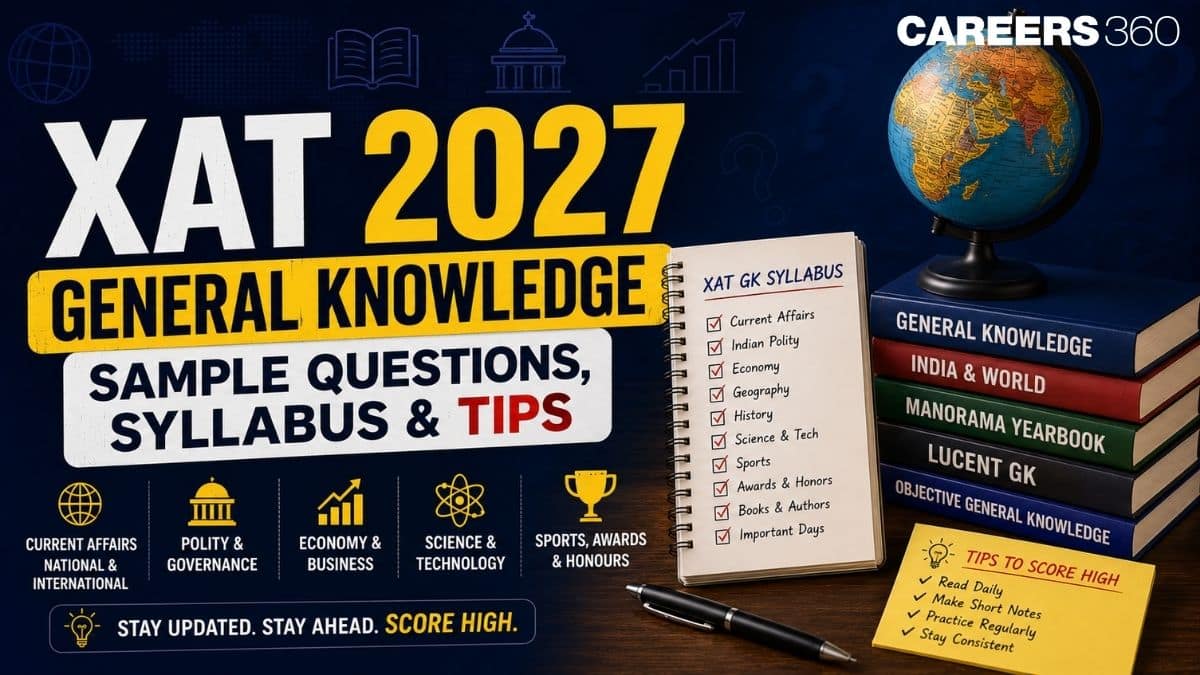
The XAT 2027 GK section will carry 20 questions, making it one of the highest-weight sections in terms of question count. Although GK scores are not included in the overall percentile, they play a crucial role during the PI stage. The section usually includes a mix of current affairs (12 questions) and static GK (8 questions) covering history, geography, science, business, and global events. A strong GK performance helps candidates stand out during interviews and final selection rounds.
Also check the year wise XAT General Knowledge question weightage asked over the years below.
|
Year |
Number of Questions |
| 2026 | 20 |
|
2025 |
20 |
|
2024 |
25 |
|
2023 |
25 |
|
2022 |
25 |
|
2021 |
25 |
|
2020 |
25 |
Every year in the XAT exam, 25 questions feature from the GK section. But from XAT 2025, the number of questions has reduced to 20 from 25. This includes 8 questions from static GK and 12 from current affairs. While the XAT GK section would not be considered for the overall XAT marking, it plays a significant role during further selection rounds for the candidate. Hence, overlooking the GK section during the candidate's XAT preparation can be fatal.
Also Read: XAT Question Paper with Answer
The General Knowledge syllabus for XAT 2027 covers detailed information regarding important topics designed to assess candidates' overall awareness and knowledge. The syllabus covers traditional subjects, such as history and geography, alongside contemporary issues and recent events. Candidates must prepare across multiple domains to perform well in this comprehensive knowledge assessment.
General knowledge topics can be divided into two parts.
Static GK
Current Affairs
These topics remain constant across years but require a deep understanding:
History & Civilization – Ancient to modern history, cultural developments, independence movements
Geography – Physical geography, rivers, climate zones, population distribution
Indian Economy – Key reforms, taxation, GDP trends, sectors of growth
Science & Technology – Innovations, health, environment, and energy developments
Awards, Sports & Organizations – Nobel Prize, Olympic events, global agencies
|
Subject |
Key Areas of Focus |
|
History |
Important global events, Indian national movements, freedom fighters, Mughal, Sultanate, and Slave dynasties. |
|
Geography |
Rivers, oceans, cities on their banks, deserts, mountains, capitals, currencies, and flags of various countries. |
|
Science |
Topics in physics, chemistry, and biology; discoveries, inventions, chemical reactions, plants, and animals. |
|
Polity |
Indian constitution, its articles and amendments, government bodies, and their functions. |
|
Economics |
Banks and monetary policies, key economic terms, and their definitions. |
|
Organizations |
WTO, NATO, UN, BRICS, SAARC, their members, and headquarters. |
|
Awards |
Nobel Prize, Oscar, Bharat Ratna, Padma Shri, Dadasaheb Phalke Award, Emmys, and other prestigious honors. |
|
Sports |
Famous athletes, unique achievements, sports records, notable "firsts," and recent events in sports. |
|
Books |
Renowned books and their authors. |
|
Folk Dances and Festivals |
Names of folk dances and festivals of various Indian states. |
Current topics from 2024–26 form a major part of the paper:
International summits like G20, COP29, and trade agreements
Scientific breakthroughs such as vaccine developments and AI applications
Climate change initiatives and global environmental policies
Economic changes, digital currency trends, and major industry shifts
Global health alerts and disease outbreaks
Important summits and conferences (2023-24)
Olympics, the Last FIFA World Cup, the Cricket World Cup, and other major sports tournaments from 2023-24
Important appointments like Indian ambassadors in different countries and various brand ambassadors
Recent global disasters, environmental issues and international conflicts
Publication of recent books by famous personalities
Recent deaths between 2023-24 of famous persons and their working field
Sports milestones and recognitions
Reviewing GK for XAT 2027 current events regularly helps you stay updated and confident.
The General Knowledge (GK) section in XAT 2027 checks a candidate’s awareness of current events and static facts rather than calculation skills. Though GK marks are not counted in the final percentile, they play an important role during the interview stage. A smart, selective approach helps candidates attempt this section confidently without wasting valuable time.
Give priority to national and international events from the last 12–18 months. Topics like economy, government schemes, global issues, business news, and major appointments are frequently asked. Daily newspaper reading and monthly current affairs capsules are enough if revised properly.
Static GK questions usually come from areas like Indian polity, geography, history basics, important organizations, and awards. Do not try to cover everything. Prepare commonly repeated themes such as countries–capitals, currencies, books–authors, and important days.
XAT GK may have negative marking in some years. Attempt questions only when you are reasonably sure of the answer. Random guessing can reduce your overall score and affect confidence during the paper.
Many GK questions can be solved by eliminating incorrect options. Use logic, basic awareness, and contextual clues to narrow down choices, especially when you are unsure of the exact answer.
Do not spend more than a few seconds on any GK question. Attempt easy and familiar questions first and skip difficult ones. Since GK does not affect the percentile, it should never disturb your performance in core sections.
2023-24 papers: Focused more on static GK and fact recall.
2025 paper: Included analytical reasoning based on current events.
2027 paper: Expected to have a balanced approach with more scenario-based questions and updated current affairs from 2024–26.
Number of questions may slightly increase, but total time will remain limited.
Analytical ability and decision-making under pressure are now emphasized.
Reviewing past papers and XAT 2027 GK questions static + current affairs helps you adapt to these changes.
Daily Reading: Dedicate 30–45 minutes daily to reading news summaries and fact-based reports.
Note-Making: Maintain a notebook with key events from 2024–26, separated by topic.
Mock Practice: Solve at least two GK quizzes weekly to improve speed and accuracy. XAT 2027 Mock test practice helps in boosting the preparation.
Group Discussions: Engage with peers to discuss current affairs and exchange perspectives.
Revision Cycle: Revise frequently, especially before mock tests, to ensure retention.
Focus Areas: Prioritize high-weightage topics like economy, governance, and environment.
Time Management: Practice under timed conditions to simulate the actual test environment.
Preparing for the Static GK part is easier than the current affairs section. Static GK covers history, geography, science, economics, and politics. Before studying objective-type questions, read subjective books on these topics. After building the basic foundation for these topics, try objective-type questions.
Some of the objective-type XAT GK questions and answers books are:
Lucent’s GK book
Arihant’s GK book
To follow current affairs, read daily newspapers like The Hindu, Times of India, and The Indian Express. Follow journals and monthly magazines like the Manorama yearbook. You can also check online about the important events around the world. Some top sites to follow current events are GKToday, AffairsCloud, and Jagran Josh. Note the events that you think are important to memorize later. To sum up, referring to highly esteemed XAT preparation books is essential for XAT success. Apart from the famous books, you should also refer to the preparation tips shared by the toppers.
| Category | Book | Description |
|---|---|---|
| Static GK | Lucent’s General Knowledge | Covers history, geography, economy, polity, and awards with concise facts for quick revision |
| Manohar Pandey’s General Knowledge | Detailed explanations and practice questions aligned with competitive exams | |
| NCERT Books | Strong foundational knowledge in history, geography, and economics for static GK | |
| Current Affairs | Pratiyogita Darpan (Monthly) | Updated reports on government schemes, global events, and policy changes |
| The Hindu / Indian Express (Daily Newspaper) | Reliable news for daily gk for xat 2027 current events, editorials, and analyses |
Good knowledge and performance in the General Awareness section in the XAT exam increase your chances of being admitted to the top B-schools like XLRI.
General knowledge and General awareness are both almost the same terms used interchangeably.
General knowledge focuses mainly on the static GK parts, where facts can not be changed. But using the General awareness term, we focus mostly on current events like events of national and international importance, economy, environment, sports, etc, and some of the static GK.
In the XAT exam 2027, static GK and current affairs hold the same importance.
Some of the common mistakes students make in the GK section are:
Focusing too much on the static GK part and neglecting the current affairs. Preparing for both is essential to achieve high marks in the exam.
Students often do not read regular newspapers. Daily newspapers keep us updated with national and international events.
Lack of attempting mock tests in the GK part often plays a dividend role during the preparation. Mock tests are set as per the exam’s syllabus, covering diverse topics. Attempting those will help you to learn new things as well as identify the areas in which you need more practice.
Students often ignore the mock test results. After checking the mock test number, most of the students do not check the correct answers to the wrongly attempted questions. Make a note of new questions that you learn during those tests.
Time management skills are very important in the XAT exam. Here are some tips to manage time while answering the GK section in the XAT exam.
As we know, the GK section of the XAT exam has no negative marking, so allot 10-15 minutes in the end to do this section.
Do not overthink easier questions. Trust your instinct and answer the next question.
Attempt the ones that are familiar to you first to boost your confidence level. Then try those questions that you are unsure of. This can be very essential for you to score better in your first XAT attempt.
Eliminate the incorrect options and make an educated guess to solve those questions.
Do not spend too much time on one question; move on to the next and return later.
At the end of the exam, if there is time left, then take a revision and check if all the answers you gave in the GK section look correct to you.
At the beginning of the preparation, go through the previous year's sample paper and check the answer keys. It will help you to understand the important topics, the difficulty level of the questions, and answer techniques.
Some of the questions asked in the previous XAT exams are:
Q1. Which of the following Indian states does the River Ganges not flow through?
Bihar
Jharkhand
Uttar Pradesh
Haryana (Correct answer)
Uttarakhand
Q2. Which of the following years is NOT a leap year?
1900 (Correct answer)
2000
1924
1896
2024
Q3. What is X-37B?
The U.S. military plane that has gone into space. (Correct answer)
The name of India's Jupiter mission.
The new electric vehicle is to be launched by Tesla.
The name of the youngest kid of Elon Musk.
None of the above.
Q4. What is the common terminology used to describe the following applications: ChatGPT, Google Bard, and Chatsonic?
News Aggregators
Dating Tools
Generative AI Tools (Correct answer)
UPI Applications
Gaming Applications
Q5. Which rocket was used to launch Aditya-L1?
LVM3 -M4
GSLV-F12
PSLV-C57 (Correct answer)
NGLV
TERLS
Name the largest freshwater lake in India.
Answer: Wular Lake
Who is the first Indian to get the Nobel Prize, and in which category?
Answer: Rabindranath Tagore in 1913 for "Geetanjali"
What is the currency of Japan?
Answer: Yen
Which indigenous computational software was developed by ISRO's Vikram Sarabhai Space Centre (VSSC) for computational fluid dynamics (CFD)?
Answer: PraVaHa (Parallel RANS Solver for Aerospace Vehicle Aero-thermo-dynamic Analysis)
Which countries became the newest members of BRICS in 2024?
Answer: Egypt, Ethiopia, Iran, and the United Arab Emirates
Credit cards are known as:
Answer: Plastic money
Which film won the Best Picture award at the 96th Oscar ceremony?
Answer: Oppenheimer
What is "Bachpan Bachao Andolan"?
Answer: A movement in India protecting the rights of children.
Who has been declared the new Chief Minister of Assam?
Answer: Sarbananda Sonowal
The 'Bandipur National Park', established in 1974 as a tiger reserve under Project Tiger, is located in the Indian state of _______
Answer: Karnataka
Practice some XAT 2027 General Knowledge sample questions with solutions and review them. It will enhance your answering techniques. Additionally, you will gain insight into important topics and the difficulty level of the questions.
Here are some important questions with solutions that have come in recent years.
Q1. Malfunction of which of the following organs is the MOST common cause of vertigo?
Heart
Kidney
Stomach
Lung
Ear
Q2. Which Indian state enjoys special provisions under Article 371(D)?
Jharkhand
Meghalaya
Tripura
Andhra Pradesh
Arunachal Pradesh
Q3. In which Indian state is Sriharikota located?
Tamil Nadu
Andhra Pradesh
Odisha
Kerala
Telangana
Q4. Which is the largest landlocked saltwater lake in India?
Chilika Lake
Chital Lake
Vembanad Lake
Pulicat Lake
Sambhar Lake
Q5. Which of the following rivers does not cross international borders?
Tapi
Ravi
Brahmaputra
Ganga
Teesta
Q6. What is a grey market?
The trade of a commodity for which the country of origin is not mentioned
The trade of a commodity through distribution channels not authorised by the manufacturer
The trade of a commodity that is recognised as a counterfeit product
The trade of a commodity for which the taxes are evaded
The trade of a commodity that is unbranded
Q7. Who is the first Field Marshal of independent India?
A.S. Vaidya
Bipin Rawat
KM Cariappa
Krishnaswamy Sundarji
Sam Manekshaw
Q8. From the following options, choose the one that arranges the given queen's ascension to the throne in chronological order.
Razia Sultana, Ahilyabai Holkar, Durgavati, Lakshmi Bai, Rudrama Devi
Ahilyabai Holkar, Durgavati, Razia Sultana, Rudrama Devi, Lakshmi Bai
Razia Sultana, Rudrama Devi, Durgavati, Ahilyabai Holkar, Lakshmi Bai
Rudrama Devi, Razia Sultana, Durgavati, Lakshmi Bai, Ahilyabai Holkar
Razia Sultana, Rudrama Devi, Ahilyabai Holkar, Durgavati, Lakshmi Bai
Q9. Omuamua is:
A character in the TV series "Star Trek"
A Buddhist chant
An interstellar object
A small primate
NASA's spaceship to Pluto
Q10. Which Indian state has different capitals in summer and winter?
Gujarat
Mizoram
Maharashtra
Uttarakhand
Sikkim
After solving the XAT 2027 exam sample GK questions, review the answer key thoroughly and note the areas from which the questions are coming more frequently. Also, try to identify the area where you are making the most mistakes and revise those chapters urgently. These will help you to increase your accuracy.
Here are the answer keys to the above questions.
Q1. Option E: Ear
Q2. Option D: Andhra Pradesh
Q3. Option B: Andhra Pradesh
Q4. Option E: Sambhar Lake
Q5. Option A: Tapi
Q6. Option B: The trade of a commodity through distribution channels not authorised by the manufacturer
Q7. Option E: Sam Manekshaw
Q8. Option C: Razia Sultana, Rudrama Devi, Durgavati, Ahilyabai Holkar, Lakshmi Bai
Q9. Option C: An interstellar object
Q10. Option C: Maharashtra
Regular practice of XAT GK sample papers will enhance your knowledge and improve your answer techniques.
Step 1: Separate current affairs and static GK before you start
While attempting the sample paper, first identify which questions are from current affairs and which are static. This helps you judge whether your weakness lies in news-based topics or core GK areas like history, economy, or science.
Step 2: Attempt questions in one pass without overthinking
XAT GK questions are fact-based. Answer what you clearly know and avoid second-guessing. Mark doubtful questions for review instead of spending extra time on recall.
Step 3: Track topic-wise accuracy, not just score
After solving, note how many questions you got right in areas like business, global events, awards, or static subjects. This gives better insight than total marks.
Step 4: Create a revision list for XAT GK Section
For every mistake, write one crisp fact or concept. This turns each sample paper into a focused revision tool.
Step 5: Compare patterns across multiple sample papers
Analyse repeated topics or question types appearing across papers. These patterns often reflect high-probability GK areas for XAT 2027.
Frequently Asked Questions (FAQs)
Candidates should practice previous year questions, read newspapers daily, revise monthly current affairs, and focus on commonly repeated static GK topics
In most XAT exams, GK questions may carry negative marking. Candidates should avoid blind guessing and attempt only confident questions.
No. GK marks are not included in percentile calculation. However, they are considered during the interview and final selection stages.
No. XAT GK has a mix of current affairs and static GK. Static areas like geography, history basics, and important days are also asked.
XAT GK questions include current affairs and static GK. Topics cover national and international events, economy, business, awards, sports, books, and important organisations.
You can expect a mix of XAT 2026 GK questions static + current affairs, covering topics like economy, governance, science, climate change, awards, and sports. Recent developments from GK for XAT 2026 current events (2024–26) will be especially important.
Focus about 60% on current affairs and 40% on static GK. Both are essential since XAT 2027 GK questions static + current affairs require a balanced approach.
Make a routine at the beginning of the preparation period and allocate 30 minutes to 1 hour for each subject each day. Give mock tests every alternate day and review the questions and answers.
Read daily newspapers and monthly magazines to stay updated on the current affairs section.
No. There is no negative marking in the XAT GK section. Students can attempt all the questions in this section without having the fear of negative marks.

On Question asked by student community
Hello Student, exam-centre availability can change depending on the live slots shown during the XAT application process. I would suggest checking Chikkaballapura directly in the test-city selection before completing the application. If the city is not appearing, it may mean that the centre is unavailable or not offered for that
You can find all the information here:
CAT- https://bschool.careers360.com/articles/cat-exam-dates
SNAP- https://bschool.careers360.com/articles/snap-exam-dates
You can check the XIMB XAT Cutoff 2026 to determine the percentile for non-domicile female candidates.
The IRMA XAT 2026 cutoff is expected to be in the range of 55 to 60 percentile for ST category candidates. At an XAT score of 47 percentile, it is unlikely to get a PI call for the IRMA MBA admission 2026.

Globally Recognized by AACSB (US) & AMBA (UK) | 18 LPA Avg. CTC for PGPM 2026
75+ years of legacy | #1 Entrance Exam | Score accepted by 250+ BSchools
6-Hour Masterclass to help you score 99+ percentile in CAT 2026
400+ Recruiters | Highest CTC 25 LPA | Average CTC 8 LPA | 92% Placements in 2025 | Ranked as Platinum Institute | Awarded Best Business School of the Year
1 Exam accepted by 17 Top Symbiosis Institutes for 29 MBA programmes.
Among top 6% B-Schools globally to be accredited by AACSB | Highest Package-35 LPA