XAT- Xavier Aptitude Test 2027
75+ years of legacy | #1 Entrance Exam | Score accepted by 250+ BSchools


Choosing the best books for XAT 2027 preparation can make your study plan more structured and effective. Since the Xavier Aptitude Test (XAT) tests candidates across Verbal Ability & Logical Reasoning, Decision Making, Quantitative Ability & Data Interpretation, and General Knowledge, relying on the right study resources is essential for building conceptual clarity and improving problem-solving skills. A good combination of concept books, practice material, mock tests, and previous year question papers can help candidates prepare efficiently and perform confidently on the exam day. In this article, we have compiled a list of the best books for XAT 2027 preparation, including section-wise recommendations, books suitable for beginners and advanced learners, expert-recommended study material, previous year question paper books, and mock test resources. You will also find practical tips on selecting the right books based on your preparation level and strategy for XAT 2027.
This Story also Contains
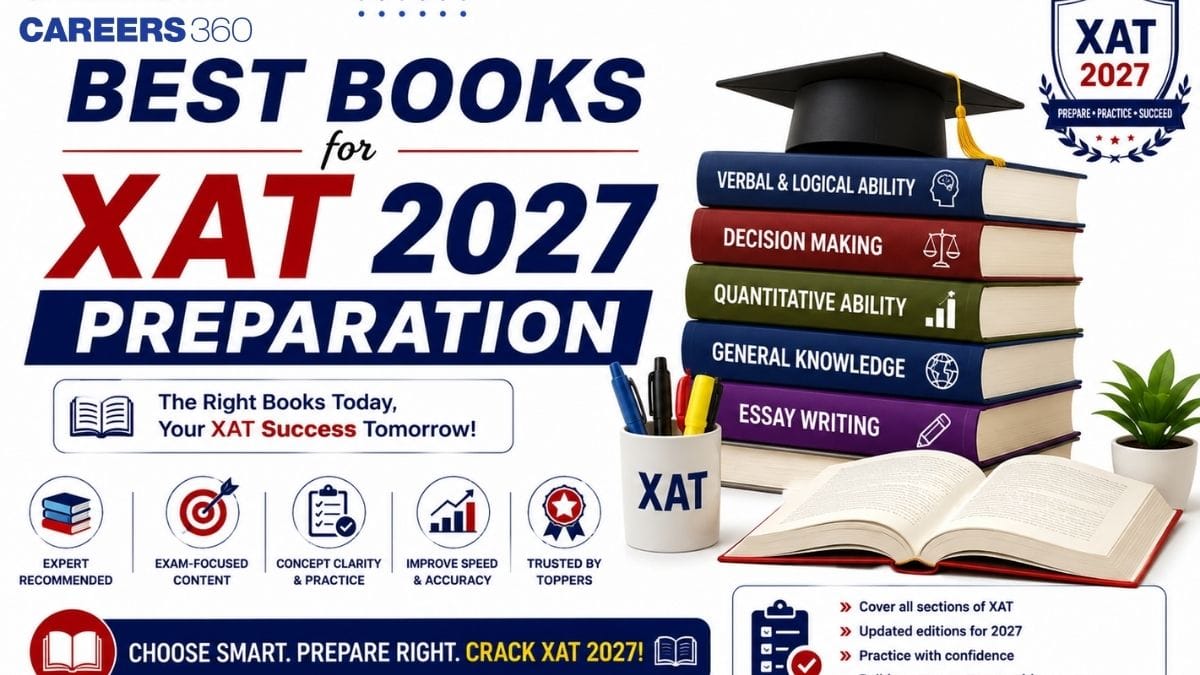
Selecting the best books for XAT 2027 preparation is the foundation of an effective study plan. Since XAT assesses candidates across multiple sections with varying levels of difficulty, using the right study material helps build conceptual clarity, strengthen problem-solving skills, and improve exam readiness. Instead of referring to numerous resources, candidates should choose a few reliable books that comprehensively cover the syllabus and provide sufficient practice questions.
Quality study material enables candidates to learn concepts systematically and practise questions of different difficulty levels. It also helps develop speed, accuracy, and confidence before the examination.
Some benefits of using the right books include:
Build strong conceptual fundamentals.
Understand section-wise topics in detail.
Practise a variety of question types.
Improve problem-solving speed.
Strengthen exam-taking confidence.
Prepare according to the latest XAT pattern.
Not every preparation book is suitable for every candidate. Before selecting a book, consider the following factors to ensure it matches your preparation needs.
Choose books that:
Cover the latest XAT syllabus.
Explain concepts in a simple and structured manner.
Include sufficient practice questions.
Provide detailed solutions and explanations.
Contain previous year questions or similar practice sets.
Are suitable for your current preparation level.
Candidates should avoid purchasing too many books. Completing and revising a few high-quality resources is generally more effective than studying from multiple sources.
Before selecting preparation books, candidates should understand the latest XAT exam pattern. Knowing the section-wise structure and marking scheme helps you choose books that adequately cover every part of the syllabus.
| Particular | Details* |
|---|---|
| Exam Mode | Computer-Based Test (CBT) |
| Question Type | Multiple Choice Questions (MCQs) and NAT (where applicable) |
| Duration | As per the latest official notification |
| Sections | Verbal Ability & Reading Comprehension, Decision Making, Quantitative Ability & Data Interpretation, General Knowledge |
| Negative Marking | Applicable for incorrect MCQ responses |
| Conducting Body | XLRI Jamshedpur |
Ranked among top 10 B-Schools in India by multiple publications | Top Recruiters-Google, MicKinsey, Amazon, BCG & many more.
400+ Recruiters | Highest CTC 25 LPA | Average CTC 8 LPA | 92% Placements in 2025 | Ranked as Platinum Institute | Awarded Best Business School of the Year
Candidates should refer to the official XAT 2027 notification for any updates to the exam pattern.
The XAT examination evaluates candidates across multiple skill areas. Every section requires a different preparation strategy and suitable study resources.
| Section | Focus Area |
|---|---|
| Verbal Ability & Reading Comprehension | Reading comprehension, grammar, vocabulary, verbal ability |
| Decision Making | Analytical thinking, caselets, decision-based questions |
| Quantitative Ability & Data Interpretation | Arithmetic, Algebra, Geometry, Modern Maths, Data Interpretation |
| General Knowledge | Current Affairs and Static GK |
Candidates should understand the marking scheme before attempting mock tests and practice questions.
| Response | Marks |
|---|---|
| Correct Answer | +1 |
| Incorrect MCQ | -0.25 |
| Unattempted Questions (beyond the permissible limit, if applicable) | Penalty as per official guidelines |
Understanding the marking scheme helps candidates develop an effective question selection strategy during the examination.
Section name | Number of questions | Major topics | Marking scheme | Time limit |
26 |
|
| 170 minutes | |
Critical Reasoning: Decision-making making conclusion derivation, and theme detection | 21 |
| ||
Quantitative Ability and Data Interpretation | 28 | |||
General Knowledge | 20 (12 questions from current affairs and 8 questions from static GK) | Static GK and Current Affairs |
| 10 minutes |
Essay | 01 | Will be evaluated of those who qualify for the XAT entrance exam | No negative marking | 30 minutes |
Total | 101 | - | - | 210 minutes |
The XAT examination is generally regarded as one of the more challenging MBA entrance exams in India due to its unique Decision Making section and application-based questions.
| Section | Expected Difficulty |
|---|---|
| Verbal Ability & Reading Comprehension | Moderate |
| Decision Making | Moderate to Difficult |
| Quantitative Ability & Data Interpretation | Moderate to Difficult |
| General Knowledge | Moderate |
| Overall | Moderate to Difficult |
Candidates should therefore choose books that offer both conceptual explanations and higher-level practice questions.
MBA Entrance Exam June GK Bundle ? – Get the latest Current Affairs and Static GK PDFs for XAT 2027 in one place.
Watch: MBA Entrance Exam June GK Bundle video
Using section-wise study material ensures balanced preparation across the entire syllabus. The following books are widely recommended for conceptual learning and practice.
A good VARC book should improve reading comprehension, vocabulary, grammar, and verbal reasoning skills.
| Book | Author | Best For |
|---|---|---|
| How to Prepare for Verbal Ability & Reading Comprehension for CAT | Arun Sharma & Meenakshi Upadhyay | Complete VARC preparation |
| Word Power Made Easy | Norman Lewis | Vocabulary building |
| High School English Grammar & Composition | Wren & Martin | Grammar fundamentals |
Decision Making is one of the most distinctive sections of XAT. Candidates should practise a variety of case-based questions to develop analytical thinking. Given below are the best books for XAT Decision Making:
| Book | Best For |
|---|---|
| Previous Year XAT Decision Making Questions | Understanding actual XAT question patterns |
| XAT Preparation Books with Decision Making Practice | Topic-wise and caselet practice |
Candidates should also solve previous year XAT papers regularly, as they remain one of the best resources for Decision Making preparation.
These books help candidates strengthen both mathematical concepts and data interpretation skills.
| Book | Author |
|---|---|
| Quantitative Aptitude for CAT | Arun Sharma |
| Quantum CAT | Sarvesh K. Verma |
| Quantitative Aptitude for Competitive Examinations | R.S. Aggarwal |
| Logical Reasoning and Data Interpretation for CAT | Nishit K. Sinha |
The General Knowledge section requires regular reading and revision rather than memorisation.
Recommended resources include:
Manorama Yearbook
Daily newspapers
Monthly current affairs magazines
Reliable current affairs compilations
Candidates should focus on both current affairs and important static GK topics.
If the essay writing component is included in the XAT selection process, candidates should practise writing on business, economy, social issues, and current affairs.
Useful resources include:
Editorials from leading newspapers.
Business magazines.
Opinion articles.
Previous essay topics.
Regular reading and writing practice improve both content quality and writing speed.
The ideal book depends on your current preparation level. Beginners should focus on conceptual books, while advanced candidates should practise higher-level questions and mock tests.
| Section | Beginner-Level Books | Advanced-Level Books |
|---|---|---|
| Verbal Ability & Reading Comprehension | Wren & Martin, Word Power Made Easy | Arun Sharma VARC, Advanced RC Practice Sets |
| Decision Making | Previous Year XAT Papers | Advanced Decision Making Caselets and Mock Tests |
| Quantitative Ability & Data Interpretation | R.S. Aggarwal, Arun Sharma | Quantum CAT, Nishit K. Sinha QA & DI |
| General Knowledge | Newspapers, Manorama Yearbook | Monthly Current Affairs Compilations and Yearly GK Revision Books |
| Essay Writing | Newspaper Editorials | Business Magazines, Essay Practice Resources |
Candidates should begin with beginner-friendly books to strengthen their fundamentals and gradually move to advanced practice resources as their preparation progresses. This approach ensures steady improvement while avoiding unnecessary study material overload.
When choosing XAT books for preparation, consider the following factors:
Quick Link: How to prepare for XAT while working?
Choosing the right books is important, but using them effectively is equally essential. Many candidates spend time collecting study material instead of completing and revising it. Avoiding these common mistakes can help you prepare more efficiently for XAT 2027.
One of the most common mistakes is purchasing multiple books for the same subject. This often leads to confusion and incomplete preparation.
Instead:
Choose one or two reliable books for each section.
Complete the entire book before moving to another resource.
Prioritise quality over quantity.
Many candidates focus only on preparation books and overlook previous year XAT question papers. Since XAT has a unique question pattern, especially in the Decision Making section, previous year papers are an essential preparation resource.
Benefits of solving previous year papers include:
Understanding the actual exam pattern.
Identifying frequently tested concepts.
Learning the difficulty level.
Improving exam temperament.
No single book covers every aspect of the XAT examination. While one book may be excellent for concepts, another may provide better practice questions or mock tests.
A balanced preparation strategy should include:
One concept-building book.
One practice book.
Previous year question papers.
Regular mock tests.
Completing several books and XAT preparation resources without revision is less effective than revising a few high-quality resources multiple times.
Candidates should:
Revise important chapters regularly.
Reattempt difficult questions.
Review short notes before mock tests.
Strengthen weak concepts through repeated practice.
Simply owning the best books for XAT does not guarantee success. Candidates should follow a systematic approach to get the maximum benefit from their study material.
Avoid switching between multiple books for the same subject. Finish one resource completely before referring to additional material.
This helps you:
Build conceptual clarity.
Avoid repetition.
Complete the syllabus more efficiently.
Preparing concise notes during your first reading saves valuable revision time later.
Your notes should include:
Important formulas.
Vocabulary.
Decision Making approaches.
Shortcut techniques.
Frequently made mistakes.
Daily practice helps improve both accuracy and speed.
Aim to solve:
Reading comprehension passages.
Quantitative Aptitude questions.
Logical reasoning sets.
Decision Making caselets.
Even 30–60 minutes of focused daily practice can lead to steady improvement.
Revision ensures better retention of concepts and formulas.
An effective revision routine includes:
Weekly formula revision.
Vocabulary revision.
Reattempting incorrect questions.
Reviewing mock test mistakes.
Mock tests should always be followed by detailed performance analysis.
After every mock test:
Check your accuracy.
Identify weak sections.
Analyse time spent on each question.
Revise topics where mistakes occurred.
Consistent analysis helps improve performance in future mock tests.
The final month before XAT should focus on revision rather than learning new topics. A structured revision plan helps candidates strengthen concepts and improve confidence before the examination.
The first week should be dedicated to revising core concepts from all subjects.
Focus on:
Quantitative Aptitude formulas.
Grammar and vocabulary.
Logical reasoning concepts.
Decision Making approaches.
Continue solving topic-wise practice questions alongside revision.
During the second week, shift your focus towards application-based learning.
Activities should include:
Solving previous year XAT papers.
Attempting sectional tests.
Revising weak chapters.
Reviewing short notes.
This phase helps bridge the gap between conceptual knowledge and exam application.
The third week should emphasise full-length practice and performance analysis.
Candidates should:
Attempt 2–3 full-length mock tests.
Analyse every mock test thoroughly.
Revise frequently asked topics.
Improve question selection strategy.
Avoid spending excessive time learning completely new concepts during this stage.
The final week should be used to consolidate your preparation and stay confident.
Prioritise the following activities:
Revise formulas, vocabulary, and short notes.
Solve light practice questions.
Review previous mock test mistakes.
Maintain a regular sleep schedule.
Avoid starting new books or unfamiliar topics.
The objective of the last week is to reinforce what you have already learned and enter the examination with confidence rather than overwhelming yourself with additional study material.
To support candidates preparing for SNAP 2026, Careers360 has compiled a collection of helpful ebooks. You can find the links to these SNAP 2026 ebooks and sample papers below for easy access.
TITLE | DOWNLOAD LINK |
SNAP 2026 Preparation Tips PDF | |
| SNAP 2026 Sample Paper with Solutions | |
How to prepare for SNAP 2026 in 2 Months? | |
SNAP 2025 Official Mock Test |
Frequently Asked Questions (FAQs)
The XAT 2027 entrance test is expected to have 95 multiple-choice questions divided into four sections: Decision-Making, Verbal and Logical Ability, Quantitative Aptitude and Data Interpretation, and General Knowledge.
Spend 45-50 minutes each on Verbal Reasoning and Quant sections, 40 minutes on Decision Making, and 10 minutes on GK. Practice with mock tests regularly.
Six to eight months of consistent study are ideal for XAT preparation. Working professionals may need 8-10 months to effectively balance work and studies.
Yes, with 6-8 hours of daily study and an innovative preparation strategy. Focus on your strong areas first, then work on improving your weak areas. Use quality books and mock tests.
You might refer to books suggested by experts and top performers, which are accessible in bookshops and online websites.
It entirely varies depending on the applicants. XAT has a unique Decision Making part that might be difficult, while CAT concentrates on more complex arithmetic questions.

On Question asked by student community
You can find all the information here:
CAT- https://bschool.careers360.com/articles/cat-exam-dates
SNAP- https://bschool.careers360.com/articles/snap-exam-dates
You can check the XIMB XAT Cutoff 2026 to determine the percentile for non-domicile female candidates.
The IRMA XAT 2026 cutoff is expected to be in the range of 55 to 60 percentile for ST category candidates. At an XAT score of 47 percentile, it is unlikely to get a PI call for the IRMA MBA admission 2026.
Assuming the candidate is from the general category with a decent academic profile, sectional scores, and work experience can get PI calls from XLRI, Jamshedpur, XIMB, GIM, Goa, SPJIMR, and more. You can refer to XAT college predictor for more information.
IMT Ghaziabad XAT 2026 cutoff varies in the range of 85-90+ percentile. You may get a PI call from IMT Ghaziabad, depending on your academic profile and category. For more information, you can refer to the XAT 2026 cutoff .

75+ years of legacy | #1 Entrance Exam | Score accepted by 250+ BSchools
13-hour master class to help you score 99+ percentile in CAT 2026
Registration Start: 3 August 2026 | Last Date to Apply: 15 September 2026 (till 5 PM)
AACSB Accredited | 40 LPA-Highest CTC | Scholarships worth 10 CR
Get Real CAT-like Experience | Attend Mock Test on 8th & 9th August 2026 | Timings: 8:30 AM | 12:30 PM | 4:30 PM
Recognized as Category-1 Deemed to be University by UGC | 41,000 + Alumni Imprints Globally | Students from over 20+ countries