
Search Colleges, Exams, Schools & more


Login
SNAP is generally easier than CAT in terms of question complexity and conceptual depth, but the comparison changes sharply when time pressure is considered. Analysis of recent papers shows CAT moving more often between moderate and difficult levels, while SNAP has largely remained in the easy-to-moderate or moderate range. For 2026, SNAP also adds a 10-question Ethics, Morality and Values section, while CAT remains a three-section exam. With CAT 2026 scheduled for November 29, 2026, the two exams now require noticeably different preparation approaches.
SNAP vs CAT Difficulty: What Does the Recent Data Show?
Given below is the comparison of difficulty levels of overall exams of CAT and SNAP based on previous year question papers analysis (2021-2025):
Year | CAT overall trend | SNAP overall trend |
2021 | Moderate | Easy-Moderate |
2022 | Moderate | Moderate |
2023 | Moderate to Difficult | Moderate |
2024 | Moderate | Easy-Moderate |
2025 | Moderate to Difficult | Easy-Moderate |
The five-year comparison shows a fairly consistent pattern: CAT has displayed greater difficulty variation and deeper reasoning requirements, while SNAP has generally remained more approachable at the question level.
The important qualification is that SNAP compensates with a much tighter clock.
CAT vs SNAP Exam Pattern 2026: Side-by-Side Comparison
The CAT exam pattern is one of the clearest reasons why an easier SNAP question can still become a time-management challenge.
Feature | CAT 2026 | SNAP 2026 |
Questions | 68 | 60 |
Duration | 120 minutes | 60 minutes |
Sections | 3 | 4 |
Avg. time/question | ~1.76 minutes | 1 minute |
Total marks | 204 | 60 |
Correct answer | +3 | +1 |
Wrong MCQ | -1 | -0.25 |
Section movement | Fixed 40-minute sections | Any section, any order |
CAT 2026 has 24 VARC, 22 DILR and 22 QA questions, with 40 minutes for each section. SNAP 2026 has 60 questions in 60 minutes, with 25% negative marking and flexible section order.
This creates the central difference: CAT gives you more time to solve a harder question; SNAP gives you less time to solve a generally shorter question.
CAT vs SNAP Syllabus 2026: What Are You Actually Preparing For?
The difference is no longer limited to the traditional three aptitude areas because SNAP 2026 has introduced EMV.
CAT 2026 Syllabus
Section | Major areas based on recent papers |
VARC | Reading Comprehension, Para Summary, Para Jumbles, Odd One Out, Verbal Ability |
DILR | Arrangements, tables, charts, games, networks, distributions, caselets |
QA | Arithmetic, Algebra, Geometry, Number System, Modern Mathematics |
The CAT 2021-2025 PYQ collections cover these areas across multiple slots and show how the same broad concepts are presented through changing applications.
SNAP 2026 Syllabus
Section | Questions | Focus |
General English | 10 | Grammar, vocabulary, verbal ability |
Analytical & Logical Reasoning | 20 | Logical and analytical reasoning |
Quantitative Aptitude, DI & DS | 20 | Quant, Data Interpretation and Data Sufficiency |
Ethics, Morality & Values | 10 | Applied ethical judgement |
Total | 60 | 60 minutes |
The new official SNAP 2026 pattern can be checked on https://www.snaptest.org/.
How Is the New EMV Section Changing SNAP 2026?
EMV is not simply an additional topic added to the existing syllabus. It changes the composition of the entire paper.
Earlier SNAP analysis showed a 60-question paper divided into 15 English, 25 Analytical & Logical Reasoning and 20 QA/DI/DS questions.
In 2026:
Earlier structure | SNAP 2026 |
English: 15 | English: 10 |
LR: 25 | LR: 20 |
QA/DI/DS: 20 | QA/DI/DS: 20 |
EMV | 10 new questions |
Total: 60 | Total: 60 |
So 16.7% of the SNAP paper is now EMV. The new section does not make SNAP automatically harder than CAT, but it expands the preparation requirement and introduces a skill that CAT does not test separately.
What Do CAT and SNAP Questions Actually Look Like?
This is where the difficulty difference becomes clearer than a syllabus comparison.
A CAT 2025 Quant paper included a multi-stage ratio problem, logarithmic inequality, circle geometry, successive mixture replacements and a speed-time problem involving multiple conditions.
SNAP 2025, by comparison, included shorter formats such as fillers, vocabulary, sentence jumbles, syllogisms, coding-decoding, calendars, clocks, arithmetic and basic algebra.
Dimension | CAT | SNAP |
Concept application | Deeper | More direct |
Multi-step questions | More frequent | Less dominant |
Reading load | Higher | Lower |
Calculation | Important | Very speed-sensitive |
Logical structure | Complex sets | More compact questions |
Primary challenge | Depth + selection | Speed + selection |
This is stronger evidence for calling SNAP easier than simply saying that its syllabus is “smaller.”
See how CAT converts familiar Quant concepts into application-heavy questions across five years of actual papers.
Download now: CAT Quant PYQs: 2021-2025
CAT DILR vs SNAP LR: Where Is the Reasoning Gap?
CAT DILR often requires candidates to build a structure before answering individual questions. A 2025 CAT set, for instance, involved people moving around numbered chairs over several turns with multiple conditions determining the arrangement.
SNAP's recent LR analysis contains more compact question types such as course of action, cause-effect, syllogisms, statement-assumption, series, blood relations, coding-decoding, calendars and clocks.
That difference matters because CAT can spend several questions testing one complex information structure, whereas SNAP more often allows faster movement between individual questions.
CAT vs SNAP Marking Scheme: Which Gives You More Room for Error?
The marking systems also affect how candidates approach questions.
Marking feature | CAT 2026 | SNAP 2026 |
Correct | +3 | +1 |
Wrong MCQ | -1 | -0.25 |
TITA wrong | No negative marking | Not applicable |
Unanswered | 0 | 0 |
CAT's TITA questions provide a different risk profile because incorrect TITA responses do not attract negative marking. SNAP applies the same 25% penalty to incorrect responses.
This makes question selection important in both exams, but the type of risk is different.
CAT 2025 Slot-Wise Master Weightage Matrix
Understand the CAT 2025 slot-wise topic weightage across VARC, DILR and Quant to identify recurring areas, compare section trends and make your CAT 2026 preparation more targeted.
Download now: CAT 2025 Slot-Wise Master Weightage Matrix
Should CAT Aspirants Prepare Differently for SNAP 2026?
Yes. CAT preparation provides a strong conceptual base for SNAP, particularly in Quant, English and reasoning, but the final phase should be adapted.
CAT preparation | SNAP-specific adjustment |
Deep Quant practice | Faster Quant drills |
Complex DILR sets | Short LR practice |
Detailed RC analysis | Rapid verbal questions |
Sectional strategy | Flexible section order |
SNAP-specific mocks | |
Three core sections | Add EMV preparation |
The transition is especially practical because CAT and SNAP are in a 15- 20-day gap.
SNAP 2026 Ethics, Morality & Values Notes
Build your preparation for the new SNAP 2026 Ethics, Morality & Values (EMV) section with focused notes covering key ethical principles, values and situation-based concepts.
Download now: SNAP 2026 Ethics, Morality & Values Notes
The 60-Minute Catch: Why an Easier SNAP Paper Can Still Feel Tough?
SNAP gives candidates 60 questions in 60 minutes, which works out to exactly one minute per question. That changes the meaning of “easy”: a question that looks straightforward can still become costly if it takes 90 seconds.
Situation | SNAP impact |
Easy question in 40 seconds | High-value opportunity |
Moderate question in 60 seconds | Average pace |
90-second question | 50% above average time |
2-minute question | Twice the average allocation |
So the comparison is best expressed as:
CAT = greater question depth
SNAP = greater time compression
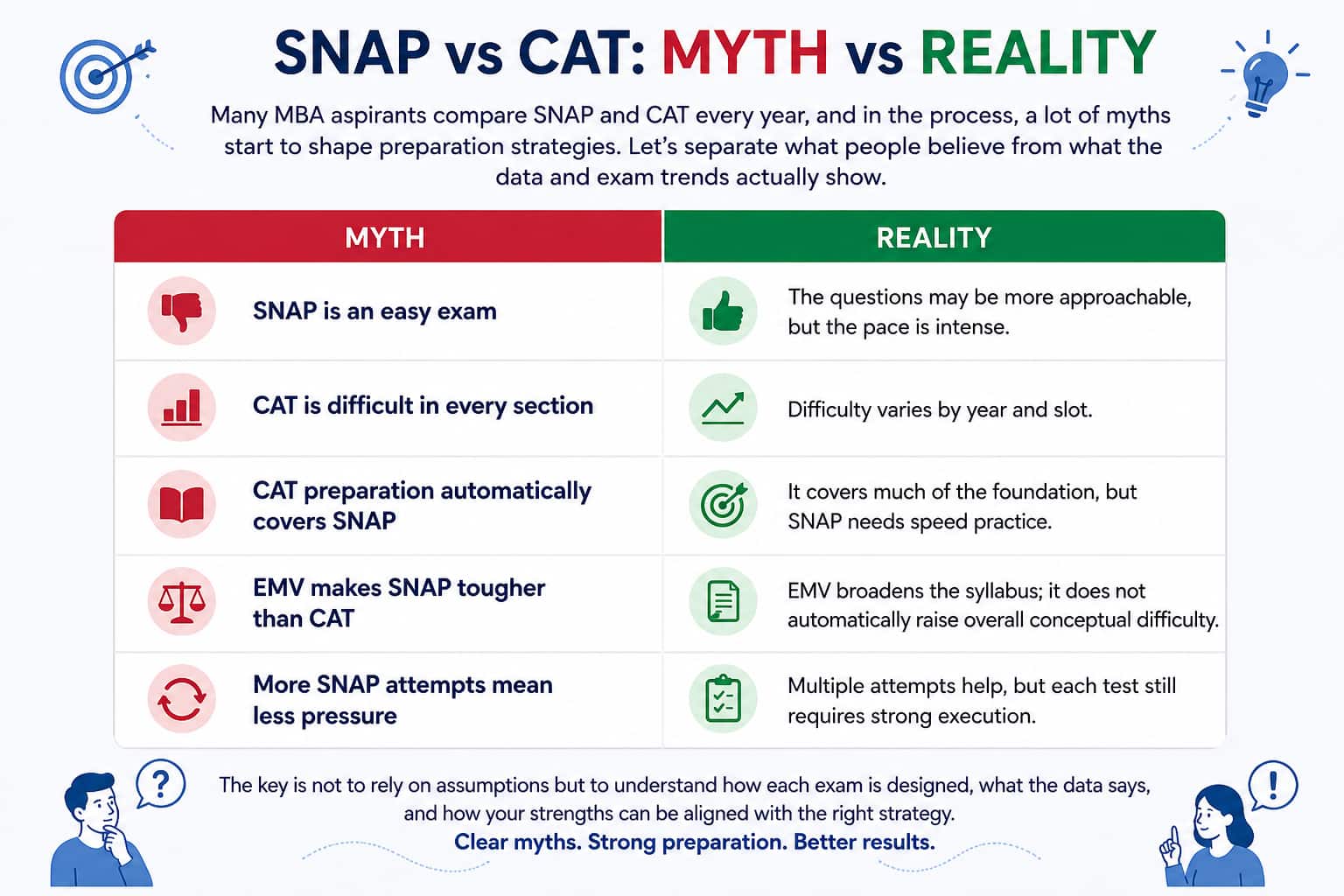
SNAP vs CAT: Myth vs Reality
SNAP 2026 Free Mock Test
Practise the 60-minute SNAP format to see whether your CAT preparation translates into the speed and decision-making required by SNAP.
Take the free mock: SNAP Free Mock Test
CAT 2026 Free Mock Test
Simulate the CAT exam environment with a free CAT mock test and evaluate your speed, accuracy, question selection and sectional performance. Use your results to identify weak areas and refine your CAT 2026 exam strategy before the actual test.
Attempt Now: CAT 2026 Free Mock Test
Final Verdict
SNAP is generally easier than CAT in terms of question complexity and conceptual depth, but it is more compressed for time. CAT's recent papers show more demanding multi-step Quant and DILR structures, while SNAP's recent papers have leaned towards shorter, more direct questions.
The clearest conclusion: CAT is harder to solve; SNAP is harder to solve quickly.
Articles
Related Stories
|
Upcoming Bschool Exams

Certifications By Top Providers
Explore Top Universities Across Globe
Popular Courses and Specializations
List of colleges accepting SNAP
Browse Bschool Colleges by State
Questions related to SNAP
On Question asked by student community
Have a question related to SNAP ?
You can find all the information here:
CAT- https://bschool.careers360.com/articles/cat-exam-dates
SNAP- https://bschool.careers360.com/articles/snap-exam-dates
Dear Student,
SIBM Nagpur SNAP 2025 Cutoff is expected to be on higher side this year, around 93+ percentile if we look at the trends of the previous years. As per the SNAP 2025 score vs percentile, to match the SIBM Nagpur SNAP 2025 cutoff one need to score around
Hi Student
Getting 70 percentile in the SNAP examination is well within the range of SSBF Pune. You can register and apply for admission to the college. Click on the link below to learn more about the admission process, dates, fees, etc.
Hello candidate,
SIBM Pune over the years has been known for its holistic development of students . SIBM Pune courses include MBA, MBA Executive and MBA Innovation and Entrepreneurship programmes in various specialisations.
Symbiosis Centre for Management and Human Resource Development, Pune was established in 1993. Admission to SCMHRD Pune
Yes, you can definitely prepare better for the SNAP Quantitative Ability section by keeping a complete formula list with you. Instead of memorising everything randomly, it helps to organise formulas chapter-wise so you can revise faster.
Here is a useful formula list for the SNAP Quant section:
1. Arithmetic
•

Study Resources, Applications and Opportunities
Globally Recognized by AACSB (US) & AMBA (UK) | 18 LPA Avg. CTC for PGPM 2026
XAT- Xavier Aptitude Test 2027
Apply75+ years of legacy | #1 Entrance Exam | Score accepted by 250+ BSchools
Career Launcher Race To 99%ile In CAT 2026 - Phase 03
Enquire6-Hour Masterclass to help you score 99+ percentile in CAT 2026
NMAT by GMAC 2026
ApplyTest centres are available in 70+ cities across India | 75,000+ aspirants apply for the NMAT exam | Accepted by 58+ institutions like NMIMS, KJSIM, ISB, SPJIMR and Great Lakes.
Common Admission Test 2026 (CAT 2026)
ApplyRegistration Start: 3 August 2026 | Last Date to Apply: 15 September 2026 (till 5 PM)
IBSAT 2026-ICFAI Business School MBA/PGPM 2027
ApplyAACSB Accredited | 40 LPA-Highest CTC | Scholarships worth 10 CR
SNAP Notifications
Never miss SNAP update
Get timely SNAP updates directly to your inbox. Stay informed!