IBSAT 2026-ICFAI Business School MBA/PGPM 2027
AACSB Accredited | 40 LPA-Highest CTC | Scholarships worth 10 CR


The SNAP exam 2025 test 3 slot 2 is now over. Candidates can get the complete exam analysis and memory based questions on this page. We will provide the complete subject wise memory based questions and topic wise weightage. These question papers give a clear idea about the exam pattern, topic distribution, and difficulty level. We have also provided the SNAP slot 1 test 3 memory based questions and analysis on this page. Practising these papers will help candidates improve accuracy, understand question trends, and build confidence for SNAP 2025 and other MBA entrance exams.
This Story also Contains
Understanding the exam pattern of the SNAP examination is critical for the success of any SNAP exam aspirant. As the SNAP exam date draws near, here is a quick revision of the SNAP exam pattern for the 2025 examination.
| Section | Number of Questions | Total Marks |
|---|---|---|
General English: Reading Comprehension, Verbal Reasoning, Verbal Ability | 15 | 15 |
Analytical and Logical Reasoning | 25 | 25 |
Quantitative Aptitude, Data Sufficiency & Data Interpretation | 20 | 20 |
SNAP Total Marks | 60 | 60 |
| Shift | Exam Time |
|---|---|
Shift 1 | 2:00 PM – 3:00 PM |
Shift 2 | 4:30 PM – 5:30 PM |
The SNAP 2025 examination is held across three separate test days, with each test consisting of two slots, resulting in a total of six question papers. All memory-based questions from these sessions will be updated here to help candidates review the types of questions asked and understand the overall exam pattern. Below, you can find the complete set of memory-based questions from Test 1, and the remaining tests will be added as soon as the sessions conclude.
1. What is the meaning of the word “prognostication”?
2. Select the correct option to fill the blank:
The chairman refused to sign the proposal ______ it lacked proper documentation.
3. Choose the idiom that best fits the sentence:
He revealed the secret unintentionally and ______.
4. Select the word that is similar in meaning to: “contemplate”.
5. Choose the correct preposition to complete the sentence:
She has been working here ______ 2015.
6. In the analogy Soporific : Sleep :: Antidote : ?, choose the correct answer.
7. Find the next number in the series:
11,19,35,59,?
8. Statement: The government plans to increase subsidies on renewable energy equipment.
Question: Is the subsidy amount expected to reduce the final consumer price?
Choose the correct option regarding data sufficiency.
9.
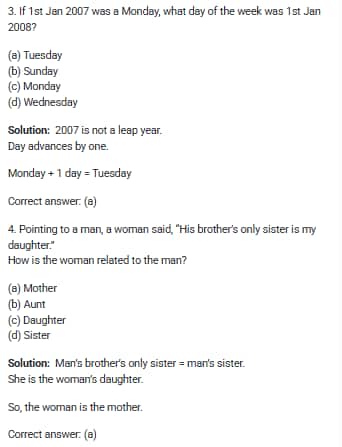
A man introduces a woman as the daughter of his mother’s only brother. How is the woman related to him?
10.
Four lunch items — Pasta, Rice, Soup, and Salad — are delivered to four floors (1 to 4).
Pasta is delivered to a higher floor than Soup.
Rice is not delivered to floor 1.
Salad is delivered to floor 4.
Find the correct arrangement.
11.
Three friends — A, B, and C — have different favourite sports: Cricket, Tennis, and Hockey.
A does not like Hockey.
B likes Tennis.
Find who likes Cricket.
12.
Six people — P, Q, R, S, T, U — sit in a row facing North.
P sits third to the left of S.
Q is to the immediate left of P.
R sits at one extreme end.
Find the correct seating order.
13.
Five people, P, Q, R, S, T, sit in a row:
S sits between T and Q.
P sits to the left of T.
R sits at the leftmost position.
Who sits at the rightmost position?
14. From the statements given below, choose the correct conclusion:
All roses are flowers.
Some flowers are red.
15. Based on the statements below, identify the correct inference:
Most engineers know programming.
All programmers use computers.
16. In a certain code language, TREE is written as SUFD. How is HOME written in that code?
A shopkeeper buys an article for Rs 800 and sells it for Rs 920. Find the profit percentage.
The average weight of 6 persons is 52 kg. One more person joins, and the average becomes 53 kg. Find the weight of the new person.
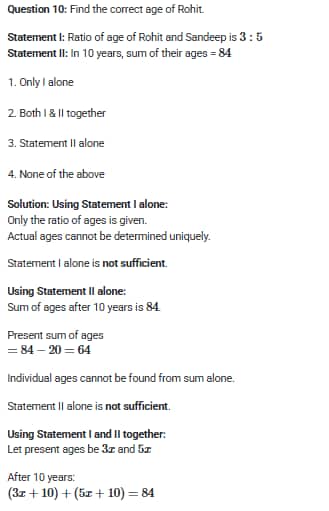
The present age of a father is 4 times that of his son. In 5 years, their ages will differ by 30 years. Find their present ages.
A candidate received 65% of the total valid votes. If he got 13000 votes, find the total number of valid votes.
Find the remainder when 7103 is divided by 6.
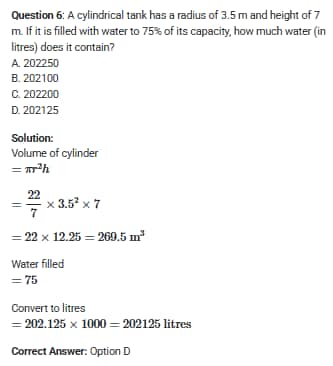
A cylinder has a radius of 7 cm and a height of 10 cm. Find its total surface area.
A triangle has sides 15 cm, 14 cm, and 13 cm. Find its area.
The Vande Bharat train covers 540 km in 6 hours. Find its average speed.
In how many ways can the letters of the word DELHI be arranged?
The difference between Simple Interest and Compound Interest on a sum for 2 years at 10 per annum is Rs 150. Find the principal.
Pipe P1 and P2 together fill a tank in 20 minutes. Pipe P2 alone fills it in 30 minutes. Pipe P3 empties it in 15 minutes. If all pipes are opened together, how long will it take to fill the tank?
Amit can complete the work in 12 days, and Brijesh in 18 days. They work together, but Amit leaves 6 days before completion. Find the total number of days the work takes.
Three traffic lights change at intervals of 48 seconds, 72 seconds, and 108 seconds. If all change together at 7:00 AM, at what time will they change together next?
If tanθ+cotθ=4, find the value of tan2θ+cot2θ.
For the sequence Sn=3n2−2n, find the 5th term.
Solve the logarithmic equation log2x+log2(x−2)=x.
1- If TACITURN: GARRULOUS, then Insolvent: ________
2- The startup would not have secured the funding _________ its innovative business model and the founder’s compelling pitch.
if not for it was
unless it was for
if it had been for
had it not been for
3- The old bureaucratic system was a labyrinth of red tape, where a single request could take months to be processed.
Simile
Metaphor
Paradox
Euphemism
4- The old library in Pune contained several recondite texts on ancient Indian philosophy that were accessible only to a handful of scholars.
Popular
Manifest
Esoteric
Pedestrian
5- The drone flew high above the city of Jaipur, capturing breathtaking aerial footage.
Identify the part of speech for the underlined word.
6- The _______ crafted silver filigree from Cuttack is _______ sought after by collectors worldwide.
Delicately, high
Dedicate, high
Delicate, highly
Delicately, highly
7- The new quality control manager was determined to ________ all the outdated procedures in the factory.
Do away with
Get along with
Give in to
Make up to
8- The CEO’s decision to resign came as a _________ shock to the employees and the stock market.
Crude
Raw
Rude
Stark
1- What was the day on 15th August, 1947?
2- Which year matched the calendar of 2007?
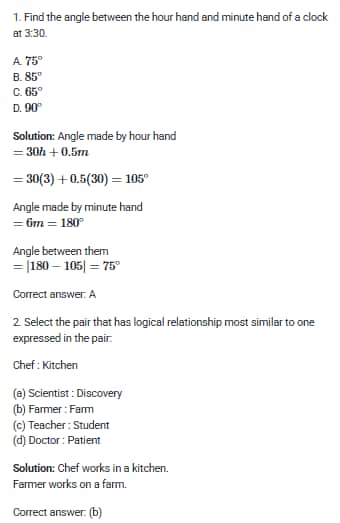
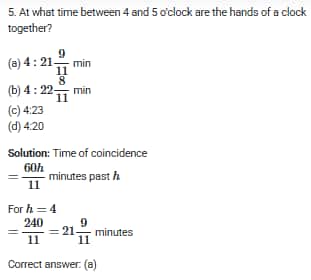
3- If a clock gets slow by 5 minutes every hour, and it was correct at 6 AM on Monday, what will be the time at 6 PM on Tuesday?
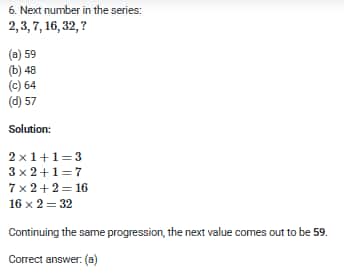
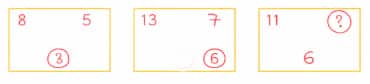
4- Find the missing number: 5, 7, 13, 25, 45, ______
5- Find the missing term: Q3F, S5J, U8N, W12R, ______
6- Find the missing term: 1, 2, 6, 30, 210, ______
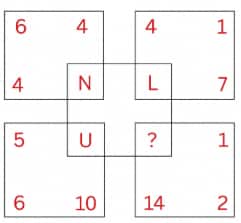
7- Which letter will replace the question mark?
R
Q
S
P
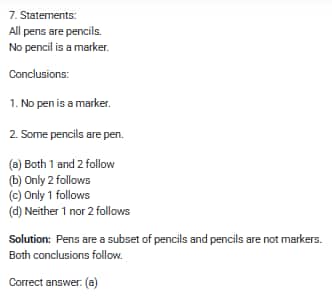
8- Statements:
Some cats are black.
Some black things are big.
Conclusions:
Some cats are big.
All big things are black.
9- Find the missing number: 2, 10, 30, 68, 130, ______
10- Statements:
All metals are conductors
No insulators are conductors
Conclusions:
No metal is an insulator
Some calculators are metals
Neither 1 nor 2 follows
Only 1 follow
Only 2 follow
Both 1 and 2 follow
1- Find the unit digit of 1! + 2! + 3! + … + 100!
2- If a man covers 1/3rd distance at speeds 10 km/h, 20 km/h, and 60 km/h, find the average speed.
3- If the HCF of two numbers is 15 and their product is 1800, find the LCM.
4- Two dice (red and blue) are thrown. Find the probability that the sum is prime and the number on red dice is greater than blue dice.
5- Given two pairs of lines:
K:
x+2y=11
2x−y=7
L:
x+2y=11
2x+y=7
Find the difference in values of x in K and L.
6- Given points A(1,2), B(3,8), C(7,k) are collinear. Find k.
7- If 10 men take 12 days to complete work and 12 women take 15 days to complete the same work, find the time taken by 6 men and 6 women.
8- Evaluate: sin3θ+cos3θsinθ+cosθ+sin3θ−cos3θsinθ−cosθ
9- A furniture store makes a profit of 25% after offering a discount of 20% on a sofa. If the cost price (CP) increases by 10% and the store still offers the same 20% discount, what is the new profit percentage?
10- A laddu from a shop has a radius of 3.5 cm. If 10 such laddus are packed in a cubical box, what is the approximate total volume occupied by 10 laddus (in cm)?
The comprehensive analysis across all the tests and analysis of the SNAP 2025 examination will be discussed here as the examination concludes. Stay tuned and visit us on the exam day for the fastest and latest updates.
The section was overall easy to moderate in difficulty.
Vocabulary-oriented items dominated, including idioms, proverbs, synonyms, and similar word choices.
Fillers and preposition questions were straightforward and context-driven.
One question tested the meaning of the word “prognostication.”
An analogy question was included (for example: soporific → sleep).
Test centres are available in 70+ cities across India | 75,000+ aspirants apply for the NMAT exam | Accepted by 58+ institutions like NMIMS, KJSIM, ISB, SPJIMR and Great Lakes.
75+ years of legacy | #1 Entrance Exam | Score accepted by 250+ BSchools
This part was moderate and largely direct in nature.
Two questions appeared from the number series.
A data sufficiency item was based on a government subsidy situation.
Several questions were asked about blood relations.
A floor-based puzzle featured lunch-item placements.
A puzzle involving three friends was included.
Seating arrangement questions covered:
A set with six people facing North.
Another configuration based on P, Q, R, S, and T with given constraints.
Syllogism and statement–inference were part of the set.
One question involved coded reasoning.
Difficulty level leaned moderate to tough overall.
The section mixed arithmetic, algebra, geometry, and application-based questions.
Topics included:
Profit and Loss
Average weight problems
Age-related calculations
Voting arithmetic
Remainders
Concentric circle concepts
Cylinder-based computation
Geometry featured a Triangle Park question using a 15–14–13 triangle.
SI–CI difference for 2 years at 10% resulted in a difference of 150, to determine the principal.
A tank-filling scenario involved three pipes with both filling and emptying rates.
Work & Time included Amit and Brijesh, with Amit leaving 6 days early.
An LCM-based question involved traffic lights changing at 48 s, 72 s, and 108 s.
A permutation question required finding the number of ways to arrange DELHI.
Test-takers uniformly described the VA section as simple, quick, and highly rewarding.
Slot 2 contained no RC passage, whereas Slot 1 included a short business-themed one.
The structure leaned heavily on core grammar skills, with questions centred around:
Error spotting, which formed the largest chunk
Grammar-based fill-in-the-blanks
A few items on active vs. passive voice
Light sentence-correction style tasks
Vocabulary also appeared in multiple forms, such as:
Synonyms and antonyms
Idioms and phrases
Two analogy-based questions
A single para-jumble rooted in an economics concept was rated as straightforward.
Students appearing on 12 December are encouraged to revise:
Tenses
Pronouns
Conjunctions
Subject–Verb Agreement Rules
Due to the predictable and uncomplicated nature of questions, the accuracy potential was very high.
LR continued to serve as SNAP’s major separator among candidates.
The twist in Slot 2 was the noticeable presence of puzzles:
Slot 1 had almost none.
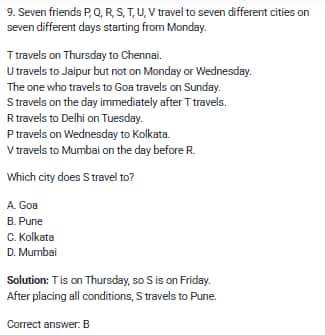
Slot 2 offered two puzzles and one seating arrangement, all considered highly doable.
The question spread included familiar reasoning themes:
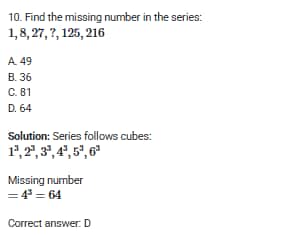
Series problems
Coding–decoding (2 items)
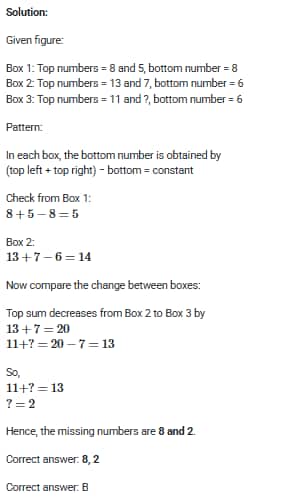
Number reasoning (find the missing 6th number)
Critical reasoning (3–4 questions) focusing on assumption, cause–and–effect, and inference
Prep recommendation for upcoming attempts:
Master Clock & Calendar, as these remain recurring topics across shifts.
LR also featured a very simple DI-style set:
A small table with easy calculations, though many skipped it because of the limited time.
Quant in Slot 2 leaned a bit more toward the moderate side compared to Slot 1.
The section was dominated by Arithmetic, which is the backbone of SNAP Quant every year.
Key question types included:
Simple Interest & Compound Interest (1–2 questions)
Time & Work (1 question)
Upstream–downstream problem
Percentage, ratio, and proportion
The section also pulled in a mix of other chapters:
Logarithms (2 questions)
Coordinate Geometry (3 questions — heavier than Slot 1)
Mensuration involving a hexagon fold and perimeter
Probability vs P&C split:
Slot 1 had a probability question
Slot 2 switched to one P&C question
A few algebraic equation questions were also added.
Number System included a remainder theorem–based question.
Quant DI offered:
A compact bar/line/table set with 3–4 very quick questions
Overall, the difficulty was tied not to complexity but to the speed required to apply formulas efficiently.
| Area | Slot 1 | Slot 2 |
|---|---|---|
RC | 1 RC | None |
LR Puzzles | Very few | 2 puzzles + 1 arrangement |
VA Difficulty | Easy | Easy |
LR Difficulty | Easy–Moderate | Slightly more scoring |
Quant | Easy–Moderate | Slightly more moderate |
Clock–Calendar | Heavy presence | Fewer, but still asked |
SNAP 2025 Test 2 Slot 1 Paper was slightly longer compared to SNAP 2025 Test 1 Paper. However, despite the increased length, the overall difficulty level of the question paper was easy.
The overall difficulty level of the exam was easy to moderate and was easier compared to Test 1.
The overall difficulty level of the Logical Reasoning section was moderate.
Topic-wise distribution and difficulty:
Critical Reasoning: 3–4 questions; easy in terms of difficulty
Arrangements: 3 questions, including a number-based pyramid arrangement
Family Tree and Blood Relations: 2 questions
Syllogisms: 2–3 questions
Coding–Decoding: 2 questions
Series: 1 question; easy
Calendar: 2 questions
Clock: 2 questions
The Quantitative Aptitude section was lengthy and calculative, making time management a key challenge for many candidates. Overall, this section was on the tougher side compared to the SNAP Test 1 Paper.
Topic-wise distribution:
Percentage: 1 question
Logarithms and Indices: 2–3 questions
Time and Work: 2 questions
Time, Speed, and Distance: 2 questions
Mixtures and Alligation: 2 questions
Unit digit and LCM HCF: 1 question
No questions were asked from the DI section.
The paper was similar in approach to Slot 1, making it overall doable for prepared candidates.
One question was based on idioms and phrases.
Antonyms- and synonyms-based questions were included.
The overall difficulty level was easy.
One question was based on a series.
Critical Reasoning questions were easy.
Two questions were from coding–decoding.
3–4 questions were from the clock and calendar.
One question was based on a circular arrangement of 8 people.
2–3 questions were from the arrangements overall.
Quantitative Aptitude was easy to moderate in terms of difficulty level.
The Arithmetic section was lengthy and calculative.
Most of the questions were from Arithmetic.
Coordinate Geometry: 1 question.
One question was based on a table, which was calculative (based on the highest percentage of car production).
| Parameter | Slot 1 | Slot 2 |
|---|---|---|
Paper Length | Slightly longer | Similar to Slot 1 |
Overall Difficulty | Easy overall | Easy to Moderate |
Nature of Paper | Balanced | Slightly more QA-heavy |
Time Management | Manageable except QA | More pressure due to QA |
SNAP 2025 Test 3 Slot 1 had an overall easy to moderate difficulty level. General English and Logical Reasoning turned out to be scoring sections, while Quantitative Aptitude played a key role due to its lengthy and calculation-intensive questions. Candidates who managed their time well and maintained calculation accuracy were able to perform better.
Compared to SNAP Test 1, SNAP 2025 Test 3 Slot 1 was relatively easier and followed a familiar exam pattern similar to other slots. Although there were no unexpected changes in the paper structure, many candidates felt the exam was lengthy, making time management an important factor for completing the test comfortably.
The General English section was easy and highly scoring for well-prepared candidates. The question mix was similar to previous SNAP tests, with a strong focus on grammar concepts.
Key Topics Covered:
Idioms and Phrases
Proverbs-based question
10–11 questions based on Grammar
Modals and Auxiliary Verbs
Parts of Speech
Pattern closely matched SNAP Test 1 and Test 2
Accuracy levels were high as most questions were direct and concept-based.
The Logical Reasoning section was easy, allowing candidates to attempt most questions confidently. Critical reasoning questions were straightforward and not time-consuming.
Topics Asked in Logical Reasoning:
Alphanumeric Series – 1 question
Binary Logic – 1 question
Calendar-based question (easy)
Decision Making – 1 question
3 questions from Critical Reasoning
Blood Relations – 1 question
Clocks – 1 question
Coding–Decoding – 1 question
Syllogism – 1 question
This section rewarded speed and conceptual clarity.
The Quantitative Aptitude section was the most time-consuming in SNAP 2025 Test 3 Slot 1. Candidates reported lengthy and calculation-heavy questions, making it tougher than QA sections in earlier SNAP tests.
Topic-wise Question Distribution:
Ratio and Proportion – 1 question
Profit and Loss – 1 question
Time and Distance – 1 question
Logarithms – 2 questions
Permutation & Combination and Probability – 5 questions (1 tricky)
Number Series – Easy
Simple Interest & Compound Interest – 2 questions
Percentage – 1 question
Averages – 1 question
Trigonometry – 2 questions
Modern Mathematics – 4–5 questions (dominant)
Geometry – No questions asked
This section demanded strong calculation speed and smart question selection.
Overall, SNAP 2025 Test 3 Slot 2 was easier than SNAP Test 1 but slightly trickier than SNAP Test 2. The paper fell in the easy to moderate range and was clearly easier than SNAP 2024. While the difficulty was manageable, a few sections felt lengthy and time-consuming, especially due to calculation-heavy questions.
The General English section was largely straightforward and scoring for most candidates.
The overall difficulty level ranged from easy to moderate.
Fill-in-the-blank questions were asked, focusing on vocabulary and contextual usage.
Preposition-based questions appeared, testing basic grammar concepts.
Around three idiom-based questions were included, all familiar and commonly asked.
The section was similar in nature to previous SNAP papers, with no unexpected twists.
Candidates with decent grammar fundamentals could attempt most questions comfortably.
The Logical Reasoning section was mostly on the easier side, with a mix of familiar patterns.
The overall difficulty level was easy to moderate.
Four questions from a series were asked, including number-based and pattern-based series.
A question based on the series tested basic mathematical reasoning.
Critical Reasoning had a significant presence, with five questions in total.
One clock-based question was asked, following a standard SNAP format.
Only one Critical Reasoning question was tricky, while the rest were fairly direct.
This section offered good scoring potential with smart question selection.
The Quantitative Aptitude section was the most demanding in terms of time management.
The section was moderate in difficulty but lengthy.
1–2 geometry questions were asked; these were time-consuming due to calculations.
AP and GP questions appeared and were similar to those seen in Slot 1.
Time and Work contributed two questions, both calculation-based.
One logarithm question was asked, testing basic log properties.
The section was largely calculative, which increased the time pressure.
Accuracy mattered more than attempting a high number of questions here.
Difficulty level: Easy to Moderate
Length: Moderate to Lengthy
Best sections to score: General English and Logical Reasoning
Most time-consuming section: Quantitative Aptitude
With balanced preparation and smart time allocation, SNAP 2025 Test 3 Slot 2 was a well-manageable paper and offered good scoring opportunities, especially for candidates strong in reasoning and verbal ability.
Candidates can find the SNAP Test 3 2025 memory based questions asked in the exam from the section below.
General English
1. The investigative journalist uncovered a _____ between corrupt officials and powerful construction lobby in Mumbai.
A. Cover-up
B. Hidden deal
C. Up-cover
D. Covering up
Answer- Hidden deal
2. The _______ of the factory was a major blow to the local economy, as it was the largest employer in the small town of Tiruppur.
A. Close up
B. Close down
C. Closedown
D. Shut off
Answer- Closedown
3. In compliance ___ new environmental regulations, the factory in Manesar was retrofitted ___ a state-of-the-art filtration system.
A. with, with
B. of, with
C. to, by
D. for, into
“In compliance with” is the correct prepositional phrase.
“Retrofitted with” is the correct verb–preposition combination.
. Correct answer: (a)
4. For past 5 years, the weaver of Kanchipuram ___ ancient techniques with modern designs, a fusion that now ___ international acclaim.
A. blend, receives
B. have been blending, is receiving
C. were blending, received
D. had been blending, has been receiving
“For past 5 years” indicates an action continuing till the present, so present perfect continuous is required.
The second blank refers to a present ongoing result, so present continuous fits.
Correct answer: B
5. ___ had the monsoon arrived in Mumbai ___ the city’s drainage systems were overwhelmed, leading to widespread waterlogging.
A. As soon as, then
B. No sooner, than
C. Not only, but also
D. Scarcely, then
The correct correlative conjunction is “No sooner … than”, used for immediate succession of events.
Correct answer: B
6. You ___ have told me you were coming to Delhi; I ___ have arranged a car to pick you up from the airport.
A. must, will
B. may, must
C. can, should
D. could, would
The sentence expresses a missed past possibility.
“Could have” and “would have” correctly express unreal past conditions.
Correct answer: D
Logical Reasoning
Quantitative Aptitude


This section presents the latest SNAP 2025 ebook, updated with Test 1 memory-based questions and comprehensive section-wise analysis. It offers a clear overview of the question types, difficulty levels, and key trends, giving candidates a structured resource to review the exam and strengthen their preparation for the next tests.
| SNAP 2025 Test 1 Memory-Based Questions and Analysis | Download Now |
SNAP 2025 will be conducted across multiple tests and slots, and understanding the SNAP 2025 test questions is extremely important for every aspirant. Once each SNAP 2025 test concludes, the memory-based questions become a crucial resource for analysing the exam’s structure, difficulty level, and trends. Examining the SNAP 2025 test questions becomes essential for the following reasons:
Going through the SNAP 2025 test questions provides candidates with a clear idea of the difficulty level of the examination. While previous editions of SNAP have generally been rated easy to moderate, slight variations across tests and slots are common. Evaluating the SNAP 2025 test questions helps aspirants understand how each test performed relative to past years.
Analysing the SNAP 2025 test questions allows candidates to estimate their tentative score for each test day. Using these memory-based questions alongside previous year trends, aspirants can predict a possible percentile range and understand their standing in the overall admission process.
The SNAP 2025 test questions will serve as an excellent reference for SNAP 2026 preparation. As SNAP follows a consistent exam pattern, reviewing the 2025 questions helps future aspirants identify the commonly asked topics, recurring question types, and variations across different tests.
For candidates appearing in SNAP 2025 Tests 2 and 3, going through the earlier test questions helps them identify which areas are frequently tested and where improvements are needed.
Even for candidates preparing for other MBA entrance exams, reviewing the SNAP 2025 test questions helps recognise mistakes, analyse performance, and refine strategies for upcoming exams.
Frequently Asked Questions (FAQs)
Memory-based SNAP 2025 questions for Test 1, Test 2, and Test 3 will be updated once each test concludes. These compiled questions are extremely useful for performance evaluation and understanding section-wise trends.
By comparing the memory-based SNAP 2025 test questions with past-year papers and analysing your accuracy, you can estimate a tentative score range. This helps in predicting a possible percentile based on historical cutoff and scoring trends.
Yes. SNAP is conducted in multiple tests and slots, and the difficulty level may vary slightly across them. Reviewing all available SNAP 2025 test questions helps aspirants understand these variations.
SNAP 2025 test questions help candidates understand the exam’s difficulty level, analyse the type of questions asked, and evaluate their performance. They also serve as a reference for estimating scores and percentiles based on previous year trends.

On Question asked by student community
You can find all the information here:
CAT- https://bschool.careers360.com/articles/cat-exam-dates
SNAP- https://bschool.careers360.com/articles/snap-exam-dates
Dear Student,
SIBM Nagpur SNAP 2025 Cutoff is expected to be on higher side this year, around 93+ percentile if we look at the trends of the previous years. As per the SNAP 2025 score vs percentile, to match the SIBM Nagpur SNAP 2025 cutoff one need to score around
Hi Student
Getting 70 percentile in the SNAP examination is well within the range of SSBF Pune. You can register and apply for admission to the college. Click on the link below to learn more about the admission process, dates, fees, etc.
Hello candidate,
SIBM Pune over the years has been known for its holistic development of students . SIBM Pune courses include MBA, MBA Executive and MBA Innovation and Entrepreneurship programmes in various specialisations.
Symbiosis Centre for Management and Human Resource Development, Pune was established in 1993. Admission to SCMHRD Pune
Yes, you can definitely prepare better for the SNAP Quantitative Ability section by keeping a complete formula list with you. Instead of memorising everything randomly, it helps to organise formulas chapter-wise so you can revise faster.
Here is a useful formula list for the SNAP Quant section:
1. Arithmetic
•

Globally Recognized by AACSB (US) & AMBA (UK) | 18 LPA Avg. CTC for PGPM 2026
75+ years of legacy | #1 Entrance Exam | Score accepted by 250+ BSchools
6-Hour Masterclass to help you score 99+ percentile in CAT 2026
Test centres are available in 70+ cities across India | 75,000+ aspirants apply for the NMAT exam | Accepted by 58+ institutions like NMIMS, KJSIM, ISB, SPJIMR and Great Lakes.
Registration Start: 3 August 2026 | Last Date to Apply: 15 September 2026 (till 5 PM)
AACSB Accredited | 40 LPA-Highest CTC | Scholarships worth 10 CR