Great Lakes - PGDM & PGPM Admissions 2027
Globally Recognized by AACSB (US) & AMBA (UK) | 18 LPA Avg. CTC for PGPM 2026


Yes, the final year is one of the best times to prepare for CAT 2026. Since the CAT 2026 exam is scheduled for 29 November, students beginning their preparation in July get nearly five months to build concepts, practise sectional tests, attempt mock exams, and revise thoroughly - without taking a gap year. Based on previous CAT admission cycles, many aspirants begin serious preparation only after graduation, leaving themselves with significantly less time. Starting during your final semester gives you a practical advantage if you can balance college, placements and CAT 2026 preparation effectively. This guide explains exactly how to do that.
This Story also Contains

Ready to test your preparation? Attempt our free CAT 2026 Mock Test and see where you stand. CAT 2026 Free Mock Test
Can I prepare for CAT 2026 in my final year of graduation?
Yes. The final year is one of the best times to start CAT 2026 preparation because students beginning in July get nearly 135-140 days before the expected November exam. This is generally enough time to complete the CAT 2026 syllabus, attempt mock tests, and revise before graduation without taking a gap year.
Usually, the final semester has a lighter academic workload than earlier semesters, giving students enough time to build concepts, practise consistently and attempt mock tests. Starting now also helps avoid the pressure of preparing after graduation.
| Advantage | How does it help in CAT 2026 Preparation? |
|---|---|
Flexible academic schedule | Easier to create a daily CAT study routine alongside college. |
Fresh learning mindset | Concepts from graduation subjects often improve logical thinking, reading comprehension, and analytical ability. |
Enough preparation window | Starting in the final semester provides sufficient time for concept building, practice, revision, and mock tests before CAT. |
Back opportunities | A good CAT score allows you to apply for final-year admissions immediately after graduation without taking a gap year. |
Students starting off their CAT 2026 preparation around mid-July, usually get something like 135-140 days before the exam shows up in the last week of November. That window is, in general, sufficient to push through roughly 18-20 study weeks, work on about 700-1,000 solid practice questions and not just any random ones, try around 20-40 full length mock tests also, plus do a complete syllabus revision at least a couple of times before exam day.
A high CAT percentile alone doesn't guarantee admission to the top IIMs. Learn how academics, work experience, and interviews influence final selection in our guide to IIM BLACKI Selection Criteria.
Treat your final semester as a structured preparation phase rather than waiting until graduation.
CAT Trend: Candidates who complete the syllabus by the end of August usually get 8-10 weeks for mock tests and revision before CAT. This preparation phase often contributes more to percentile improvement than learning new topics during the final month, as it focuses on speed, accuracy and question selection.
IIM Indore is Back for CAT 2026! Big Pattern Changes Incoming?
A consistent 2-4 hours of focused preparation outside college is usually more effective than irregular weekend study sessions.
Balancing College and CAT Preparation Without Missing Deadlines
| College Schedule | CAT Preparation Focus |
|---|---|
Regular class days | Learn new concepts and practise sectional questions |
Assignment weeks | Short study sessions, vocabulary, reading, and revision |
Semester exams | Revise formulas, solve previous mock mistakes, and maintain reading habits |
Weekends, | Attempt a full-length mock test and analyse performance |
College breaks/holidays | Cover backlog topics and strengthen weak areas |
Time Allocation Analysis
A final-year student studying 2.5 hours on weekdays and 6 hours across weekends accumulates nearly 300-350 focused preparation hours before CAT. This is generally sufficient to complete the syllabus, practise previous-year questions, analyse mock tests and revise weak areas, provided the study schedule remains consistent.
Learn about which IIM pays the best.
Placement activities tend to hit their stride around August to October, kind of the same window where CAT aspirants should start doing regular mock tests without too much delay. In those hectic weeks, it helps to curb fresh learning and lean more towards revision, plus Reading Comprehension and then the mock analysis part. Once placement activities get a bit less intense, you can go back to full length mocks again.
Semester examinations should not fully interrupt your CAT prep, like don’t let it go completely off rails. Even 45-60 minutes a day, of quick revision editorial reading or formula practice, can keep things steady and consistent. Try to not overthink it, just stay on the rhythm, because small continuity matters. As soon as your exams end, jump back into your usual mock test routine immediately, no long delay.
A realistic timetable works better than an ambitious one. Here's a sample CAT preparation timetable for the final semester CAT strategy and CAT success roadmap for the students that can be adjusted according to your college schedule. final-semester
A real-life timetable usually beats a very ambitious plan. Here’s a sample CAT preparation timetable for final semester students, you can tweak it as per what your college demands.
Review every mock test you take, rather than attempting too many mocks back to back without any proper breaks. Keep one whole day per week for revision; this helps lock concepts in your head.
Use a simple tracker for topics completed, mock marks, and the weaker subareas.
| Day | Focus Area |
|---|---|
Monday | Quant + VARC |
Tuesday | DILR Practice |
Wednesday | Quant Revision |
Thursday | VARC + Previous-Year Questions |
Friday | Mixed Practice |
Saturday | Full-Length Mock |
Sunday | Mock Analysis + Revision |
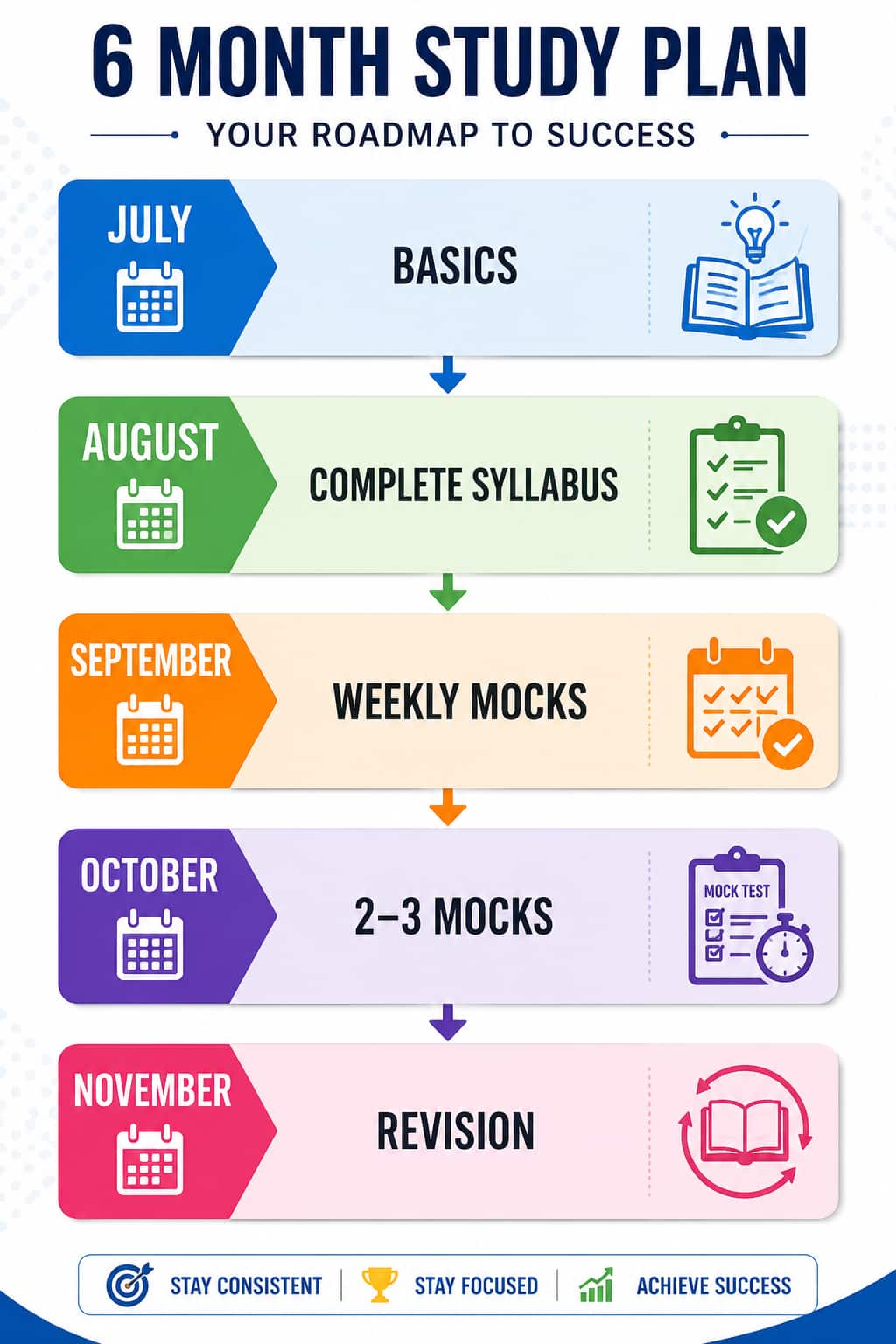
| Month | Goals to be achieved |
|---|---|
July | Basics Completed |
August | Syllabus Completed |
September | Weekly Mocks |
October | 2-3 Mocks/Week |
November | Revision |
Quick Tip: If your semester exams overlap with CAT preparation, don’t fully pause everything. Even 60-90 minutes of focused revision daily is enough to keep the rhythm going. Small, consistent effort across several months works far better than attempting to “catch up” later with long marathon sessions, which are usually unsustainable.
Practice with regular CAT 2026 mock tests to improve your speed, accuracy, and time management. CAT 2026 Mock Test Series - 20 Sets, Questions with Solutions By Experts
CAT 2026 Study Plan for Final Year College Students
Divide your preparation into monthly phases instead of trying to complete the entire syllabus at once.
| Timeline | Primary Focus | Target Outcome |
|---|---|---|
July | Build fundamentals in VARC, DILR, and Quant; understand the exam pattern | Complete basic concepts and create short notes |
August | Increase sectional practice and solve previous-year CAT questions | Strengthen accuracy and identify weak areas |
September | Start taking one mock test every week and analyse every CAT preparation mistake | Improve speed, question selection, and time management |
October | Increase mock frequency to 2-3 per week, revise formulas and concepts | Boost percentile through consistent performance |
Final Weeks | Revise notes, revisit weak topics, and focus on mock analysis | Enter the exam with confidence and a clear strategy |
Instead of measuring preparation by study hours alone, track CAT mock test percentile, accuracy rate and recurring mistakes. These indicators provide a more reliable measure of progress and help identify areas that need immediate improvement.
Choosing the right IIM is just as important as securing a good CAT percentile. Compare the latest Baby IIM salary trends and placement data before making your MBA decision: Baby IIM Salary 2026: Is the IIM Tag Still Enough? 6 of 9 IIMs Report Lower Salaries While BLACKI Grows
Yes. Starting in July provides nearly 19-20 weeks before CAT 2026. If utilised efficiently, this period is enough to:
Complete the syllabus in 6-8 weeks
Spend 8-10 weeks on sectional practice and mock tests
Reserve the final 2-3 weeks exclusively for revision, previous-year papers and exam strategy.
Previous CAT toppers consistently emphasise that the final two months contribute more to percentile improvement than the initial concept-building phase because this is where speed, question selection and accuracy improve rapidly.
Target Percentile | Recommended Full-Length Mocks | Analysis Time After Each Mock |
|---|---|---|
85-90 | 15-20 | 1-2 hours |
90-95 | 20-30 | 2 hours |
95-99 | 30-40 | 2-3 hours |
99+ | 40-50 | 3+ hours |
Expert Insight: Candidates often improve more by analysing one mock thoroughly than by attempting two mocks back-to-back. Review every incorrect answer, skipped question and time-management mistake before taking the next test.
Yes. Every year, thousands of students with average academic background somehow manage to grab very high CAT percentiles. Your graduation marks, or even your stream, do not really decide your CAT score. Candidates who keep practising with focus, do post- test analysis and steadily work on weak areas over months, usually edge out the ones who only bank on a strong academic record.
Below is the section-wise preparation strategy to keep your preparation on point:
Analysis of recent CAT papers shows that Reading Comprehension contributes nearly 70-75% of the VARC section, making it the single biggest scoring area. Students who consistently read editorials, business articles and opinion pieces improve not only reading speed but also question accuracy over time. Therefore, final-year students should spend 45-60 minutes daily on reading rather than focusing only on vocabulary.
DILR Strategy
Try doing 2 solid practice sets daily, instead of speeding through a lot of them.
Based on recent CAT trends, the DILR section generally consists of four sets, and attempting 2-3 sets with high accuracy is often enough to secure an excellent percentile. Instead of solving every set, students should practise identifying the easiest set within the first 3-5 minutes, as question selection has become a decisive skill in recent CAT papers. |
When you’re in mocks, spend those first few minutes spotting which sets feel easiest to you.
Keep a notebook with the approaches you use most, plus the recurring, common errors you keep making.
Test centres are available in 70+ cities across India | 75,000+ aspirants apply for the NMAT exam | Accepted by 58+ institutions like NMIMS, KJSIM, ISB, SPJIMR and Great Lakes.
AACSB Accredited | 40 LPA-Highest CTC | Scholarships worth 10 CR
The more variety you add in practice, the more naturally you start noticing the same patterns during the exam.
Quantitative Aptitude Strategy
Analysis of CAT papers from the last five years indicates that Arithmetic and Algebra together account for nearly half of the Quant section in most exams. Students beginning their preparation in July should therefore complete these topics first before moving to Geometry, Number System and Modern Mathematics.
Priority order for Quant preparation
Arithmetic
Algebra
Geometry & Mensuration
Number System
Modern Mathematics
Preparation tips
Go over formulas every week; don't skip it.
Work through previous-year CAT questions in a topic-wise manner.
Maintain an error log so you don’t repeat the same slip-ups over and over.
Strengthen your preparation by solving previous-year CAT question papers and understanding the latest exam trends. Past 10 years CAT Question Papers with Solutions
| Section | Daily Time | Primary Goal | Weekly Target |
|---|---|---|---|
VARC | 45-60 mins | Improve reading speed and comprehension | 12-15 RC passages + Verbal Ability practice |
DILR | 45-60 mins | Develop logical thinking and set selection | 15-20 quality DILR sets |
Quantitative Aptitude | 60-90 mins | every day |
Recommended eBooks:
The CAT Arithmetic Hackbook PDF: Zero Math Background? No Problem- Concepts, Questions | |
CAT Algebra Handbook 2026: Everything You Need to Master Algebra: Concepts, Practice Questions | |
CAT 2026 Number System PDF Handbook: Complete Concepts, Practice Questions & Solutions | |
CAT 2026 Geometry & Mensuration PDF: Important Concepts, Shortcuts & Practice Questions | |
CAT 2026 Modern Maths PDF Handbook: Key Concepts, Tricks & PYQ-Based Practice | |
CAT 2026 Quantitative Aptitude 20 Free Sectional Tests |
Frequently Asked Questions (FAQs)
Yes, if you stick to a structured plan and don’t keep drifting. A lot of students finish the syllabus by August, then they spend September and October on mock tests + sectional practice. Finally, the last weeks are for revision and tightening the weak spots. In general, consistency, along with mock analysis, seems to matter more than just the total number of hours you study. Also, after each mock, do a detailed review because that’s where you catch recurring errors and you learn how to improve question selection.
The number of mock tests depends on your target percentile.
| Target Percentile | Recommended Mocks |
| 85-90 | 15-20 |
| 90-95 | 20-30 |
| 95-99 | 30-40 |
| 99+ | 40-50 |
Every mock should be followed by a detailed analysis to identify recurring mistakes and improve question selection.
Yes, definitely. Every year, students from engineering, commerce, arts, and science backgrounds manage strong CAT percentiles even with self-study. What really decides the result is concept clarity, regular practice, previous-year questions, and doing mock analysis on a routine basis. Coaching can help, but it’s not the main thing; background usually isn’t a deciding factor either.
During placements, keep it practical. Focus on revision, Reading Comprehension, and mock analysis. Avoid starting brand new topics at that time, because your schedule is already busy. When semester exams are on, even 45-60 minutes of daily revision helps you stay in continuity. Then, once academics calm down a bit, you can restart full-length mock tests and build momentum again.
By the end of August, try to finish the full syllabus. Along with that, prepare short notes, solve previous-year questions, and note your weak areas clearly. That way, you’ll have around 8-10 final weeks before CAT, which you can use for mock tests, revision, and improving accuracy, speed, plus decision making.

On Question asked by student community
If you have already received your final MA result and have technically completed the degree , but you are only waiting for the revaluation outcome, you would generally be considered a graduate rather than someone whose master's degree is still completely in progress. However, CAT has specific instructions about qualification
If you mean CAT (Common Admission Test) preparation, you can practise with previous-year CAT papers. IIM has a collection of CAT papers from 2017 to 2025, covering VARC, DILR and Quant across different slots, along with solutions and explanations. Solving the recent papers first can help you understand the current
Hello Student,
Yes, you can apply for CAT with an EWS certificate issued in Hindi, provided it is issued by the competent authority and follows the required format. However, CAT applicants need a Central-level EWS certificate, not merely a state-level EWS certificate. Since you are from Uttar Pradesh, ensure your
Hey there,
If you mean your MBA counselling seat-allotment letter, the exact download process depends on the counselling authority.
Usually:
With a Telangana state merit rank of 10,953, admission to MBBS Category A in Hyderabad Muslim minority colleges is generally very difficult. However, you may have a better chance for BDS Category A, depending on the year's cutoff and seat availability.
Directions for question:
The bar-graph given below shows the foreign exchange reserves of Nepal (in million Rupees) from 2014 to 2021. Answer the following questions based on the graph :

Question:
What was the percentage increase (rounded to the nearest integer, if deemed necessary) in the foreign exchange reserves in

Globally Recognized by AACSB (US) & AMBA (UK) | 18 LPA Avg. CTC for PGPM 2026
75+ years of legacy | #1 Entrance Exam | Score accepted by 250+ BSchools
6-Hour Masterclass to help you score 99+ percentile in CAT 2026
Test centres are available in 70+ cities across India | 75,000+ aspirants apply for the NMAT exam | Accepted by 58+ institutions like NMIMS, KJSIM, ISB, SPJIMR and Great Lakes.
Registration Start: 3 August 2026 | Last Date to Apply: 15 September 2026 (till 5 PM)
AACSB Accredited | 40 LPA-Highest CTC | Scholarships worth 10 CR