
Search Colleges, Exams, Schools & more


Login
CAT DILR 2026 Practice Questions form the backbone of effective preparation for the Data Interpretation and Logical Reasoning section. Since DILR sets demand clear thinking and patience, regular practice helps candidates get comfortable with different data formats and logical conditions. Practising a variety of questions also improves the ability to stay calm while handling unfamiliar sets. Over time, aspirants learn how to read questions accurately, avoid common traps, and apply step-by-step logic for CAT 2026.
This Story also Contains
- CAT DILR 2026: Practice Questions with Solutions
- Most Repeated DILR Question Types in CAT (2018–2024 Analysis)
- CAT 2026: DILR Expected Topic Wise Weightage (Based on previous year analysis)
- How to Select the Right DILR Sets in CAT 2026 for Maximum Score
- Visualisation Techniques to Solve Complex Arrangement Puzzles in CAT 2026
- Solving CAT 2026 LRDI Puzzles Efficiently with Probability and Combinatorics
- CAT DILR 2026 Preparation Sample Questions
- CAT LRDI Types of Questions
- Seating Arrangement, Venn Diagram & Puzzle-Based LRDI Questions Explained
- CAT 2026 DILR Most Important Topics
- CAT 2026 Mock Test by Careers360
- CAT 2026 DILR Best Books
- CAT 2026 Preparation Resources by Careers360
In this article, you will get the most repeated DILR question types based on previous year paper analysis, CAT 2026 DILR important topics, sample questions, preparation tips along with useful study resources.
CAT DILR 2026: Practice Questions with Solutions
Preparing for the CAT 2026 DILR section requires focused effort, as this segment often challenges even seasoned aspirants. Careers360 offers a comprehensive CAT logical reasoning and data interpretation, packed with topic-wise questions and expert-crafted solutions.
CAT 2026 DILR Practice Questions |
Most Repeated DILR Question Types in CAT (2018–2024 Analysis)
Candidates must analyse past papers from 2018 to 2024; you can identify the most repeated set types and maximise your scoring potential. Practising the right question types will help you improve your problem solving skills in the CAT LRDI questions 2026 practice sets.
If you're preparing seriously, focus your efforts on solving the CAT LRDI questions 2026 practice sets that mirror these repeated patterns. Here are the most commonly asked CAT 2026 LRDI focus areas based on recent trends:
Question Type |
Games & Tournaments |
Linear & Circular Arrangements |
Team Formation / Grouping |
Venn Diagram & Set Theory |
Bar, Line & Table Graphs |
Puzzles Based on Networks/Routes |
CAT DILR Difficulty Trend: What Changed in the Last 5 Years?
Over the last five years, the CAT DILR section has maintained a balance between data-heavy and logic-intensive sets. The recurring nature of certain question types—like Table-Based DI, Games and Tournaments, and Seating Arrangements—shows that CAT focuses on testing a candidate’s ability to analyse structured and semi-structured data under pressure. Recognising these trends helps aspirants plan topic-wise practice and allocate time effectively during mocks.
CAT 2024 Highlights
The CAT 2024 DILR section leaned heavily toward Graph-Based Data Interpretation, especially Scatter Graphs and Candlestick Charts, demanding accurate visual analysis and comparison of multi-variable data. Candidates also encountered Quant-Based Puzzles that required integrating arithmetic concepts like ratios, percentages, and averages within logical frameworks. These sets blended numerical reasoning with situational problem-solving. In addition, Games and Tournaments appeared in variant formats, testing consistency and pattern identification across multiple matches or rounds.
CAT 2023 Trends
In CAT 2023, the emphasis was on Table-Based DI with Missing Values, where aspirants had to fill incomplete datasets using logical constraints and numerical relationships. This required multi-step reasoning, mental calculation efficiency, and a strong grasp of arithmetic operations. The Tournament-Based LR sets made a strong comeback, pushing candidates to interpret win–loss matrices and derive rankings systematically. Quant-LR hybrid puzzles also gained traction, testing aspirants’ ability to combine data interpretation with algebraic or arithmetic insights—marking a gradual shift towards integrated reasoning sets.
CAT 2022 Trends
The CAT 2022 DILR section featured multiple Games and Tournaments sets that required both result tracking and elimination logic. Seating Arrangement questions—linear, circular, and matrix-based, appeared with complex placement and positional rules, demanding careful inference sequencing. Some sets also integrated Arithmetic-based Logical Puzzles, where aspirants needed to blend quantitative reasoning with deductive logic to arrive at unique solutions. The paper reflected CAT’s growing inclination toward cross-domain logical reasoning and contextual data application.
CAT 2021 Trends
The CAT 2021 paper featured highly analytical Table-Based DI sets, notably the Soccer Competition and Missing Values Table, where candidates had to infer patterns from incomplete numerical data. Seating Arrangement problems also featured prominently, with dual-layer constraints, such as fixed positions and conditional swaps, requiring sequential elimination. The section rewarded structured problem-solving and the ability to filter relevant data from complex information sets, reinforcing the need for clarity and precision under time pressure.
CAT 2026: DILR Expected Topic Wise Weightage (Based on previous year analysis)
Understanding topic-wise weightage in CAT DILR helps aspirants prioritise preparation and allocate time efficiently. Based on past trends, Data Interpretation (DI) and Logical Reasoning (LR) questions are distributed across different subtopics with varying frequency. We have given below a table expectage weightage of the high weightage and frequently asked topics, based on previous year question papers analysis. Focusing on high-weightage areas ensures better accuracy, time management, and scoring potential, while low-frequency topics can be attempted selectively during the exam.
Section | Topic | Weightage (%) |
Data Interpretation (DI) | Tables | 10–12 |
Bar Graphs | 8–10 | |
Line Graphs | 6–8 | |
Pie Charts | 5–6 | |
Caselets | 10–12 | |
Logical Reasoning (LR) | Seating Arrangements | 12–15 |
Blood Relations & Family Trees | 5–6 | |
Syllogisms | 5–6 | |
Puzzles | 10–12 | |
Inequalities & Coding | 6–8 | |
Direction & Order | 4–5 | |
Mixed / Miscellaneous | Miscellaneous Sets | 8–10 |
How to Select the Right DILR Sets in CAT 2026 for Maximum Score
Selecting the right DILR sets in CAT 2026 is crucial because time is limited to 40 minutes and each wrong set can cost 10+ valuable minutes. The paper usually has 4–5 sets of mixed difficulty, but only 2–3 are fully solvable within the time limit. A smart selection strategy, based on difficulty, structure, and familiarity, can help candidates maximise accuracy and push their DILR percentile beyond 95+.
Identify Calculation-Heavy vs Logic-Heavy Sets
Begin by scanning all sets in the first 4–5 minutes. Prefer logic-driven sets like arrangements or games, as they involve limited calculations and allow systematic elimination. Avoid data-heavy sets with large tables or layered percentages early, as they consume more time and increase error risk.
Choose Sets with Clear Entry Points
Select DILR sets where information is clearly structured, such as fixed constraints or step-by-step conditions. Sets with unclear data flow or excessive cross-referencing usually signal higher difficulty and should be attempted only if time permits.
Prioritise Familiar Set Types
Always attempt DILR sets you have practiced the most—such as Venn diagrams, tournaments, or selection puzzles. Past CAT data shows that familiarity can reduce solving time per set by 30–40%, leading to higher accuracy.
Avoid Partial Set Traps
Do not jump into solving a few questions from many sets. CAT DILR rewards complete set solving, so commit to one set at a time and finish it fully before moving to the next to avoid wasting time and mental energy.
Keep a Time Cap per Set
Fix a strict limit of 8–10 minutes per set. If progress is slow or deductions are not forming, leave the set immediately. Toppers consistently follow this rule to secure 2–3 complete sets, which is often enough for a 95+ percentile in DILR.
Visualisation Techniques to Solve Complex Arrangement Puzzles in CAT 2026
Complex arrangement puzzles are a significant part of CAT 2026 LRDI sets. Many aspirants struggle with seating, scheduling, and ranking problems due to their multi-layered conditions. Visualisation techniques help map information clearly, identify relationships, and spot patterns quickly. By practising these strategies, candidates can reduce trial-and-error, improve accuracy, and solve puzzles faster, making them better prepared for high-difficulty CAT LRDI questions.
Drawing Tables and Grids for Quick Clarity
Using tables or grids allows candidates to organise information systematically in CAT 2026. For seating, ranking, or scheduling puzzles, mapping data visually reduces confusion and makes it easier to identify valid arrangements, saving valuable exam time.
Using Symbols and Abbreviations for Faster Mapping
Assigning letters, numbers, or symbols to people, items, or positions helps simplify complex conditions. This method enhances memory retention and speeds up solving multi-variable arrangement puzzles efficiently.
Colour-Coding Relationships and Constraints
Highlighting relationships, restrictions, or fixed positions with different colours enables instant recognition of valid and invalid options. Colour-coding is particularly effective in circular and linear seating arrangements, as asked in CAT 2026 questions.
Breaking Down Multi-Step Conditions into Layers
Complex puzzles often have multiple dependent conditions. Visualising each condition in layers helps to tackle one constraint at a time, reducing mistakes and making the logical deduction process smoother.
Practising Pattern Recognition Through Diagrams
Regular practice with visual diagrams trains aspirants to identify recurring arrangement patterns quickly. Recognising common structures like left-right relationships or circular seating shortcuts improves speed and accuracy in CAT 2026 LRDI sets.
Solving CAT 2026 LRDI Puzzles Efficiently with Probability and Combinatorics
Probability and combinatorics are key tools for cracking CAT 2026 LRDI puzzles. They often appear in seating arrangements, selection, and scheduling sets. Knowing how to apply formulas and spotting patterns helps solve problems faster, avoid mistakes, and manage time efficiently. These concepts give a clear edge in high-difficulty LRDI questions during CAT exam.
Calculating Favourable Outcomes for Arrangement Puzzles
In seating and ranking problems, count the exact number of valid arrangements using permutations. For example, arranging n items in a line or around a table requires understanding factorials. This approach ensures precise answers and reduces guesswork in tricky LRDI sets.
Using Combinations to Solve Selection Problems
Selection puzzles often ask “how many ways” to choose items or teams. Apply combination formulas like nCr to calculate possibilities quickly. This is especially useful in group formation, subset selection, and scheduling sets that appear frequently in CAT LRDI 2026.
Complementary Counting to Simplify Complex Sets
Some LRDI questions are easier solved by calculating the total outcomes minus invalid cases. Complementary counting reduces steps and speeds up solving arrangements or selection problems where direct counting is cumbersome.
Using Probability in Multi-Stage Puzzles
Multi-stage CAT 2026 LRDI sets require conditional probability. For example, calculating chances when one event affects the next. Understanding dependent and independent events helps solve these puzzles accurately and efficiently under exam time pressure.
Practising Mixed Logic-Puzzle Sets with Formulas
CAT LRDI often combines logic, tables, and probability. Regular practice of integrated sets, using formulas for permutations, combinations, and probability, improves speed, pattern recognition, and accuracy. Mock tests are ideal for applying these techniques effectively.
CAT DILR 2026 Preparation Sample Questions
Given below are a few sample questions from the CAT LRDI questions 2026 practice sets.
1. Directions: In a coaching class, some students register online, and some others register offline. No student registers both online and offline; hence, the total registration number is the sum of online and offline registrations. The following facts and table pertain to these registration numbers for the five months, January to May of 2023. The table shows the minimum, maximum, and median registration numbers of these five months, separately for online and offline, and the total number of registrations. The following additional facts are known.
1. Every month, online and offline registration numbers were multiples of 10.
2. In January, the number of offline registrations was twice that of online registrations.
3. In April, the number of online registrations was twice that of offline registrations.
4. The number of online registrations in March was the same as the number of offline registrations in February.
5. The number of online registrations was the largest in May.
Minimum | Maximum | Median | |
Online | 40 | 100 | 80 |
Offline | 30 | 80 | 50 |
Total | 110 | 130 | 120 |
Question: Which of the following statements can be true?
I. The number of offline registrations was the smallest in May.
II. The total number of registrations was the smallest in February.
2. Directions: Study the table and answer the questions that follow.
Player | Round 1 | Round 2 | Round 3 | Round 4 | Round 5 |
Alice | 80 | 90 | 70 | 85 | 95 |
Bob | 75 | 85 | 80 | 90 | 75 |
Carol | 90 | 75 | 95 | 80 | 90 |
David | 85 | 80 | 75 | 75 | 80 |
Emma | 70 | 95 | 85 | 70 | 85 |
Question: Who has the greatest average score in the entire table?
3. Directions for question:
Consider the following pie chart and answer the questions that follow.
In Denic Computer World, there are 300 laptops. The types of laptops are represented by the below pie chart.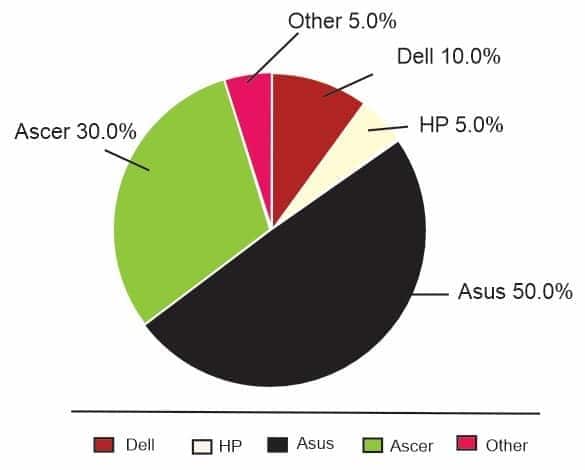
Question: Using the data given above, find how many laptops Asus have more than Acer.
4. Directions: In a group of friends, they were asked about their preferred vacation destinations. 50% wanted to visit the mountains, 40% preferred the beach, and 30% were interested in both.
Question: Calculate the percentage of friends who had a preference for either the mountains or the beach.
5. Directions: In a Venn diagram representing three sets, Set A has 25 elements, Set B has 30 elements, and Set C has 20 elements. The intersection of A and B contains 15 elements, the intersection of B and C contains 10 elements, and the intersection of A and C contains 5 elements. Intersection of A, B and C has 3 elements.
Question: How many elements are in the union of all three sets?
6. Directions: Study the bar diagram carefully and answer the questions. The bar diagram shows the trends of foreign direct investment (FDI) into India from all over the World (in Rs. crores).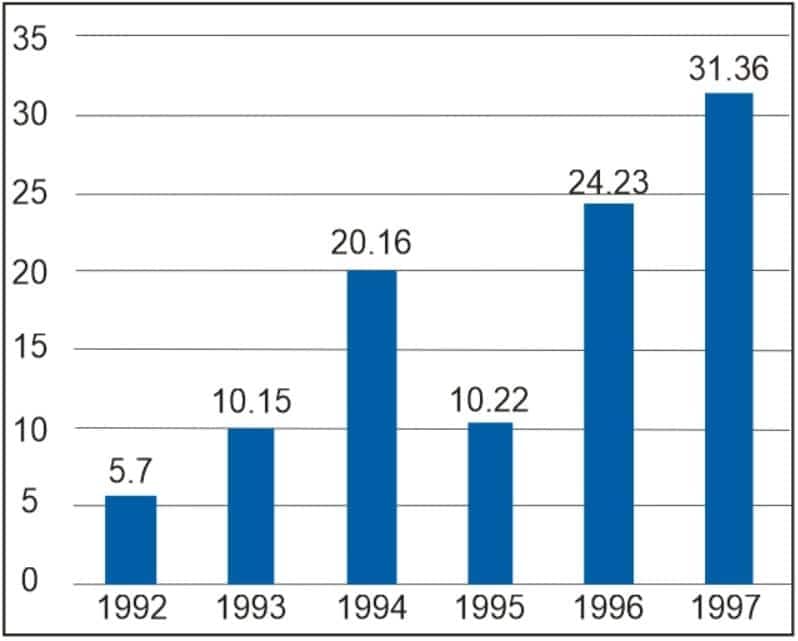
Question: The sum of FDI of 1995 and 1993
7. Directions: Read the following instructions and answer the questions given below.
In a coding scheme, each alphabet letter is assigned a unique code, consisting of a single or double digit. The scheme is case-insensitive, meaning it does not distinguish between upper and lower case letters. Decode the following sentence using the provided coding scheme:
"Apple is a fruit."
The coded sentence is: "261515114 818 26 51720819 ."
Question: What is the code for the letter "u"?
8. Directions: Read the instructions and answer the question carefully.
Wind turbine maker Leone Energy posted a net loss of Rs. 250 crore for the fourth quarter ended March 31, 2010, as against a net profit of Rs. 350 crore in the same quarter a year ago. In the financial year 2009-10, the company clocked a gross income of Rs. 6,517 crore, as against Rs. 9,778 crore in the previous year. Leone Energy clocked a loss of Rs. 1,100 crore in 2009-10, as against a net profit of Rs.320 crore in 2008-09. The sales revenues stood at Rs. 22,400 crore for the year, approximately 21 per cent less than Rs. 28,350 crore last year. For the financial year ending March 31, 2010, Leone Energy’s sales volume (in terms of capacity of projects executed) was 4,560 MW from 2,935 MW a year ago. The CEO of Leone Energy in his message to shareholders suggested that the poor performance of the company was the result of adverse economic conditions during the year ended March 31, 2010.
Question: You are a shareholder owning 5% of the shares of Leone Energy, have seen the stock price decline by more than 50% during the year 2009-10, and are quite upset with the way the management has been handling the business. You have decided to confront the management at the next shareholders’ meeting and have chosen the following 5 points to argue against the CEO’s version of the story. In light of the above paragraph, select the most appropriate order of these 5 statements that you, as a disappointed shareholder, should adopt as a stringing and robust preface in your case against the management in front of the management and other shareholders.
a. The management is not doing its best to maintain the profitability of the company.
b. The company has increased its sales volume during the year under consideration.
c. The adverse economic conditions have led to a worldwide increase in the adoption of alternative energy sources, reflecting in all-time highest profits for wind turbine makers in both developed and developing countries.
d. The management has been lax with its employees as the management enjoys a large set of benefits from the company that they would have to forgo if they became strict with employees.
e. The company is trying to increase sales by charging lower, unprofitable prices.
9. Comprehension: Eight gymnastics players numbered 1 through 8 underwent a training camp where they were coached by three coaches - Xena, Yuki, and Zara. Each coach trained at least two players. Yuki trained only even numbered players, while Zara trained only odd numbered players. After the camp, the coaches evaluated the players and gave integer ratings to the respective players trained by them on a scale of 1 to 7 , with 1 being the lowest rating and 7 the highest.
The following additional information is known.
1. Xena trained more players than Yuki.
2. Player-1 and Player-4 were trained by the same coach, while the coaches who trained Player-2, Player-3 and Player-5 were all different.
3. Player-5 and Player-7 were trained by the same coach and got the same rating. All other players got a unique rating.
4. The average of the ratings of all the players was 4.
5. Player-2 got the highest rating.
6. The average of the ratings of the players trained by Yuki was twice that of the players trained by Xena and two more than that of the players trained by Zara.
7. Player-4's rating was double of Player-8's and less than Player-5's.
Question: What was the rating of Player-6?
10. Comprehension: Six web surfers M, N, O, P, X, and Y each had 30 stars which they distributed among four bloggers A, B, C, and D. The number of stars received by A and B from the six web surfers is shown in the figure below.
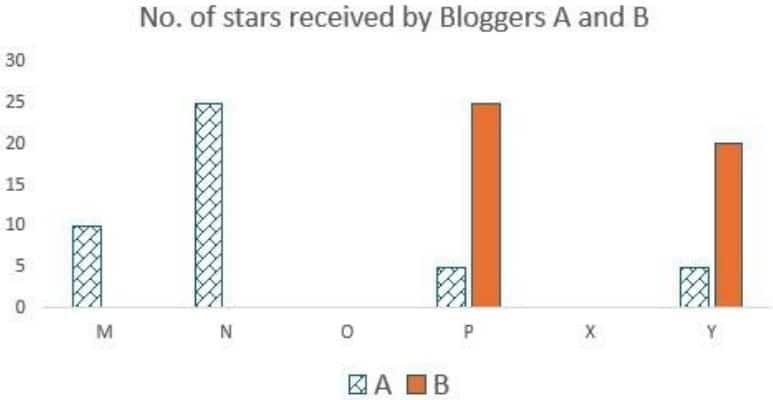
The following additional facts are known regarding the number of stars received by the bloggers from the surfers.
1. The numbers of stars received by the bloggers from the surfers were all multiples of 5 (including 0).
2. The total numbers of stars received by the bloggers were the same.
3. Each blogger received a different number of stars from M.
4. Two surfers gave all their stars to a single blogger.
5. D received more stars than C from Y.
Question: What was the total number of stars received by D?
CAT LRDI Types of Questions
Careers360 provides 100+ CAT LRDI practice question sets with solutions, carefully divided by topic to help candidates master every question type. These resources allow students to build confidence by attempting exam-style sets and then reviewing detailed explanations.
Logical Reasoning Sets
These sets cover seating arrangements, team distributions, and blood relation puzzles, which often appear in CAT. Practising such problems helps students strengthen reasoning flow and eliminate confusion. Many CAT LRDI questions 2026 practice sets are designed to reflect the real exam’s logical structures.
Data Interpretation Sets
Data-based problems built on tables, bar charts, and pie charts form the backbone of LRDI. These sets test both accuracy and speed under timed conditions. Solving from a CAT logical reasoning and data interpretation PDF helps aspirants refine calculation skills while learning how to interpret complex datasets quickly.
Mixed LRDI Caselets
CAT frequently combines reasoning and data in a single caselet to test deeper analytical skills. For example, a company sales case may involve interpreting data while applying logical constraints. Practising with CAT 2026 LRDI sets with solutions ensures students know how to approach such hybrid challenges.
Seating Arrangement, Venn Diagram & Puzzle-Based LRDI Questions Explained
Some of the most challenging yet scoring areas in the CAT 2026 LRDI section come from seating arrangements, Venn diagrams, and puzzle-based sets. These problems demand clarity of logic, attention to detail, and the ability to handle multiple conditions at once. Practicing through CAT LRDI questions 2026 practice sets ensures students get enough exposure to variations and learn the shortcuts that save time in the exam.
Seating Arrangement Questions
Seating arrangement problems test spatial reasoning and logical sequencing. Candidates may face circular, linear, or grid-based setups where multiple conditions must be satisfied simultaneously. By solving CAT LRDI practice questions 2026 in this category, aspirants can learn how to build diagrams, eliminate contradictions, and arrive at accurate solutions within minutes.
Example:
Eight people are sitting around a circular table. A is sitting between B and C. D is two places to the right of B. E is opposite C. Who is sitting opposite A?
Solution (short):
Placing A between B and C, then D two right of B fixes half the circle. E opposite C places F opposite A. Hence, F sits opposite A.
Venn Diagram-Based Sets
Venn diagram questions often appear when candidates need to analyse overlapping groups, such as survey data or customer segmentation. These sets require a balance of set theory concepts and logical deduction. Accessing a CAT logical reasoning and data interpretation PDF with solved examples helps students visualise intersections quickly and reduce calculation errors.
Example:
In a group of 100 students, 40 like cricket, 50 like football, and 20 like both. How many students like neither sport?
Solution (short):
Cricket + Football – Both = 40 + 50 – 20 = 70.
So, 100 – 70 = 30 students like neither sport.
Puzzle-Based LRDI Sets
Puzzle-driven sets may involve distribution, ranking, or scheduling tasks, where logical deductions must be applied step by step. These are highly common in CAT and can vary in difficulty from moderate to extremely tough. Working with CAT 2026 LRDI sets with solutions allows aspirants to understand problem patterns, review detailed explanations, and practise the art of elimination when stuck.
Example:
Three friends – X, Y, and Z – each like a different fruit: apple, banana, and mango. X does not like apple. Y does not like banana. Who likes which fruit?
Solution (short):
If X doesn’t like apple, he must like banana or mango. Y doesn’t like banana, so Y must like apple. That leaves Z with mango. Final answer: X → Banana, Y → Apple, Z → Mango.
CAT 2026 DILR Most Important Topics
While analysing the previous year's question papers and the latest examination trends, a few topics from the DILR section are seen to stand out. Focusing on these sections and amending the CAT 2026 exam preparation strategies can be extremely helpful for the candidates to score better in the DILR section of the CAT examination. The most important topics to prioritise under the CAT 2026 DILR section are:
CAT 2026: 10 Most Important Topics -Data Interpretation and Logical Reasoning | |
Topics | Graphs: Questions involving bar graphs, line charts, pie charts, or combination charts to interpret data. |
Routes and Networks: Pathfinding problems, shortest or longest route, network traversal logic-based questions. | |
Reasoning-Based Data Interpretation: DI questions combined with logical reasoning – expect caselets, constraints, and inference-heavy scenarios. | |
CAT 2026 Mock Test by Careers360
The CAT 2026 mock test by Careers360 is one of the most effective tools for aspirants to boost their preparation. This free online CAT mock test is designed on the official CAT 2026 exam pattern, giving students a real exam-like experience across all sections – VARC (Verbal Ability & Reading Comprehension), DILR (Data Interpretation & Logical Reasoning), and Quantitative Aptitude.
Being a computer-based CAT practice test, it allows candidates to get comfortable with the actual test interface, question navigation, and most importantly, time management strategies. Practicing with this mock helps aspirants reduce exam-day anxiety and improve accuracy.
Title | Link |
CAT 2026 Free Mock Test |
After attempting the CAT 2026 Careers360 mock test, students receive an in-depth performance analysis report, which includes:
Time spent per question and section
Accuracy levels in each part of the test
Identification of strong and weak areas
Personalized insights for strategy improvement
These expert-driven analytics enable aspirants to fine-tune their CAT 2026 preparation strategy and focus on areas that need the most attention.
Students can easily access the Careers360 CAT 2026 mock test online through the official link provided below and start practicing for better scores in the upcoming exam.
CAT 2026 DILR Best Books
Preparing for the CAT Data Interpretation and Logical Reasoning (DILR) section for CAT 2026 becomes easier with the right preparation books and study materials. Students preparing for CAT 2026 should consider these recommended CAT 2026 best study materials to enhance their overall DILR performance and maximize their percentile scores. Below are some of the most recommended books for CAT DILR preparation that students should consider including in their study plan to boost their overall performance.
Book Title | Details |
How to Prepare for Data Interpretation for CAT by Arun Sharma | A reliable book offering detailed coverage of data interpretation, including topics like data analysis, bar charts, line graphs, and logical puzzles. |
Logical Reasoning and Data Interpretation for the CAT by Nishit K. Sinha | Highly recommended for CAT aspirants due to its deep focus on logical reasoning and DI. It includes topics such as tables, pie charts, caselets, and logical games. |
Data Interpretation & Data Sufficiency by Ananta Ashisha | Well-organised content that progresses from basic to advanced concepts, with a strong focus on graphs, charts, tables, and logical deductions. |
CAT 2026 Preparation Resources by Careers360
Careers360 CAT eBooks are comprehensive digital guides created to support effective exam preparation. These resources cover all three key sections, Quantitative Aptitude, Verbal Ability & Reading Comprehension, and Data Interpretation & Logical Reasoning. Each eBook offers clear topic-wise explanations, solved examples, CAT Previous Year Question Papers. These help aspirants build strong concepts and improve performance.
eBook Title | Download Links |
3000+ Most Important Words - Vocabulary Builder | |
500+ Most Important Idioms and Phrases | |
300+ Most Important Phrasal Verbs | |
Permutation & Combination - Video Lectures and Practice Questions | |
CAT 2026 DILR Questions with Expert Solutions |
Frequently Asked Questions (FAQs)
Q: What are CAT 2025 LRDI questions?
A:
CAT 2025 LRDI questions test Logical Reasoning and Data Interpretation skills through puzzles, seating arrangements, tables, charts, and graphs. These questions assess analytical thinking, problem-solving, and decision-making abilities. Practising LRDI sets helps aspirants handle complex problems efficiently in the exam.
Q: Why are LRDI practice sets important for CAT 2025?
A:
LRDI practice sets train candidates to solve diverse question types under time pressure. They improve speed, accuracy, and pattern recognition, which are crucial for scoring high. Regular practice also builds confidence to tackle high-difficulty LRDI questions in CAT 2025.
Q: What are CAT LRDI 2025 practice sets?
A:
CAT LRDI 2025 practice sets are curated question groups designed to simulate actual exam difficulty. They include Logical Reasoning and Data Interpretation problems that help improve accuracy, speed, and analytical thinking.
Q: How do LRDI practice sets help in CAT preparation?
A:
Regularly solving LRDI practice sets helps you recognise data patterns, choose the right sets faster, and manage time better. It also builds your stamina for solving complex puzzles under pressure.
Q: How many LRDI sets should I solve daily for CAT 2025?
A:
Ideally, solving 2–3 CAT 2025 DILR sets daily ensures consistent improvement. Gradually, you can increase difficulty and analyse your accuracy for targeted learning.
Q: What’s the best way to analyse LRDI practice sets?
A:
After solving, review your approach step-by-step to identify where time was lost or logic failed. Re-solve incorrectly attempted sets to strengthen your reasoning section.
Articles
Related Stories
|
Upcoming Bschool Exams

Certifications By Top Providers
Explore Top Universities Across Globe
Popular Courses and Specializations
List of colleges accepting CAT
Browse Bschool Colleges by State
Questions related to CAT
On Question asked by student community
Have a question related to CAT ?
If you have already received your final MA result and have technically completed the degree , but you are only waiting for the revaluation outcome, you would generally be considered a graduate rather than someone whose master's degree is still completely in progress. However, CAT has specific instructions about qualification
If you mean CAT (Common Admission Test) preparation, you can practise with previous-year CAT papers. IIM has a collection of CAT papers from 2017 to 2025, covering VARC, DILR and Quant across different slots, along with solutions and explanations. Solving the recent papers first can help you understand the current
Hello Student,
Yes, you can apply for CAT with an EWS certificate issued in Hindi, provided it is issued by the competent authority and follows the required format. However, CAT applicants need a Central-level EWS certificate, not merely a state-level EWS certificate. Since you are from Uttar Pradesh, ensure your
Hey there,
If you mean your MBA counselling seat-allotment letter, the exact download process depends on the counselling authority.
Usually:
- Open the official MBA counselling portal.
- Log in with your application/registration number and password/DOB.
- Go to Seat Allotment / Allotment Result.
- If a seat has been allotted, select “Download/Print Allotment
With a Telangana state merit rank of 10,953, admission to MBBS Category A in Hyderabad Muslim minority colleges is generally very difficult. However, you may have a better chance for BDS Category A, depending on the year's cutoff and seat availability.
Popular CAT Questions
Directions for question:
The bar-graph given below shows the foreign exchange reserves of Nepal (in million Rupees) from 2014 to 2021. Answer the following questions based on the graph :

Question:
What was the percentage increase (rounded to the nearest integer, if deemed necessary) in the foreign exchange reserves in

Study Resources, Applications and Opportunities
Globally Recognized by AACSB (US) & AMBA (UK) | 18 LPA Avg. CTC for PGPM 2026
XAT- Xavier Aptitude Test 2027
Apply75+ years of legacy | #1 Entrance Exam | Score accepted by 250+ BSchools
Career Launcher Race To 99%ile In CAT 2026 - Phase 03
Enquire6-Hour Masterclass to help you score 99+ percentile in CAT 2026
NMAT by GMAC 2026
ApplyTest centres are available in 70+ cities across India | 75,000+ aspirants apply for the NMAT exam | Accepted by 58+ institutions like NMIMS, KJSIM, ISB, SPJIMR and Great Lakes.
Common Admission Test 2026 (CAT 2026)
ApplyRegistration Start: 3 August 2026 | Last Date to Apply: 15 September 2026 (till 5 PM)
IBSAT 2026-ICFAI Business School MBA/PGPM 2027
ApplyAACSB Accredited | 40 LPA-Highest CTC | Scholarships worth 10 CR
CAT Notifications
Never miss CAT update
Get timely CAT updates directly to your inbox. Stay informed!