
Search Colleges, Exams, Schools & more


Login
One of the most prominent issues that candidates from non Maths background face is weak performance in the Quantitative Aptitude section. Since the questions in the CAT exam from the Quant section are extremely tricky and rely heavily on the application of concepts and formulas. Therefore, a high VARC score alone is not enough for admission to most IIMs. Candidates must also clear the Quant sectional cutoff to get admission to top B schools.
This Story also Contains
- CAT Quant Topic-Wise Difficulty Analysis (Based on Recent CAT Trends)
- How Many CAT Quant Questions Should You Target for 90, 95 and 99 Percentile?
- CAT Quant Weightage Trends
- Top Quant Topics to Master First If You're Weak at Maths
- How Much Time Should You Spend on VARC vs Quant?
- Best Books of CAT Quant for Beginners
- Can Strong VARC Compensate for Weak Quant?
- Free Resources to Improve CAT Quant Preparation

In this article, we have discussed a good CAT Quant preparation strategy for candidates who are struggling with Quantitative Aptitude but wish to crack the exam.
CAT Quant Topic-Wise Difficulty Analysis (Based on Recent CAT Trends)
The Quantitative Ability section in CAT has changed noticeably over the last few years. As per trends, questions asked in CAT are more concept- and logic-focused. Rather than lengthy calculations, candidates have to keep these CAT Quant Logics at their fingertips.
Topic | Expected Questions | Difficulty Level (Based on Trends) | Trend Analysis | Preparation Priority |
Arithmetic | 8–10 | Moderate | Highest-weightage area in recent CAT papers. Questions test concept application rather than calculations. | Very High |
Algebra | 5–7 | Moderate to High | Strong presence in every paper. Linear equations, quadratics, inequalities, and logarithms appear regularly. | Very High |
Geometry & Mensuration | 3–5 | Moderate | Questions are fewer but often require strong conceptual understanding of basic theorems. | High |
Number System | 2–3 | Moderate to High | Asked less frequently, but questions can be tricky and involve divisibility or remainders. | Medium |
Modern Mathematics | 1–2 | Easy to Moderate | Lowest weightage. Probability and Permutation & Combination appear occasionally. | Medium to Low |
How Many CAT Quant Questions Should You Target for 90, 95 and 99 Percentile?
The number of Quant questions required for a particular percentile changes every year because the CAT question paper varies in difficulty and scores are scaled. Instead of aiming for a fixed score, candidates should focus on the number of correct answers with high accuracy. In recent CAT exams, attempting fewer questions with good accuracy has been more effective than attempting many questions with frequent mistakes.
Target Quant Percentile | Recommended Attempts | Correct Answers | Target Accuracy | Approximate Raw Score |
90 Percentile | 10–12 | 8–9 | 80–85% | 22–26 |
95 Percentile | 12–14 | 10–11 | 85–90% | 28–32 |
98 Percentile | 14–16 | 12–13 | 85–90% | 34–38 |
99 Percentile | 16–18 | 14–16 | 90%+ | 40–46 |
CAT Quant Weightage Trends
Let’s have a look at the past 5 years’ weightage of Quantitative Aptitude in the CAT exam below.
CAT Quantitative Aptitude Weightage Trend (2020 - 2025)
Year | Total CAT Questions | Quant Questions | Quant Weightage (in %) | Total Marks |
2025 | 68 | 22 | 32.35 | 204 |
2024 | 68 | 22 | 32.35 | 204 |
2023 | 66 | 22 | 33.33 | 198 |
2022 | 66 | 22 | 33.33 | 198 |
2021 | 66 | 22 | 33.33 | 198 |
2020 | 76 | 26 | 34.21 | 228 |
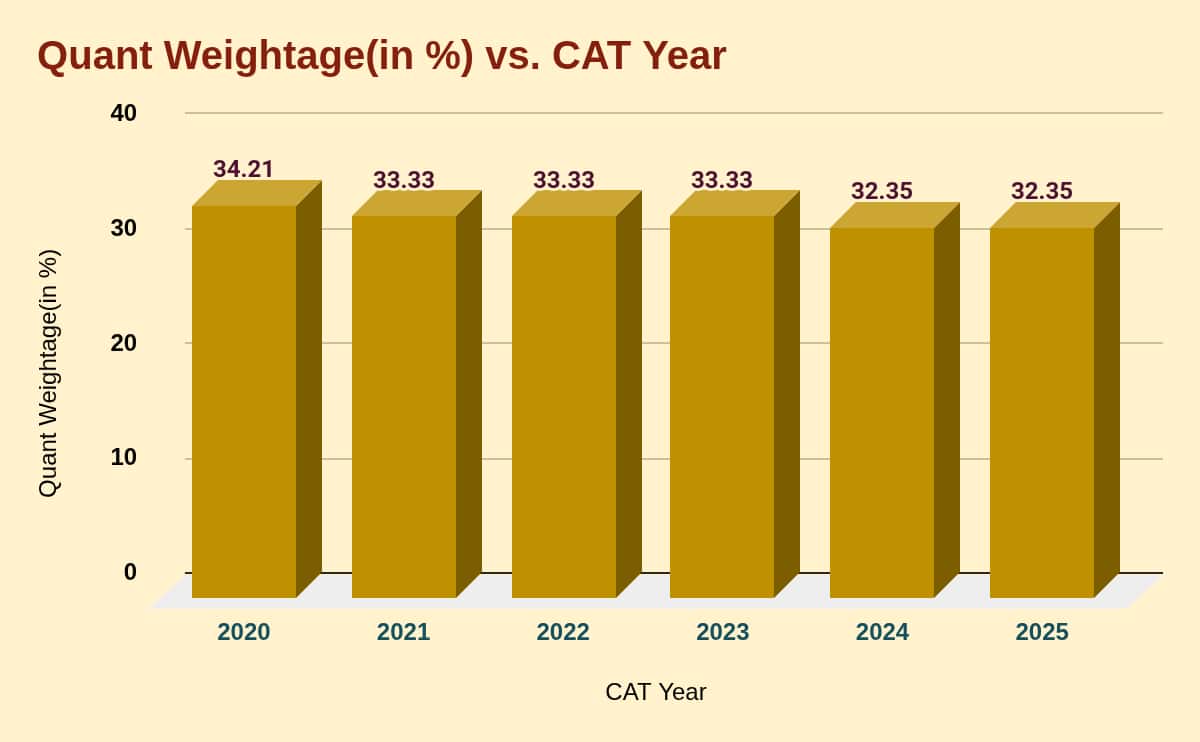
The above clearly shows the weightage of the quant section in the total CAT paper. The trend has be shown from CAT 2020 to CAT 2025.
Top Quant Topics to Master First If You're Weak at Maths
Candidates who are not comfortable with mathematics should avoid starting with advanced topics such as Permutation & Combination or Probability. The better approach for CAT 2026 preparation is to begin with chapters that have simple concepts, regular question patterns, and high weightage in the CAT.
Topic | Why Start with It? | Difficulty Level | Expected Weightage* |
Forms the base for many Arithmetic topics such as Profit & Loss and SI-CI | Easy | 1–2 Questions | |
Ratio, Proportion & Partnership | Frequently used in Arithmetic and easy to understand with practice | Easy | 1–2 Questions |
Averages & Mixtures | Formula-based and requires basic calculations | Easy | 1–2 Questions |
Direct application of percentages and commonly tested | Easy to Moderate | 1–2 Questions | |
Standard concepts with predictable question types | Moderate | 1–2 Questions | |
Important Arithmetic topic with regular CAT questions | Moderate | 1–2 Questions | |
Simple & Compound Interest | Short formula-based questions that are easy to master | Easy to Moderate | 1 Question |
Linear Equations | Builds the foundation for Algebra | Moderate | 1–2 Questions |
One of the first Algebra topics to learn | Moderate | 1–2 Questions | |
Geometry Basics | Helps understand figures, angles, triangles, and circles before moving to advanced Geometry | Moderate | 2–3 Questions |
How Much Time Should You Spend on VARC vs Quant?
There is no fixed study-hour ratio for VARC and Quant because the right allocation depends on a candidate's current level. However, candidates must do a proper mock test analysis to know how much time they are spending on weaker sections as compared to stronger ones.
Candidate Profile | Daily VARC Time | Daily Quant Time | Why This Works |
Strong VARC, Weak Quant | 45–60 minutes | 2–2.5 hours | Quant requires concept building and repeated practice. VARC skills are maintained through daily reading and RC practice. |
Weak VARC, Strong Quant | 2 hours | 1–1.5 hours | Reading speed and comprehension improve gradually, making regular VARC practice essential. |
Weak in Both Sections | 1.5–2 hours | 1.5–2 hours | Balanced preparation ensures steady improvement across both sections without creating a large gap. |
Strong in Both Sections | 1–1.5 hours | 1–1.5 hours | Focus shifts from learning concepts to mocks, revision, and accuracy improvement. |
Best Books of CAT Quant for Beginners
Many CAT aspirants find Quantitative Ability difficult, especially if they have not studied mathematics for a few years or come from a non-engineering background. The right CAT books help build concepts step by step instead of starting with difficult questions. Go through the section below to get best books to aid your CAT preparation strategy.
Book | Author |
Quantitative Aptitude for Competitive Examinations | R.S. Aggarwal |
How to Prepare for Quantitative Aptitude for CAT | Arun Sharma |
Quantitative Aptitude Quantum CAT | Sarvesh K. Verma |
Quantitative Aptitude for CAT | Nishit K. Sinha |
The Pearson Guide to Quantitative Aptitude for CAT | Dinesh Khattar |
Fast Track Objective Arithmetic | Rajesh Verma |
NCERT Mathematics (Classes 8–10) | NCERT |
Can Strong VARC Compensate for Weak Quant?
Yes, a strong VARC score can help candidates improve their CAT percentile. However, it cannot fully compensate for your weak score in Quant. The reason being that leading MBA colleges consider both overall percentile and sectional percentile for final selection.
Let's understand this with an example, suppose a candidate has scored CAT 99 percentile in VARC, but he does not qualify for the Quant sectional cut off. Then, the top IIMs will reject his application at the very instant. However, other candidates who have just scored a medium score in Quant but an exceptional score in VARC and DILR still have the chance to score in the 98 to 99th percentile.
Free Resources to Improve CAT Quant Preparation
Candidates looking to qualify for CAT 2026, even though they are weak in the Quant section, must also refer to popular ebooks. These Careers360 ebooks cover each section in detail and also provide practice questions to master the exam with high marks.
Title | Download Link |
The CAT Arithmetic Hackbook PDF: Zero Math Background? No Problem- Concepts, Questions | |
CAT Algebra Handbook 2026: Everything You Need to Master Algebra-Concepts, Practice Questions | |
CAT 2026 Number System PDF Handbook: Complete Concepts, Practice Questions & Solutions | |
CAT 2026 Geometry & Mensuration PDF: Important Concepts, Shortcuts & Practice Questions | |
CAT 2026 Quantitative Aptitude Questions with Answers | |
CAT 2026 Quantitative Aptitude Study Material PDF - Geometry and Mensuration | |
500+ Idioms And Phrases List With Meanings & Examples For MBA Entrance Exams | |
Permutation & Combination - Important Concepts, Videos, Questions for CAT & Other MBA Entrance Exams | |
CAT 2026 Verbal Ability and Reading Comprehension (VARC) Study Material PDF | |
CAT VARC: 3000+ Most Important English Words | |
CAT 2026 Mock Test Series - 20 Sets, Questions with Solutions By Experts |
Frequently Asked Questions (FAQs)
Q: Can I crack CAT if I am good at VARC but weak in Quant?
A:
Yes, you can crack the CAT if you are good at VARC but weak in Quant. However, you might not get selected in a good IIM or B-school since colleges consider overall marks.
Q: Which Quant topics should I prepare first for the CAT exam?
A:
Start with Arithmetic topics such as Percentages, Profit and Loss, Time and Work, Time, Speed and Distance, Averages, Ratio and Proportion, and Simple & Compound Interest. These topics form a major part of the CAT Quant section.
Q: How much time should I dedicate to Quant preparation every day?
A:
If Quant is your weak area, dedicate 1.5 to 2 hours daily to learning concepts, solving topic-wise questions, and analysing your mistakes.
Q: Should I focus more on VARC or spend extra time improving Quant?
A:
No, a strong VARC score can improve your overall percentile, but you still need to perform well in Quant. Work on improving your basics and aim to clear the Quant sectional cutoff while maintaining your VARC performance.
Q: What is the best strategy to improve Quant accuracy before CAT?
A:
Start by understanding the basic concepts and practise questions every day. Solve previous years' CAT questions, take regular sectional tests, and review your mistakes after each test.
Articles
Related Stories
|
Upcoming Bschool Exams

Certifications By Top Providers
Explore Top Universities Across Globe
Popular Courses and Specializations
List of colleges accepting CAT
Browse Bschool Colleges by State
Questions related to CAT
On Question asked by student community
Have a question related to CAT ?
If by B-category you mean management/private quota MBBS seats, the cutoff is very different from government-quota MBBS.
In Tamil Nadu, management-quota MBBS seats are available in self-financing/private medical colleges through the state counselling process. The closing rank varies significantly between colleges and counselling rounds. The 2025 counselling data shows that
Hello Student,
With a CAT 2025 percentile of 98.25, you have a good chance of receiving calls from several IIMs, particularly newer IIMs. However, IIM Ahmedabad , Bangalore , Calcutta , and Lucknow generally require higher percentiles for General-category candidates. Calls also depend on sectional percentiles, academics, work experience, and
Hello Aspirant,
Yes, you can access CAT preparation resources, including mock tests, practice questions, previous-year papers, and study material. Explore the CAT preparation resources and test series using the link below:
https://bschool.careers360.com/download/ebooks-and-sample-papers?exam=45
Hope this Helps!
Hello CAT Aspirant!
If you mean the CAT ( Common Admission Test) EWS certificate, the important point is whether the certificate is valid and issued in the prescribed format, rather than simply the language used on it.
Yes, a Hindi EWS certificate can generally be accepted for CAT, provided it
Popular CAT Questions
Directions for question:
The bar-graph given below shows the foreign exchange reserves of Nepal (in million Rupees) from 2014 to 2021. Answer the following questions based on the graph :

Question:
What was the percentage increase (rounded to the nearest integer, if deemed necessary) in the foreign exchange reserves in

Study Resources, Applications and Opportunities
Globally Recognized by AACSB (US) & AMBA (UK) | 18 LPA Avg. CTC for PGPM 2026
XAT- Xavier Aptitude Test 2027
Apply75+ years of legacy | #1 Entrance Exam | Score accepted by 250+ BSchools
Career Launcher Race To 99%ile In CAT 2026 - Phase 03
Enquire6-Hour Masterclass to help you score 99+ percentile in CAT 2026
NMAT by GMAC 2026
ApplyTest centres are available in 70+ cities across India | 75,000+ aspirants apply for the NMAT exam | Accepted by 58+ institutions like NMIMS, KJSIM, ISB, SPJIMR and Great Lakes.
Common Admission Test 2026 (CAT 2026)
ApplyRegistration Start: 3 August 2026 | Last Date to Apply: 15 September 2026 (till 5 PM)
IBSAT 2026-ICFAI Business School MBA/PGPM 2027
ApplyAACSB Accredited | 40 LPA-Highest CTC | Scholarships worth 10 CR
CAT Notifications
Never miss CAT update
Get timely CAT updates directly to your inbox. Stay informed!