Great Lakes - PGDM & PGPM Admissions 2027
Globally Recognized by AACSB (US) & AMBA (UK) | 18 LPA Avg. CTC for PGPM 2026


With IIM Indore taking charge of CAT 2026, a familiar question has come back again among MBA aspirants: Does the conducting IIM leave its fingerprint on the CAT question paper? Starting from CAT 2013 and CAT 2014, right up to the pandemic-era CAT 2020, IIM Indore has handled some pretty memorable versions of the exam. So naturally, many candidates are digging into old papers, trying to spot clues about the CAT 2026 difficulty level, the kind of questions that might show up, and how each section usually moves across VARC, DILR, and QA. Now, no one can truly predict the exact CAT paper, but past years often show small patterns that are worth noticing. Like, could CAT 2026 have a more concept-driven Quant section? Will DILR remain as unpredictable as in recent years, or did people just overthink it? And is the idea of a “tougher CAT” really just another exam-season myth, repeated too many times? In this article, we will walk through IIM Indore’s track record as a CAT conducting institute, revisit CAT 2013, 2014, and 2020, compare the trends in their question papers, and see whether the exam actually got tougher when IIM Indore was at the helm. Then we’ll discuss what aspirants can, realistically, expect from CAT 2026.
To learn more about the insights of the previous years where IIM Indore conducted the CAT exam, check out IIM Indore is Back for CAT 2026! Big Pattern Changes Incoming?
With IIM Indore expected to conduct CAT 2026, a lot of aspirants keep asking if the exam might end up looking different from recent years. The curiosity comes mainly from how IIM Indore handled CAT years back in 2013, 2014, and 2020, which people generally recall for testing different abilities and also bringing in some clear shifts in pattern.
Now, even though the conducting institute cannot totally dictate how CAT paper will feel or what it will contain, its previous years have still motivated candidates to revisit older trends, and look for tiny hints for CAT 2026.
CAT 2026 will be the fourth time IIM Indore conducts the Common Admission Test.
CAT Year | Key Highlight |
CAT 2013 | Concept-focused approach |
CAT 2014 | Increased question count |
CAT 2020 | Reduced duration |
CAT 2026 | Yet to be conducted |
These years differed significantly from one another, which is why IIM Indore's return has generated considerable discussion among MBA aspirants.
Many students closely follow the conducting institute, because they think it can influence the overall nature of the exam and such, I mean it can. Even if CAT stays largely standardized, aspirants still often look for some potential patterns in the difficulty level, question selection, sectional emphasis, and a practical test-taking strategy.
CAT Year | Key Skill Rewarded |
CAT 2013 | Conceptual Strength |
CAT 2014 | Question Selection |
CAT 2020 | Adaptability |
This kind of thing hints that the different CAT years tied to IIM Indore didn’t quite reward the same strengths, more like they leaned into various weak points or skills, rather than sticking to one smooth template all the time.
Yeah, to some extent, sure. The institute actually running it might sway which kinds of questions show up, how balanced the sections feel, and even the overall “vibe” of the exam. But it can’t fully reshape CAT, because the test is still a strictly standardized, national-level exam.
Can Influence | Cannot Easily Change |
Question Selection | Core CAT Structure |
Sectional Emphasis | Percentile System |
Difficulty Distribution | Purpose of CAT |
Exam Philosophy | National Standards |
The more interesting observation is that IIM Indore's previous CAT years did not necessarily make the exam tougher; instead, they appeared to shift the skills being tested.
Year | What the Exam Rewarded |
CAT 2013 | Solving challenging problems |
CAT 2014 | Managing a larger paper efficiently |
CAT 2020 | Adapting to a changed format |
The biggest takeaway is that IIM Indore’s previous CAT years were more about a shift in focus, than some steady, always-rising difficulty curve. For CAT 2026 aspirants, it’s probably more productive to build fundamentals, stay flexible in the way you approach questions, and refine a test-taking strategy rather than trying to guess the exact “shape” of the paper beforehand.
IIM Indore has run CAT three times before: 2013, 2014, and 2020. Even though those exams didn’t look identical in structure, or in how hard they felt, each one mirrored how CAT itself keeps evolving and in turn tested candidates in different ways. So reviewing these years gives some useful background, for all the talk around CAT 2026.
CAT 2013 was mostly viewed as a concept-oriented exam that sort of favored candidates who could reason well and solve problems in a clear way. The paper needed careful thinking, plus a firm grasp of core Quant themes and ideas.
Feature | CAT 2013 |
Total Questions | 60 |
Duration | 140 Minutes |
QA Focus | Concepts and calculations |
DILR Style | Traditional sets |
VARC Style | Conventional RC and VA |
Strong conceptual understanding was still kind of important, but not really the only thing. Accuracy often mattered more than those aggressive attempts, and yeah, that made a difference. Arithmetic, Algebra, and Geometry all played meaningful roles in the whole process.
CAT 2014 brought in one of the biggest structural shifts that people had seen up to that point. With the increase in the number of questions, candidates had to change the way they approached the exam completely.
Feature | CAT 2014 |
Total Questions | 100 |
Duration | 170 Minutes |
Major Change | Increased question count |
Focus | Strategy and time management |
More questions meant more decision-making.
Time management became even more important.
Candidates really had better chances to maximize their scores because of smarter question choices and a bit of strategy in what to pick.
CAT 2020 actually happened in unusual situations, and the exam duration was shorter too. Because of that, it became even more crucial to make quick decisions and run the whole thing in an efficient way.
Feature | CAT 2020 |
Total Questions | 76 |
Duration | 120 Minutes |
Major Change | Reduced duration |
Focus | Adaptability |
Less time available per question.
Reading-intensive VARC section.
Greater emphasis on efficient problem-solving.
Despite their differences, some common themes can be observed across CAT 2013, 2014, and 2020.
Trend | Observation |
Analytical Thinking | Consistently important |
Aptitude-Based Testing | Strong focus throughout |
Strategic Decision-Making | Valuable in every year |
Adaptability | Increasingly important |
Instead of cheering rote memorization, all three exams leaned on reasoning, careful analysis, and kind of smart decision-making, like they wanted you to think first not just recite.
The earlier CAT years handled by IIM Indore don’t really show one fixed CAT exam pattern, but they do point out some recurring inclinations that aspirants usually talk about.
Mostly, the Quant portions linked with IIM Indore seemed to favor comprehension over remembering things, even when the question looked simple at first glance.
Topic Area | Importance |
Arithmetic | High |
Algebra | High |
Geometry | Moderate |
Modern Math | Moderate |
DILR evolved noticeably across the three years.
Year | DILR Characteristics |
2013 | Conventional reasoning sets |
2014 | Greater variety |
2020 | More complex interpretations |
VARC remained a major scoring area, but the style evolved.
Year | VARC Focus |
2013 | Traditional RC and VA |
2014 | Broader verbal coverage |
2020 | Reading-heavy and inference-based |
The emphasis increasingly moved toward comprehension and interpretation rather than direct answers.
One of the most interesting differences across the three years was the balance between speed and accuracy.
CAT Year | What Mattered Most |
CAT 2013 | Accuracy |
CAT 2014 | Speed and Selection |
CAT 2020 | Adaptability and Execution |
This shows that while the exam format kind of shifted over time, success always depended on picking the right approach for the paper you have in front of you.
When you look at CAT 2013, CAT 2014, and CAT 2020 together, you get a clearer picture on how the exam evolved under IIM Indore. Rather than becoming consistently easier or harder, each year tested candidates differently and rewarded a distinct skill set.
Feature | CAT 2013 | CAT 2014 | CAT 2020 |
QA Focus | Concepts & Calculations | Broad Topic Coverage | Efficient Solving |
DILR Focus | Traditional Sets | Diverse Set Types | Complex Interpretation |
VARC Focus | Traditional RC | Expanded Coverage | Reading Intensive |
While all three papers were considered competitive, the source of difficulty varied. CAT 2013 sort of challenged conceptual understanding, CAT 2014 tested time management since the paper was larger, and CAT 2020 kinda increased pressure by reducing the time and forcing quicker decision-making requirements.
One of the most striking differences was the exam structure itself. CAT 2014 featured the highest question count among the three, while CAT 2020 reduced both the duration and the number of questions quite a lot. So aspirants had to keep adjusting to changing exam conditions, not just depend on previous year patterns that people usually trust.
CAT 2013 taught the value of solid fundamentals. CAT 2020 pushed aspirants towards adaptability. Put together, these years showed that clearing CAT is not only about subject knowledge, there is more to it.
This question is really common among CAT aspirants. However, history does not suggest that IIM Indore automatically produces tougher CAT papers.
Many students think that the organizing institute, like straight up directly, decides whether CAT will be easy or difficult. But that is not exactly how it works. CAT is actually formed through a multi-level academic process, with several rounds of scrutiny, plus standardization that keeps things fairly consistent.
Even if the convening institute manages the examination process, it still cannot really overhaul CAT’s core intent. The test has to keep judging aptitude, logical reasoning, and comprehension skills, for a large group of candidates. So no, one institute doesn’t just redesign the whole thing overnight, or with a single decision.
Difficulty is often influenced by:
Question quality and complexity.
Sectional balance.
Time available per question.
Candidate preparedness.
Overall performance of the test-taking population.
Test centres are available in 70+ cities across India | 75,000+ aspirants apply for the NMAT exam | Accepted by 58+ institutions like NMIMS, KJSIM, ISB, SPJIMR and Great Lakes.
AACSB Accredited | 40 LPA-Highest CTC | Scholarships worth 10 CR
Because CAT is percentile-based, even a difficult paper may not significantly change admission outcomes.
Probably not, but, the earlier CAT years under IIM Indore kinda show that the institute has been linked with some notable shifts in exam structure and emphasis. So aspirants should, you know, be ready for moderate changes, don’t assume it will be a total overhaul.
Past patterns can’t really predict CAT 2026, yet they can hint at what might stay relevant.
CAT 2013 showed that concept oriented Quant sections can separate strong candidates from the average, in a very real way. A similar focus on understanding rather than doing shortcuts would not feel surprising at all.
In most CAT papers, including ones under IIM Indore, Arithmetic and Algebra keep contributing the biggest chunk of questions. Those areas will likely stay at the center of CAT 2026 preparation too.
Candidates should be comfortable with, or at least familiar enough to not freeze on:
Caselets
Arrangements
Games and tournaments
Data interpretation-based reasoning
Hybrid DI-LR sets
Also, recent CAT trends point toward versatility being more important than perfecting just one kind.
VARC is likely to keep centring on reading comprehension, inference-based questions, para summaries, and logical flow-type questions. Solid reading routines will remain one of the biggest advantages for aspirants; honestly, it’s like a quiet multiplier.
If you want to prepare and strengthen your concepts, you can check out: CAT Algebra PDF Handbook 2026: Everything You Need to Master
For practising questions and strengthening concepts, check this out: The CAT Arithmetic Hackbook PDF: Zero Math Background? No Problem
The three CAT years conducted by IIM Indore offer valuable lessons that remain relevant today.
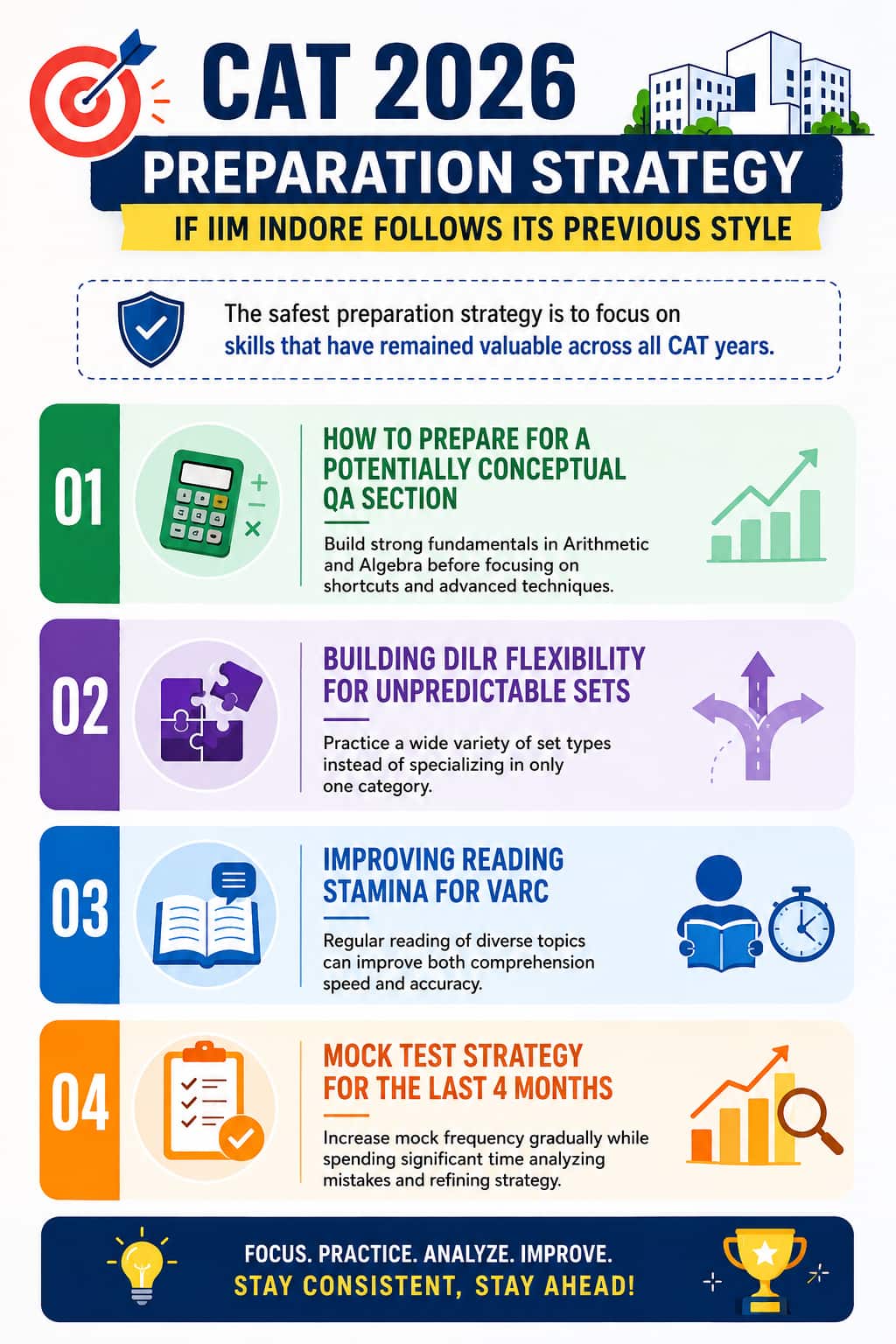
Lesson 1 - Fundamentals Beat Shortcuts, when the paper becomes conceptual, a strong understanding of fundamentals provides a much bigger advantage than memorized tricks.
Lesson 2 - Percentile relies on relative results, not some fixed score, so your outcome is compared with other candidates, somehow, and it really does not matter as much “where you land” in absolute terms.
Lesson 3 - Adaptability matters way more than guesses or predictions. Most aspirants keep trying to forecast the paper, but high performers just adjust to whatever shows up on exam day.
Lesson 4 - Balanced preparation is what usually wins, because people who keep working all three sections consistently tend to be in a better stance when something unexpected turns up.
Looking for the best CAT 2026 preparation resources? Check out these carefully selected CAT 2026 eBooks, study material, and some preparation guides that can really help you strengthen your concepts, and also boost your probability of getting a high percentile. Take a look and compare them before you commit to just one thing.
| Title | Download Link |
CAT 2026 Arithmetic Important Concepts and Practice Questions | |
CAT 2026 Algebra Important Concepts and Practice Questions | |
Ultimate DILR CAT 2026 Guide: Concepts, Practice Sets, and Detailed Solutions | |
CAT 2026 Exam: Success Strategy for Working Professionals & College Students | |
CAT 2026 Quantitative Aptitude 20 Free Sectional Tests | |
CAT 2026 DILR Masterbook - Practice 100 DILR Sets to score 90+ Percentile | Download Now |
CAT 2026 - 30 Days Preparation Time Table | |
CAT 2026 Quantitative Ability Mock Test by IIM CAT 2024 Toppers | |
CAT 2025 Official Question Paper with Solutions (Slot 1, 2 and 3) | |
Avoid These Common CAT 2026 RC Mistakes to Boost Your VARC Score |
The short answer is no.
What History Suggests
In previous IIM Indore CAT years, they often rewarded different skills and sometimes, coincided with notable changes in exam structure. like the vibe shifted just enough to catch a few people off guard.
What History Cannot Predict
History can’t say the exact pattern, or the difficulty level, or any surprises that CAT 2026 might include. It’s more of a compass than a timetable, you know.
The Smartest Approach for CAT 2026 Aspirants
Instead of fretting about the paper setter, just stay on the fundamentals, build adaptability, do mock tests consistently, and keep your preparation well balanced. those strengths have kept their value across CAT 2013, CAT 2014, CAT 2020, and they will likely stay relevant in CAT 2026 too, even if the surface changes a bit.
Frequently Asked Questions (FAQs)
Yes, IIM Indore will conduct CAT 2026. It will be the fourth time the institute will conduct the exam, after handling CAT in 2013, 2014 and 2020.
Not really. Those earlier CAT years under IIM Indore had a different structure, and different emphasis, but there is no clear proof that they were always more difficult than the other CAT years.
IIM Indore previously conducted CAT 2013, CAT 2014, and CAT 2020. So CAT 2026 will be its fourth role as the CAT convening institute.
No. Even if the convening institute can nudge certain things, big pattern changes usually come from broader academic and administrative decisions , not only from the convening institute’s preferences.
No. Candidates should just keep working on solid basics, raise their mock test scores, and maintain a stable balanced routine instead of switching everything around every time, for example because which IIM is conducting it this round.

On Question asked by student community
Hello CAT Aspirant!
If you mean the CAT ( Common Admission Test) EWS certificate, the important point is whether the certificate is valid and issued in the prescribed format, rather than simply the language used on it.
Yes, a Hindi EWS certificate can generally be accepted for CAT, provided it
If you have already received your final MA result and have technically completed the degree , but you are only waiting for the revaluation outcome, you would generally be considered a graduate rather than someone whose master's degree is still completely in progress. However, CAT has specific instructions about qualification
If you mean CAT (Common Admission Test) preparation, you can practise with previous-year CAT papers. IIM has a collection of CAT papers from 2017 to 2025, covering VARC, DILR and Quant across different slots, along with solutions and explanations. Solving the recent papers first can help you understand the current
Hello Student,
Yes, you can apply for CAT with an EWS certificate issued in Hindi, provided it is issued by the competent authority and follows the required format. However, CAT applicants need a Central-level EWS certificate, not merely a state-level EWS certificate. Since you are from Uttar Pradesh, ensure your
Hey there,
If you mean your MBA counselling seat-allotment letter, the exact download process depends on the counselling authority.
Usually:
Directions for question:
The bar-graph given below shows the foreign exchange reserves of Nepal (in million Rupees) from 2014 to 2021. Answer the following questions based on the graph :

Question:
What was the percentage increase (rounded to the nearest integer, if deemed necessary) in the foreign exchange reserves in

Globally Recognized by AACSB (US) & AMBA (UK) | 18 LPA Avg. CTC for PGPM 2026
75+ years of legacy | #1 Entrance Exam | Score accepted by 250+ BSchools
6-Hour Masterclass to help you score 99+ percentile in CAT 2026
Test centres are available in 70+ cities across India | 75,000+ aspirants apply for the NMAT exam | Accepted by 58+ institutions like NMIMS, KJSIM, ISB, SPJIMR and Great Lakes.
Registration Start: 3 August 2026 | Last Date to Apply: 15 September 2026 (till 5 PM)
AACSB Accredited | 40 LPA-Highest CTC | Scholarships worth 10 CR