Great Lakes - PGDM & PGPM Admissions 2027
Globally Recognized by AACSB (US) & AMBA (UK) | 18 LPA Avg. CTC for PGPM 2026


CAT 2026 exam is merely four months away, but it does not mean that you cannot crack the exam even if you start today. If you follow a proper CAT preparation strategy, then you can maximise your marks and also crack a top B school. But what is a good CAT 2026 preparation plan? Well, experts suggest that you must first work on your fundamentals and then go for practice. Going the other way round causes confusion and a lot of mistakes. As of now, IIMs have not announced the CAT 2026 exam date. However, based on past year trends, the exam will be held tentatively on the last Sunday of November.
This Story also Contains

In this article, we have discussed the 4 Month CAT Plan perfect for late starters along with preparation tips and resources.
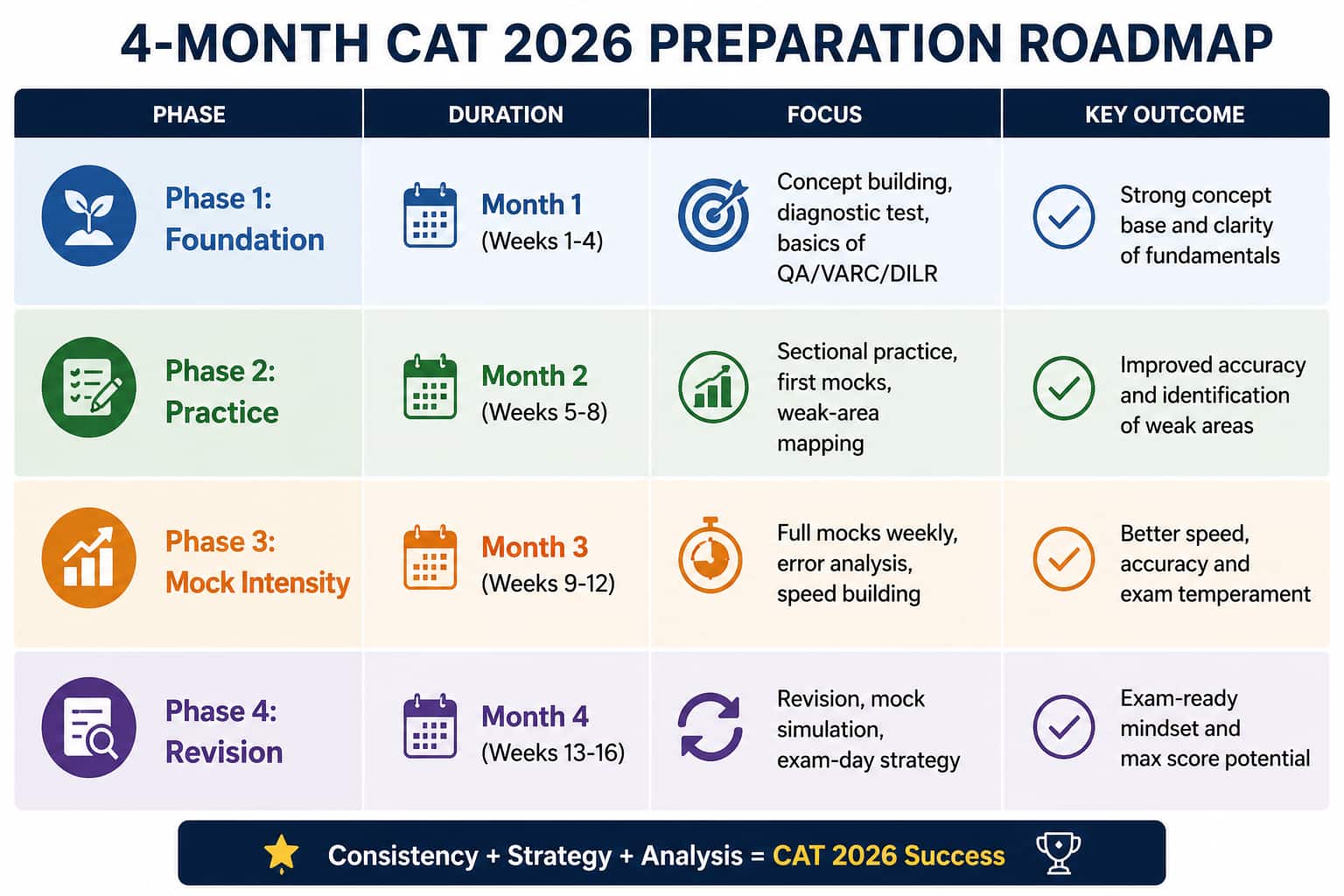
Of course, but then again, you will need to work hard each day to crack the CAT paper. You must develop a systematic approach and cover all the subjects.
Let us understand this with the help of an example. If you are new to Quantitative Aptitude, then you should first mark the chapters you are comfortable with and then clear the basics. Once your basics are done, move to practice https://bschool.careers360.com/articles/cat-exam-topic-wise-weightage-analysis-qa-dilr-varcquestions. Categorise the questions from Easy to Difficult level so that your confidence level remains intact.
Follow a similar approach for the DILR as well. However, VARC needs a different approach, and you must make a habit of reading CAT English editorials every day. This section accounts for around 70% of the questions in the exam.
Your first month is not about solving cat 2026 mock tests. It's about getting your fundamentals sorted so mocks actually make sense later.
Attempt a mock test before you start your CAT 2026 preparation. This is extremely helpful to get a crux of where you stand and what sections you need to work on.
Pick NCERT books from class 8 to 10 of Maths and begin revising concepts of topics like percentages, ratios, averages, time-speed-distance, profit-loss.
Start reading for 30 minutes daily, which includes editorials and opinion pieces from newspapers like The Hindu and The Indian Express.
After you have understood the basic concepts related to Number Systems, Algebra, and Arithmetic, start solving application based questions.
Start with questions of DILR and in Quant start with DI questions. This will increase your problem solving skills
Para-jumble and RC practice will boost your concept insights for the VARC section.
Now, since you have cleared your basics in the first month of your four-month CAT study plan. The next level is to develop the speed of solving problems. Set weekly targets for yourself and accomplish them:
Week | Focus Areas | Daily Targets | Weekend Goals |
Week 5 | Build Accuracy | • VARC: 2 RCs + 15 VA questions • DILR: 2 complete sets daily • QA: Arithmetic (Percentages, Profit & Loss, Time & Work) + 25 questions • Revise Month 1 concepts for 20 mins | Take 1 Sectional Mock (VARC) Analyse every incorrect answer Revise error notebook |
Week 6 | Increase Speed | • VARC: 3 RCs under time limit • DILR: 2–3 sectional sets • QA: Algebra + Number System (30 questions/day) • Learn shortcuts and calculation techniques | Take 1 Full-Length CAT Mock Spend 3–4 hours analysing it Identify weak topics |
Week 7 | Strengthen Weak Areas | • Revise topics where mock accuracy was below 70% • VARC: RC inference & para-jumbles • DILR: Mixed sets • QA: Geometry & Modern Math practice | Solve Previous Year CAT Questions (1 section) Update mistake notebook Revise formulas |
Week 8 | Exam Readiness | • Mixed practice from all three sections • Solve 60–70 questions daily • Focus on question selection and time management • Revise all formulas and vocabulary | 1 Full-Length CAT Mock Analyse attempts, skips, and accuracy Prepare Month 3 strategy based on performance |
By now you should be taking one full mock every week, without exception.
Shift from learning new concepts to sharpening what you know.
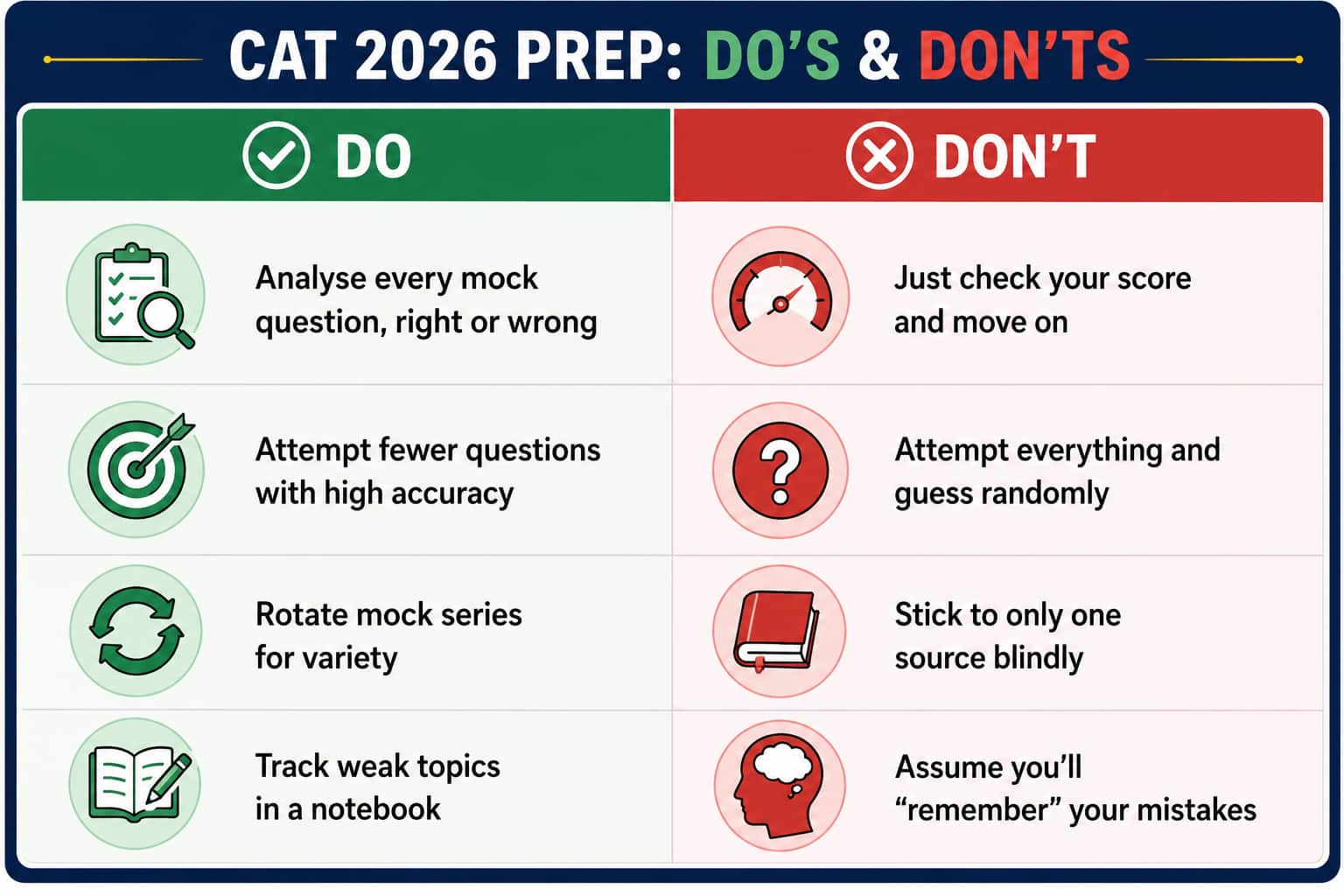
Spend more time analysing mocks than taking them — a 3-hour mock deserves at least 2 hours of review.
Track your accuracy percentage per section, not just your overall score.
The final month of your CAT 4 month preparation journey should be focused completely on revision. You must make a CAT revision strategy for yourself, prioritising things like CAT formulas, short tricks, and difficult Vocabulary words. Also, when you attempt CAT mock tests in this phase, your goal should be to do it in a way that creates a strategy for the exam day. Other things to keep in mind are not to start any new topics and only focus on revision.
Preparing for the CAT 2026 exam along with an 8-hour job is not impossible but slightly difficult. However, there are ways in which you can streamline your preparation with the right strategy. You do not need to study 8 hours straight during CAT exam preparation. Instead, a smart schedule that covers every aspect of your everyday preparation is enough. Refer to the table below to get the daily timetable you must follow as a working professional preparing for the CAT.
Time | Activity | Purpose |
6:00 AM – 6:15 AM | Wake up and freshen up | Start the day with a fresh mind |
6:15 AM – 7:30 AM | CAT Study Session 1 (90 mins) | Learn a new concept (QA/LRDI/VARC) when concentration is highest |
7:30 AM – 8:00 AM | Breakfast and get ready for work | Recharge before office |
8:00 AM – 9:00 AM | Commute (if applicable) | Listen to vocabulary podcasts, editorials, or CAT strategy videos |
9:00 AM – 6:00 PM | Office Hours | Focus on work; avoid burnout |
During Lunch Break (20–30 mins) | Solve 8–10 VARC questions or revise formulas | Make productive use of breaks |
6:00 PM – 7:00 PM | Commute/Home and relax | Take a short mental break |
7:00 PM – 8:00 PM | Dinner and unwind | Avoid studying immediately after work |
8:00 PM – 10:00 PM | CAT Study Session 2 (2 hours) | Practice sectional questions, timed sets, or analyse previous mocks |
10:00 PM – 10:20 PM | Revise key formulas, vocabulary, and mistakes | Reinforce concepts before sleeping |
10:30 PM | Sleep | Aim for 7–8 hours of quality sleep |
One thing that students often miss during their journey of the CAT 2026 exam is that this is a competitive exam. Therefore, you need to follow a smart approach as your ultimate goal is to maximise your marks. You do not have to study for 9 to 10 hours straight. Simply stick to a strategy that enables you to get hold of topics that can actually elevate your percentile.
Strategy | What You Should Do | Why It Matters |
Prioritise High-Weightage Topics | Cover topics that appear frequently in CAT before low-priority chapters. | Increases your chances of scoring more marks with limited preparation time. |
Study with Daily Goals | Set a clear target for each study session, such as completing one chapter or one DILR set. | Keep your preparation focused and measurable. |
Take Regular Mock Tests | Attempt one mock every 2–3 weeks initially, then one every week closer to the exam. | Helps improve speed, accuracy, and exam temperament. |
Analyse Every Mock | Spend more time analysing mistakes than taking the mock itself. | Identifies weak areas and prevents repeating the same errors. |
Strengthen Your Strong Sections | Continue practising sections where you already perform well while improving weaker ones. | A stronger section can significantly boost your overall percentile. |
Practise Mocks | Solve sectional tests and previous year CAT questions within the actual time limit. | Improves time management and decision-making during the exam. |
Maintain an Error Log | Note down mistakes, shortcuts, and concepts you frequently forget. | Regular revision of errors leads to continuous improvement. |
Avoid Comparing Yourself | Focus on your own mock scores and weekly progress instead of others' preparation. | Reduces stress and helps maintain consistency. |
Be Consistent | Study 3–4 focused hours daily instead of long, unproductive sessions. | Consistency is more effective than occasional marathon study sessions. |
Ebook Title |
In the table
Download Link
The CAT Arithmetic Hackbook PDF: Zero Math Background? No Problem- Concepts, Questions
CAT Algebra Handbook 2026: Everything You Need to Master Algebra-Concepts, Practice Questions
CAT 2026 Number System PDF Handbook: Complete Concepts, Practice Questions & Solutions
CAT 2026 Geometry & Mensuration PDF: Important Concepts, Shortcuts & Practice Questions
CAT 2026 Modern Maths PDF Handbook: Key Concepts, Tricks & PYQ-Based Practice
CAT 2025 Slot-by-Slot Master Weightage Matrix PDF
15 CAT Myths That Waste Months of Preparation
CAT 2025 Exam: Success Strategy for Working Professionals & College Students
Frequently Asked Questions (FAQs)
Yes, with 4 months of focused and consistent preparation, an average aspirant may achieve a 90-96 percentile. It won't guarantee a 99+ score if you're starting from absolute zero, but with the right prioritisation of high-weightage topics and disciplined mock test practice, a strong percentile is achievable. The key differentiator isn't total hours studied but how well you analyse your mistakes and adjust your strategy each week.
Aim for roughly 12-16 full-length mocks over 4 months — starting with 1 every two weeks in Month 1-2, moving to 1-2 per week by Month 3-4. What matters more than the count is spending at least an hour or two analysing each mock, tracking accuracy by section, and identifying recurring error patterns rather than just chasing a higher score each time.
No section should be ignored, since CAT has sectional cut-offs. However, late starters often benefit from focusing early on VARC (reading habits take time to build) and core Arithmetic in QA, since these topics carry consistent weightage. DILR set-selection strategy — knowing which sets to attempt— often gives faster percentile gains than trying to master every question type.
A focused 3 hours daily works better than unfocused 6-hour sessions. Split it across QA, VARC, DILR, and revision or mock analysis. Consistency across all 16 weeks matters far more than occasional long study marathons followed by burnout-driven breaks.
Yes, many working professionals successfully prepare for CAT in compressed timelines by using early.

On Question asked by student community
If by B-category you mean management/private quota MBBS seats, the cutoff is very different from government-quota MBBS.
In Tamil Nadu, management-quota MBBS seats are available in self-financing/private medical colleges through the state counselling process. The closing rank varies significantly between colleges and counselling rounds. The 2025 counselling data shows that
Hello Student,
With a CAT 2025 percentile of 98.25, you have a good chance of receiving calls from several IIMs, particularly newer IIMs. However, IIM Ahmedabad , Bangalore , Calcutta , and Lucknow generally require higher percentiles for General-category candidates. Calls also depend on sectional percentiles, academics, work experience, and
Hello Aspirant,
Yes, you can access CAT preparation resources, including mock tests, practice questions, previous-year papers, and study material. Explore the CAT preparation resources and test series using the link below:
https://bschool.careers360.com/download/ebooks-and-sample-papers?exam=45
Hope this Helps!
Hello CAT Aspirant!
If you mean the CAT ( Common Admission Test) EWS certificate, the important point is whether the certificate is valid and issued in the prescribed format, rather than simply the language used on it.
Yes, a Hindi EWS certificate can generally be accepted for CAT, provided it
Directions for question:
The bar-graph given below shows the foreign exchange reserves of Nepal (in million Rupees) from 2014 to 2021. Answer the following questions based on the graph :

Question:
What was the percentage increase (rounded to the nearest integer, if deemed necessary) in the foreign exchange reserves in

Globally Recognized by AACSB (US) & AMBA (UK) | 18 LPA Avg. CTC for PGPM 2026
75+ years of legacy | #1 Entrance Exam | Score accepted by 250+ BSchools
6-Hour Masterclass to help you score 99+ percentile in CAT 2026
400+ Recruiters | Highest CTC 25 LPA | Average CTC 8 LPA | 92% Placements in 2025 | Ranked as Platinum Institute | Awarded Best Business School of the Year
Test centres are available in 70+ cities across India | 75,000+ aspirants apply for the NMAT exam | Accepted by 58+ institutions like NMIMS, KJSIM, ISB, SPJIMR and Great Lakes.
Registration Start: 3 August 2026 | Last Date to Apply: 15 September 2026 (till 5 PM)
 Month 4: Proper Revision (Weeks 13–16)