Great Lakes - PGDM & PGPM Admissions 2027
Globally Recognized by AACSB (US) & AMBA (UK) | 18 LPA Avg. CTC for PGPM 2026


More CAT preparation is useful when the extra time improves accuracy, solving speed, question selection or retention. Once your extra study hours stop improving these indicators, adding more questions, books, or revision may have lower returns. CAT Quant analysis of 330 questions across 15 slots from 2021 to 2025 found that Arithmetic and Algebra together accounted for 73.9% of questions, while Reading Comprehension made up 66.67% of VARC in CAT 2025. These patterns support a focused preparation strategy rather than endlessly expanding study material. With CAT 2026 scheduled for November 29, 2026, knowing when to study more-and when to switch to testing-can directly shape your score.

Over-preparation begins when additional study adds activity without producing measurable improvement. It does not necessarily mean studying for too many hours. A student studying 8 hours inefficiently may be more over-prepared than someone studying 5 focused hours with regular mock analysis and revision.
Productive preparation | Over-preparation |
Revising weak areas | Revising everything repeatedly |
Analysing mistakes | Solving without review |
Using a focused resource set | Collecting multiple resources |
Taking mocks and analysing them | Taking mocks without analysis |
Tracking accuracy and speed | Tracking only study hours |
Reattempting difficult questions | Constantly chasing new questions |
The key metric is simple: Is the extra study improving your performance?
The warning signs usually show up in your preparation pattern and mock results.
Study hours are increasing while mock scores remain unchanged.
You keep solving new questions but repeat the same mistakes.
You delay mocks because you want to complete more topics first.
You keep switching between books, courses and PDFs.
Your accuracy falls sharply after long study sessions.
You spend more time collecting resources than analysing errors.
The clearest warning sign is a mismatch between effort and performance. If your study hours, question count and revision time keep increasing but mock accuracy, percentile, sectional scores or average solving time remain unchanged for several weeks, your preparation strategy may need adjustment.
The problem is not the number of questions itself. It is whether the questions are helping you improve.
The CAT Quant and Data Interpretation and Logical Reasoning preparation material emphasises independent attempts, mistake analysis, revisiting difficult questions and learning which questions or sets to attempt.
Practice pattern | Value |
50 questions + detailed review | High |
100 questions + no analysis | Low |
Difficult PYQs + reattempts | High |
Random questions across sources | Moderate |
Timed practice + error tracking | High |
This is why quality of practice matters more than raw question count.
Practise five years of actual CAT Quant questions to understand recurring concepts, question framing and application-based problem solving.
Download now: CAT Quant PYQs: 2021-2025
One of the most common CAT preparation mistakes is treating every topic as equally important.
The recent CAT papers cover broad areas in Quant, Data Interpretation and Logical Reasoning and VARC, but your preparation should also account for personal accuracy, question frequency and improvement potential.
High priority: Frequently tested + low personal accuracy
Medium priority: Frequently tested + moderate accuracy
Maintenance: Strong areas already producing consistent marks
Low priority: Low-yield areas requiring disproportionate preparation time
This approach makes your CAT 2026 study strategy more score-oriented.
Compare topic-wise representation across CAT 2025 slots to understand where different sections and topics received greater weightage.
Download now: CAT 2025 Slot-Wise Master Weightage Matrix
In recent CAT exams, the CAT exam pattern has been consistent with 68 questions to be answered within 120 minutes, with separate time limits for VARC, DILR and QA. Unused time from one section cannot be transferred to another. That makes timed decision-making essential.
A student who spends most preparation hours solving questions comfortably without a clock may know the syllabus well but still struggle with sectional pacing, question selection and time pressure.
Preparation activity | Priority |
Concept learning | As required |
PYQ practice | High |
Timed sectional tests | High |
High | |
Mock analysis | Very high |
New resources | Low |
Passive revision | Low |
Mock analysis is preparation. It should not be treated as time taken away from studying.
Resource overload can fragment your preparation. Using multiple books, videos, PDFs and test series for the same topic often creates repetition without deeper understanding.
A focused resource stack is usually easier to manage:
One primary concept source
One reliable mock series
One error log
One concise revision resource
Work through five years of CAT DILR sets to understand arrangements, games, charts, networks, distributions and other recurring set structures while improving set-selection skills.
Download now: CAT DILR PYQs: 2021-2025
A common mistake is waiting until every topic feels complete before taking serious mocks.
Once you understand the core concepts and can solve basic questions independently, your preparation should increasingly move towards CAT PYQs, timed sectionals and full-length mocks.
Concept phase: Learn and practise fundamentals
Application phase: Solve CAT PYQs topic-wise
Testing phase: Take timed sectional tests
Simulation phase: Attempt full-length mocks
Correction phase: Analyse mistakes and revise weak areas
Your preparation should gradually become more performance-driven and less content-driven.
Test your current preparation in an exam-like environment and use the results to identify gaps in speed, accuracy and question selection.
Take the free mock: CAT Free Mock Test
Practice multiple mock tests with CAT 2026 Mock Test Series - 20 Sets, Questions with Solutions by Experts
A balanced routine should include learning, practice and feedback. Extending only your study hours can create diminishing returns.
Daily activity | Purpose |
Concept revision | Fix knowledge gaps |
PYQs | Understand CAT-level application |
Timed practice | Build speed |
Error analysis | Correct recurring mistakes |
Revision | Improve retention |
Breaks | Maintain consistency |
The Quantitative Aptitude preparation material specifically recommends analysing mistakes and reattempting difficult questions after a gap to compare improvement in speed and accuracy.
Identify frequently tested Quant concepts and prioritise them while revising for CAT 2026 instead of spending equal time across every possible topic.
Download now: CAT Quant: 10 Most Repeated Concepts
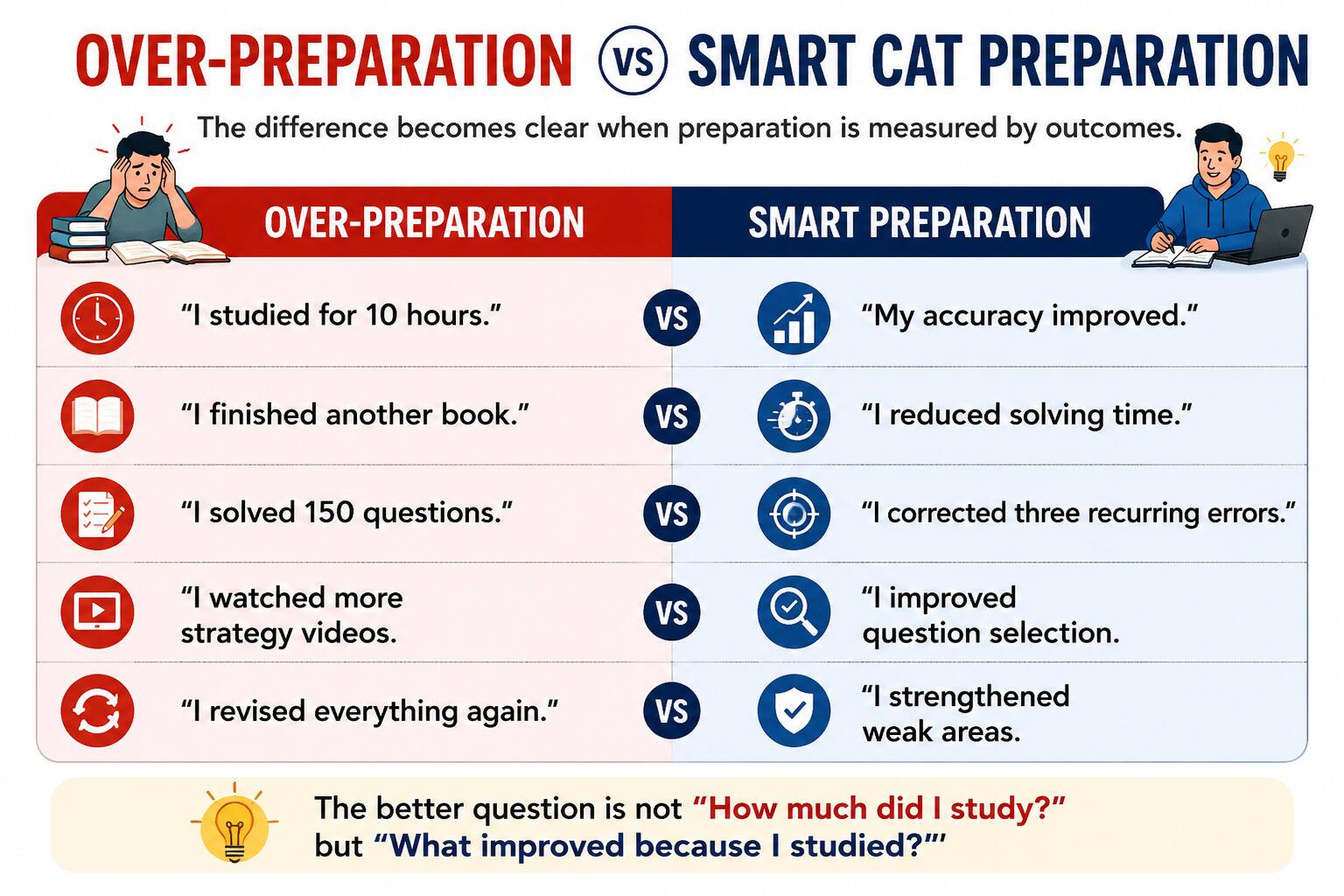
Do not simply cut your study hours. First identify which activities have the lowest return.
Track:
Total study hours
PYQs solved
Mocks taken
Mock-analysis time
Repeated mistakes
Accuracy by section
Average solving time
Sleep and breaks
Test centres are available in 70+ cities across India | 75,000+ aspirants apply for the NMAT exam | Accepted by 58+ institutions like NMIMS, KJSIM, ISB, SPJIMR and Great Lakes.
AACSB Accredited | 40 LPA-Highest CTC | Scholarships worth 10 CR
Then remove activities that consume substantial time without improving your performance.
For example, replacing two hours of random question-solving with one hour of targeted practice and one hour of mock analysis can make the same study window significantly more useful.
Yes, when extra study begins replacing practice analysis, mock tests, revision and recovery. CAT preparation should be measured through performance indicators rather than the number of hours spent studying.
Study with a purpose, test what you know, analyse what went wrong and revise what matters.
Frequently Asked Questions (FAQs)
Additional study helps when it improves accuracy, speed, retention or decision-making. Once those indicators stop improving, increasing study hours alone may have limited value.
There is no universal number. Your weekly study time should be judged by measurable outcomes such as mock performance, accuracy and improvement in weak areas.
Covering the major PYQ range is useful, but detailed analysis and reattempting difficult questions are more valuable than rushing through questions simply to increase the count.
The ideal number varies by preparation stage. The important part is analysing every mock thoroughly and using the findings to adjust your preparation.
Prioritise topics that have a realistic chance of improving your score. In the final phase, strengthening existing concepts and fixing recurring errors can be more productive than trying to master several unfamiliar areas.
Set weekly performance targets instead of only study-hour targets. Track accuracy, solving time, mock scores and recurring errors, and reduce activities that produce little measurable improvement.

On Question asked by student community
If by B-category you mean management/private quota MBBS seats, the cutoff is very different from government-quota MBBS.
In Tamil Nadu, management-quota MBBS seats are available in self-financing/private medical colleges through the state counselling process. The closing rank varies significantly between colleges and counselling rounds. The 2025 counselling data shows that
Hello Student,
With a CAT 2025 percentile of 98.25, you have a good chance of receiving calls from several IIMs, particularly newer IIMs. However, IIM Ahmedabad , Bangalore , Calcutta , and Lucknow generally require higher percentiles for General-category candidates. Calls also depend on sectional percentiles, academics, work experience, and
Hello Aspirant,
Yes, you can access CAT preparation resources, including mock tests, practice questions, previous-year papers, and study material. Explore the CAT preparation resources and test series using the link below:
https://bschool.careers360.com/download/ebooks-and-sample-papers?exam=45
Hope this Helps!
Hello CAT Aspirant!
If you mean the CAT ( Common Admission Test) EWS certificate, the important point is whether the certificate is valid and issued in the prescribed format, rather than simply the language used on it.
Yes, a Hindi EWS certificate can generally be accepted for CAT, provided it
Directions for question:
The bar-graph given below shows the foreign exchange reserves of Nepal (in million Rupees) from 2014 to 2021. Answer the following questions based on the graph :

Question:
What was the percentage increase (rounded to the nearest integer, if deemed necessary) in the foreign exchange reserves in

Globally Recognized by AACSB (US) & AMBA (UK) | 18 LPA Avg. CTC for PGPM 2026
75+ years of legacy | #1 Entrance Exam | Score accepted by 250+ BSchools
6-Hour Masterclass to help you score 99+ percentile in CAT 2026
Test centres are available in 70+ cities across India | 75,000+ aspirants apply for the NMAT exam | Accepted by 58+ institutions like NMIMS, KJSIM, ISB, SPJIMR and Great Lakes.
Registration Start: 3 August 2026 | Last Date to Apply: 15 September 2026 (till 5 PM)
AACSB Accredited | 40 LPA-Highest CTC | Scholarships worth 10 CR