Great Lakes - PGDM & PGPM Admissions 2027
Globally Recognized by AACSB (US) & AMBA (UK) | 18 LPA Avg. CTC for PGPM 2026


Getting ready for CAT 2026 doesn’t really mean you have to master every chapter at the exact same level or at the same speed. Since the exam is tentatively expected on the last Sunday of November 2026, a smarter preparation plan is to start with the areas that have, again and again, shown up as the main attractions in recent CAT papers. If you glance at CAT 2025 and also connect the dots with the patterns from CAT 2024 and a few earlier rounds, you’ll notice clearly: only a handful of topics actually end up making up the bulk of the questions.
This Story also Contains
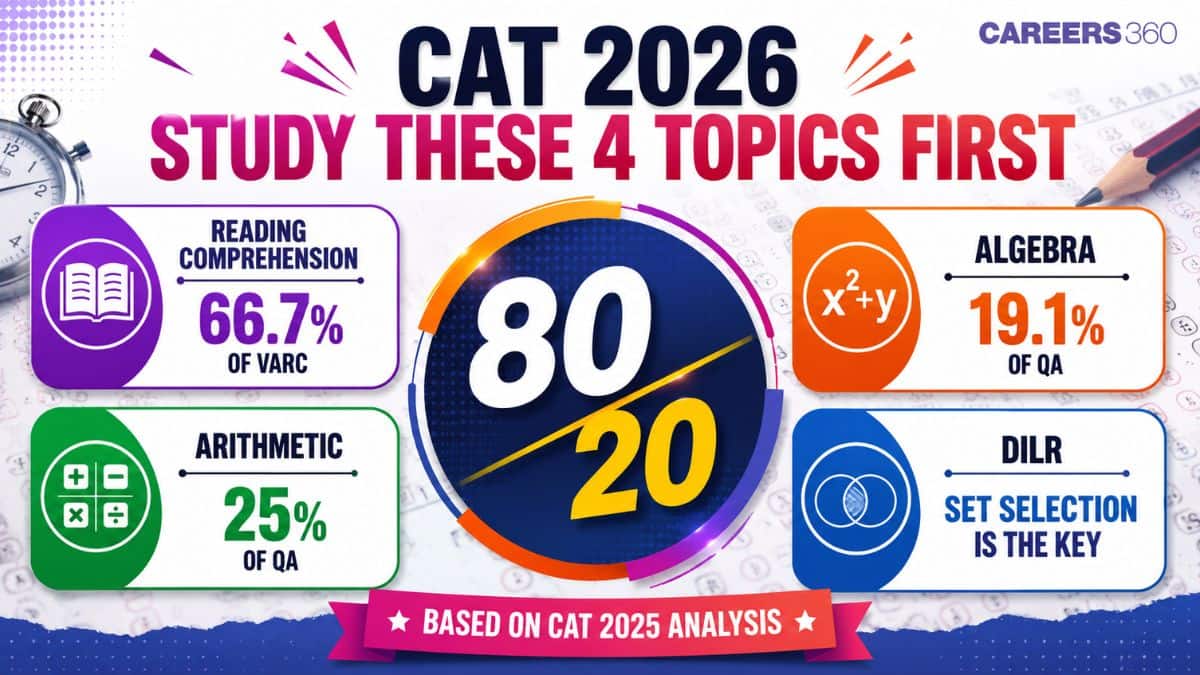
The whole “80/20” approach is that you don’t drop the syllabus; you just prioritise the topics that give the best return for the time you put in. In this article, we give the high-weightage topics so you can prepare in a more focused way and score better too.
Learn how your preparation is so far; Attempt our CAT 2026 Free Mock Test
CAT 2025 went with the same old 68-question-based exam pattern, where there were 24 VARC, 22 DILR and 22 QA. Overall, the difficulty did change a bit across the slots, but the topic distribution remained consistent in a similar way every time.
| Sections | High-Weightage Topics |
|---|---|
VARC | Reading Comprehension |
QA | Arithmetic |
QA | Algebra |
DILR | Tables, Graphs, Arrangements, Puzzles, Caselets |
Priority | Why it matters | CAT 2025 Evidence |
|---|---|---|
Reading Comprehension | 16 of 24 VARC questions (66.7%) | Dominated every slot |
Arithmetic | The largest contributor to QA (25%) | 6 questions across slots |
Algebra | Second-largest QA topic (19.1%) | 4-5 questions across slots |
DILR Set Selection | Determines sectional score more than any individual topic | 5 sets, only 2-3 were highly doable |
The biggest takeaway: Reading Comprehension remained the backbone of VARC, and Arithmetic, along with Algebra, together brought in around 12-14 of the 22 Quant questions (~44%) across all CAT 2025 slots.
Based on the Careers360 CAT 2025 analysis, here is how the Quant topics were distributed section-wise across all three slots.
Topic | Slot 1 | Slot 2 | Slot 3 | Total Questions | Percentage |
|---|---|---|---|---|---|
6 | 5 | 6 | 17 | 25.0% | |
4 (2 Linear Equations + 1 Quadratic + 1 Logarithm) | 5 | 4 questions (Logarithm, Inequalities, Functions) | 13 | 19.1% | |
2 | 3 | 2 questions | 7 | 10.3% | |
2 | 2 | 2 questions | 6 | 8.8% | |
4 | 3 questions (GP, P&C) | 3 questions (Progressions) | 10 | 14.7% | |
Mixed Question (Arithmetic + Algebra ) | 0 | 0 | 1 | 1 | 1.5% |
Miscellaneous / Higher-order Mixed Concepts | 2 | 2 | 2 | 6 | 8.8% |
Coordinate Geometry | 1 | 0 | 0 | 1 | 1.5% |
Quadratic / Functions (counted separately where dominant) | 1 | 2 | 1 | 4 | 5.9% |
There is always an appearance of Arithmetic in each CAT after 2021, while Geometry varies from 1-3 questions. Hence, Arithmetic should be learned first to optimise the expected value.
If CAT 2025 had one clear message, it was that Arithmetic and Algebra continue to dominate Quant.
In Slot 2 alone, around 6–7 questions each came from Arithmetic and Algebra. Slot 3 was again Arithmetic-heavy with questions from Percentages, Profit & Loss, Time & Work, Time-Speed-Distance and Geometry, while Slot 1 featured multiple questions from Linear Equations, Profit & Loss, Mixtures and Coordinate Geometry.
Prioritise these topics first:
Linear Equations
Inequalities
Logarithms
Functions
Geometry, Number System and Modern Mathematics should not be ignored, but they contributed comparatively fewer questions in CAT 2025.
| Topic | Slot 1 | Slot 2 | Slot 3 | Weightage |
|---|---|---|---|---|
Reading Comprehension | 16 | 16 | 16 | 66.7% (16/24) |
Para Summary | 2 | 2 | 2 | 8.3% |
Para Completion | 2 | 2 | 2 | 8.3% |
Para Jumbles / Odd One Out | 4 (2+2) | 4 (2+2) | 4 (2+2) | 16.7% |
No section demonstrates the 80/20 principle better than VARC.
Across CAT 2025, Reading Comprehension accounted for 66.7% of the VARC section, while 33.3% contributed to Verbal Ability. The RC passages touched diverse themes AI and literature, plus economics and science, but the overall structure remained basically the same across the slots.
For most aspirants, improving RC accuracy will have a much greater impact than spending weeks on low-frequency verbal topics.
DILR is set-based, so it is better to analyse recurring set types instead of topics.
| Set Type | Slot 1 | Slot 2 | Slot 3 | |
|---|---|---|---|---|
3 Sets | 3 Sets | 3 Sets | Most recurring | |
Data Interpretation (Tables, Graphs, Charts) | 2 Sets | 2 Sets | 2 Sets | Consistently tested |
Total Sets | 5 | 5 | 5 | 22 Questions |
DILR feels a bit less tied to individual chapters and more to choosing the right set, you have to read the room or something. CAT 2025 kept moving with five sets and 22 questions total, covering graphs, arrangements, puzzles, caselets, and reasoning-based DI.
If you’re starting your CAT 2026 preparation today, here’s the order you should follow for priority, a rough, must-do first list.
1. Reading Comprehension - this is 66.7% of VARC, so focus here early.
2. Arithmetic - the most repeated QA area, over and over.
3. Algebra - with Arithmetic, it adds up to more than half of QA, so don’t treat it lightly.
4. DILR set practice - it helps you get better at choosing the right set and also improves your pace.
5. Geometry basics - you’ll see it regularly, but the weight is usually a bit lower.
6. Number System and Modern Math - keep this for after you’ve mostly mastered the stuff above.
And no, this doesn’t mean you should skip the rest of the syllabus, just that you approach it in this order.
It simply ensures that your preparation is aligned with the areas CAT has tested most consistently in recent years.
If your preparation time is limited, don't ignore these topics-but don't start with them either.
Geometry
Number System
Modern Mathematics
Low-frequency Verbal Ability question types
Recent CAT papers show these areas contribute fewer questions than the four priorities above. Once you've built strong accuracy in Reading Comprehension, Arithmetic, Algebra and DILR set selection, you can expand your preparation to cover the remaining syllabus.
Frequently Asked Questions (FAQs)
From CAT 2025, plus some recent paper trends, Reading Comprehension, Arithmetic and Algebra stay on top for weight, while DILR keeps rewarding those careful set selection skills, which honestly matter a lot.
Yes. Reading Comprehension alone covers 16 out of the 24 VARC questions (66.7%), so it becomes the biggest contributor in the whole section, by a wide margin.
Begin with Arithmetic and Algebra, followed by Geometry basics, Number System and Modern Mathematics. CAT 2025 again gave maximum importance to Arithmetic and Algebra.
Not really. Even if these chapters give you fewer questions than Arithmetic and Algebra, they still keep appearing, and they can give you relatively easier marks if your fundamentals are steady and properly clear.
No. It doesn’t promise anything that. It mainly helps you decide what to study first, using recent CAT trends. In the end, your score still depends a lot on accuracy, your mock test performance, revision cycles, and how carefully you handle time inside the exam.

On Question asked by student community
If by B-category you mean management/private quota MBBS seats, the cutoff is very different from government-quota MBBS.
In Tamil Nadu, management-quota MBBS seats are available in self-financing/private medical colleges through the state counselling process. The closing rank varies significantly between colleges and counselling rounds. The 2025 counselling data shows that
Hello Student,
With a CAT 2025 percentile of 98.25, you have a good chance of receiving calls from several IIMs, particularly newer IIMs. However, IIM Ahmedabad , Bangalore , Calcutta , and Lucknow generally require higher percentiles for General-category candidates. Calls also depend on sectional percentiles, academics, work experience, and
Hello Aspirant,
Yes, you can access CAT preparation resources, including mock tests, practice questions, previous-year papers, and study material. Explore the CAT preparation resources and test series using the link below:
https://bschool.careers360.com/download/ebooks-and-sample-papers?exam=45
Hope this Helps!
Hello CAT Aspirant!
If you mean the CAT ( Common Admission Test) EWS certificate, the important point is whether the certificate is valid and issued in the prescribed format, rather than simply the language used on it.
Yes, a Hindi EWS certificate can generally be accepted for CAT, provided it
Directions for question:
The bar-graph given below shows the foreign exchange reserves of Nepal (in million Rupees) from 2014 to 2021. Answer the following questions based on the graph :

Question:
What was the percentage increase (rounded to the nearest integer, if deemed necessary) in the foreign exchange reserves in

Globally Recognized by AACSB (US) & AMBA (UK) | 18 LPA Avg. CTC for PGPM 2026
75+ years of legacy | #1 Entrance Exam | Score accepted by 250+ BSchools
6-Hour Masterclass to help you score 99+ percentile in CAT 2026
Test centres are available in 70+ cities across India | 75,000+ aspirants apply for the NMAT exam | Accepted by 58+ institutions like NMIMS, KJSIM, ISB, SPJIMR and Great Lakes.
Registration Start: 3 August 2026 | Last Date to Apply: 15 September 2026 (till 5 PM)
AACSB Accredited | 40 LPA-Highest CTC | Scholarships worth 10 CR