
Search Colleges, Exams, Schools & more


Login
Thousands of government exam aspirants wonder whether preparing for CAT means starting from scratch. The good news? Nearly 70% of the syllabus is already common and overlaps. The real challenge is knowing what NOT to study twice. The difference lies in how these skills are tested and at what difficulty level. CAT emphasises conceptual application and problem-solving, while government exams focus on speed, accuracy, and question familiarity.
This Story also Contains
- Can You Prepare for CAT Along with Government Exams?
- Best Strategy for CAT and Government Exams Together
- Should You Prepare for CAT and Government Exams Together?
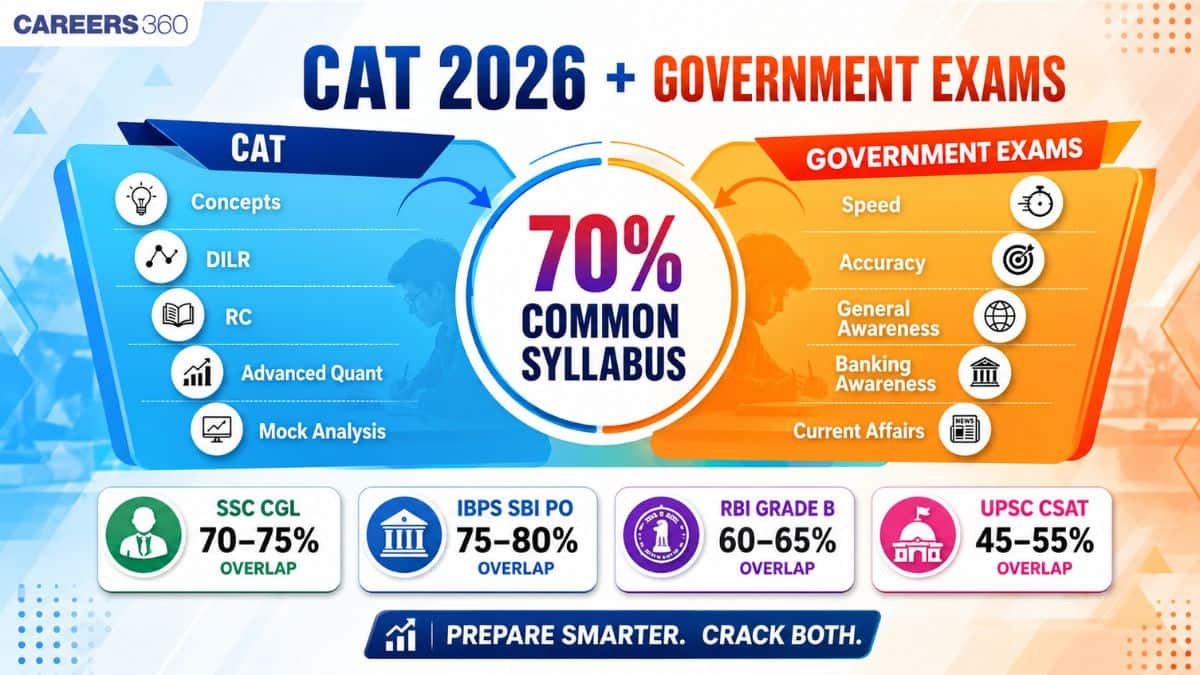
An effective CAT 2026 preparation strategy is to build a common aptitude base first before moving to exam-specific topics.
Mocks don't just measure your preparation - they reveal how you'll think under pressure on the actual CAT. Attempt Now
Can You Prepare for CAT Along with Government Exams?
Yes, but your success depends less on managing two exams and more on understanding how much of the preparation is shared. While CAT 2026 and government exams have different objectives.
CAT = concepts
Government exams = speed
What’s common, what’s different:
CAT and Government Exams: Which Combination Works Best?
Government Exam | Approx. Syllabus Overlap with CAT | Common Subjects | Additional Preparation Required | Dual Preparation Suitability |
75-80% | Quantitative Aptitude, Data Interpretation, Logical Reasoning, English | Banking Awareness | Highly Recommended | |
70-75% | Arithmetic, Algebra, English, Logical Reasoning | General Awareness | Highly Recommended | |
RBI Grade B (Phase I) | 60-65% | Quantitative Aptitude, English, Logical Reasoning | Economics, Finance, Current Affairs | Recommended with Additional Preparation |
UPSC CSE (CSAT) | 45-55% | Reading Comprehension, Aptitude, Logical Reasoning | General Studies, Essay, Optional Subject | Suitable with Careful Planning |
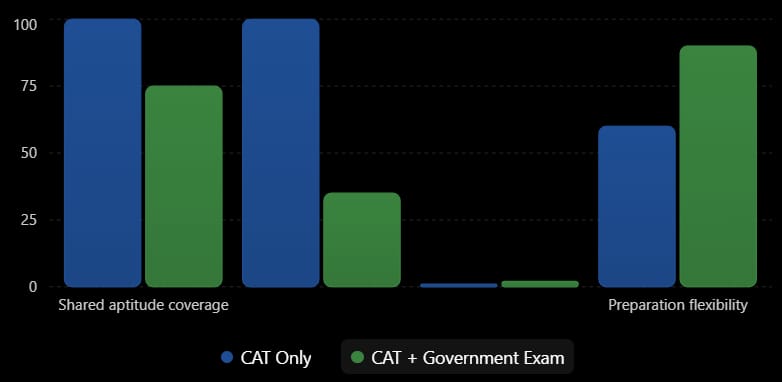
What the Comparison Tells You
Banking exams are the closest match to CAT, so they end up being one of the best picks for dual preparation.
Should I prepare for CAT along with SSC? SSC CGL also lines up well since the aptitude base stays strong, and General Awareness becomes the main extra subject you have to handle.
RBI Grade B is still manageable alongside CAT till Phase II kicks in, and then Economics, plus Finance, start demanding attention.
UPSC CSAT overlaps with CAT on aptitude, but the huge General Studies syllabus means balancing both noticeably tougher.
Is Dual Preparation the Right Choice for You?
If you're preparing for... | Is CAT preparation a good parallel choice? | Why? |
SSC CGL | Yes | High overlap in Quant, English, and Reasoning with limited additional subjects. |
IBPS PO / SBI PO | Yes | Strongest overlap across aptitude sections; only Banking Awareness needs separate focus. |
RBI Grade B | Yes, with planning | Phase I overlaps well, but Phase II requires dedicated subject preparation. |
UPSC CSE | Depends | Suitable if your aptitude foundation is strong and you can separately manage General Studies. |
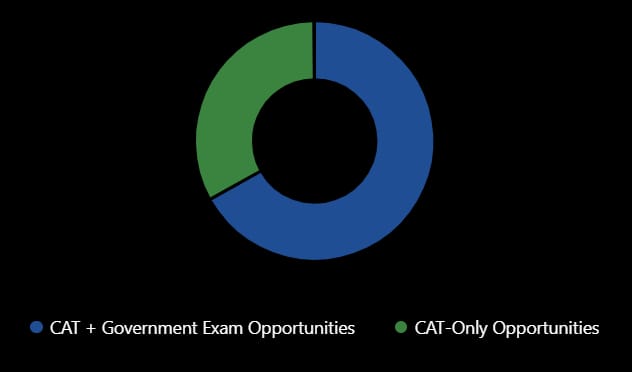 CAT vs Government Exams: Where Does the Preparation Overlap?
One of the biggest misconceptions among aspirants is that CAT and government exams have completely different syllabuses. In reality, there is overlap in the fundamentals, and the difference is in the level of application, the question style and also time management.
Shared Syllabus: Prepare Once, Use in Multiple Exams
The following topics form the core of both CAT and most aptitude-based government exams, so you don’t have to start from scratch twice.
Topic | CAT | SSC CGL | Banking Exams | RBI Grade B | UPSC CSAT | Can Be Prepared Together? |
Arithmetic | Yes | Yes | Yes | Yes | Yes | Yes |
Algebra | Yes | Yes | Partial | Partial | Partial | Mostly |
Number System | Yes | Yes | Yes | Yes | Yes | Yes |
Yes | Yes | Yes | Yes | Yes | Yes | |
Reading Comprehension | Advanced | Basic | Moderate | Advanced | Advanced | Yes |
Vocabulary & Grammar | Advanced | Standard | Standard | Standard | Basic | Yes |
Insight: Roughly 60-80% of your aptitude preparation can be reused between CAT and exams such as SSC CGL or IBPS PO.
Think of a mock series as your performance dashboard, highlighting strengths, weak spots, and section-wise growth. Start Practising.
Where the Preparation Begins to Diverge
Even if the foundation stays the same, these other areas still need dedicated prep, depending on what exam you’re aiming for.
CAT vs Government Exams: The Real Difference
Aspect | CAT | Government Exams |
Focus | Conceptual problem-solving | Speed and accuracy |
Question Pattern | Fewer but more challenging questions | More questions with shorter solving time |
Difficulty Level | Moderate to High | Easy to Moderate (varies by exam) |
Preparation Style | Deep understanding and analysis | Extensive practice and quick execution |
Success Depends On | Selection of the right questions and accuracy | Attempt rate, speed, and consistency |
Best Strategy for CAT and Government Exams Together
Build a common aptitude foundation during the initial months, then gradually increase exam-specific preparation as the exam dates approach.
The Shared Foundation Strategy
Prioritise According to the Exam Calendar
Align your preparation with the exam calendar, not staying the same all year.
Timeline | Primary Focus | Secondary Focus |
6-8 months before CAT | Build a common aptitude foundation | Light preparation for exam-specific subjects |
3-4 months before the first exam | Continue aptitude revision | Increase sectional tests and exam-specific practice |
Last 6-8 weeks before an exam | Mock tests, revision, and exam pattern | Maintain only essential practices for the second exam |
Shift your focus towards whichever examination is scheduled first while maintaining light revision for the other.
How Should You Prepare for CAT and Government Exams Together?
If you’re aiming for CAT preparation without coaching and at the same time prepping for government exams, then picking the right resources matters more than counting study hours; The hours are there, but selection steers everything.
A practical self-study could look like this:
- Stick to one Quant and Reasoning source instead of juggling separate books for CAT and for government exams.
- Do Reading Comprehension practice daily, because it really helps both CAT and RBI Grade B and UPSC CSAT exams; you’ll notice the pattern sooner rather than later.
- Take separate mock tests for each exam, so you can spot the differences in question layout and how you manage time, especially under pressure.
- Keep short notes for formulas, vocab, and current affairs, rather than re-reading multiple resources again and again.
Time | Focus |
1.5 hrs | Quant |
1 hr | Reasoning |
45 min | RC |
30 min | Current Affairs |
45 min | Mock Analysis |
Solve previous CAT papers to experience how concepts are tested - not just what concepts are important. Practice now: Past 10 years' CAT Question Papers with Solutions
The 70-20-10 Preparation Framework
Rather than dividing your schedule by exams, divide it by preparation purpose.
Allocation | Focus |
70% | Shared aptitude topics common to CAT and government exams |
20% | Exam-specific subjects such as DILR, General Awareness, Banking Awareness, or Economics |
10% | CAT Mock tests, performance analysis, and revision |
How to Prepare for CAT and Government Exams in 6 Months
Should You Prepare for CAT and Government Exams Together?
Dual preparation is most effective for aspirants targeting CAT alongside banking or SSC exams because of the significant syllabus overlap. UPSC aspirants should attempt it only if their General Studies preparation is already well structured.
Who Should Consider Dual Preparation?
When Should You Avoid Dual Preparation?
Trying to prepare for both exams might not be the best idea if you’ve got less than 3-4 months before your first big exam, or if you’re still forming basic aptitude concepts from scratch (you’re starting again). Also, when your target government exam has a very syllabus-heavy, subject-oriented structure that really needs dedicated grind, juggling both plans can end up messing with your mock test flow, or at least your consistency.
Frequently Asked Questions (FAQs)
Q: Can I prepare for CAT and SSC together?
A:
Yes. CAT and SSC CGL share a solid base in Quantitative Aptitude, Logical Reasoning, and English. If you prepare these parts conceptually for CAT and then add General Awareness, plus SSC-style practice becomes practical and time-efficient too.
Q: Can UPSC aspirants crack CAT easily?
A:
UPSC aspirants usually get edge in Reading Comprehension, reasoning, and aptitude because of CSAT. Still, CAT needs stronger Data Interpretation, Logical Reasoning, and more advanced Quantitative Aptitude.
Q: How many hours should I study for CAT?
A:
The exact study duration depends on where you are right now and what percentile you’re aiming for. For people aiming at CAT as well as government exams, around 5 to 7 focused hours a day tend to be enough if the basic aptitude portion is studied together and the exam-specific work is handled a bit differently, later on. Not everything should be mashed in the same session; otherwise, too much at once, so a separate plan for each exam helps.
Q: Can banking aspirants prepare for CAT?
A:
Yes, banking exams have one of the highest syllabus overlaps with CAT, especially around Quantitative Aptitude, Data Interpretation and Logical Reasoning, plus English. Usually, banking aspirants need extra practice with those difficult DILR sets and also CAT-like Reading Comprehension.
Q: Which subjects are common in CAT and government exams?
A:
The main common areas are Arithmetic, Number System, Algebra, Logical Reasoning, Reading Comprehension, Vocabulary, and basic Data Interpretation. The real differences show up in General Awareness, Banking Awareness, Economics, General Studies, and CAT’s advanced DILR section.
Articles
Related Stories
|
Upcoming Bschool Exams

Certifications By Top Providers
Explore Top Universities Across Globe
Popular Courses and Specializations
List of colleges accepting CAT
Browse Bschool Colleges by State
Questions related to CAT
On Question asked by student community
Have a question related to CAT ?
If by B-category you mean management/private quota MBBS seats, the cutoff is very different from government-quota MBBS.
In Tamil Nadu, management-quota MBBS seats are available in self-financing/private medical colleges through the state counselling process. The closing rank varies significantly between colleges and counselling rounds. The 2025 counselling data shows that
Hello Student,
With a CAT 2025 percentile of 98.25, you have a good chance of receiving calls from several IIMs, particularly newer IIMs. However, IIM Ahmedabad , Bangalore , Calcutta , and Lucknow generally require higher percentiles for General-category candidates. Calls also depend on sectional percentiles, academics, work experience, and
Hello Aspirant,
Yes, you can access CAT preparation resources, including mock tests, practice questions, previous-year papers, and study material. Explore the CAT preparation resources and test series using the link below:
https://bschool.careers360.com/download/ebooks-and-sample-papers?exam=45
Hope this Helps!
Hello CAT Aspirant!
If you mean the CAT ( Common Admission Test) EWS certificate, the important point is whether the certificate is valid and issued in the prescribed format, rather than simply the language used on it.
Yes, a Hindi EWS certificate can generally be accepted for CAT, provided it
Popular CAT Questions
Directions for question:
The bar-graph given below shows the foreign exchange reserves of Nepal (in million Rupees) from 2014 to 2021. Answer the following questions based on the graph :

Question:
What was the percentage increase (rounded to the nearest integer, if deemed necessary) in the foreign exchange reserves in

Study Resources, Applications and Opportunities
Globally Recognized by AACSB (US) & AMBA (UK) | 18 LPA Avg. CTC for PGPM 2026
XAT- Xavier Aptitude Test 2027
Apply75+ years of legacy | #1 Entrance Exam | Score accepted by 250+ BSchools
Career Launcher Race To 99%ile In CAT 2026 - Phase 03
Enquire6-Hour Masterclass to help you score 99+ percentile in CAT 2026
NMAT by GMAC 2026
ApplyTest centres are available in 70+ cities across India | 75,000+ aspirants apply for the NMAT exam | Accepted by 58+ institutions like NMIMS, KJSIM, ISB, SPJIMR and Great Lakes.
Common Admission Test 2026 (CAT 2026)
ApplyRegistration Start: 3 August 2026 | Last Date to Apply: 15 September 2026 (till 5 PM)
IBSAT 2026-ICFAI Business School MBA/PGPM 2027
ApplyAACSB Accredited | 40 LPA-Highest CTC | Scholarships worth 10 CR
CAT Notifications
Never miss CAT update
Get timely CAT updates directly to your inbox. Stay informed!