
Search Colleges, Exams, Schools & more


Login
Top Advantages of Pursuing PGDM at GIBS Business School Bangalore in 2026
Selecting a PGDM is not just about obtaining a management degree. For many, it is a decision involving their career, exposure to different sectors, professional self-assurance, and the ability to face the challenges of a dynamic and diverse business environment. Management education at GIBS Business School Bangalore also adopts a similar practical framework and integrates academic theories with practical experience and developmental aspects for students’ careers.
This Story also Contains
- 1. Learning Model Focused on the Industry
- 2. Dual Specialisation for Greater Career Options
- 4. Innovation, Research, and Entrepreneurship Exposure
- 5. Personal Development Through CPMP
- 6. Interaction With Industry Professionals
- 7. Internship and Placement Preparation
- 8. Benefits of Pursuing PGDM in Bangalore
- 9. Exposure to Management Areas that are Future-Ready
- 10. Holistic Management Development
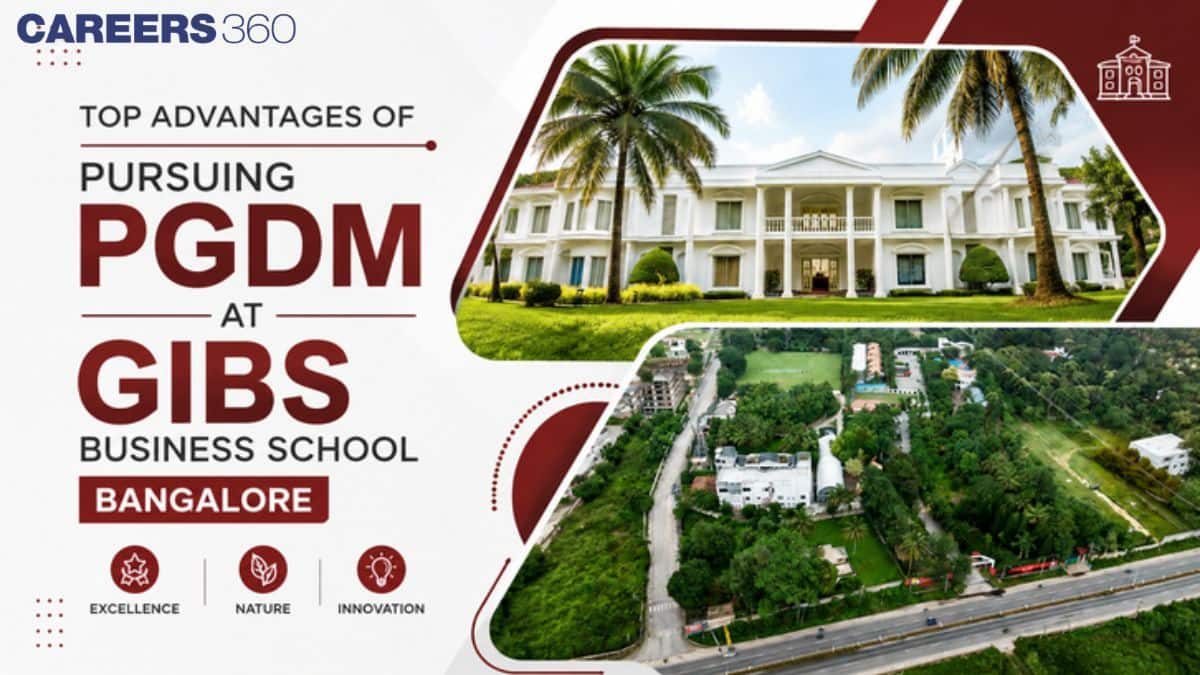
The PGDM at GIBS is a full-time, two-year management programme. Official information from the institution mentions the programme incorporates dual specialisation, contextual learning, and interaction with the industry, as well as combined learning, and numerous skills.
Also See: GIBS Business School Bangalore Admission
1. Learning Model Focused on the Industry
A significant benefit of pursuing PGDM at GIBS Business School Bangalore is the focus beyond the classroom.
Management graduates are expected to be able to analyse, express and communicate ideas, collaborate, understand who their customers are, and draw and make business decisions. Knowledge gained from the classroom is important, and so is the practice of what has been learned.
GIBS demonstrates a pedagogy of 50% practical exposure, 20% field work, and 30% theory.
GIBS students utilise management theory by engaging with real business situations through a variety of techniques, including, but not limited to, projects, case learning, presentations, simulations, workshops, and field work. Through this integration of management theory and business practice, students are able to develop a variety of skills, including the ability to make decisions and solve problems, in addition to gaining theoretical knowledge.
2. Dual Specialisation for Greater Career Options
Today’s business roles are increasingly being seen as cross-functional. For example, a marketing professional may be required to possess some amount of business analytics knowledge, while a finance professional may need to have knowledge of technology or digital business as well.
The dual specialisation feature of GIBS’s PGDM programme allows students to customise and broaden their management skill sets.
Students may choose from a wide variety of management fields to add a focused specialisation to their PGDM programme. The available specialisations include Marketing, Finance, Human Resource Management, Operations and Supply Chain Management, International Business, Business Analytics, Digital Marketing, Information Technology, FinTech, and many more.
An additional specialisation also gives students varied career options. Marketing paired with Business Analytics is a good fit for a career in data-driven marketing, while Finance paired with FinTech provides excellent options for careers in the newly emerging tech-based financial services.
3. Practical Learning Beyond the Classroom
The value of a management programme greatly increases when students are able to practice the skills in real-life scenarios.
Business education offers students the opportunity to learn through the analysis of projects, simulations, corporate workshops, and practical learning assignments.
Business education also offers students the opportunity to learn the practical skills of analysis, solution creation, and presentation in a real-world corporate team.
Exposure to the real world may also provide students with an understanding of their individual strengths. The management functions the students may discover they prefer the most may be marketing, finance, analytics, operations, human resources, and entrepreneurship.
4. Innovation, Research, and Entrepreneurship Exposure
Even students with no desire to start their own business benefit from an entrepreneurial mindset, and so do the corporations where they work. Employees must be able to identify problems and then create several innovative solutions.
GIBS utilises its Innovation, Research, and Entrepreneurship framework to encourage this type of thinking.
Students can evaluate, analyse, and tackle entrepreneurship and business problems.
This is valuable experience for students interested in startup businesses, consulting, product management, business development, and innovation and entrepreneurship business teams, as well as those interested in creating their own businesses.
Read More: GIBS Business School Bangalore Courses
5. Personal Development Through CPMP
Knowing the technical aspects of a profession is not enough for a person to be job-ready.
Attributes such as good communication, confidence, a strong work ethic, leadership, emotional intelligence, and the ability to work in and lead a team can determine a person’s level of success in their career.
The GIBS Finishing School includes the Certificate in Personal Mastery Programme (CPMP) in its offerings. An official description from the institution states the Finishing School helps students with internships and other job placements, startups, and the development of their soft skills and personality.
Many of the students coming from various backgrounds will benefit from this type of support and professional development to enhance their confidence to face the business world.
6. Interaction With Industry Professionals
Learning about business from professionals provides real-world depth that is missing from management education.
GIBS provides various methods of industry exposure, including professional masterclasses, workshops, HR talks, entrepreneurship sessions, and everyday business conversations.
Learning from founders, CEOs, CFOs, HR leads, business managers, entrepreneurs, and specialists will help students learn the modern challenges of the business world and the expectations that will come from their future jobs.
This type of learning will also help students when selecting their business specialisation, or when deciding on which internship, industry, or career to pursue.
7. Internship and Placement Preparation
PGDM students have a vested interest in career readiness.
Based on GIBS's institutional disclosure, students are aided in getting internships and job placements. Additionally, preparation includes development of both technical and soft skills.
Preparation for placement must begin far in advance of the actual placement. Many aspects of preparation must be done by students, including the development of a professional profile, enhancement of communication skills, and the ability to understand job descriptions. Students must also be prepared for and complete practice sessions on job-related skills, as well as gain quality work experience through internships.
The combination of formal education and the CPMP, projects, internships, corporate interactions, and practical exposure can assist students in the recruitment process.
8. Benefits of Pursuing PGDM in Bangalore
The area in which a student studies offers many benefits.
Bangalore offers a well-established business ecosystem, including technology and startups, consulting, e-commerce, analytics, and financial services, as well as developing sectors.
For management students, the ability to study in such a well-established business ecosystem allows the development and understanding of the adaptability to changing business sectors and models.
What students are taught in the classroom can be augmented by participation in corporate events, as well as doing internships and an assortment of networking activities.
9. Exposure to Management Areas that are Future-Ready
The ways in which business activities are conducted are in a state of evolution, as a result of the development of artificial intelligence, automation, analytics, and digital technology. Because of this, the future manager will require more than just an understanding of business functions.
Areas of specialisation at GIBS include Business Analytics and Digital Marketing, as well as specialisations in the management domain of IT and FinTech, in addition to the traditional management disciplines of Finance, Marketing, HR, and Operations.
The value-added benefit of having these specialisations is not merely the knowledge of a technology/tool. Students also learn how financial decisions and strategies, as well as marketing and operational strategies, and even customer behavior and organisational performance, can be influenced by technology.
10. Holistic Management Development
Learning opportunities beyond the classroom are a big part of the PGDM experience.
Formal lectures are just one part of the many ways to develop professionally through PGDM. Group work and presentations, as well as participation in student-led activities and events, and even formal and informal leadership roles and peer-to-peer work, are all vital to business education.
Learning to work and study alongside a diverse peer group also helps develop the ability to work as a member of a team, communicate and learn to handle conflicts, be accountable, and perform under stress. These traits are all vital to success in business and management.
Groups of people that work in an organisation are often diverse, requiring people to adapt to stressful and changing environments.
Also Read: GIBS Business School Bangalore Placement
Conclusion
At GIBS Business School Bangalore, the PGDM combines the foundations of business management, experiential learning, dual specialisations, and additional focuses on the industry, personal development, and career readiness.
The school’s environment encourages students to develop professional skills during the PGDM, as opposed to viewing employability as a concern limited to final placements.
GIBS offers the flexibility and focus seen in the Top 10 PGDM colleges in Bangalore. The emphasis on personality development and career support is an integral part of a PGDM.
Disclaimer: This article has been published as a part of a marketing campaign between Careers360 and GIBS Business School Bangalore.
Articles
Upcoming Bschool Exams

Certifications By Top Providers
Explore Top Universities Across Globe
List of Related colleges
Questions related to GIBS Business School, Bangalore
On Question asked by student community
Have a question related to GIBS Business School, Bangalore ?
If you're comparing GIBS Business School, Bangalore and ISME Bangalore for BBA, GIBS is a strong choice for students looking for practical learning and industry exposure.
-
Industry oriented BBA curriculum
-
Internship and live project opportunities
-
Certification and skill development programs
-
Regular workshops and guest lectures
-
Focus on communication, leadership, and
Due to the fact that opportunities have grown in the last four to five years, MBA equivalent to PGDM programmes are becoming increasingly popular today. One of the top business schools such as Iims, GIBS Bangalore, Christ University & others! I would recommend to go with GIBS Bangalore. It is
For comparison between ISBR and GIBS Business School, Bangalore for BBA, GIBS can be a better option if you are interested in gaining industry exposure through practical learning.
- Industry oriented BBA syllabus
- Real life projects and internships
- Skill development courses and certifications
- Workshops and guest lectures
- Emphasis on communication, leadership
For most students, GIBS Business School Bangalore is generally considered the better choice for BBA due to its stronger industry exposure, skill-development programs, internships, and overall student development opportunities.
- Better focus on practical learning and industry interaction.
- More workshops, certification programs, and skill-building activities.
- Strong emphasis on internships and career
GIBS Business School, Bangalore is a good option for pursuing MBA/PGDM program since it gives importance to industry exposure, learning through doing, internships, certification programs, and placement preparation.
- Internship and live project opportunities
- Certification and skill-development programs
- Placement training, aptitude sessions, and mock interviews
- Regular corporate interactions and guest lectures

Study Resources, Applications and Opportunities
Globally Recognized by AACSB (US) & AMBA (UK) | 18 LPA Avg. CTC for PGPM 2026
XAT- Xavier Aptitude Test 2027
Apply75+ years of legacy | #1 Entrance Exam | Score accepted by 250+ BSchools
Career Launcher Race To 99%ile In CAT 2026 - Phase 03
Enquire6-Hour Masterclass to help you score 99+ percentile in CAT 2026
NMAT by GMAC 2026
ApplyTest centres are available in 70+ cities across India | 75,000+ aspirants apply for the NMAT exam | Accepted by 58+ institutions like NMIMS, KJSIM, ISB, SPJIMR and Great Lakes.
Common Admission Test 2026 (CAT 2026)
ApplyRegistration Start: 3 August 2026 | Last Date to Apply: 15 September 2026 (till 5 PM)
IBSAT 2026-ICFAI Business School MBA/PGPM 2027
ApplyAACSB Accredited | 40 LPA-Highest CTC | Scholarships worth 10 CR