Great Lakes - PGDM & PGPM Admissions 2027
Globally Recognized by AACSB (US) & AMBA (UK) | 18 LPA Avg. CTC for PGPM 2026


Every year, CAT aspirants obsess over expected cutoffs, mock scores, and question trends. But this year, a different conversation is gaining momentum. With IIM Indore returning as the convening institute for CAT 2026, many students are asking a simple question: Is this just an administrative change, or could it signal something more? The curiosity isn't coming out of nowhere. Some of the most talked-about CAT editions happened when IIM Indore was in charge. While nobody can predict exactly what CAT 2026 will look like, one thing is certain: whenever a familiar name returns after a gap, aspirants start looking for clues in the past. Coincidence or pattern? Noise or signal? That's what makes the discussion around IIM Indore so interesting. In this article, we'll revisit IIM Indore's previous CAT editions, uncover the major changes that occurred under its watch, examine whether those changes were truly connected to the conducting institute, and explore what CAT 2026 aspirants should-and shouldn't-read into the headlines.
The CAT 2026 official notification has been released, and the exam is scheduled for November 29, 2026.
This Story also Contains

Worried about your CAT Preparation so far? Attempt now the CAT 2026 Free Mock Test
Whenever the CAT conducting institute changes, aspirants start searching for patterns. And when the name is IIM Indore, the discussion becomes even louder. The reason is simple: two of the most significant structural changes in CAT's modern history occurred during editions conducted by IIM Indore.
Of course, this does not mean that IIM Indore deliberately redesigns the exam every time it takes charge. However, history shows that some of the most memorable CAT transformations have happened under its watch, making CAT 2026 a topic of intense curiosity among aspirants.
Most aspirants would probably choose a tough CAT.
However, unexpected changes often create a greater challenge. Difficult questions affect a few minutes of your exam. Structural changes can influence your entire strategy, time management, and decision-making process.”
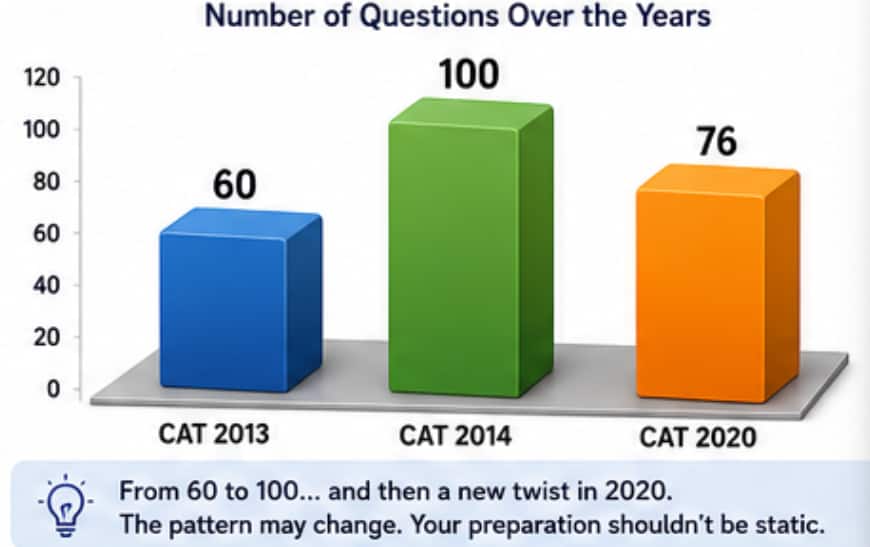
| Feature | CAT 2013 | CAT 2014 | CAT 2020 |
|---|---|---|---|
Total Questions | 60 | 100 | 76 |
Duration | 140 Minutes | 170 Minutes | 120 Minutes |
Major Focus | Conceptual Strength | Speed + Selection | Adaptability |
QA Style | Calculation & Logic Heavy | Broad Topic Coverage | Efficient Problem Solving |
VARC Style | Traditional RC & VA | Expanded Coverage | Reading Intensive |
LRDI Style | Conventional Sets | Larger Variety | Complex Modern Sets |
CAT 2013 felt like a classic aptitude examination. The paper rewarded aspirants who possessed strong fundamentals and were comfortable handling lengthy mathematical and logical reasoning problems. Several questions demanded multi-step thinking, and shortcuts alone were rarely sufficient.
Strong emphasis on Arithmetic, Algebra, and Geometry
Traditional Logical Reasoning sets
Calculation-intensive problem solving
Limited dependence on guesswork
High importance of conceptual clarity
Accuracy often mattered more than speed
Strong fundamentals
Patience under pressure
Logical thinking
Mathematical rigor
If CAT 2013 represented continuity, CAT 2014 represented disruption. The examination expanded dramatically, exposing aspirants to a much larger pool of questions and a wider range of topics. This was one of the biggest structural changes CAT had seen at the time.
Significant increase in question count
Wider topic representation
More opportunities for scoring
Greater emphasis on question selection
Increased importance of time management
Reduced ability to spend excessive time on individual questions
Smart selection of questions
Time management
Section balancing
Strategic decision-making
Perhaps.
Three CAT editions are not enough to establish a guaranteed pattern. At the same time, when two of those editions witnessed significant structural changes, it is understandable why aspirants are paying attention. The challenge is to stay informed without becoming overly speculative.”
CAT 2020 arrived under exceptional circumstances and looked very different from previous editions. With fewer questions and reduced duration, every minute became more valuable. Candidates had less room for mistakes and needed to adapt quickly throughout the test.
Shorter exam duration
Reduced question count
Reading-heavy VARC passages
Inference-based questioning
Modern LRDI frameworks
Faster decision-making requirements
Adaptability
Reading ability
Quick decision-making
Efficient execution
The pattern is not that IIM Indore makes CAT harder.
The pattern is that IIM Indore has been associated with CAT editions that looked different from the immediately preceding years.
2014 → biggest structural overhaul in CAT history.
2020 → biggest time-format overhaul in CAT history.
2013 → continuation year but still featured a strong emphasis on mathematical reasoning and analytical thinking.
That's a much stronger angle than claiming IIM Indore increases difficulty.
To learn more about the insights of the previous years where IIM Indore conducted the CAT exam, you can check out IIM Indore is Back for CAT 2026! Big Pattern Changes Incoming?
Looking only at difficulty levels misses the bigger picture.
The real story is how dramatically the focus of the exam shifted across these three editions.
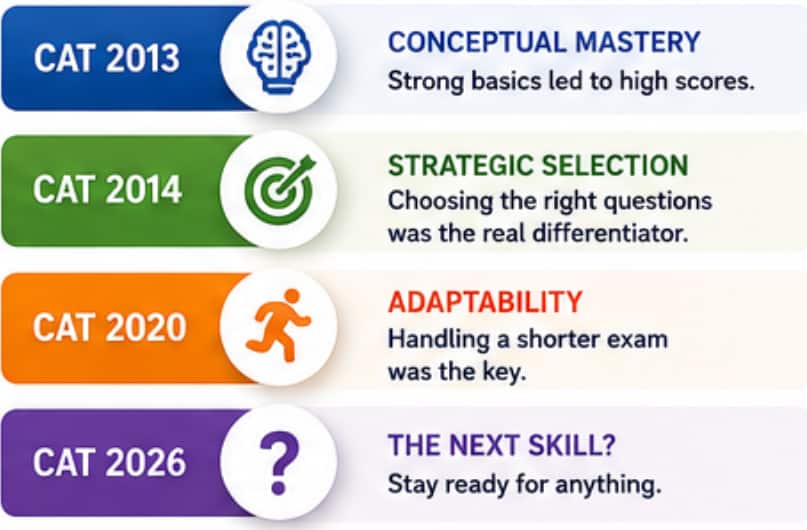
Notice the trend:
CAT 2013 asked, "Can you solve difficult problems?"
CAT 2014 asked, "Can you manage a larger exam efficiently?"
CAT 2020 asked, "Can you adapt to a completely different environment?"
The challenge changed. The skill being tested changed. The winning strategy changed.
Why This Matters for CAT 2026
The history of CAT under IIM Indore does not prove that CAT 2026 will become harder, easier, longer, or shorter. However, it does highlight one recurring theme: some of CAT's most memorable structural shifts have occurred during editions conducted by IIM Indore.
For aspirants, the takeaway is not to predict the exact pattern of CAT 2026. The takeaway is to recognize that flexibility has repeatedly emerged as the defining trait of successful candidates whenever the exam has undergone meaningful change.
If CAT 2013 rewarded thinkers, CAT 2014 rewarded strategists, and CAT 2020 rewarded adapters, the biggest question for CAT 2026 is simple: what skill will the next IIM Indore CAT choose to reward?
If there is one lesson from previous IIM Indore-led CAT editions, it is that aspirants should be prepared for more than just difficult questions. CAT 2014 changed the structure of the exam, while CAT 2020 changed the testing experience itself. As a result, CAT 2026 aspirants may need to focus on flexibility just as much as preparation.
Most aspirants take mocks primarily to improve scores. However, CAT history suggests that mocks should also prepare candidates for uncertainty.
Instead of limiting yourself to one type of mock, it may be useful to expose yourself to different situations.
| Mock Type | Purpose |
|---|---|
Standard CAT-pattern mocks | Build familiarity |
High-difficulty mocks | Improve resilience |
Speed-based mocks | Enhance decision-making |
LRDI-intensive mocks | Strengthen problem-solving |
Reading-heavy mocks | Prepare for VARC surprises |
A wider range of mock experiences often translates into greater confidence on exam day.
You can check out the CAT 2013 Question Paper With Solution
Adaptability is one of the most underrated CAT skills. While concepts remain important, the ability to adjust quickly can make a significant difference when the paper does not match expectations.
Aspirants can develop adaptability by:
Solving questions from different CAT years
Attempting unfamiliar LRDI sets
Experimenting with multiple test-taking strategies
Learning to move on from difficult questions
Practicing under varying levels of time pressure
The objective is not to predict every change but to remain effective regardless of the change.
One of the biggest mistakes aspirants make is preparing for only one version of CAT.
A better approach is to consider multiple possibilities.
Possible Scenario | What It Could Mean? |
|---|---|
No major changes | Traditional preparation remains effective |
Minor modifications | Strategy adjustments become important |
Significant changes | Adaptability becomes a competitive advantage |
Candidates who prepare for several possibilities are generally less affected by surprises.
You can also check the CAT 2026 Syllabus and High-Weightage Topics Guide and Download Now
Even when CAT evolves, some skills continue to deliver results.
These include:
Strong conceptual understanding
Reading comprehension ability
Logical reasoning skills
Time management
Question selection
Decision-making under pressure
These qualities were valuable in CAT 2013, CAT 2014, and CAT 2020, and they are likely to remain valuable in CAT 2026.
A comparison of CAT 2013, CAT 2014, and CAT 2020 highlights several lessons that remain relevant for current aspirants.
Many aspirants assume that the next CAT will closely resemble the previous one. However, history tells a different story.
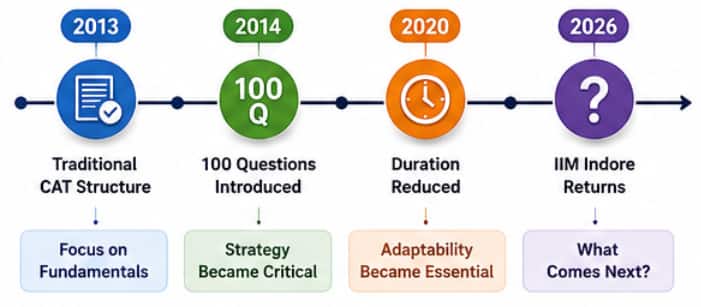
The broader lesson is simple: preparation should not depend entirely on continuity.
A strong conceptual foundation is essential, but it is only one part of the equation.
CAT 2014 demonstrated that:
Question selection matters
Time allocation matters
Prioritization matters
Decision-making matters
The ability to execute a strategy effectively can be just as important as knowing how to solve a problem.
Whenever CAT changes, some aspirants struggle while others thrive.
The difference often comes down to adaptability.
Top performers tend to:
Stay calm under pressure
Adjust quickly to unexpected situations
Avoid emotional decision-making
Focus on execution rather than speculation
This pattern has been visible across multiple CAT editions.
Practice with CAT 2014 Question Paper With Solution
Historically, certain categories of aspirants tend to perform better when the exam introduces change.
Candidates with strong concepts are usually less dependent on a specific exam pattern.
Whether CAT becomes longer, shorter, or more difficult, a solid foundation provides stability.
Some candidates become distracted when faced with unexpected situations. Others remain composed and continue executing their strategy.
The second group generally adapts more effectively.
Exposure to different testing conditions often reduces exam-day shock.
These aspirants have already experienced:
Unusual VARC passages
Time-intensive sections
Unexpected difficulty distributions
As a result, they are less likely to be unsettled by surprises.
Every year, countless discussions revolve around predicting CAT.
However, successful aspirants typically focus more on preparation than prediction.
Preparing for possibilities is often more productive than trying to forecast the future.
The significance of IIM Indore's return lies not in difficulty levels but in the possibility of change.
Most discussions quickly turn toward a familiar question:
"Will CAT 2026 be harder?"
However, previous CAT editions suggest that structural changes can influence performance more than difficulty alone.
A difficult question can be skipped.
A structural change affects the entire paper.
Consider the difference:
| Situation | Potential Impact |
|---|---|
Difficult questions in a familiar format | Manageable |
Moderate questions in an unfamiliar format | Potentially disruptive |
This is why aspirants often remember major pattern changes long after they forget individual questions.
Rather than attempting to predict the exact CAT 2026 pattern, aspirants may benefit more from focusing on:
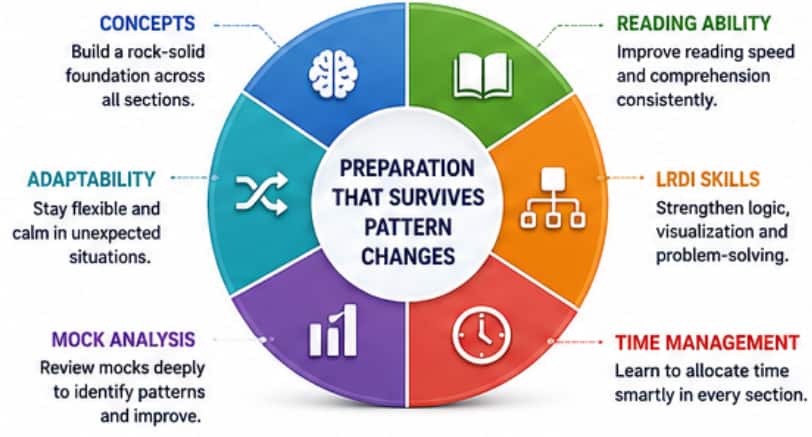
These areas remain valuable regardless of future changes.
The answer is nuanced.
Previous CAT editions conducted by IIM Indore have coincided with some of the most significant structural shifts in the exam's modern history.
This alone makes CAT 2026 worth watching closely.
At the same time, history does not prove that:
CAT 2026 will definitely be harder
The number of questions will increase
A new format is guaranteed
Difficulty levels will rise significantly
Such conclusions go beyond what the evidence supports.
A review of CAT 2013, CAT 2014, and CAT 2020 points toward one recurring theme.
The highest percentilers are rarely the candidates who correctly predict the exam.
They are usually the candidates who prepare well enough to perform under any circumstances.
If IIM Indore's previous CAT editions teach us anything, it is that flexibility remains one of the most valuable assets a CAT aspirant can possess.
Preparing for CAT 2026 requires more than just hard work-it requires the right resources. Explore these carefully curated CAT 2026 eBooks, preparation guides, and study materials designed to strengthen your concepts and boost your exam readiness.
| Ebook Title | Link |
|---|---|
CAT 2024 Official Question Paper with Solutions (Slot 1, 2 and 3) | |
CAT 2026 Arithmetic Important Concepts and Practice Questions | |
CAT 2026 Algebra Important Concepts and Practice Questions | |
Ultimate DILR CAT 2026 Guide: Concepts, Practice Sets and Detailed Solutions | |
CAT 2026 Number System Important Concepts & Practice Questions | |
CAT 2026 Quantitative Aptitude Cheat Sheet | |
CAT 2026 Exam: Mistakes to Avoid for 99+ Percentile | |
CAT 2026 Exam: Success Strategy for Working Professionals & College Students | |
CAT 2026 Quantitative Aptitude 20 Free Sectional Tests | |
CAT 2026 DILR Masterbook - Practice 100 DILR Sets to score 90+ Percentile | |
CAT 2026 - 30 Days Preparation Time Table | |
CAT 2026 Mock Test by IIM CAT 2024 Toppers (99+ Percentilers) | |
CAT 2026 Quantitative Ability Mock Test by IIM CAT 2024 Toppers | |
CAT 2025 Slot 3 Question Paper | |
CAT 2025 Slot 2 Question Paper and Solutions | |
CAT 2025 Slot 1 Question Paper with Solutions PDF Download | |
CAT 2025 Official Question Paper with Solutions (Slot 1, 2 and 3) | |
Avoid These Common CAT RC Mistakes to Boost your VARC Score |
Frequently Asked Questions (FAQs)
While analyzing historical trends can be useful, relying too heavily on predictions can be risky. CAT has a history of surprising aspirants, making comprehensive preparation a more reliable strategy than pattern forecasting.
The best approach is to strengthen core aptitude skills, practice diverse mock tests, and improve decision-making under pressure. Candidates with strong fundamentals are generally better equipped to handle unexpected changes.
These three editions highlight an important lesson: CAT rewards different skills in different years. While CAT 2013 emphasized conceptual strength, CAT 2014 rewarded strategic question selection, and CAT 2020 tested adaptability. Successful aspirants are usually those who can adjust to changing exam conditions.
Yes. Mock tests help develop time management, decision-making, and exam temperament. Even if the pattern changes, the underlying skills gained through mock-test practice remain highly relevant.
The most important takeaway is not that CAT becomes harder under IIM Indore, but that previous IIM Indore-led editions have coincided with significant structural shifts. As a result, adaptability may be one of the most important skills for CAT 2026 aspirants.

On Question asked by student community
If by B-category you mean management/private quota MBBS seats, the cutoff is very different from government-quota MBBS.
In Tamil Nadu, management-quota MBBS seats are available in self-financing/private medical colleges through the state counselling process. The closing rank varies significantly between colleges and counselling rounds. The 2025 counselling data shows that
Hello Student,
With a CAT 2025 percentile of 98.25, you have a good chance of receiving calls from several IIMs, particularly newer IIMs. However, IIM Ahmedabad , Bangalore , Calcutta , and Lucknow generally require higher percentiles for General-category candidates. Calls also depend on sectional percentiles, academics, work experience, and
Hello Aspirant,
Yes, you can access CAT preparation resources, including mock tests, practice questions, previous-year papers, and study material. Explore the CAT preparation resources and test series using the link below:
https://bschool.careers360.com/download/ebooks-and-sample-papers?exam=45
Hope this Helps!
Hello CAT Aspirant!
If you mean the CAT ( Common Admission Test) EWS certificate, the important point is whether the certificate is valid and issued in the prescribed format, rather than simply the language used on it.
Yes, a Hindi EWS certificate can generally be accepted for CAT, provided it
Directions for question:
The bar-graph given below shows the foreign exchange reserves of Nepal (in million Rupees) from 2014 to 2021. Answer the following questions based on the graph :

Question:
What was the percentage increase (rounded to the nearest integer, if deemed necessary) in the foreign exchange reserves in

Globally Recognized by AACSB (US) & AMBA (UK) | 18 LPA Avg. CTC for PGPM 2026
75+ years of legacy | #1 Entrance Exam | Score accepted by 250+ BSchools
6-Hour Masterclass to help you score 99+ percentile in CAT 2026
400+ Recruiters | Highest CTC 25 LPA | Average CTC 8 LPA | 92% Placements in 2025 | Ranked as Platinum Institute | Awarded Best Business School of the Year
1 Exam accepted by 17 Top Symbiosis Institutes for 29 MBA programmes.
Among top 6% B-Schools globally to be accredited by AACSB | Highest Package-35 LPA