Great Lakes - PGDM & PGPM Admissions 2027
Globally Recognized by AACSB (US) & AMBA (UK) | 18 LPA Avg. CTC for PGPM 2026


The CAT 2024 Slot 2 Question Paper should be checked by the candidates to get an insight into the overall difficulty level of the shift. The conducting IIM has released the slot-wise CAT 2024 question paper with solutions. Candidates can analyse and attempt the CAT Slot 2 question paper to deduce the question types and other details. Additionally, attempting the CAT Slot 2 memory based paper helps one to understand their overall preparation level in the examination. Know more benefits that attempting previous year papers offer to the CAT 2025
This Story also Contains
Latest: Download CAT 2024 Question Paper
The CAT 2024 Slot 2 question paper was considered slightly tougher than Slot 1, though easier than the CAT 2023 Slot 2 exam. The total number of questions increased to 68, with two extra questions in the DILR section.
Unlike Slot 1, the VARC section in the CAT 2024 Slot 2 question paper had no para-jumble questions. LRDI was a bit more challenging, making the overall paper moderately tough.
Reviewing the CAT 2024 Slot 2 question paper with solutions is crucial for understanding the updated pattern and assessing your performance.
The CAT 2024 Slot Question Paper with Solutions is a valuable resource that provides candidates with memory-based questions along with expert-verified answers for all three sections, VARC, DILR, and QA. It helps aspirants understand the exam’s actual difficulty level, question formats, and effective solving techniques. Candidates can assess their performance, identify weak areas, and refine their preparation strategy for a better percentile in the CAT exam.
The CAT 2024 Slot 2 question paper included three sections: Quantitative Aptitude, LRDI, and VARC. Candidates can go through memory-based questions and detailed solutions to evaluate their performance. Practising the CAT 2024 Slot 2 memory based paper also helps in strengthening preparation for upcoming CAT exams.
1. A fruit seller has a stock of mangoes, bananas and apples with at least one fruit of each type. At the beginning of the day, the number of mangoes makes up 40% of his stock. That day, he sells half of the mangoes, 96 bananas and 40% of the apples. At the end of the day, he ends up selling 50% of the fruits. The smallest possible total number of fruits in the stock at the beginning of the day is
Ans. 340
2. Find the remainder $3^{333} ÷ 11$
Ans. 5
3. When 2 liters of water is added to a mixture of acid and water, the concentration of acid becomes 50%. Then, 15 liters of acid is added to the solution, which makes the concentration of acid 80%. What is the quantity of the initial mixture?
Ans. 8
4. If $\alpha$ and $\beta$ are the roots of the quadratic equation $x^2+px+q=0$ find the value of $(\alpha^3+\beta^3)^2$
Ans. $( -p^3 + 3pq )^2$
5. What is the sum of coefficients of the equation $4x^2+4y^2−4xy+3y^2−6y+3=0$?
Ans. 7
6. If $|x|+x+y=15$. Find the value of $x−y$.
Ans. 15
7. Solve the inequality: x+3≤12x−3 restricting the solution to :
Ans. $(\frac{3}{2},8]$
8. If m and n are integers and mn=225×340 then calculate the value of m−n.
Ans. -45
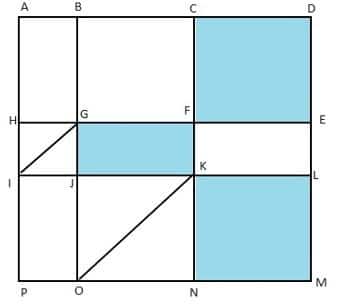
1. The above is a schematic diagram of walkways (indicated by all the straight-lines) and lakes (3 of them, each in the shape of rectangles – shaded in the diagram) of a gated area. Different points on the walkway are indicated by letters (A through P) with distances being OP = 150 m, ON = MN = 300 m, ML = 400 m, EL = 200 m, DE = 400 m.
The following additional information about the facilities in the area is known.
1. The only entry/exit point is at C.
2. There are many residences within the gated area; all of them are located on the path AH and ML with four of them being at A, H, M, and L.
3. The post office is located at P and the bank is located at B.
2. One resident whose house is located at L, needs to visit the post office as well as the bank. What is the minimum distance (in m) he has to walk starting from his residence and returning to his residence after visiting both the post office and the bank?
3200
2700
3000
3000
Correct Answer: 3200
3. One person enters the gated area and decides to walk as much as possible before leaving the area without walking along any path more than once and always walking next to one of the lakes. Note that he may cross a point multiple times. How much distance (in m) will he walk within the gated area?
3800
2800
3000
3200
Correct Answer: 3800
4. One resident takes a walk within the gated area starting from A and returning to A without going through any point (other than A) more than once. What is the maximum distance (in m) she can walk in this way?
Correct Answer: 5100
5. Visitors coming for morning walks are allowed to enter as long as they do not pass by any of the residences and do not cross any point (except C) more than once. What is the maximum distance (in m) that such a visitor can walk within the gated area?
Correct Answer: 3500
6. What best can be concluded about the number of players coached by Zara?
Exactly 3
Either 2 or 3 or 4
Exactly 2
Either 2 or 3
Correct Answer: Exactly 2
1. The passage given below is followed by four alternate summaries. Choose the option that best captures the essence of the passage.
Recent important scientific findings have emerged from crossing the boundaries of scientific fields. They stem from physicists collaborating with biologists, sociologists and others, to answer questions about our world. But physicists and their potential collaborators often find their cultures out of sync. For one, physicists often discard a lot of information while extracting broad patterns; for other scientists, information is not readily disposed. Further, many non-physicists are uncomfortable with mathematical models. Still, the desire to work on something new and different is real, and there are clear benefits from the collision of views.
Physicists have successfully buried their differences on research methods applied in other fields in their desire to find answers to baffling scientific questions.
Large data sets and mathematical models in physics research combined with the research methods of non-physicist collaborators have yielded important scientific findings.
The desire to diversify their research and answer important questions has led to several collaborations between physicists and other social scientists.
Despite differences in their research styles, physicists' research collaborations with scholars from other disciplines have yielded important research findings.
Correct Answer: Large data sets and mathematical models in physics research combined with the research methods of non-physicist collaborators have yielded important scientific findings.
2. The passage below is accompanied by four questions. Based on the passage, choose the best answer for each question.
The job of a peer reviewer is thankless. Collectively, academics spend around 70 million hours every year evaluating each other's manuscripts on the behalf of scholarly journals — and they usually receive no monetary compensation and little if any recognition for their effort. Some do it as a way to keep abreast with developments in their field; some simply see it as a duty to the discipline. Either way, academic publishing would likely crumble without them.
In recent years, some scientists have begun posting their reviews online, mainly to claim credit for their work. Sites like Publons allow researchers to either share entire referee reports or simply list the journals for whom they've carried out a review….
The rise of Publons suggests that academics are increasingly placing value on the work of peer review and asking others, such as grant funders, to do the same. While that's vital in the publish-or-perish culture of academia, there's also immense value in the data underlying peer review. Sharing peer review data could help journals stamp out fraud, inefficiency, and systemic bias in academic publishing.….
Peer review data could also help root out bias. Last year, a study based on peer review data for nearly 24,000 submissions to the biomedical journal eLife found that women and non-Westerners were vastly underrepresented among peer reviewers. Only around one in every five reviewers was female, and less than two percent of reviewers were based in developing countries…. Openly publishing peer review data could perhaps also help journals address another problem in academic publishing: fraudulent peer reviews. For instance, a minority of authors have been known to use phony email addresses to pose as an outside expert and review their own manuscripts.…
Opponents of open peer review commonly argue that confidentiality is vital to the integrity of the review process; referees may be less critical of manuscripts if their reports are published, especially if they are revealing their identities by signing them. Some also hold concerns that open reviewing may deter referees from agreeing to judge manuscripts in the first place, or that they'll take longer to do so out of fear of scrutiny…
Even when the content of reviews and the identity of reviewers can't be shared publicly, perhaps journals could share the data with outside researchers for study. Or they could release other figures that wouldn't compromise the anonymity of reviews but that might answer important questions about how long the reviewing process takes, how many researchers editors have to reach out to on average to find one who will carry out the work, and the geographic distribution of peer reviewers.
Of course, opening up data underlying the reviewing process will not fix peer review entirely, and there may be instances in which there are valid reasons to keep the content of peer reviews hidden and the identity of the referees confidential. But the norm should shift from opacity in all cases to opacity only when necessary.
a. Based on the passage we can infer that the author would most probably support
publicising peer review data rather than the publication of actual reviews.
preserving the anonymity of reviewers to protect them from criticism.
more careful screening to ensure the recruitment of content-familiar peer reviewers.
greater transparency across the peer review process in academic publishing.
Correct Answer: greater transparency across the peer review process in academic publishing.
b. According to the passage, which of the following is the only reason NOT given in favour of making peer review data public?
It can tackle the problem of selecting appropriately qualified reviewers for academic writing.
It would highlight the gender and race biases currently existing in the selection of reviewers.
It will deal with peer review fraud such as authors publishing bogus reviews of their work.
It could address various inefficiencies and fraudulent practices that continue in academic publishing process.
Correct Answer: It can tackle the problem of selecting appropriately qualified reviewers for academic writing.
c. According to the passage, some are opposed to making peer reviews public for all the following reasons EXCEPT that it
delays the manuscript evaluation process as reviewers would take longer to write their reviews.
makes reviewers reluctant to review manuscripts, especially if these are critical of the submitted work.
leaves the reviewers unexposed to unwarranted and unjustified criticism or comments from others.
deters reviewers from producing honest, if critical, reviews that are vital to the sound publishing process.
Correct Answer: leaves the reviewers unexposed to unwarranted and unjustified criticism or comments from others.
The sectional analysis of CAT 2024 Slot 2 is important for candidates to get a clear idea of the exam and to predict their possible scores. Candidates can find out what they are good at by going through different sections. It also highlights where they need to improve, which will help them prepare better. Let’s take a closer look at the analysis of each section to understand the overall performance in CAT 2024 Slot 2.
In the VARC section of the CAT 2024 examination, the questions were presented in a random order rather than being grouped by type.
This section included 2 odd one-out questions, 3 para summary questions, and 3 para completion questions.
Some questions were tricky, requiring a degree of reasoning that added complexity to certain reading comprehension items.
The reading comprehension passages on the topics of Spice Trade and the Unexpected Consequences of Technology were generally considered easier.
In contrast, the passages related to Peer Review of Research and the Issues between Carnivores and Humans were classified as medium to difficult.
The section also featured questions on True and False statements and critical reasoning.
A notable change in the VARC section was the absence of para jumble questions, while the para summary questions were concise and manageable for candidates.
Test centres are available in 70+ cities across India | 75,000+ aspirants apply for the NMAT exam | Accepted by 58+ institutions like NMIMS, KJSIM, ISB, SPJIMR and Great Lakes.
AACSB Accredited | 40 LPA-Highest CTC | Scholarships worth 10 CR
Area / Questions | Number of Questions | Difficulty Level |
RC 1 - Spice Trade | 4 | Easy to Medium |
RC 2 - Unexpected Consequences of Technology | 4 | Easy to Medium |
RC 3 - Peer Review of Research | 4 | Medium |
RC 4 - Issues between Carnivore and Human | 4 | Medium |
Questions | Number of Questions | Type | Overall, Difficulty |
Paragraph Completion | 3 | MCQ | Medium |
Summary | 3 | MCQ | Medium to Difficult |
Odd Sentence | 2 | TITA | Easy to Medium |
The CAT 2024 Slot 2 question paper featured a relatively easier Data Interpretation and Logical Reasoning (DILR) section. It included 12 MCQs and 10 TITA questions, with no negative marking for TITA-type questions. This breakdown helps candidates understand the section’s structure and refine their preparation accordingly.
The Logical Reasoning question related to gymnasts was rated between easy and moderate, and candidates found it manageable.
The Data Interpretation question involving six sets and their profitability included four MCQs and was also perceived as relatively easy.
Additionally, there was a Logical Reasoning question that required arranging numbers between 1 and 10 in a grid according to specific conditions. These questions were somewhat time-consuming and categorized as moderate to difficult.
Lastly, the Data Interpretation question focused on e-commerce was regarded as easy by the candidates.
Topics | Question Title | Number of Questions | Type of Questions | Difficulty Level |
LR | Rating concerned with 8 gymnasts | 5 | 2 MCQ 3 TITA | Easy to Medium |
DI | 6 firms, PAT, Es, PRD - 2 graphs | 4 | 4 MCQ 0 TITA | Easy |
LR | Schematic diagram of walkways - Lake | 4 | 2 MCQ, 2 TITA | Medium |
LR | 1 to 10 numbers to be arranged in 10 slots with conditions | 5 | 2 MCQ, 3 TITA | Medium - Difficult |
DI | Ecommerce rating distribution -cumulative | 4 | 2 MCQ, 2 TITA | E |
In the CAT 2024 Slot 2 question paper, the Quantitative Aptitude section was considered easier compared to the same section in CAT 2023 Slot 2. This shift in difficulty level offers candidates a better opportunity to score and highlights key changes in the question pattern.
Notably, several questions were repeated from Slot 1 of the exam.
This section included 14 multiple-choice questions (MCQs) and 8 Type In The Answer (TITA) questions.
It covered topics such as percentages, time, speed and distance, and circles. The CAT 2024 Slot 2 question paper had a well-balanced variety of topics, leading to a lower difficulty level.
In more detail, a question regarding fruits was repeated from Slot 1, but the context shifted from ratios to percentages.
Additionally, a question involving the remainder theorem also appeared again in Slot 2. Another question focused on calculating the radius of a circle was present in the CAT 2024 Slot 2 paper.
There were two questions related to ratios: one concerning age and the other about mixtures and allegations. Lastly, one question was included on logarithms.
Area | Number of Questions |
Arithmetic | 8 |
Algebra | 5 |
Geometry | 3 |
Modern Math | 3 |
Numbers | 3 |
Practising the CAT 2024 Slot 2 question paper helps aspirants understand the real exam difficulty, improve time management, and boost accuracy. It is a key resource for CAT preparation, performance analysis, and percentile prediction.
The CAT 2024 Slot 2 question paper analysis PDF provides key insights into question distribution and difficulty level. Careers360’s comprehensive ebook includes a detailed section-wise review of Slot 2. Download the analysis to understand the exam pattern better and improve your CAT preparation strategy.
CAT SLOT 2 Question Paper Analysis |
Frequently Asked Questions (FAQs)
The VARC section accounted for the maximum questions in CAT 2024 Slot 2, featuring a total of 24 questions.
The difficulty level of CAT slot 2 changes every year and depends upon how well you get ready. Normally, it has a mix of easy, medium, and hard questions. Students can check the CAT 2024 Slot 2 detailed analysis for the difficulty level so that they can understand what this slot really was all about.
Downloading the CAT 2024 Slot 2 question paper with solutions aids practice and also helps to develop effective strategies for the upcoming CAT exam.
Basically, there are three sections to the CAT exam-VARC or Verbal Ability and Reading Comprehension, DILR or Data Interpretation and Logical Reasoning, and QA or Quantitative Ability. We will analyze the CAT Slot 2 Pattern based on the pattern which is visible post exam in the CAT Slot 2 Analysis.
The overall difficulty level of all CAT 2024 slots was moderate in terms of difficulty level. Also, a major change in CAT 2024 was the number of questions increased to 68. There was 22 questions in DILR instead of 20.
IIM Ahmedabad and IIM Bangalore tend to have the highest cutoffs because an overwhelming number of aspirants are seeking admission, making it very competitive. The exact cutoff varies each year and by category also, generally between 99 and 99.5 percentile amongst the general category aspiring candidates. The CAT 2024 Slot 2 Analysis would help understand how this year's slot may influence the cutoffs.

On Question asked by student community
If by B-category you mean management/private quota MBBS seats, the cutoff is very different from government-quota MBBS.
In Tamil Nadu, management-quota MBBS seats are available in self-financing/private medical colleges through the state counselling process. The closing rank varies significantly between colleges and counselling rounds. The 2025 counselling data shows that
Hello Student,
With a CAT 2025 percentile of 98.25, you have a good chance of receiving calls from several IIMs, particularly newer IIMs. However, IIM Ahmedabad , Bangalore , Calcutta , and Lucknow generally require higher percentiles for General-category candidates. Calls also depend on sectional percentiles, academics, work experience, and
Hello Aspirant,
Yes, you can access CAT preparation resources, including mock tests, practice questions, previous-year papers, and study material. Explore the CAT preparation resources and test series using the link below:
https://bschool.careers360.com/download/ebooks-and-sample-papers?exam=45
Hope this Helps!
Hello CAT Aspirant!
If you mean the CAT ( Common Admission Test) EWS certificate, the important point is whether the certificate is valid and issued in the prescribed format, rather than simply the language used on it.
Yes, a Hindi EWS certificate can generally be accepted for CAT, provided it
Directions for question:
The bar-graph given below shows the foreign exchange reserves of Nepal (in million Rupees) from 2014 to 2021. Answer the following questions based on the graph :

Question:
What was the percentage increase (rounded to the nearest integer, if deemed necessary) in the foreign exchange reserves in

Globally Recognized by AACSB (US) & AMBA (UK) | 18 LPA Avg. CTC for PGPM 2026
75+ years of legacy | #1 Entrance Exam | Score accepted by 250+ BSchools
6-Hour Masterclass to help you score 99+ percentile in CAT 2026
400+ Recruiters | Highest CTC 25 LPA | Average CTC 8 LPA | 92% Placements in 2025 | Ranked as Platinum Institute | Awarded Best Business School of the Year
Test centres are available in 70+ cities across India | 75,000+ aspirants apply for the NMAT exam | Accepted by 58+ institutions like NMIMS, KJSIM, ISB, SPJIMR and Great Lakes.
Registration Start: 3 August 2026 | Last Date to Apply: 15 September 2026 (till 5 PM)