Great Lakes - PGDM & PGPM Admissions 2027
Globally Recognized by AACSB (US) & AMBA (UK) | 18 LPA Avg. CTC for PGPM 2026


TANCET 2026 Exam Analysis Live Updates - The TANCET MBA 2026 Shift 1 examination conducted on May 9, 2026, has concluded successfully. Candidates appearing for the exam were evaluated across major sections such as Data Analysis, logical reasoning, Reading Comprehension, Quantitative Aptitude, Data Sufficiency, and General English. The detailed TANCET MBA 2026 Shift 1 exam analysis provided in this article includes the section-wise difficulty level, overall paper analysis, expected good attempts, probable cut-off trends, student reactions, and memory-based question insights based on the initial feedback received from candidates and TANCET 2026 experts.
This Story also Contains
Candidates looking for the analysis can download TANCET MBA 2026 Exam Analysis and Memory Based Questions
The analysis examines the difficulty level of the TANCET 2026 examination. The TANCET MBA 2026 difficulty level analysis is now available based on the initial student reactions and expert reviews. The overall paper was reported to be moderate to difficult, with a few sections being comparatively lengthy and time-consuming. Verbal Ability and Reading Comprehension were considered tougher by several candidates, while Business Communication remained relatively manageable and scoring.
The overall difficulty level of TANCET MBA 2026 was reported to be moderately difficult to difficult, mainly due to the lengthy nature of the paper and the high reading intensity in certain sections. Based on the initial student reactions and exam analysis, the paper demanded a balanced combination of conceptual understanding, analytical reasoning, and time management skills.
| Parameter | Analysis |
|---|---|
| Overall Difficulty | Moderate to Difficult |
| Nature of Questions | Conceptual + Application-Based |
| Time Pressure | Moderate to High |
| Variation Across Sections | Noticeable |
| Most Difficult Section | Verbal Ability & Reading Comprehension |
| Calculation Intensity | Moderate |
| Reading Load | High |
| Logical Reasoning Level | Moderate |
| Previous Year Pattern Similarity | Some Questions Followed Earlier Trends |
| Overall Student Reaction | Lengthy but Doable |
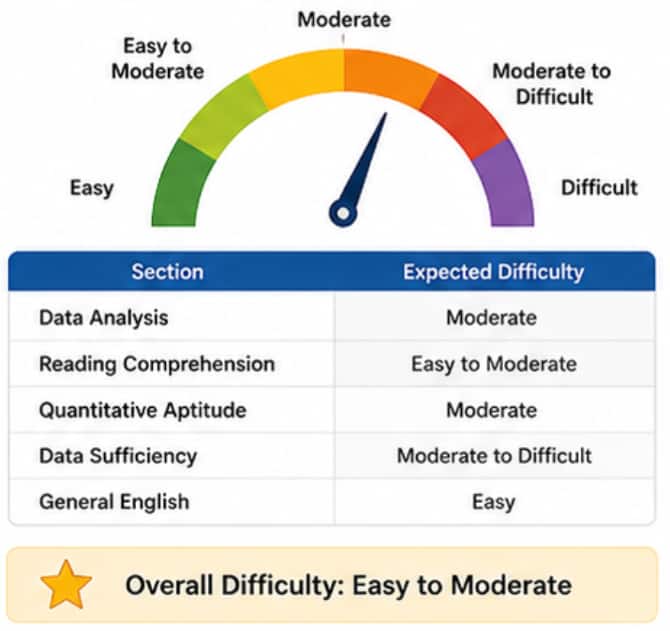
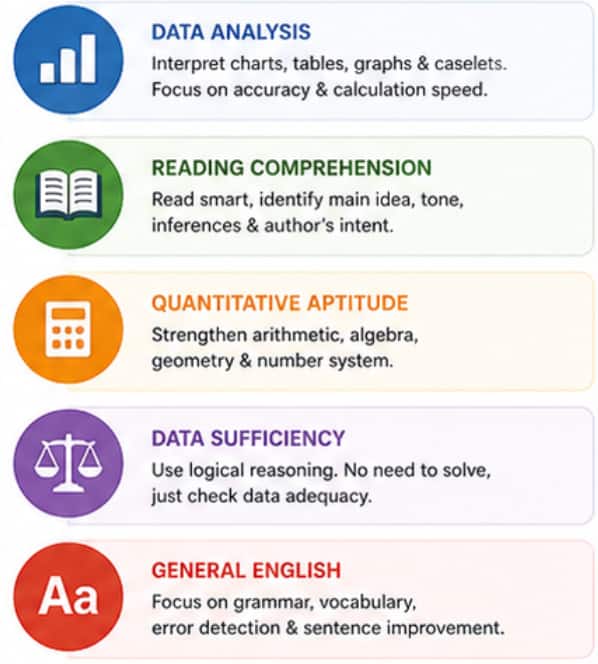
The section-wise TANCET MBA 2026 paper analysis highlights which sections were easy, moderate, or difficult. However, below are the expected key focus areas for the exam:
Section | Key Focus Area |
Data Analysis | Interpretation of charts, tables, and business data |
Reading Comprehension | Passage understanding, inference-based questions |
Quantitative Aptitude | Arithmetic, algebra, problem-solving |
Data Sufficiency | Logical evaluation of statements |
General English | Grammar, vocabulary, and error detection |
Candidates are advised to focus on accuracy over blind attempts, as negative marking can significantly impact the overall score.
The TANCET 2026 MBA exam is expected to include a mix of conceptual, analytical, and application-based questions.
Data-based questions involving graphs, tables, and caselets
Passage-based questions for reading comprehension
Problem-solving questions from arithmetic and algebra
Statement-based questions in data sufficiency
Grammar and vocabulary-based questions in English
Business decision-making scenarios testing analytical thinking
The paper emphasises real-world application and decision-making ability, rather than rote memorisation.
The TANCET MBA 2026 exam was reported to be moderately difficult to difficult by a majority of candidates. As per the initial reactions, the paper was lengthy and time-consuming, especially for candidates who struggled with speed and question selection. While a few direct questions appeared from previous year trends and concepts, the overall paper demanded strong analytical ability, reading comprehension skills, and efficient time management.
Candidates noted that the exam was doable for well-prepared aspirants, but several sections required careful interpretation and multi-step reasoning. The verbal and reading-based portions were considered comparatively tougher than expected by many students.
| Overall Parameter | Analysis |
|---|---|
| Overall Difficulty Level | Moderate to Difficult |
| Paper Nature | Lengthy and Analytical |
| Time Management | Challenging |
| Calculation Intensity | Moderate to High |
| Reading Load | High |
| Previous Year Pattern Similarity | Moderate |
| Overall Candidate Reaction | Tough but Doable |
The Business Situation Analysis section was moderately difficult and heavily case-study oriented. Most questions required analytical interpretation rather than direct factual knowledge. Candidates found some business scenarios lengthy, which increased the overall time pressure.
Caselet-based questions dominated
Business decision-making and logical interpretation were tested
Some questions were statement and inference driven
Economic and managerial scenarios appeared prominently
Moderate reading load increased time consumption
Elimination techniques helped in solving several questions
| Parameter | Analysis |
|---|---|
| Difficulty Level | Moderate |
| Nature of Questions | Analytical and Case-Based |
| Time Consumption | Moderate to High |
The verbal and reading comprehension section was considered one of the tougher parts of the exam by several candidates. Passages were moderately lengthy and inference-heavy, requiring careful reading and interpretation.
Verbal section was reported tougher than expected
Reading comprehension passages were lengthy
Inference-based questions had strong presence
Vocabulary questions appeared context-driven
Close answer choices increased confusion
Grammar questions were moderate in difficulty
| Parameter | Analysis |
|---|---|
| Difficulty Level | Moderate to Difficult |
| Nature of Questions | Inference and Comprehension Based |
| Time Consumption | High |
This section featured a balanced mix of arithmetic, algebra, geometry, and logical reasoning questions. Candidates reported that calculations were manageable, but some questions required multiple concepts and longer solving approaches.
Arithmetic dominated the section
Questions from percentages, ratios, and time-work were visible
Some geometry and algebra questions appeared tricky
Calculation speed played an important role
Mixed-concept reasoning questions were present
A few questions resembled previous year trends
| Parameter | Analysis |
|---|---|
| Difficulty Level | Moderate |
| Nature of Questions | Calculation Intensive |
| Time Consumption | Moderate |
The Data Sufficiency section tested conceptual clarity and logical reasoning. Some questions were direct, while others required evaluating both statements carefully before arriving at a conclusion.
Statement evaluation formed the core structure
Arithmetic and algebra concepts appeared frequently
Logical interpretation was important
Some questions were straightforward
A few statement combinations were tricky
Accuracy mattered more than speed
| Parameter | Analysis |
|---|---|
| Difficulty Level | Moderate |
| Nature of Questions | Logic and Concept-Based |
| Time Consumption | Moderate |
The Business Communication section was comparatively manageable for candidates with strong grammar fundamentals. However, some vocabulary and contextual usage questions required careful interpretation.
Grammar-based questions had good weightage
Error spotting and sentence correction appeared frequently
Vocabulary questions were contextual
Tenses and prepositions were asked
Functional English questions were included
Less time-consuming compared to RC section
| Parameter | Analysis |
|---|---|
| Difficulty Level | Easy to Moderate |
| Nature of Questions | Grammar and Vocabulary Based |
| Time Consumption | Low to Moderate |
The paper was lengthy and time-consuming overall
Verbal Ability and Reading Comprehension were tougher than expected
Quantitative section required balanced speed and accuracy
Data Sufficiency focused heavily on logical interpretation
Some questions followed previous year patterns
Strong time management was crucial for maximizing attempts
Candidates with balanced sectional preparation are expected to perform better
Based on the latest TANCET MBA 2026 analysis, student reactions, and previous year question trends, the following topics carried significant weightage in the examination. Candidates preparing for upcoming sessions or analysing their performance can refer to these section-wise important topics to understand the overall paper pattern and frequently tested concepts.
| Topic | Description | Weightage |
|---|---|---|
| Bar Graphs | Comparison and percentage-based interpretation | High |
| Pie Charts | Ratio and distribution analysis | High |
| Tables | Numerical comparison and calculations | High |
| Caselet DI | Multi-variable data interpretation sets | High |
| Line Graphs | Trend and growth-based analysis | Medium |
| Percentage Change | Increment and decrement calculations | Medium |
| Ratio & Average-Based DI | Applied arithmetic within data sets | High |
| Topic | Description | Weightage |
|---|---|---|
| Inference-Based Questions | Logical conclusions from passages | High |
| Main Idea Questions | Identifying the central theme | High |
| Factual Questions | Direct information retrieval | High |
| Vocabulary in Context | Meaning of words within passages | Medium |
| Tone & Author Intent | Understanding writing style and opinion | Medium |
| Critical Reasoning | Analytical and argument-based questions | Medium |
| Topic | Description | Weightage |
|---|---|---|
| Percentages | Core arithmetic applications | High |
| Ratio & Proportion | Comparative numerical analysis | High |
| Profit & Loss | Business-oriented calculations | High |
| Averages | Numerical summarisation concepts | High |
| Time & Work | Efficiency and productivity problems | Medium |
| Time, Speed & Distance | Motion and travel-based problems | Medium |
| Simple & Compound Interest | Financial aptitude questions | Medium |
| Algebra | Equations and simplification | Medium |
| Number System | Divisibility and remainder concepts | Medium |
| Geometry & Mensuration | Basic shape and area calculations | Low to Medium |
| Topic | Description | Weightage |
|---|---|---|
| Statement Analysis | Evaluating provided conditions | High |
| Sufficiency Logic | Determining whether data is adequate | High |
| Arithmetic-Based DS | Quantitative statement evaluation | Medium |
| Comparison-Based Questions | Value and quantity comparison | Medium |
| Logical Elimination | Eliminating incorrect options logically | High |
| Case-Based DS | Situation-oriented data evaluation | Low to Medium |
| Topic | Description | Weightage |
|---|---|---|
| Grammar Rules | Tenses, articles, and prepositions | High |
| Error Detection | Sentence correction and spotting errors | High |
| Word Usage | Appropriate contextual usage | High |
| Sentence Completion | Grammar and contextual understanding | Medium |
| Synonyms & Antonyms | Vocabulary-based questions | Medium |
| Para Completion | Logical sentence arrangement | Low to Medium |
The above-mentioned TANCET MBA 2026 important topics were among the most frequently tested and high-weightage areas observed in the examination. Candidates with strong conceptual clarity and regular practice across these topics were better positioned to manage accuracy, speed, and overall sectional performance in the exam.
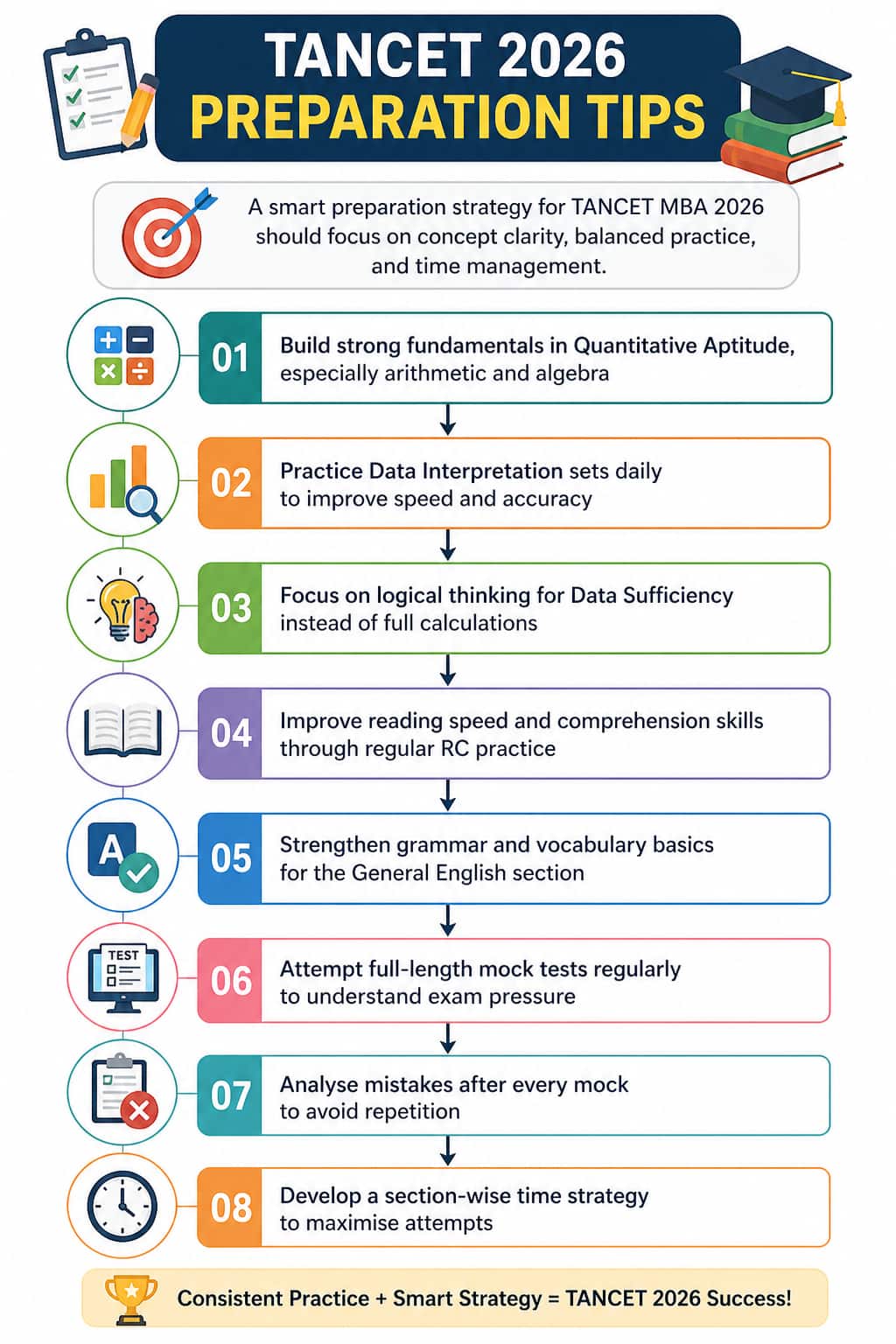
A smart preparation strategy for TANCET MBA should focus on concept clarity, balanced practice, and time management.
Prepare yourself effectively for the TANCET MBA exam using this specially crafted mock test paper, which will make your preparation effective by being made according to the recent TANCET pattern. Practice Quantitative Ability, Logical Reasoning, Verbal Ability, General Knowledge, and Data Sufficiency Questions, along with increasing your speed and accuracy.
Attempt Now: TANCET MBA 2026 Free Mock Test
The TANCET MBA preparation ebooks in are meant for quick learning, intelligent practice, and last-minute revision, which will enable you to revise significant subjects of Quantitative Aptitude, Logical Reasoning, Verbal Ability, General Knowledge, and test practice in less time.
Title | Download Link |
TANCET MBA 2025 Question Paper with Solutions | |
TANCET MBA Previous Year Question Papers (2022 - 2025) | |
Know All About TANCET MBA 2024 | |
TANCET Question Paper 2023 | |
TANCET Question Paper 2022 | |
TANCET MBA Question Paper 2016 | |
TANCET MBA 2016 Question Paper | |
TANCET MBA Question Paper 2015 | |
TANCET MBA Question Paper 2014 | |
TANCET MBA Question Paper 2013 | |
TANCET MBA Question Paper 2012 | |
TANCET MBA Question Paper 2011 | |
TANCET MBA Question Paper 2010 | |
TANCET MBA Question Paper 2009 | |
TANCET MBA Question Paper 2008 | |
TANCET MBA Question Paper 2007 |

Frequently Asked Questions (FAQs)
Good attempts would depend on performance after the examination, but in general, around 70-80 attempts can be deemed satisfactory.
Yes, there is a negative marking of 1/3rd for each wrong attempt.
Data Analysis, Reading Comprehension, Quantitative Ability, Data Sufficiency and General English are some of the topics that are covered in the TANCET 2026 MBA entrance examination.
It is generally believed that Data Sufficiency and Data Analysis are relatively tough compared to other parts of the examination.
Compared to the CAT and XAT examinations, the TANCET MBA entrance examination is comparatively easy.

On Question asked by student community
Hello Student,
If you are seeking admission to the MBA programming at KumaraGuru College of Technology (KCT) coimbatore through TANCET 2026, the approximate tution fee is rupees of 35,000 to 50,000 per year under the government quota. In additional to the tuition fee you may need to pay admission, examination,
Hello Dear Student,
With a TANCET percentile of 96.664, a general rank of 342, and a communal rank of 212, your chances of admission to the MBA program at PSG College of Technology (PSG Tech) are moderate to low, depending on your specific community category.
You can check, find and
Hello Dear Student,
You can check, find and access more information here:
Hi Candidate, please refer to the following links below:
https://bschool.careers360.com/articles/tancet-2026-question-paper-with-solutions-mba-memory-based-questions-answers
https://engineering.careers360.com/articles/ceeta-pg-answer-key
Hello Dear Student,
With a 95.9 percentile in TANCET MBA 2026, securing a regular MBA seat at the University of Madras during the general counselling process is highly challenging, but possible depending on your community category and the specific TANCET cutoff list for the year.
You can check, find and

Globally Recognized by AACSB (US) & AMBA (UK) | 18 LPA Avg. CTC for PGPM 2026
75+ years of legacy | #1 Entrance Exam | Score accepted by 250+ BSchools
13-hour master class to help you score 99+ percentile in CAT 2026
Registration Start: 3 August 2026 | Last Date to Apply: 15 September 2026 (till 5 PM)
AACSB Accredited | 40 LPA-Highest CTC | Scholarships worth 10 CR
Get Real CAT-like Experience | Attend Mock Test on 8th & 9th August 2026 | Timings: 8:30 AM | 12:30 PM | 4:30 PM