Great Lakes - PGDM & PGPM Admissions 2027
Globally Recognized by AACSB (US) & AMBA (UK) | 18 LPA Avg. CTC for PGPM 2026


The National Testing Agency will conduct the CMAT 2027 examination soon. Based on previous years' schedules, CMAT 2027 is expected to be conducted in January 2027. The exact exam date will be known after NTA releases the official notification. With around five to six months left for the CMAT, the candidates have enough time to begin their preparation from scratch. However, this is not easy due to the exam’s vast syllabus; therefore, candidates must follow a CMAT 2027 study plan.
This Story also Contains
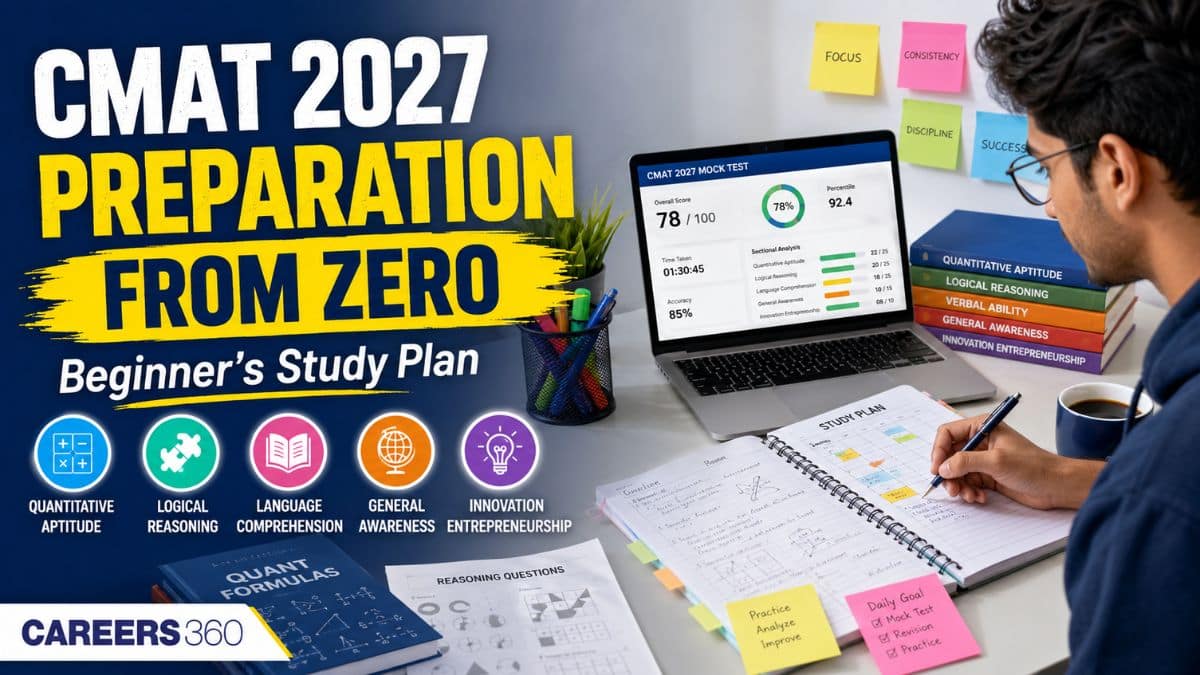
In this article, we have discussed CMAT 2027 preparation for beginners along with subject wise plan, and the best resources here.
CMAT 2027 is expected to be the next edition of the Common Management Admission Test, a national-level entrance examination conducted by the National Testing Agency (NTA) for admission to management programmes. CMAT scores are accepted by AICTE-approved institutions and participating universities, departments and colleges.
Important: CMAT 2027 has not been officially notified yet. Therefore, the exam pattern and syllabus below are based on the latest available CMAT format and should be updated when NTA releases the CMAT 2027 Information Bulletin.
Particular | CMAT 2027 Overview for Beginners |
Full form | Common Management Admission Test |
Conducting body | National Testing Agency (NTA) |
Exam level | National level |
Purpose | Admission to management programmes such as MBA/PGDM at participating institutes |
Exam mode | Computer-Based Test (CBT) |
Exam duration | 3 hours / 180 minutes, based on the latest official CMAT format |
Based on the latest CMAT exam pattern, the exam has 100 objective-type questions, divided equally among five sections.
Candidates get 180 minutes to complete the paper.
The standard marking scheme used in the latest format is +4 marks for every correct answer and -1 mark for every incorrect answers.
Globally Recognized by AACSB (US) & AMBA (UK) | 18 LPA Avg. CTC for PGPM 2026
Test centres are available in 70+ cities across India | 75,000+ aspirants apply for the NMAT exam | Accepted by 58+ institutions like NMIMS, KJSIM, ISB, SPJIMR and Great Lakes.
Section | Number of Questions | Maximum Marks |
Quantitative Techniques and Data Interpretation | 20 | 80 |
Logical Reasoning | 20 | 80 |
Language Comprehension | 20 | 80 |
General Awareness | 20 | 80 |
Innovation and Entrepreneurship | 20 | 80 |
Total | 100 | 400 |
The CMAT syllabus is not limited to a few fixed chapters. For beginners, the best approach is to understand the major topic areas within each section and prepare from basic concepts to CMAT-level questions.
CMAT Syllabus Section-Wise | Topics |
Quantitative Techniques and Data Interpretation |
|
Logical Reasoning |
|
Language Comprehension |
|
CMAT General Awareness and Current Affairs Syllabus |
|
Starting your preparations right is always going to be a lot more effective than studying randomly. If you are just starting your preparations for CMAT, first understand what the exam expects you to do, and then create your own strategy based on building basics, topic-wise practice, sectional and full-length tests, and regular revision and analysis of your mock tests.
Check the latest pattern, syllabus, sections, marking scheme, and previous years’ papers. This will give you an idea about what all you need to prepare for instead of browsing through random material.
Try giving one CMAT previous year’s question paper or a mock test without any preparation and see what all topics you are not confident about. What are the topics that make you commit calculation mistakes? What are the sections that consume a lot of your time? This will help you create your study plan accordingly.
If you have weaker basics, start with school-level topics of Quant, Grammar, Vocabulary, and Reasoning. Do not solve high level questions from the starting but start with the basics as it helps to clear concepts.
For each topic, first grasp the basics. Then, practice CMAT do or die topics with easy levels and gradually move on to moderate and higher levels. For example, learn percentage before moving on to profit and loss. Practice basic topics before you attempt to solve complex puzzles and reasoning questions.
Keep an error notebook for topics or questions that you keep getting wrong, forget the formulas and the concepts, or keep making mistakes. Keep track of the mistakes you are making in your weekly revision. This will show you what exactly you are weak in, and you can avoid them in the future completely by practicing similar questions again and again.
Also Read, CMAT preparation tips and trend analysis
Candidates can check out the subject-wise CMAT preparation strategy 2027 for beginners in the section below.
Develop conceptual knowledge on basic Arithmetic topics like Percentage, Ratio and Proportion, Average, Profit and Loss, Simple and Compound Interest, Time and Work, and Time, Speed and Distance. Solve easy level problems first and then proceed with moderate ones. Practice calculations regularly and also revise the formulas weekly. In case of Data Interpretation, develop an understanding of tables, bar graphs, pie-charts, and other data interpretations along with improving calculation skills.
Do not practice random questions of Reasoning Ability. It is better to study a particular set of questions of the same pattern. You can start preparing for Series, Coding-Decoding, Blood Relations, Directions, and Ranking. Once strong in these topics, proceed for Syllogisms, Statements, Seating Arrangements, and Puzzles. Once confident about the topic, try to solve questions with a time limit. At the same time, evaluate the tricky questions that took a lot of time to solve to determine whether it was a weak area or an incorrect approach.
It is essential to practice this section on a daily basis by reading and attempting questions. Read newspapers, articles, and editorials to improve reading skills. Maintain a notebook for new words and repeated errors in grammar and revise them regularly. It is always better to understand the language rather than spend time learning new words without proper practice.
Divide your preparation for General Awareness into static GK and current affairs. Prepare topics like History, Geography, Indian Polity, and Economy, Science and Technology, Business, Awards, Sports, and Books and Authors among others. Make notes while studying and also revise them frequently. Current Affairs always require consistent preparation, but it is better to prepare from reliable resources rather than studying everything.
Start preparing for this section by studying the basics of entrepreneurship, innovation, and startups, business plans, and intellectual property rights, and various other concepts. Study about prominent entrepreneurs, startups, government schemes, and business-related news items. It is crucial to solve previous years’ questions to determine the types of questions in this section. It would be better to make notes on key points, terms, examples, and relevant cases for quick revision before the exams.
For beginners, the most useful approach is to divide CMAT preparation into clear stages: first learn the basics, then practise chapter-wise questions, move to mixed practice, and finally take full-length mocks. The table below gives CMAT important topics to cover each month so that you know exactly what to study and what to achieve before moving ahead.
Month | Main Focus | What Beginners Should Do | Monthly Goal |
August 2026 | Understand the exam and build basics | Check the CMAT syllabus and previous-year question papers. Start basic Arithmetic, grammar, vocabulary and simple Logical Reasoning questions. Begin daily GK reading. | Understand the level of questions and complete basic concepts. |
September 2026 | Arithmetic and reasoning foundation | Study Percentage, Ratio and Proportion, Profit and Loss, Average, Simple and Compound Interest. Practise Series, Coding-Decoding, Blood Relations and Directions. | Build confidence in the most basic Quant and LR topics. |
October 2026 | Complete important Quant topics | Cover Time and Work, Time, Speed and Distance, Mixtures, Algebra basics and Number System. Start Data Interpretation sets. | Finish the major Arithmetic topics and improve calculation accuracy. |
November 2026 | Strengthen all five sections | Practise Seating Arrangement, Puzzles, Syllogisms and other reasoning topics. Continue RC, grammar and vocabulary. Start Innovation and Entrepreneurship topics. | Complete first-round preparation of the syllabus. |
December 2026 | Section-wise practice | Solve topic-wise and sectional tests. Revise weak Quant and LR chapters. Practise RC, para jumbles, grammar and vocabulary regularly. Revise GK and I&E notes. | Identify weak areas before starting intensive mock practice. |
January 2027 | Mocks, revision and exam strategy | Take full-length mocks and analyse every test. Revise formulas, mistakes, GK notes and important I&E concepts. Practise previous-year papers. | Finalise question selection and time-management strategy. |
Take your first CMAT mock after going through the basic concepts of all the five sections; you do not need to study the entire syllabus. Take the help of one mock test to understand your strong areas, weak areas, and frequent errors. With increasing levels of preparation, you can take more mock tests and analyze each and every exam before taking the next one. Taking CMAT mock tests from Careers360 can help candidates understand the test pattern, assess their preparation level and identify areas for improvement.
Refer to the table below to get the names of popular CMAT books that is useful for beginners preparing from the basics.
Section | Book for Beginners | Why It Is Useful | How to Use It |
Quantitative Techniques & DI | Quantitative Aptitude for Competitive Examinations by R.S. Aggarwal | Explains basic concepts and provides a large number of practice questions. | Start with Arithmetic and solve easy questions before moving to advanced exercises. |
Quantitative Techniques & DI | NCERT Mathematics Class 8–10 | Useful for students whose school-level maths concepts are weak. | Use it only to clear basics before moving to competitive exam books. |
A Modern Approach to Verbal & Non-Verbal Reasoning by R.S. Aggarwal | Covers many basic reasoning question types. | Learn one topic at a time and solve questions immediately after studying the concept. | |
Logical Reasoning & DI | Logical Reasoning and Data Interpretation for the CAT by Nishit K. Sinha | Provides higher-level practice after basic concepts are clear. | Use selected chapters after completing basic LR topics. |
Language Comprehension | Word Power Made Easy by Norman Lewis | Helps build vocabulary gradually. | Study a small portion regularly and revise previously learned words. |
Language Comprehension | How to Prepare for Verbal Ability and Reading Comprehension for the CAT by Arun Sharma | Useful for RC, verbal ability and question practice. | Start after basic grammar and vocabulary are reasonably comfortable. |
General Awareness | Lucent’s General Knowledge + current affairs notes | Covers static GK, while current affairs notes help with recent events. | Revise static GK regularly and update current affairs until the exam. |
Innovation & Entrepreneurship | CMAT-focused notes and practice questions | The section requires familiarity with business, innovation, entrepreneurship and related concepts. | Make short notes of important terms, schemes, startups and concepts, then solve section-wise questions. |
List down some of the common mistakes that students make while preparing for the exam below:
Some students start preparing for the CMAT without knowing the syllabus, pattern, marking scheme or previous year’s question papers. A lot of students make the mistake of studying topics without understanding which part will carry more marks. It is crucial to first understand the exam pattern and then make a study plan around it.
Instead of understanding concepts related to Percentage, Ratio, Average, Profit and Loss, some students try to directly solve advanced level questions. Understanding fundamentals is important to answer tricky questions.
It is natural to gravitate towards topics that you like or are good at but ignore your weak areas. Even if you are good at certain topics, try to spend sufficient time practicing them every day. It is important to dedicate enough time to your weak areas rather than leaving it for the last minute.
A mock test is only useful if you analyze it properly. Do not just check your score and move on. It is important to understand where you are spending more time, what are the weak areas, topics or question types that you are making maximum mistakes in. You should spend time analyzing the mock tests and then take corrective steps.
Also Read, CMAT Language Comprehension important topics
GA section requires consistent revision and you cannot cram all the current affairs and static topics before the exam. It is advisable to revise this section on a day to day basis rather than waiting for the last minute.
Students get tempted to collect study material for each topic and study from each resource. However, it is important to prepare each topic from only one resource. It is advisable to finish one book or one set of lectures before moving on to the next one.
Ebook Title | Download Link |
CMAT 2027: Innovation and Entrepreneurship: All Chapters with Sample Questions, with Syllabus PDF | |
CMAT 2027: 10 Free Mock Tests PDF with Detailed Solution | |
CMAT 2027 Language Comprehension Questions with Solutions PDF | |
CMAT 2027 General Awareness Questions with Answers PDF | |
CMAT Logical Reasoning Questions with Answers PDF | |
CMAT 2027 Quantitative Techniques & Data Interpretation Questions Answers PDF | |
CMAT 2026: Mastering All Sections with 1000+ Expertly Crafted Questions and Detailed Answers | |
Ultimate CMAT 2026 MCQs Guide: Master the Exam with Section-wise Practice Questions | |
CMAT 2027 Most Scoring Topics and High-Weightage Chapters |
Frequently Asked Questions (FAQs)
Yes, but you have to follow a CMAT preparation strategy from the beginning. It helps to build your basics in all subjects and give mock tests to understand your preparation level.
As per experts, candidates require only 4 to 6 months to prepare for CMAT from scratch. However, first understand the level of conceptual understanding you have.
Always prioritise the subject in which you are weak. Beginners must start with the Quantitative Ability and General Knowledge sections as they have vast syllabus
You should take up one mock test at the beginning to assess your level. Then, it is important that you first learn the basics and take up mock tests at regular intervals in between.
Yes, you can always prepare for CMAT on your own if you follow a proper study material and an exam schedule.

On Question asked by student community
Hello Sanya
Please check the link given below for the best books for CMAT preparation:
https://bschool.careers360.com/articles/best-books-for-cmat-preparation
Hope it helps.
Hello Dear Student,
With an 89 CMAT percentile and an interest in Finance , you can target several good AICTE-approved MBA/PGDM colleges outside Mumbai and Pune.
Recommended Colleges
Hello Dear Student,
For SC category candidates aiming for top-tier MBA programs through CMAT and SNAP, a safe percentile typically ranges from 75 to 85. The exact cutoff required to get a shortlist depends on the specific institute’s prestige, as detailed below.
You can check, find and access more information
Yes, you can get a seat in the Institute of Management Studies DAVV with a CMAT score of 170. An expected percentile of 80 improves the chances of admission in the college in a course of your choice.
For safety, we advise you to check the cutoffs released by the
Hello,
Here you can check all the details related to CMAT Innovation and Entrepreneurship- Download PDF

Globally Recognized by AACSB (US) & AMBA (UK) | 18 LPA Avg. CTC for PGPM 2026
75+ years of legacy | #1 Entrance Exam | Score accepted by 250+ BSchools
6-Hour Masterclass to help you score 99+ percentile in CAT 2026
Test centres are available in 70+ cities across India | 75,000+ aspirants apply for the NMAT exam | Accepted by 58+ institutions like NMIMS, KJSIM, ISB, SPJIMR and Great Lakes.
Registration Start: 3 August 2026 | Last Date to Apply: 15 September 2026 (till 5 PM)
AACSB Accredited | 40 LPA-Highest CTC | Scholarships worth 10 CR