Great Lakes - PGDM & PGPM Admissions 2027
Globally Recognized by AACSB (US) & AMBA (UK) | 18 LPA Avg. CTC for PGPM 2026


The TS ICET 2026 Analytical Ability Sample Questions are an essential resource for candidates preparing for the Telangana State Integrated Common Entrance Test. The TS ICET 2026 exam is scheduled to be conducted on May 13 and 14, 2026, in multiple sessions. Among the three sections of the TS ICET question paper, Analytical Ability carries the highest weightage of 75 marks, making it a crucial scoring area for MBA and MCA aspirants. This section evaluates logical reasoning and problem-solving skills. Practising TS ICET analytical ability sample questions can help candidates understand the question types, improve accuracy, and enhance their overall performance in the TS ICET 2026 exam.
This Story also Contains
The TS ICET examination will follow the same pattern as in the previous years. The candidates can expect 200 questions in the question paper, which is divided into 3 sections: Analytical ability, Mathematical ability and Communication ability. The number of questions in each section is 75, 75 and 50, respectively. The detailed examination pattern of the TS ICET examination is given below.
Section | Topic-wise Distribution | No. of Questions |
A. Analytical Ability (Total: 75 Questions) | Data Sufficiency | 20 |
Problem Solving | 55 | |
B. Mathematical Ability (Total: 75 Questions) | Arithmetical Ability | 35 |
Algebraic and Geometric Ability | 30 | |
Statistical Ability | 10 | |
C. Communication Ability (Total: 50 Questions) | Meanings (sentences with dashes) | 5 |
Synonyms and Antonyms | 5 | |
Verb (Tense & Voice) | 5 | |
Phrasal Verbs & Idioms | 5 | |
Articles & Prepositions | 5 | |
Computer Terminology | 5 | |
Business Terminology | 5 |
The Analytical Ability section is the first part of the TS ICET question paper and plays an important role in setting the tone for the rest of the exam. This section includes questions on data sufficiency and problem-solving, which test a candidate’s logical reasoning and analytical skills. Since data sufficiency questions can be tricky, carefully reading and understanding the statements is essential. Regular practice with TS ICET analytical ability sample questions helps candidates improve accuracy and speed. Solving model questions on topics like coding–decoding, series completion, and blood relations can significantly strengthen preparation.
Section A – Analytical Ability | |
1. Data Sufficiency | 20 |
2. Problem-Solving | 55 |
1. The following bar diagram gives information on smartphone market share (in billions of dollars). Based on this, answer the question:
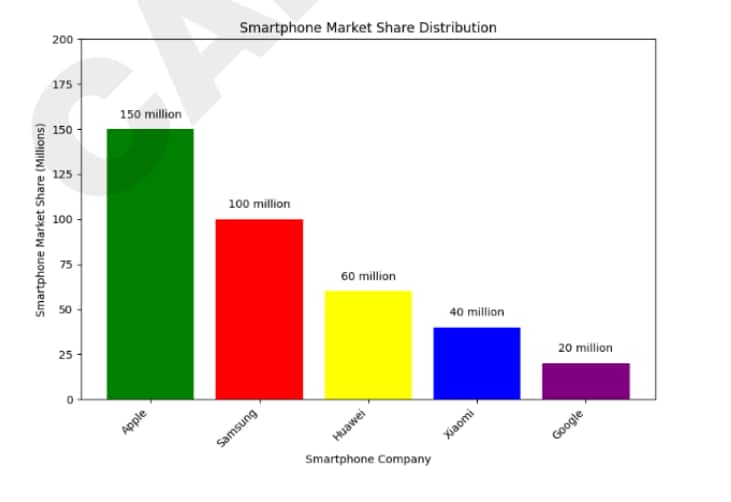
1. What is the total number of smartphone units sold by the five companies combined?
A. 250 million units
B. 200 million units
C. 370 million units
D. 270 million units
2. Calculate the average number of smartphone units sold by the five companies.
A. 50 million units
B. 60 million units
C. 54 million units
D. 48 million units
3. Which companies have a market share greater than the calculated average?
A. Apple and Samsung
B. Apple, Samsung, and Huawei
C. Apple, Samsung, Huawei, and Xiaomi
D. All five companies except Google
4. What is the ratio of Xiaomi's smartphone units sold to Samsung's smartphone units sold?
A. 2:5
B. 1:2.5
C. 1:5
D. 2:3
5. If Google's smartphone units sold are increased by 50%, what is the new number of units sold by Google?
A. 15 million units
B. 25 million units
C. 30 million units
D. 35 million units
2. 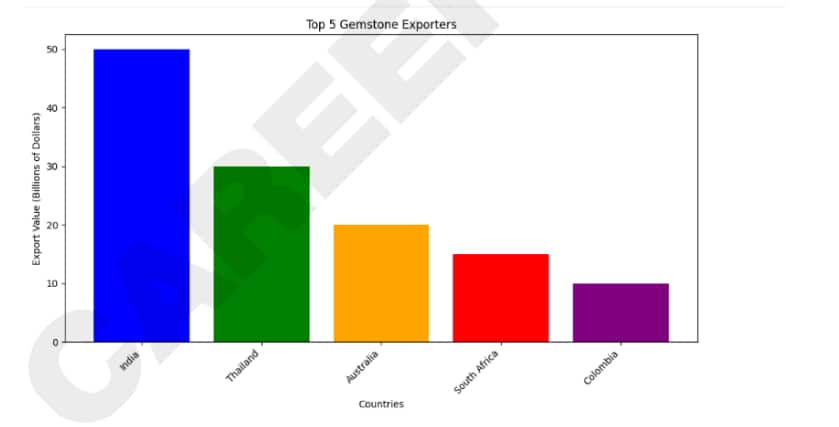
1. What is the average export value of gemstones for India, making it the largest exporter in the world?
A. $30 billion
B. $50 billion
C. $20 billion
D. $15 billion
2. Which country ranks second in gemstone exports globally?
A. Australia
B. Thailand
C. South Africa
D. Colombia
3. What is the average export value of gemstones for Thailand, the second-largest exporter?
A. $50 billion
B. $30 billion
C. $20 billion
D. $15 billion
4. Which country is the third-largest exporter of gemstones?
A. Australia
B. South Africa
C. Colombia
D. India
5. With an average export value of $10 billion, which country holds the fifth position in gemstone exports?
A. India
B. Thailand
C. Australia
D. Colombia
3. Directions: In a certain code language, GALE is coded as 3576, and FLAG is coded as 7361. What is the code for E in the given language?
A. 6
B. 5
C. 3
D. 7
4. Directions: In a certain code language, BOOK is written as 325, and READ is written as 400. How will ABLE be written in that language?
A. 445
B. 440
C. 442
D. 438
5. Directions: In a certain code language, SLAP is coded as 3160, and PAST is coded as 6071. What is the code for L in the given code language?
A. 3
B. 1
C. 6
D. 0
6. In a class, 17 students like maths, 10 like english and 3 like none. If 2 like both English and Maths then the total number of students in the class is
A. 24
B. 20
C. 27
D. 28
7. In a society of 25 people, 16 like tea, 13 like coffee, 2 like none. Then the number of people who like tea only are
A. 10
B. 6
C. 15
D. 9
8. Directions: Looking at a photograph of a woman, Samuel said, "She is the mother of my father's brother's daughter." How is Samuel related to the women shown in the picture?
A. Son
B. Brother
C. Brother-in-law
D. Husband's brother's son
The first 20 questions of the TS ICET 2026 question paper will be the data sufficiency section. In this section, one conclusion will be given, followed by two statements, A andB. The candidates should identify how the statements are responsible for influencing the conclusion. There are four possible answers. Statement one alone is sufficient for concluding, statement two alone is sufficient for concluding, both statements A and B are necessary for concluding or finally, neither A nor B is sufficient for concluding. These 20 questions might be tricky because the candidates should go through all the possible choices to conclude. But the challenges can be tackled through proper TS ICET analytical ability sample question practice. Some of the selected solved TS ICET analytical ability model questions under the data sufficiency section is listed below:
Note:
In the questions below, a question is followed by data in the form of two statements labelled as (I) and (II). You must decide whether the data given in the statements are sufficient to answer the questions. Using the data, make an appropriate choice from (1) to (4) as per the following guidelines:
(a) Mark choice (1) if the statement (I) alone is sufficient to answer the question.
(b) Mark choice (2) if the statement (II) alone is sufficient to answer the question.
(c) Mark choice (3) if both the statements (I) and (II) are sufficient to answer the question but neither statement alone is sufficient.
(d) Mark choice (4) if both the statements (I) and (II) together are not sufficient to answer the question and additional data are required.
Question:
Find the two-digit number x.
Options:
1
2
3
4
Globally Recognized by AACSB (US) & AMBA (UK) | 18 LPA Avg. CTC for PGPM 2026
Test centres are available in 70+ cities across India | 75,000+ aspirants apply for the NMAT exam | Accepted by 58+ institutions like NMIMS, KJSIM, ISB, SPJIMR and Great Lakes.
Statements:
(I) The difference between the number x and the one obtained by reversing it is 27.
(II) The number is greater than 5.
Explanation:
Statement (I):
Let the two-digit number be x = 10a + b, where a is the tens digit and b is the ones digit. When the number is reversed, it becomes 10b +A.
According to the statement, the difference is 27, so:
| (10a + b) - (10b + a) | = 27
Simplifying the equation:
| 9a - 9b | = 27
Dividing by 9:
| a - b | = 3
This gives us two possibilities:
a - b = 3 or b - a = 3
Statement (II):
The number is greater than 5. This just tells us the number is positive and is a two-digit number.
Now, using both statements, we check possible values of a and b that satisfy | a - b | = 3 and a, b are digits (from 0 to 9).
The possibilities are:
a = 6, b = 3 → Number = 63
a = 7, b = 4 → Number = 74
a = 8, b = 5 → Number = 85
a = 9, b = 6 → Number = 96
These satisfy the condition of the difference being 27. Therefore, 63 is the solution.
Correct Answer:
Option 1
Question:
Is the positive integer x divisible by 10?
Options:
1
2
3
4
Statements:
(I) x is the sum of five consecutive positive integers.
(II) x is divisible by 4.
Explanation:
Statement (I):
The sum of five consecutive integers is given by x = n + (n + 1) + (n + 2) + (n + 3) + (n + 4), which simplifies to x = 5n + 10.
For x to be divisible by 10, 5n + 10 must be divisible by 10.
5n + 10 = 10(n + 1), which is clearly divisible by 10 for any integer n.
Hence, Statement (I) alone is sufficient to conclude that x is divisible by 10.
Statement (II):
x is divisible by 4, but this does not give us information on whether it is divisible by 10. This statement alone is not sufficient to answer the question.
Thus, Statement (I) alone is sufficient to answer the question.
Correct Answer:
Option 1: 1
Question:
Among four friends P, Q, R, S, who is the tallest?
Options:
1
2
3
4
Statements:
(I) Q is taller than P.
(II) R is shorter than Q, but taller than S.
Explanation:
Statement (I):
Q is taller than P, but this information alone does not tell us the height relationship between R and S, so we cannot determine who is the tallest from this statement alone.
Statement (II):
R is shorter than Q, but taller than S. This gives us some information, but we still do not know how P compares to Q or R, and therefore, cannot definitively answer the question.
Combining both statements:
From Statement (I), we know Q is taller than P, and from Statement (II), we know R is taller than S but shorter than Q. This gives us a ranking of Q > R > S. Since P is not directly compared with R or S, Q is clearly the tallest.
Thus, combining the two statements is sufficient to determine that Q is the tallest.
Correct Answer:
Option 1: 1
Question:
What is the value of x?
Options:
1
2
3
4
Statements:
(I) x + y = 24.
(II) x² + y² = 296.
Explanation:
Statement (I):
The equation x + y = 24 gives us a relationship between x and y, but it does not provide enough information to determine the value of x without further details about y.
Statement (II):
The equation x² + y² = 296 provides a different relationship between x and y. However, this alone is not sufficient to determine x, as there are multiple possible values for x and y that satisfy this equation.
Combining both statements:
From Statement (I), we know x + y = 24. By substituting y = 24 - x into Statement (II), we get:
x² + (24 - x)² = 296
Expanding the equation:
x² + (576 - 48x + x²) = 296
2x² - 48x + 576 = 296
Simplifying:
2x² - 48x + 280 = 0
Dividing by 2:
x² - 24x + 140 = 0
Solving the quadratic equation:
x = 14 or x = 10
Therefore, we have two possible values for x. However, the provided options suggest there is only one possible answer
Thus, Option 4: 4 is the correct answer.
Question:
What is the angle subtended by the sector at the centre of the circle?
Options:
1
2
3
4
Statements:
(I) Perimeter of the sector is 16 cm.
(II) Arc length of the sector is 10 cm.
Explanation:
Statement (I):
The perimeter of the sector is given by Perimeter = 2r + l, where r is the radius and l is the arc length.
From the perimeter, we can find r and l, and use the formula for the angle subtended by the sector.
Statement (II):
The arc length l of the sector is related to the radius and the angle θ by the formula l = rθ. Using the arc length, we can calculate θ directly.
Combining both statements:
Using both statements, we can find the value of the angle θ by relating the arc length to the radius and solving for θ. Therefore, both statements together are sufficient to determine the angle.
Correct Answer:
Option 3: 3
Question:
What is the median of the integers in set S consisting of six integers?
Options:
1
2
3
4
Statements:
(I) Range of the set is 40.
(II) Arithmetic mean of the integers in S is 15.
Explanation:
Statement (I):
The range of a set is the difference between the largest and smallest numbers.
The range is 40, so we know that the difference between the maximum and minimum values in the set is 40. However, this alone doesn't help us determine the exact value of the median.
Statement (II):
The arithmetic mean is the sum of all the integers in the set divided by the number of integers. Given that the mean is 15, this implies that the sum of the integers is 6 × 15 = 90.
Combining both statements:
Since the set consists of six integers and the mean is given as 15, we know the sum of the numbers. The range tells us the difference between the highest and lowest integers. However, because there are two middle numbers (since there is an even number of integers), neither of these two statements alone, or together, provides enough information to determine the median. Additional information is required to determine the median.
Correct Answer:
Option 4: 4
Question:
What is the ratio of the areas of a circle and a square?
Options:
1
2
3
4
Statements:
(I) The radius of the circle is 4 cm.
(II) The circle circumscribes the square.
Explanation:
Statement (I):
The radius of the circle is given as 4 cm, but this alone is not sufficient to determine the ratio of the areas of the circle and square. The relationship between the square and circle needs to be defined further.
Statement (II):
The fact that the circle circumscribes the square means that the circle passes through all four vertices of the square. The diagonal of the square is equal to the diameter of the circle. We can now calculate the area of both the square and the circle.
Combining both statements:
From Statement (I), the radius of the circle is 4 cm, so the area of the circle is:
Area of circle = πr² = π(4)² = 16π cm².
From Statement (II), the diagonal of the square is equal to the diameter of the circle, which is 8 cm. Using the relation for the diagonal of a square (diagonal = √2 × side), we can find the side of the square:
Side of the square = 8 / √2 = 8√2 / 2 = 4√2 cm.
The area of the square is:
Area of square = (side)² = (4√2)² = 32 cm².
Now, the ratio of the area of the circle to the area of the square is:
Ratio = (Area of circle) / (Area of square) = 16π / 32 = π / 2 ≈ 1.57.
Thus, the ratio is approximately 3.
Correct Answer:
Option 3: 3
Question:
What is the rate of simple interest?
Options:
1
2
3
4
Statements:
(I) Principal is Rs. 1000.
(II) Amount in 3 years is Rs. 1195.
Explanation:
Statement (I):
The principal amount is given as Rs. 1000. This information is useful, but we also need to know the interest rate or the total amount at the end of the period to calculate the rate of interest.
Statement (II):
The total amount after 3 years is given as Rs. 1195. We can use this information to find the simple interest (SI) and then calculate the rate.
Using both statements together:
The formula for Simple Interest is:
SI = P × R × T / 100,
where P is the principal, R is the rate of interest, and T is the time in years.
The total amount (A) is given by:
A = P + SI,
where A is the total amount, and P is the principal.
From Statement (I), P = 1000 and from Statement (II), A = 1195 after 3 years.
So, the simple interest for 3 years is:
SI = 1195 - 1000 = 195.
Now, using the formula for SI:
195 = 1000 × R × 3 / 100
Simplifying this:
195 = 3000R / 100
195 × 100 = 3000R
19500 = 3000R
R = 19500 / 3000 = 6.5
Thus, the rate of interest is 6.5%.
Correct Answer:
Option 3: 3
Understanding the statements and conclusion is the key to solving the various types of data sufficiency questions in the TS ICET examination. The data sufficiency problems are the ones which may confuse the candidates a lot. Jumping to conclusions without going through all the statements and conclusions may result in wrong responses.
The candidates should understand the questions clearly. Read the question carefully to understand exactly what is being asked. Sometimes, the wording can be tricky, and understanding the core of the question is crucial. Candidates should understand if the questions require solving to find a single value or performing a comparison.
The candidates should go through each statement carefully and compare it with the solution to see if they can alone conclude. Candidates should also not neglect the possibility of a statement giving a partial answer. They must evaluate each statement independently so that they do not mix them and result in confusion.
In some cases, extra information can be provided that is not required to solve the problem. This is done to confuse the candidates. Focus only on the information that answers the question.
As some of the questions may also cover both logical reasoning and various quantitative aptitude concepts, the candidates should also be thorough with these concepts.
55 questions are asked from the problem-solving topic of the analytical ability section. The candidates who find the data sufficiency problems difficult can focus more on the problem-solving concepts to enhance their TS ICT analytical ability’s problem-solving section to gain a good TS ICET. Some of the TS ICET analytical ability sample questions are provided below for the reference of the candidates. Apart from practising the TS ICET analytical ability model questions, the candidates should also go through the TS ICET mock tests and TS ICET sample papers to enhance the candidate’s TS ICET scores.
Question:
257 : G :: 879 : ?
Options:
J
K
L
M
Answer:
Correct Option: 3
Solution:
The sum of the digits of 257 is 2 + 5 + 7 = 14.
The letter G is the 7th letter in the alphabet.
Dividing 14 by 2 gives 7, which corresponds to the position of G.
Now, applying this to 879:
The sum of the digits of 879 is 8 + 7 + 9 = 24.
Dividing 24 by 2 gives 12, which corresponds to the letter L (the 12th letter of the alphabet).
Hence, the correct answer is Option 3: L.
Identity the odd one out in the questions given below
Crowd, Union, Swarm, Team, Flock, Throng
Options:
Crowd
Flock
Team
Swarm
Correct Option: 3
Solution:
The words "Swarm," "Flock," "Crowd," "Throng," and "Union" all refer to a group or collection of individuals. However, "Team" specifically refers to a group working together for a common goal, which makes it the odd one out.
Hence, the correct answer is Option 3: Team.
Sequence: 71, 73, 79, 83, 87, 89, 97
Options:
73
83
87
97
Correct Option: 3
Solution: Upon reviewing the sequence:
71, 73, 79, 83, 89, and 97 are all prime numbers.
However, 87 is not a prime number (it is divisible by 3).
Therefore, 87 is the odd one out, as it is the only non-prime number in the sequence.
Hence, the correct answer is Option 3: 87.
Clear is related to Open in the same way as Confidential is related to ___.
Clean
Free
Direct
Secret
Correct Option: 4
Given:
Clear is related to Open.
Confidential is related to ___.
Like in, Clear is related to Open – the synonym of clear is open.
Similarly, the synonym of confidential is secret, meaning something that is not to be shown or told to others.
So, only the fourth option establishes the same relationship with confidential as the given pair. Hence, the fourth option is correct.
Directions: A series is given with one term missing. Select the correct alternative from the given ones that will complete the series.
ABCD, HGLO, OLUZ, VQDK, ?
RTQV
CYQR
CMVQ
CVMV
Correct Option: 4
Given:
ABCD, HGLO, OLUZ, VQDK, ?
Add 7, 5, 9, and 11 to the place values of the first, second, third, and fourth letters of the previous terms to get the next term in the series.
First letter→A + 7 = H; H + 7 = O; O + 7 = V; V + 7 = C
Second letter→B + 5 = G; G + 5 = L; L + 5 = Q; Q + 5 = V
Third letter→C + 9 = L; L + 9 = U; U + 9 = D; D + 9 = M
Fourth letter→D + 11 = O; O + 11 = Z; Z + 11 = K; K + 11 = V
So, CVMV is the missing term of the series. Hence, the fourth option is correct.
Directions: In a certain code language, CRUST is written as 201921183 and BLAME is written as 5131122. How will PLASTIC be written in that language?.
18204165138
73110209325
71642578102
39201911216
Correct Option: 4
Given:
CRUST is written as 201921183
BLAME is written as 5131122
Position values of letters is arranged in the reverse order to get the code
Position values of letters of CRUST; C → 3; R → 18; S → 19; T → 20
On reversing the numbers the code will be ⇒ 201921183
Position values of letters of BLAME; B → 2; L → 12; A → 1; M → 13; E → 5
On reversing the numbers the code will be ⇒ 5131122
Likewise, position values of the letters of PLASTIC are: P → 16; L → 12; A → 1; S → 19; T → 20; I → 9; C → 3
On reversing the numbers the code will be ⇒ 39201911216
Thus, PLASTIC is coded as 39201911216. Hence, the fourth option is correct.
Directions: Select the option that is related to the fifth letter cluster in the same way as the second letter cluster is related to the first letter cluster and the fourth letter cluster is related to the third letter cluster.
LAMB : DPEQ :: MOTH : JWSR :: NERD : ?
FVJS
FUJS
FVIS
FUIS
Correct Option: 4
Given:
LAMB : DPEQ :: MOTH : JWSR :: NERD : ?
Like, LAMB→L + 5 = Q; A + 4 = E; M + 3 = P; B + 2 = D→QEPD
Now, reverse the order of the letters obtained, we get→DPEQ
So, LAMB is related to DPEQ.
MOTH→M + 5 = R; O + 4 = S; T + 3 = W; H + 2 = J→RSWJ
Now, reverse the order of the letters obtained, we get→JWSR
So, MOTH is related to JWSR.
Similarly, for NERD→N + 5 = S; E + 4 = I; R + 3 = U; D + 2 = F→SIUF
Now, reverse the order of the letters obtained, we get→FUIS
So, NERD is related to FUIS. Hence, the fourth option is correct.
Directions: Three of the following letter-clusters are alike in some manner and hence form a group. Which letter-cluster does not belong to that group?
WDLF
YBXR
PKSM
IRMT
Correct Option: 4
Given:
Option 1: WDLF : 23, 4, 12, 6;
Option 2: YBXR : 25, 2, 24, 18;
Option 3: PKSM : 16, 11, 19, 13;
Option 4: IRMT : 9, 18, 13, 20;
In all the options First letter and Second letter are opposite pair of alphabet series, but in first three option, the difference of third letter and fourth letter is 6, but in option 4 the difference is 7;
Hence, the fourth option is correct.
Directions: If A × B means that A is the father of B, A + B means that A is the mother of B, A ÷ B means that A is the brother of B then which of the following expression shows that Q is the son of P?
Q + P × R
P + Q × R
R × Q + P
P + Q ÷ R
Correct Option: 2
Given:
A × B means that A is the father of B; A + B means that A is the mother of B; A ÷ B means that A is the brother ofB.
First option: Q + P × R
→ Q is the mother of P and P is the father of R. So, Q is not the son of P.
Second option: P + Q × R
→ P is the mother of Q and Q is the father of R. So, Q is the son of P.
Third option: R × Q + P
→ R is the father of Q and Q is the mother of R. So, Q is not the son of P.
Fourth option: P + Q ÷ R.
→ P is the mother of Q and Q is the brother of R.
Hence, the second option is correct.
The problem-solving section of the TS ICET exam consists of questions from a wide range of topics, such as series completion, coding and decoding, blood relation, distance and direction and so on. According to the official TS ICET exam pattern, there is no exact division of questions across the subtopics of logical reasoning. Still, it is beneficial for the candidates to follow expert strategies for TS ICET 2026 preparation of the analytical ability section.
Practice all the different types of questions. The questions from the problem-solving section of the TS ICET exam can come from a wide range of topics, as mentioned above. The candidates should also take TS ICET analytical ability sample questions from various domains to have an understanding of the question types.
Regular practice is necessary for the candidates, irrespective of their skills in the analytical ability section of the TS ICET examination. For the candidates with beginner and intermediate level proficiency in the logical reasoning section of the TS ICET examination, the candidates should practice often using various TS ICET analytical ability sample questions. In case the candidates are proficient in the section, they must revise regularly using the TS ICET analytical ability sample questions.
Time management is an important skill as far as any management entrance examination is concerned. Analytical Ability questions can be time-consuming. Practising solving questions within a limited time can help the candidates to improve their speed and accuracy. Taking part in the TS ICET mock tests in a timed environment can be helpful for the candidates.
One of the major mistakes made by the candidates while preparing for the TS ICET exam is prioritising speed over accuracy. While speed is necessary, focusing on accuracy is more important.
If the candidate is stuck on a question and it’s taking too long, move on to the next one. However, if they feel confident about a probable answer, try smart guessing based on elimination techniques. Since there is no negative marking in the TS ICET examination, the candidates can attempt all the questions without worrying about negative marking.
Now that the candidates have almost 2 months in hand for the TS ICET 2026 preparation, they can follow the timetable designed below by Careers360 for completing the entire TS ICET 2026 syllabus and equipping themselves for the TS ICET exam day.
Week | Topics |
Week 1 | - Symbol Interpretation - Seating Arrangements - Arrivals and Departures - Blood Relationships |
Week 2 | - Calendars and Clocks - Date, Time, and Arrangement Problems - Passage - Venn Diagram |
Week 3 | - Pie Chart - Bar Diagram - Tables and Graphs - Data Analysis - Coding and Decoding |
Week 4 | - Missing Number in Sequence - Problem Solving - Numbers and Alphabets - Sequences and Series |
Week 5 | - Data Sufficiency - Binomial Theorem - Matrices - Notions of Limit and Derivative |
Week 6 | - Plane Geometry: Lines, Triangles, Quadrilaterals, Circles - Coordinate Geometry: Distance between points |
Week 7 | - Frequency Distribution - Mean, Median, and Mode - Standard Deviation - Correlation - Probability |
Week 8 | - Areas and Volume - Mensuration - Modular Arithmetic - Algebraic and Geometrical Ability Statements |
Now that the candidates have a good enough time left for the TS ICET 2026 exam, it is the right time to strengthen their preparation using the best TS ICET 2026 books. Given below is a set of the best books arranged section-wise for bringing out the best of the candidate’s last-minute TS ICET preparation.
Section | Book Title | Authors/Publishers |
Analytical Ability | Verbal and Non-Verbal Reasoning | RS Aggarwal |
Reasoning Book for Competitive Examinations | Pearson | |
Logical Reasoning and Data Interpretation | Nishit Sinha | |
Analytical Reasoning | MK Pandey | |
Multi-Dimensional Reasoning | Mishra & Kumar Dr Lal | |
Mathematical Ability | Quantitative Aptitude Quantum CAT Common Admission Tests | Sarvesh K. Verma |
Quantitative Aptitude for Competitive Exams | RS Aggarwal | |
Mathematics Class 11th and 12th | RD Sharma | |
Vedic Mathematics | Dr. Aditi Singhal | |
How to Prepare for Quantitative Aptitude for CAT | Arun Sharma | |
Communication Ability | Word Power Made Easy | Norman Lewis |
Proficiency in Reading Comprehension | Ajay Singh | |
Grammar Error Spot | A. Uphadhaya | |
High School English Grammar | Wren and Martin | |
Objective General English | SP Bakshi |
Careers360 provides specially curated eBooks to support candidates preparing for TS ICET 2026. These eBooks cover the complete syllabus, key concepts, and practice questions designed according to the exam pattern. Prepared by experts, they help aspirants strengthen fundamentals, enhance problem-solving skills, and build an effective preparation strategy for better performance in the exam.
Ebook Name | Download Link |
TS ICET 2026 Preparation Guide | |
TS ICET Sample Papers 2026 | |
TS ICET Entrance Exams and Counselling | |
TS ICET 2023 Question Paper | |
TS ICET 2022 Question Paper | |
TS ICET 2021 Question Paper |
Frequently Asked Questions (FAQs)
The TS ICET 2025 exam will be held on June 8th and 9th, 2025, with sessions from 10:00 AM to 12:30 PM and 2:30 PM to 5:00 PM. Make sure to check the official website for any updates or changes to the schedule.
TS ICET 2025 consists of 200 questions: Analytical Ability (75 questions), Mathematical Ability (75 questions), and Communication Ability (50 questions). The exam is designed to assess candidates’ aptitude in various management-related subjects.
The TS ICET Analytical Ability section includes Data Sufficiency (20 questions) and Problem Solving (55 questions), covering topics like series completion and blood relations. Mastery of these topics is crucial for scoring well in this section.
For TS ICET Data Sufficiency, understand each statement and conclusion, practice various question types, and focus on logical reasoning. Mock tests help improve time management and boost confidence for the exam.
TS ICET Analytical Ability: RS Aggarwal, MK Pandey.
TS ICET Mathematical Ability: Sarvesh K. Verma, RS Aggarwal.
TS ICET Communication Ability: Norman Lewis, SP Bakshi.
These books are highly recommended by experts and can help you enhance your preparation effectively.

On Question asked by student community
Hello Dear Student,
Yes, as a qualified non-local student from Andhra Pradesh, you are eligible to participate in TS ICET counselling , where you can compete under the 15% unreserved open category seats, provided you meet the general qualifying marks (25% or 50 out of 200 for the unreserved category)
Hey there,
With a TS ICET rank of 2,000, BC-B (Female) category, and annual family income of 1.45 lakh, you have a very good chance of getting admission to reputed MBA/MCA colleges through TS ICET counselling. You may also be eligible for fee reimbursement/scholarships, subject to the government's eligibility rules.
As of 17 July 2026 , the official TG ICET (formerly TS ICET) 2026 counselling registration dates have not yet been announced by the Telangana Directorate of Technical Education/TGCHE.
With a TG ICET 2026 rank of 35,047 , getting a government university MBA department such as:
Osmania University
Kakatiya University
JNTU Hyderabad
Telangana University
Satavahana University
is unlikely in the General category , as these usually close at much lower ranks.
However, you have a good chance of getting
Hello Dear Student,
With a TSICET rank of 21897 in the BC-D category, securing an MCA seat at VNR VJIET through the Convenor (Category-A) quota is highly difficult, as closing ranks typically range much higher. However, you can apply for the Category-B (Management/Sponsored) quota.
You can check, find and access

Globally Recognized by AACSB (US) & AMBA (UK) | 18 LPA Avg. CTC for PGPM 2026
75+ years of legacy | #1 Entrance Exam | Score accepted by 250+ BSchools
6-Hour Masterclass to help you score 99+ percentile in CAT 2026
Test centres are available in 70+ cities across India | 75,000+ aspirants apply for the NMAT exam | Accepted by 58+ institutions like NMIMS, KJSIM, ISB, SPJIMR and Great Lakes.
Registration Start: 3 August 2026 | Last Date to Apply: 15 September 2026 (till 5 PM)
AACSB Accredited | 40 LPA-Highest CTC | Scholarships worth 10 CR