
Search Colleges, Exams, Schools & more


Login
Most aspirants start preparing for KMAT Karnataka a few weeks before the exam date. Hence, having a period of two months is quite normal and you will be able to clear the exam with good marks. As per the pattern of KMAT Karnataka, the test consists of 120 MCQs from Verbal Ability & Reading Comprehension, Quantitative Ability, and Logical Reasoning. Now, as per the expected schedule, KMAT Karnataka 2026 session 1 is going to be conducted in the first week of September 2026. Therefore, you will get around eight weeks time to cover your syllabus. Till now, the exam date is not announced by KPPGCA.
This Story also Contains
- KMAT Karnataka 2026 Exam Pattern & Section-Wise Weightage
- How to Divide Your 60-Day KMAT Karnataka Preparation Plan
- Which Topics Should You Prioritise in the Last 2 Months?
- When Should You Start Taking KMAT Mock Tests?
- How to Analyse KMAT Karnataka Mock Tests Effectively
- Top Ebooks Recommended for KMAT Karnataka 2026 Preparation
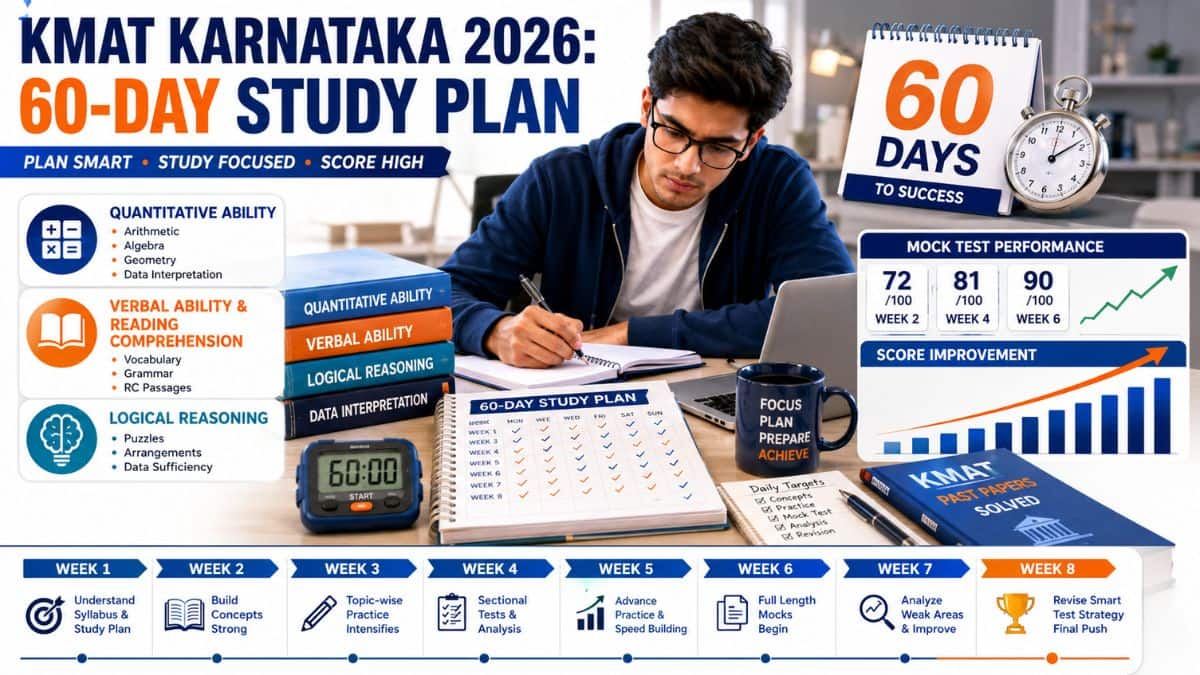
Here we have mentioned the KMAT Karnataka 2026 exam strategy along with study plan.
KMAT Karnataka 2026 Exam Pattern & Section-Wise Weightage
The KMAT Karnataka exam pattern, it has three sections with equal weightage, and each correct answer carries one mark. There is no negative marking, so candidates should attempt all questions.
Section | Questions | Marks | High-Yield Chapters |
Verbal Ability & Reading Comprehension (VARC) | 40 | 40 | Reading Comprehension, Vocabulary, Grammar, Synonyms & Antonyms, Sentence Completion |
40 | 40 | Arithmetic, Algebra, Geometry, Statistics, Modern Mathematics, Data Interpretation | |
40 | 40 | Coding-Decoding, Blood Relations, Series, Analogies, Puzzles, Direction Sense, Data Sufficiency | |
Total | 120 | 120 | — |
How to Divide Your 60-Day KMAT Karnataka Preparation Plan
Here is a timeline for your KMAT 60 day study plan that offers dedicated timeline for each week.
Weeks | Topics to Focus | Recommended Hours/Day |
Week 1–2 | Understand the exam pattern, build fundamentals in Arithmetic, Grammar, Vocabulary, Reading Comprehension, and basic Logical Reasoning. Solve 20–30 practice questions daily. | 3–4 hours |
Week 3–4 | Cover Algebra, Geometry, Data Interpretation, Puzzles, Coding-Decoding, Blood Relations, and strengthen RC with daily passages. Start sectional tests twice a week. | 4–5 hours |
Week 5–6 | Take full-length mock tests, analyse mistakes, revise formulas and grammar rules, and improve speed through timed practice. | 5–6 hours |
Week 7–8 | Focus on complete revision, previous year papers, daily mocks, weak-topic practice, and exam-day time management. Avoid learning new topics. | 5–6 hours |
Which Topics Should You Prioritise in the Last 2 Months?
The final 60 days before KMAT Karnataka are not the time to study every topic equally. Instead, your major focus should be on chapters with high weightage but low difficulty. Since these help you score marks easily during the early duration of the exam. Refer to the table below to get a list of subject wise KMAT Karnataka topics.
Section | High-Priority Topics | Medium-Priority Topics | Low-Priority Topics |
Quantitative Ability | Arithmetic, Percentages, Profit & Loss, Time & Work, Time-Speed-Distance, Ratio & Proportion, Simple & Compound Interest | Algebra, Geometry, Number System, Data Interpretation | Permutation & Combination, Probability, Trigonometry, Mensuration |
Logical Reasoning | Seating Arrangement, Blood Relations, Coding-Decoding, Series, Directions, Syllogisms | Data Sufficiency, Statement-Assumption, Analogies, Ranking | Cubes, Clocks & Calendars, Complex Logical Games |
Verbal Ability & RC | Reading Comprehension, Vocabulary, Synonyms & Antonyms, Sentence Completion, Grammar | Para Jumbles, Error Detection, Fill in the Blanks | Idioms, Foreign Words, Rare Vocabulary |
When Should You Start Taking KMAT Mock Tests?
You should start taking sectional mock tests after completing 40–50% of the syllabus. Ideally, this should be around 6 to 8 weeks before the exam since by that time you must have easily completed 70 to 80% of the syllabus.
According to our analysis, candidates should attempt 20–25 mock tests before the KMAT exam. They should spend a major portion of their time analysing the mock . This is a great tip, especially for those who are doing KMAT Karnataka preparation for beginners. Since, it helps to gauge one’s approach, question solving time and even accuracy.
How to Analyse KMAT Karnataka Mock Tests Effectively
Taking mock tests is only half the preparation. The real improvement comes from analysing every test carefully. Experts recommend spending at least as much time analysing a mock as taking it. Dedicate another 1.5–2 hours to reviewing your performance once you have completed your mock test. This helps you identify weak concepts and improve your test-taking strategy.
Step | What to Analyse | Questions to Ask Yourself | Action to Take |
1. Overall Score | Total marks and accuracy | Did your score improve from the last mock? | Track scores in a spreadsheet. |
2. Section-wise Performance | VARC, QA, LR scores | Which section took the most time? | Allocate more practice time to weak sections. |
3. Accuracy Rate | Correct vs Incorrect Answers | Are you making conceptual or careless mistakes? | Aim for 80–85% accuracy before increasing attempts. |
4. Time Spent | Time per section | Which questions consumed too much time? | Learn to skip lengthy questions early. |
5. Question Selection | Attempted vs Unattempted | Did you miss easy questions? | Improve question selection strategy. |
6. Error Type | Conceptual, Calculation, Guesswork, Silly Mistakes | Why was the answer wrong? | Maintain an error log. |
7. Strong Topics | Chapters with high accuracy | Can you solve them even faster? | Continue regular practice. |
8. Weak Topics | Low-scoring chapters | Do you need concept revision? | Revise theory before solving more questions. |
Top Ebooks Recommended for KMAT Karnataka 2026 Preparation
Candidates preparing for the KMAT Karnataka 2026 exam must also refer to exam-centric ebooks. These help to clear any topic-related doubt and also consist of proper explanation for every solution. Get the download link for the top KMAT ebooks below.
Ebook | Download Link |
500+ Idioms And Phrases List With Meanings & Examples For MBA Entrance Exams | |
Permutation & Combination - Important Concepts, Videos, Questions for CAT & Other MBA Entrance Exams | |
Avoid These Common CAT RC Mistakes to Boost your VARC Score |
Frequently Asked Questions (FAQs)
Q: Is 2 months enough to prepare for KMAT Karnataka 2026?
A:
Yes, but you must study daily for the same and have an appropriate plan to get good marks.
Q: How many hours do I need to study daily for KMAT Karnataka?
A:
You must study for 4-6 hours a day, but it is enough for most of the candidates. However, if you are working or studying full-time, then even 2-3 hours every day will help you.
Q: Is it possible to prepare for KMAT Karnataka for beginners in 2 months?
A:
Yes, it is very easy for beginners. They should first begin with basic concepts, finish one concept at a time and practice questions every day.
Q: How many mock tests should I give before the exam?
A:
Ideally, you must give 10-15 full-length mock tests before appearing in the exam. It will give you a lot of practice and after every mock test, revise your mistakes.
Q: What is the biggest mistake that one should avoid in the last 2 months?
A:
Candidates should not be learning new concepts till the last week before the exam.
Articles
Related Stories
|
Upcoming Bschool Exams

Certifications By Top Providers
Explore Top Universities Across Globe
Popular Courses and Specializations
List of colleges accepting CAT
Browse Bschool Colleges by State
Questions related to CAT
On Question asked by student community
Have a question related to CAT ?
If by B-category you mean management/private quota MBBS seats, the cutoff is very different from government-quota MBBS.
In Tamil Nadu, management-quota MBBS seats are available in self-financing/private medical colleges through the state counselling process. The closing rank varies significantly between colleges and counselling rounds. The 2025 counselling data shows that
Hello Student,
With a CAT 2025 percentile of 98.25, you have a good chance of receiving calls from several IIMs, particularly newer IIMs. However, IIM Ahmedabad , Bangalore , Calcutta , and Lucknow generally require higher percentiles for General-category candidates. Calls also depend on sectional percentiles, academics, work experience, and
Hello Aspirant,
Yes, you can access CAT preparation resources, including mock tests, practice questions, previous-year papers, and study material. Explore the CAT preparation resources and test series using the link below:
https://bschool.careers360.com/download/ebooks-and-sample-papers?exam=45
Hope this Helps!
Hello CAT Aspirant!
If you mean the CAT ( Common Admission Test) EWS certificate, the important point is whether the certificate is valid and issued in the prescribed format, rather than simply the language used on it.
Yes, a Hindi EWS certificate can generally be accepted for CAT, provided it
Popular CAT Questions
Directions for question:
The bar-graph given below shows the foreign exchange reserves of Nepal (in million Rupees) from 2014 to 2021. Answer the following questions based on the graph :

Question:
What was the percentage increase (rounded to the nearest integer, if deemed necessary) in the foreign exchange reserves in

Study Resources, Applications and Opportunities
Globally Recognized by AACSB (US) & AMBA (UK) | 18 LPA Avg. CTC for PGPM 2026
XAT- Xavier Aptitude Test 2027
Apply75+ years of legacy | #1 Entrance Exam | Score accepted by 250+ BSchools
Career Launcher Race To 99%ile In CAT 2026 - Phase 03
Enquire6-Hour Masterclass to help you score 99+ percentile in CAT 2026
NMAT by GMAC 2026
ApplyTest centres are available in 70+ cities across India | 75,000+ aspirants apply for the NMAT exam | Accepted by 58+ institutions like NMIMS, KJSIM, ISB, SPJIMR and Great Lakes.
Common Admission Test 2026 (CAT 2026)
ApplyRegistration Start: 3 August 2026 | Last Date to Apply: 15 September 2026 (till 5 PM)
IBSAT 2026-ICFAI Business School MBA/PGPM 2027
ApplyAACSB Accredited | 40 LPA-Highest CTC | Scholarships worth 10 CR
CAT Notifications
Never miss CAT update
Get timely CAT updates directly to your inbox. Stay informed!