Great Lakes - PGDM & PGPM Admissions 2027
Globally Recognized by AACSB (US) & AMBA (UK) | 18 LPA Avg. CTC for PGPM 2026


The CAT 2026 Averages and Mixtures topic is a key part of the CAT Quantitative Aptitude syllabus that tests your understanding of averages, weighted averages, and mixture problems. With at least one question expected from this area in CAT 2026 exam, mastering important formulas and problem-solving techniques is crucial for success. This article covers key concepts, essential formulas, and practice questions to strengthen your preparation and improve accuracy in solving averages and mixtures questions under exam conditions.
This Story also Contains
While analysing the CAT quantitative aptitude syllabus, it can be found that both averages and mixtures and two standalone topics with their distinct formulas and applications. But in various management entrance examinations, it was observed that the concept of mixtures and averages was clubbed together and asked. In such cases, the candidates should be able to apply the concepts related to both sections and apply them to solve the questions. This will help the candidates secure a good CAT score and ensure a high CAT percentile under the quantitative aptitude section, which is often decisive for the candidates. A few of the important CAT formulas associated with the concepts of averages and mixtures are provided below for the reference of the candidates.
|
Concept |
Formula |
|
Alligation (basic rule) |
(Quantity of A) / (Quantity of B) = (C - B) / (A - C) |
|
Repeated dilution formula |
Final quantity = Initial quantity × ((V - r) / V)n |
|
Average of N values |
Average = (Sum of all values) / Number of values |
|
Finding the sum from the average |
Sum = Average × Number of values |
|
Finding the missing value from the average |
Missing value = (Average × Total number of values) - Sum of known values |
|
New average after adding/removing |
New Average = (Old total ± Change) / (Old number ± Change in number of terms) |
The best CAT preparation strategy to answer the CAT quantitative aptitude questions is by solving as many related questions as possible. Hence, the candidates should solve a lot of CAT 2026 averages and mixtures questions to answer all the possible types of questions that the candidates may expect on the CAT exam day. A few of the practice questions under this domain are provided below for the reference of the candidates.
1. There are three people, A, B, and C in a room. If a person D joins the room, the average weight of the persons in the room reduces by x kg. Instead of D, if person E joins the room, the average weight of the persons in the room increases by 2x kg. If the weight of E is 12 kg more than that of D, then the value of x is:
1.5
0.5
1
2
Solution
According to the ques,
$\frac{A+B+C}{3} - \frac{A+B+C+D}{4} = x$
And $\frac{A+B+C+E}{4} - \frac{A+B+C}{3} = 2x$
Adding both equations, we get,
$\frac{E-D}{4} = 3x$
⇒ $E-D = 12x$
Also, $E-D=12$
So, x = 1
Hence, the correct answer is option (3).
2. If a certain amount of money is divided equally among n persons, each receives Rs. 352. However, if two persons receive Rs. 506 each and the remaining amount is divided equally among the other persons, each of them gets less than or equal to Rs. 330. Then, the maximum possible value of n is _____________.
16
14
24
18
Solution
According to the question
$352n \leq 506 \times 2 + (n-2) \times 330$
⇒ 352n - 330n ≤ 1012 - 660
⇒ 22n ≤ 352
⇒ n ≤ 16
So, the maximum value of n is 16.
Hence, the correct answer is option (1).
3. Anil mixes cocoa with sugar in a ratio 3:2 to prepare mixture A, and coffee with sugar in a ratio 7:3 to prepare mixture B. He combines mixtures A and B in the ratio 2:3 to make a new mixture C. If he mixes C with an equal amount of milk to make a drink, then the percentage of sugar in this drink will be:
16
24
26
17
Test centres are available in 70+ cities across India | 75,000+ aspirants apply for the NMAT exam | Accepted by 58+ institutions like NMIMS, KJSIM, ISB, SPJIMR and Great Lakes.
AACSB Accredited | 40 LPA-Highest CTC | Scholarships worth 10 CR
Solution
A and B mix in a ratio of 2:3 to make mixture C.
Let 20 units of A and 30 units of B be taken.
Sugar in mixture A = $\frac{2}{3+2}=\frac25$
Sugar in mixture B = $\frac{3}{7+3}=\frac3{10}$
$\therefore$ Sugar in C = $\frac25$ of 20 + $\frac3{10}$ of 30 = 8 + 9 = 17
Volume of C = 50 units
So, Volume of drink = 50 + 50 = 100
$\therefore$ Percentage of sugar in the drink $=\frac{17}{100}×100=17\%$
Hence, the correct answer is option (4).
4. You have a container with a 25% saltwater solution and another container with a 10% saltwater solution. You want to create a 15-litre mixture that contains 15% salt. How many litres of each solution should we mix to achieve the desired concentration?
15
20
10
5
Solution
Let x be the number of litres of the 25% solution and (15 - x) be the number of litres of the 10% solution.
The equation is as follows:
(0.25x) + (0.10(15 – x)) = 0.15 × 15
⇒ 0.25x + 1.5 – 0.10x = 2.25
⇒ 0.15x + 1.5 = 2.25
⇒ 0.15x = 2.25 – 1.5
⇒ 0.15x = 0.75
$\therefore$ x = 5
So, you should mix 5 litres of the 25% salt water solution with (15 - 5) = 10 litres of the 10% salt water solution to achieve the desired 15% salt concentration in a 15-litre mixture.
Hence, the correct answer is 5.
5. Dickwela is thrice as old as Thirumane and Hayden is half as old as Dickwela. If Dickwela's age is 7 years more than the average age of all three, then Hayden's age, in years, is:
9
10
12
15
Solution
Given: Dickwela is thrice as old as Thirumane and Hayden is half as old as Dickwela.
Let the ages of Dickwela, Thirumane, and Hayden be $\mathrm{D, T, and\:H}$ years, respectively.
According to the question,
$\begin{aligned} & \mathrm{D}=3 \mathrm{T \:and \:H}=\mathrm{\frac{D}{2}} \\ & \text { Also, } \mathrm{D=\frac{(D+T+H)}{3}+7} \\ & \Rightarrow \mathrm{D}=\mathrm{\frac{D+\frac{D}{3}+\frac{D}{2}}{3}}+7 \\ & \Rightarrow \mathrm{D}=18 \mathrm{ \:years} \\ & \text { So, Hayden's age }=\frac{18}{2}=9 \mathrm{ \:years}\end{aligned}$
Hence, the correct answer is option (1).
6. A family consists of a mother, a father, and some children. The average age of the members of the family is 30, the father’s age is 50 years, and the average age of the mother and children is 20. The number of children in the family is ______________.
1
2
3
4
Solution
Let the average age of children be $x$ and there are $n$ children in the family.
Let the age of mother be y.
So, $nx+y=(n+1)20$ -------------------(1)
Also, $nx+y+50=(n+2)30$ -----------------------(2)
Subtracting 1st equation from the 2nd equation,
$50=30n+60-20n-20$
⇒ $50=10n+40$
⇒ $n=1$
So, there is 1 child in the family.
Hence, the correct answer is option (1).
7. In 2001, the average age of a family of 7 members was 36 years. In 2010 a family member expired and a child was born to the family. In 2018 another family member expired merely a week later after the marriage of the younger son of the family to his bride of age 27 years. It was found that the average age of the family in 2021 was 43 years. Out of the options provided, which could have been the individual age of the two family members when they expired in 2010 and 2018, respectively?
68 and 50
74 and 52
82 and 40
84 and 43
Solution
If the average in 2001 is 36, then in 2021 the average must be 36 + 20 = 56 years
But actually, it is 43 years, that is a deficit of (56 – 43) = 13 years
Throughout the 20 year period, at the end of every year, the total members of the family were 7.
$\therefore$ Deficit in years = 7 × 13 = 91 years
But the bride was added to the family at 27 years of age.
So the total deficit created by the expiry of the 2 members of the family was = 91 + 27 = 118 years
Out of the options, only the first one’s total comes to 118 years.
Hence, the correct answer is 68 and 50.
8. Rajesh and Geeta are among 12 persons in a family. Rajesh is 26 years old. The average age of the 11 members other than Geeta is 16 years. The difference between the average age of all 12 members and the average age of 11 members other than Rajesh is between 0 and 1. If the ages of all the members are an integer value, then the age of Geeta can not be:
14
7
13
3
Solution
Total age of 11 members other than Geeta = 16 × 11 = 176 years
Let the age of Geeta be x.
Total age of 12 members = 176 + x
Average age of 12 members = $\frac{(176 +x)}{12}$
Average age of 11 members other than Rajesh $=\frac{ (176 +x -26)}{11}$
According to the question,
$[\frac{(176 +x)}{12}-\frac{ (176 +x -26)}{11}$ < 1
Solving this, we get x > 4
So, Geeta's age cannot be 3.
Hence, the correct answer is 3.
9. During the annual sports meet on 25th January 1983, at St Xavier's School, Durgapur, two big jerricans were arranged by the P.T. Sir Mr Shantimoy Biswas for the refreshment purposes of the students participating. One of the jerricans was filled with 20 liters of freshly extracted pure orange juice, while the other was filled with 20 liters of cold drinking water mixed with Electoral ORS powder. Sir Biswas took a 2-litre mug and transferred one mug of orange juice from the first jerrican to the second. He then moved the same amount from the second jerrican to the first. He repeated the whole process one more time, and the two different drinks were ready. The drink in the first jerrican became such a hit among the students that it was named the Shanti-Punch, and participation in school sports rose considerably in the subsequent years to be able to have the Shanti-Punch. What was the final concentration of pure orange juice in the Shanti-Punch?
$\frac{100}{121}$
$\frac{109}{121}$
$\frac{101}{121}$
$\frac{10}{11}$
Solution
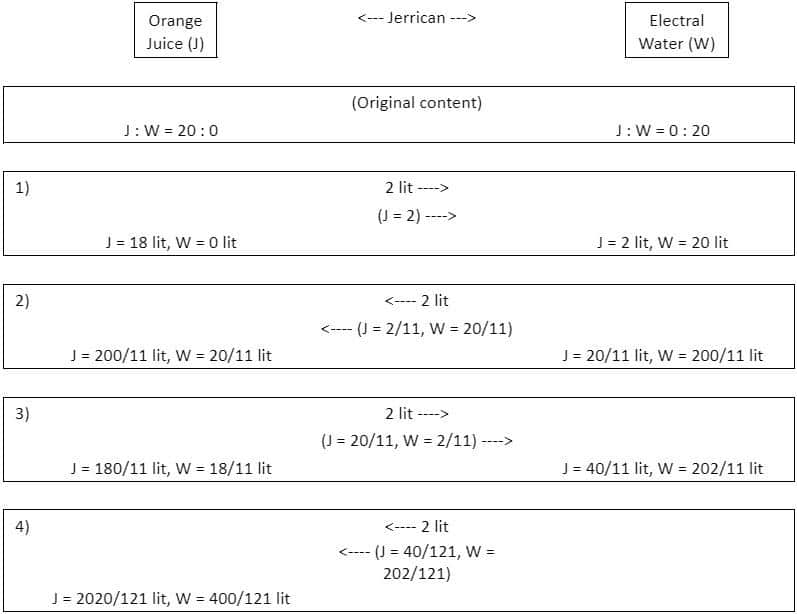
$\therefore$ Final ratio of pure orange juice and water in the first jerrican
= $\frac{2020}{121}:\frac{400}{121}$
= $101:20$
$\therefore$ Concentration of Juice in Santi-Punch = $\frac{101}{101+20}=\frac{101}{121}$
Hence, the correct answer is option (1).
10. In what proportion must water be mixed with milk to gain 37.5% by selling the mixture at a price 5% more than the actual price? (Assume that water is freely available)
1 : 9
1 : 8
13 : 42
13 : 55
Solution
Here SP denotes the selling price and CP denotes the cost price.
He gains 37.5% means he gains 3 on 8.
Final SP / Initial CP = (SP / CP) × (Selling Quantity / Purchased Quantity)
SP : CP = 21 : 20 (Since he sells at 5% higher than the actual price)
Final SP : Initial CP = 11 : 8
So,
11 / 8 = (21 / 20) × (Selling Quantity / Purchased Quantity)
⇒ 55 / 42 = Selling Quantity / Purchased Quantity
He mixes 13 litres in 42 litres of pure milk.
Hence, the correct answer is 13 : 42.
Considering the frequency of CAT 2026 averages and mixtures questions, the candidates are advised to practice various types of CAT averages and mixtures questions to enhance their CAT quantitative aptitude preparation. If a candidate is in search of other types of CAT quantitative aptitude questions under the averages and mixtures topic, they can download the PDF given below, which includes various CAT averages and mixtures topics along with their answers.
|
Title |
Download Link |
|
Averages and Mixtures |
The candidates are always advised to solve the previous year's questions on averages and mixtures to gain a good understanding of what they can expect in the CAT question paper 2026. This will help the candidates to understand the difficulty level of the CAT averages and mixtures questions and prepare accordingly. The candidates can download these previous year questions using the links provided below.
|
Title |
Download Link |
|
Mixtures and Averages |
Averages and Mixtures questions in CAT 2026 require strong conceptual clarity and logical thinking, as they are rarely solved using direct formulas alone. These questions often involve weighted averages, replacement logic, and ratio-based reasoning, where a small misunderstanding can lead to errors. A systematic approach helps candidates break down complex statements, manage calculations efficiently, and identify faster solution paths under exam pressure.
CAT mixture questions are almost always based on weighted averages, where different quantities contribute unequally to the final average. Instead of averaging values directly, focus on how each component’s quantity affects the overall result. This understanding is critical in questions involving multiple substances.
Converting averages into total quantity or total value (average × quantity) simplifies most problems. This method is especially useful in replacement and mixture scenarios, as tracking totals makes changes easier to visualize and calculate accurately.
Allegation is a powerful shortcut but works only when two components combine to form a mixture with an average between their individual values. Understanding why the ratio forms is more important than memorising the rule, ensuring correct application in CAT questions.
Replacement-based mixture problems involve multiple stages. After each replacement, recalculate the quantity and composition before moving to the next step. Skipping intermediate adjustments often leads to incorrect final answers.
Many CAT mixture problems can be solved faster using ratios instead of exact values. Choosing suitable assumed quantities reduces computation time while maintaining accuracy, making this approach ideal for time-bound sections.
The candidates can also go through the top-rated CAT quantitative aptitude books to practice various other important CAT questions on averages and mixtures. The list of the best materials available for the candidates under the CAT quantitative aptitude section is provided below.
|
Book Title |
Author |
|
Quantitative Aptitude for Competitive Examinations |
R.S. Aggarwal |
|
Quantitative Aptitude Quantum CAT |
Sarvesh Verma |
|
NCERT Mathematics books (Class 9–10) |
NCERT |
|
How to Prepare for Quantitative Aptitude for the CAT |
Arun Sharma |
The links to the various important CAT preparation materials, such as practice questions, mock tests and preparation guides designed by Careers360’s experts are provided in the links below.
|
eBook Title |
Download Links |
|
3000+ Most Important Words - Vocabulary Builder | |
|
500+ Most Important Idioms and Phrases | |
|
300+ Most Important Phrasal Verbs | |
|
Permutation & Combination - Video Lectures and Practice Questions | |
|
Mastering DILR Questions with Expert Solutions | |
|
CAT 2026 Exam's High Scoring Chapters and Topics | |
|
Mastering CAT Exam: VARC, DILR, and Quant MCQs & Weightages | |
|
CAT 2026 Mastery: Chapter-wise MCQs for Success for VARC, DILR, Quant | |
|
CAT 2026 Quantitative Aptitude Questions with Answers | |
|
CAT DILR Questions with Solution, Download LRDI Questions for CAT | |
|
CAT 2026 Verbal Ability and Reading Comprehension (VARC) Study Material |
Frequently Asked Questions (FAQs)
Averages and mixtures are significant topics in CAT Quantitative Aptitude. According to previous-year analysis, at least one question from this area is expected in the exam, making it a high-priority topic for aspirants to master.
Essential formulas include the basic average formula, converting averages to totals, weighted average, allegation rule for mixtures, repeated dilution, and finding missing values from an average — all foundational to solving CAT-level problems.
Candidates should practise a wide variety of problems — from basic average computations to mixture ratios and replacement questions. Solving previous-year questions and timed practice sets builds familiarity and improves accuracy.
Yes. Solving previous year CAT questions on averages and mixtures helps in understanding real exam patterns and difficulty levels — sharpening application skills and exam strategy.
Start with clear concept understanding and formula memorisation. Then use methods like allegation diagrams, assumption techniques for averages, and lots of practice under timed conditions to increase speed and reliability in solving questions.

On Question asked by student community
If by B-category you mean management/private quota MBBS seats, the cutoff is very different from government-quota MBBS.
In Tamil Nadu, management-quota MBBS seats are available in self-financing/private medical colleges through the state counselling process. The closing rank varies significantly between colleges and counselling rounds. The 2025 counselling data shows that
Hello Student,
With a CAT 2025 percentile of 98.25, you have a good chance of receiving calls from several IIMs, particularly newer IIMs. However, IIM Ahmedabad , Bangalore , Calcutta , and Lucknow generally require higher percentiles for General-category candidates. Calls also depend on sectional percentiles, academics, work experience, and
Hello Aspirant,
Yes, you can access CAT preparation resources, including mock tests, practice questions, previous-year papers, and study material. Explore the CAT preparation resources and test series using the link below:
https://bschool.careers360.com/download/ebooks-and-sample-papers?exam=45
Hope this Helps!
Hello CAT Aspirant!
If you mean the CAT ( Common Admission Test) EWS certificate, the important point is whether the certificate is valid and issued in the prescribed format, rather than simply the language used on it.
Yes, a Hindi EWS certificate can generally be accepted for CAT, provided it
Directions for question:
The bar-graph given below shows the foreign exchange reserves of Nepal (in million Rupees) from 2014 to 2021. Answer the following questions based on the graph :

Question:
What was the percentage increase (rounded to the nearest integer, if deemed necessary) in the foreign exchange reserves in

Globally Recognized by AACSB (US) & AMBA (UK) | 18 LPA Avg. CTC for PGPM 2026
75+ years of legacy | #1 Entrance Exam | Score accepted by 250+ BSchools
6-Hour Masterclass to help you score 99+ percentile in CAT 2026
400+ Recruiters | Highest CTC 25 LPA | Average CTC 8 LPA | 92% Placements in 2025 | Ranked as Platinum Institute | Awarded Best Business School of the Year
Test centres are available in 70+ cities across India | 75,000+ aspirants apply for the NMAT exam | Accepted by 58+ institutions like NMIMS, KJSIM, ISB, SPJIMR and Great Lakes.
Registration Start: 3 August 2026 | Last Date to Apply: 15 September 2026 (till 5 PM)