Algebra is one of the most consistent high-scoring parts in the CAT exam, and since CAT 2026 is getting closer, getting a grip on its main equation patterns can give you a real advantage. In this article, we’ll talk about the four most important kinds of algebraic equations that keep showing up in CAT exams, with easy explanations and exam-oriented methods to solve, plus the usual mistakes you should dodge and a few smart shortcuts so your speed and correctness both improve. Once you get these evergreen equation styles sorted out, your problem-solving pace grows, your accuracy improves, and it becomes easier to aim for a top percentile in CAT 2026. There will also be yearwise and slotwise distribution of the algebra questions, practice level examples and CAT specific strategies so you can handle Algebra questions more confidently through CAT 2026.
This Story also Contains
Algebra in CAT Quantitative Aptitude
Overview of Algebra in the CAT Exam
Type 1 – Linear Equations in CAT Algebra
Type 2 – Quadratic Equations in CAT Algebra
Type 3 – Inequalities and Modulus Equations
Type 4 – Functions & Polynomials in CAT Algebra
Advanced CAT Algebra Problem Types
Algebra Important Topics for CAT 2026 & Beyond
CAT 2026 Algebra Preparation Tips
CAT 2026 Preparation Resources by Careers360
Common Mistakes in CAT Algebra Preparation
How to Practice Repeated Algebra Questions in CAT for High Percentile
CAT 2026 Algebra Decoded: 4 Equation Types That Appear Year After Year
Algebra in CAT Quantitative Aptitude
Algebra plays a key role in pushing your overall CAT percentile up. It covers a bunch of different concepts, such as equations functions inequalities modulus logarithms and also algebraic expressions, kind of like the backbone of advanced problem-solving. If you have a strong grip on CAT Algebra, it really helps with accuracy in the direct algebra questions, plus it makes the other tougher questions from Quant feel more manageable, so you can solve with confidence. To master Algebra for CAT 2026, you need to build a solid mathematical base, which helps you handle both the straightforward and the tricky kinds of questions efficiently. It should be a must-focus area in your preparation strategy, even if the syllabus looks a bit long.
Why Algebra Dominates CAT Quant Every Year?
Algebra pretty much keeps the highest weightage in CAT Quantitative Aptitude, so yeah it ends up being the most dominant part of the paper. The whole point of it is also simple, it shows up in a fairly predictable way and it checks whether you really understand the concepts, not just whether you can do a bunch of long steps.
Great Lakes - PGDM & PGPM Admissions 2027
Globally Recognized by AACSB (US) & AMBA (UK) | 18 LPA Avg. CTC for PGPM 2026
Algebra shows up almost every year, and usually in good numbers so it’s a high-return area
It becomes the groundwork for tackling problems in Arithmetic, Logarithms, Surds and Indices, plus Modern Mathematics. like it’s connected everywhere
It measures conceptual clarity more than it wants lengthy calculations
Algebra based questions are great for designing moderate-to-high difficulty levels in CAT
If your Algebra is strong, then your overall speed and accuracy while solving improves too
Past 10 years CAT Question Papers with Solutions
Ace CAT with confidence! Download the Past 10 Years' CAT Question Papers with detailed answers to understand exam trends, improve accuracy, and maximize your percentile.
So, because it’s consistent and also flexible, Algebra works like a real scoring weapon for CAT 2026. If you focus your preparation on Algebra, you can seriously boost your odds of hitting a top percentile in the Quantitative Aptitude section.
Must-know Algebra concepts for CAT candidates
We have analyzed the last five years of CAT question papers to give you some idea of the concepts that have been asked earlier, so here’s what we found as listed below :
Topic
Important Concept to understand
Complex numbers
Iota, conjugate of complex number
Linear Equations
Forming and solving linear equations, nature of solutions, graphs
Algebra tests you on concepts like equations, inequalities, sequences and also functions. If you get good at these areas, you can solve the problems faster and with more accuracy, which boosts your CAT 2026 performance overall.
Weightage of Algebra in the CAT Quant section
Below is a year wise and slot wise distribution of how many questions were asked from Algebra in CAT in the last few years, so candidates can quickly check the weightage and plan prep accordingly:
Year
2020
2021
2022
2023
2024
2025
Slot/
Topic
Slot 1
Slot 2
Slot 3
Slot 1
Slot 2
Slot 3
Slot 1
Slot 2
Slot 3
Slot 1
Slot 2
Slot 3
Slot 1
Slot 2
Slot 3
Slot 1
Slot 2
Slot 3
Equations
4
4
2
1
3
1
1
3
3
5
2
2
2
4
4
3
3
3
Functions
1
1
1
1
1
1
2
1
1
0
0
1
1
1
1
1
1
1
Inequalities & Modulus
1
0
0
1
0
1
0
0
0
0
1
0
1
1
0
1
1
1
Sequence & Series
0
3
1
1
2
2
1
1
0
2
2
3
1
1
1
1
1
1
Logs / Surds / Indices
2
1
3
1
1
1
0
1
0
1
1
0
1
2
1
1
1
0
Others
0
0
0
0
0
0
1
0
1
0
1
1
0
0
0
0
0
0
Total Algebra Qs
8
9
7
5
7
6
5
6
5
8
7
7
7
9
7
7
7
6
NMAT by GMAC 2026
Test centres are available in 70+ cities across India | 75,000+ aspirants apply for the NMAT exam | Accepted by 58+ institutions like NMIMS, KJSIM, ISB, SPJIMR and Great Lakes.
Every year, on average 3 to 4 questions are asked from equations. And yeah, equations can be linear, quadratic, or kind of miscellaneous. If you master these equations it becomes a game-changer for CAT-2026, because it has a decent weightage in the Quantitative Aptitude segment.
Also, most of the time, solving equations is all about locating the value or the set of possible values for the unknown variable. These kinds of questions usually have a lower chance of getting it wrong. Plus, when you keep practising, you slowly build critical reasoning and analytical thinking.
Type 1 – Linear Equations in CAT Algebra
Linear equations can show up in one dimension, two dimensions or even three dimensions. They are a core thing in CAT Algebra , where you work with equations of the first degree , usually with one or more variables. In general these questions check how well you can untangle the unknowns quickly, and they basically form the stepping stone for more complicated ways of solving problems later on.
where a and b are non-zero coefficients and c is a constant.
Solving Linear Equations:
If there are two sets of linear equations, such as $a_1x + b_1y + c_1 = 0$ and $a_2x + b_2y + c_2 = 0$, then these represent a pair of linear equations in two variables.
The solutions of these equations can be determined by different methods:
1. Graphical Method
2. Elimination Method
3. Substitution method.
Tricks to handle multiple variables quickly
To quickly solve questions having two or more variables, you should apply the method of
1. Elimination
2. Substitution, to reduce the larger equations in to simpler ones or you should apply trial and error methods to solve through options.
3. For two linear equations, $a_1x + b_1y + c_1 = 0$ and $a_2x + b_2y + c_2 = 0$
Condition
Nature of Solution
Graphical Interpretation
$\dfrac{a_1}{a_2} \neq \dfrac{b_1}{b_2}$
Unique solution
The two lines intersect at exactly one point. The point of intersection is the solution of the equations.
Example 1: For some real numbers $a$ and $b$, the system of equations $x +y = 4$ and $(a+5)x + (b^2 -15)y = 8b$ has infinitely many solutions for $x$ and $y$. Then, the maximum possible value of $ab$ is: [CAT 2023, slot 3]
Solution:
For the given equations: $x +y = 4$ and $(a+5)x + (b^2 -15)y = 8b$ Condition for infinite many solutions $\frac {1}{a+5} = \frac {1}{ b^2 -15} =\frac {4}{8b}$ Solving $\frac {1}{ b^2 -15} =\frac {4}{8b}$ $⇒ 8b=4(b^2-15)$ On solving this quadratic equation, we get $b = -3, 5$. Solving $\frac {1}{ a+5} =\frac {4}{8b}$ ⇒ 8b = 4(a+5) For b = -3, a = -11 and hence, $ab = (-3) \times (-11) = 33$ For $b = 5, a = 5$ and hence, $ab = (5) \times (5) = 25$ So, the maximum value of $ab$ is 33.
Example 2: The number of distinct integer solutions $(x, y)$ of the equation $|x+y|+|x-y|=2$, is [CAT 2024, slot 3]
Solution:
We’ll analyze all integer pairs $(x, y)$ such that the equation holds.
Let’s denote: $A = |x + y|$; $B = |x - y|$
We are told: $A + B = 2$ Since both $A$ and $B$ are non-negative and integers, possible values of $(A, B)$ are: $(0, 2)$, $(1, 1)$, and $(2, 0)$
Let’s find all integer solutions $(x, y)$ for each case.
Case 1: $|x + y| = 0$ and $|x - y| = 2$
Then $x + y = 0$ and $x - y = \pm 2$
Solving:
$x + y = 0$, $x - y = 2$ Solving: $x = 1$, $y = -1$
$x + y = 0$, $x - y = -2$ Solving: $x = -1$, $y = 1$
So, 2 solutions.
Case 2: $|x + y| = 1$ and $|x - y| = 1$
Then $x + y = \pm 1$, $x - y = \pm 1$
Possible combinations:
$x + y = 1$, $x - y = 1$ Solving: $x = 1$, $y = 0$
$x + y = 1$, $x - y = -1$ Solving: $x = 0$, $y = 1$
$x + y = -1$, $x - y = 1$ Solving: $x = 0$, $y = -1$
$x + y = -1$, $x - y = -1$ Solving: $x = -1$, $y = 0$
So, 4 solutions.
Case 3: $|x + y| = 2$, $|x - y| = 0$
Then $x - y = 0$, $x + y = \pm 2$
Solving:
$x - y = 0$, $x + y = 2$ $x = y$, so $2x = 2 \Rightarrow x = y = 1$
$x - y = 0$, $x + y = -2$ $x = y$, so $2x = -2 \Rightarrow x = y = -1$
Quadratic equations in CAT Algebra involve second-degree equations with one or more variables. Questions on this topic assess your skills in factorization, applying the quadratic formula, and analyzing roots for problem-solving.
An equation of the form $ax^2+bx+c=0$ where a, b, and c are all real and a is not equal to 0, is a quadratic equation.
Key quadratic identities for CAT
There are a few quadratic identities which are frequently used: 1. Difference of Squares: a² - b² = (a + b)(a - b).
2. Square of a Binomial: (a + b)² = a² + 2ab + b².
3. Square of a Binomial: (a - b)² = a² - 2ab + b².
Approaches to solving quadratic equations
There are a few approaches to solving the quadratic equation:
1. Quadratic Formula (Shridharacharya Formula)
For an equation of the form
$ax^2+bx+c=0$
$x = \frac{-b \pm \sqrt{D}}{2a}$ where $D= b^2-4ac$
Example:Find the roots of $5x^2+8x+3=0$
Solution:
Here
$a=5, b= 8, c =3$
Discriminant, $D=8^2-4 \times 5 \times 3=4$
So, $x= \frac{-8 \pm \sqrt{4}}{10}$ $x=\frac{-3}{5}, -1$
2. Method of splitting middle term:
Example:Find the roots of $5x^2+8x+3=0$
Solution:
$5x^2+8x+3=0$
⇒ $5x^2+5x+3x+3=0$
⇒ $5x(x+1)+3(x+1)=0$
⇒ $(x+1)(5x+3)=0$
⇒ $x = -1, \frac{-3}{5}$
Common traps and shortcuts in CAT Quant
While solving a quadratic equation, a student can mess up in few ways, like misreading the question prompt, and also making calculation errors, or other small things they don’t notice at first.
When finding discriminants, students often forget about the negative value of the discriminant . This causes the wrong answer, so you must take each possibility seriously, don’t just assume everything is positive, it can be tricky.
Some important points that may help you to handle questions based on quadratic equations effectively include the following:
(i) If D is a perfect square, then the roots are rational and in case it is not a perfect square then the roots are irrational.
(ii) In the case of imaginary roots (D < 0) and if p + iq is one root of the quadratic equation, then the other must be the conjugate p - iq and vice versa (where p and q are real and $i = \sqrt{-1}$)
(iii) For an equation of the form
$ax^2+bx+c=0$
If a > 0, D < 0, roots are imaginary.
If a > 0, D = 0, roots are real and identical.
If a > 0, D > 0, roots are real and distinct.
If a < 0, D > 0, roots are imaginary.
If a < 0, D > 0, roots are real and distinct.
If a < 0, D = 0, roots are real and equal.
(iv) For an equation of the form
$ax^2+bx+c=0$
Sum of roots = $\frac{-b}{a}$
Product of roots = $\frac{c}{a}$
Sample questions and solutions
Q.1) If r is a constant such that |x² - 4x - 13| = r has exactly three distinct real roots, then the value of r is:
A) 17
B) 21
C) 15
D) 15
Solution:-
Alternatively,$|x^2−4x−13|=r$. This can be represented in two parts: $x^2-4x-13=r$ if r is positive. $x^2-4x-13=-r$ if r is negative. Considering the first case: $x^2−4x−13=r$ The quadratic equation becomes: $x^2−4x−13−r=0$ The discriminant for this function is : $b^2−4ac=16−[4×(−13−r)]=68+4r$ Since r is positive, the discriminant is always greater than 0 this must have two distinct roots. For the second case: $x^2−4x−13+r=0$ the function inside the modulus is negative. The discriminant is $16−(4×(r−13))=68−4r$ In order to have a total of 3 roots, the discriminant must be equal to zero for this quadratic equation to have a total of 3 roots. So, $68−4r=0$ ⇒ $r=17$ For $r=17$, we can have exactly 3 roots.
Hence, the correct answer is option (1).
Q.2) Suppose one of the roots of the equation $ax^2−bx+c=0$ is $2+3i$, Where a,b and c are rational numbers and a≠0. If $b=c^3$ then |a| equals
A) 1
B) $\frac{2}{13\sqrt{13}}$
C) 3
D) $\frac{2}{13}$
Solution:-
Given one root $x=2+3i$ and a,b,c∈Q,a≠0
Since coefficients are rational, the other root is $2−3i$
Sum of roots: $(2+3i)+(2−3i)=4=\frac{b}{a}$
⇒ $b=4a$
Product of roots: $(2+3i)(2−3i)=4+9=13$
⇒ $\frac{c}{a} =13$ ⇒ $c =13a$
Given $b=c^3$ ⇒ $4a=2197a^3$ ⇒ $a=\frac{2}{13\sqrt{13}}$
Hence, the correct answer is option 2.
Q.3) If the equations $x^2+mx+9=0,x^2+nx+17=0$ and $x^2+ (m+n)x+35=0$ have a common negative root, then the value of $(2m+3n)$ is
Solution:-
Let the common negative root be x
Since x is a root of all three equations:
From first equation: $x^2+mx+9=0$ From second equation: $x^2+nx+17=0$ From third equation: $x^2+(m+n)x+35=0$
Subtract the second from the first: $(x^2+mx+9)−(x^2+nx+17)=0$ ⇒ $(m−n)x−8=0$ So, $(m−n)x=8$ ...(i)
Now subtract the third from the first: $(x^2+mx+9)−(x^2+(m+n)x+35)=0$ ⇒$−nx−26=0$ So, $−nx=26⇒nx=−26$ ...(ii)
Add (i) and (ii) We get, $(m−n)x+nx=8−26⇒mx=−18$ ...(iii)
Now from (ii): $x=−26/n$ Substitute into (iii): $m⋅(−26/n)=−18$ ⇒$−26m=−18n$ ⇒$13m=9n$
So, $m/n=9/13$
Let $m=9k, n=13k$
Then $2m+3n=2(9k)+3(13k)=18k+39k=57k$
We now use the value of x from earlier: From $nx=−26$, ⇒ $13k⋅x=−26⇒x=−2k$
Now substitute $x=−2k$ into the first equation: $x^2+mx+9=0$ ⇒ $(−2k)^2+9k⋅(−2k)+9=0$ ⇒ $4k^2−18+9=0$ ⇒ $4k^2=9$ ⇒ $k^2=4/9⇒k=2/3$
So, $2m+3n=57k=57⋅(2/3)=38$
Q.4) If $(x+6\sqrt2)^{1/2}−(x−6\sqrt2)^{1/2}=2\sqrt2$, then x equals
Squaring both sides again ⇒ $(x−4)^2=x^2−72$ ⇒ $x^2+16−8x=x^2−72$ ⇒ $x=11$
Hence, the correct answer is 11.
Type 3 – Inequalities and Modulus Equations
Two real numbers, or maybe two algebraic expressions, related by the symbol > (“Greater Than”) or < (“Less than”), and also with signs ≥ or ≤, are said to form an inequality. That’s the idea, basically.
An inequality has two sides, like LHS and RHS. Both of them can be algebraic expressions, or they can just be numbers. The expressions that show up on the LHS and on the RHS have to be taken in a domain where they both make sense at the same time. That region is called the set of permissible values of the inequality.
If you have two or several inequalities that use the same sign, either all < or all >, then we call them inequalities of the same sense. If the signs are different, meaning one is < while another is > , they’re inequalities of the opposite sense.
Now, let’s think about some basic definitions for inequalities.
For 2 real numbers a and b,
The inequality a > b means that the difference a – b is positive.
The inequality a < b means that the difference a – b is negative.
Modulus equations involve an expression with absolute values, like |x| . The symbol | always gives a positive value. You look for the solutions where what’s inside the modulus becomes equal to the positive or negative value of the number on the other side, like when you match it with ± something.
For example, |x| = 2 gives x = 2 or – 2. To solve a basic modulus equation like |ax + b| > c, two equations will be formed ax+b>c and ax+b<−c, then solve each for x to find the solutions.
The inequality a≥b means that a>b or a=b, that is, a is not less than b.
The inequality a≤b means that a<b or a=b, that is, a is not greater than b.
Notation of Ranges:
1. Ranges where the ends are excluded:
If the value of x is denoted as (1, 2) it means 1 < x < 2 i.e. x is greater than 1 but smaller than 2.
Similarly, if we denote the range of values of $x$ as (-9, 1) U (8, 23), this means that the value of $x$ can be denoted as -9 < x < 1 and 8 < x < 23.
2. Ranges where the Ends are Included
[2, 5] means $2 \leq x \leq 5$
3. Mixed ranges
(3, 21] means $3 < x \leq 21$
Solving Algebra inequalities in less time
You can use the following results to solve inequalities in less time:
$a^2 +b^2 \geq 2ab$
$|a+b| \leq |a| + |b|$
$|a-b| \geq |a| - |b|$
Arithmetic mean ≥ Geometric mean.
$\frac{a+b}{2} \geq \sqrt {ab}$
$\frac{a}{b}+\frac{b}{a} \geq 2$ if $a>0$ and $b>0$ or if $a<0$ and $b<0$.
$a^2+b^2+c^2 \geq ab+bc+ca$
$(a+b)(b+c)(c+a) \geq 8abc$ if $a \geq 0, b \geq 0$ and $c \geq 0$, the equation being obtained when $a=b=c$.
If $a+b=2$, then $a^4+b^4 \geq 2$
CAT-level practice questions with solutions
Q.1) The number of integers n that satisfy the inequalities |n – 60| < |n – 100| < |n – 20| is:
A) 21
B) 19
C) 18
D) 18
Solution:-
Given: |n – 60| < |n – 100| < |n – 20|
The distance between these two points can be represented by |x – y| or |y – x|.
Let's take the first part of the inequality |n – 60| < |n – 100| This inequality holds good for the values of n below 80. Hence ‘n’ should be less than 80.
Now Let's check for the later part of the inequality. |n – 100| < |n – 20| This inequality holds good for the values of n above 60. Hence ‘n’ should be greater than 60.
∴ Values of ‘n’ range from 61 to 79. So, the total possible integers that satisfy this inequality are 19.
Hence, the correct answer is 19.
Q.2) All the values of x satisfying the inequality 1x+5≤12x−3 are
A) −5<x<32 or 32<x≤8
B) x<−5 or x>32
C) x<−5 or 32<x≤8
D) x<−5 or 32<x≤8
Solution:-
Given: 1x+5≤12x−3
⇒2x−3≤x+5
⇒x≤8
But x≠−5 and x≠32 as at these values fractions are not defined.
So, the set of solutions becomes
x<−5 or 32<x≤8
Hence, the correct answer is option 3.
Q.3) If x and y satisfy the equations |x|+x+y=15 and x+|y|−y=20, then (x−y) equals
A) 15
B) 10
C) 20
D) 20
Solution:-
We are given the equations:
|x|+x+y=15−−−−−−−(1) x+|y|−y=20−−−−−−−−−−(2)
There are 4 cases:
Case 1: Both x and y are positive Then the equations become x+x+y=15⇒2x+y=15 and x+y−y=20⇒x=20 So, y=15−40=−25 which is contradictory. So, this is not possible.
Case 2: x>0 and y<0 are positive Then the equations become x+x+y=15⇒2x+y=15 and x−y−y=20⇒x−2y=20 So, 4x+2y+x−2y=30+20⇒x=10 and y=−5 So, x−y=10−(−5)=15
Case 3: Both x and y are negative Then the equations become −x+x+y=15⇒y=15 which is contradictory. So, this is not possible.
Case 4: x<0 and y>0 Then the equations become −x+x+y=15⇒y=15 and x+y−y=20⇒x=20 which is contradictory. So, this is not possible.
From Case 2: x−y=15
Hence, the correct answer is option 1.
Q.4) The number of distinct real values of x, satisfying the equation max{x,2}−min{x,2}=|x+2|−|x−2|, is
Solution:-
We are given the equation:max{x,2}−min{x,2}=|x+2|−|x−2|
Left-hand side: max{x,2}−min{x,2}=|x−2| (since difference of max and min of two numbers is just their absolute difference)
So, the equation becomes:
|x−2|=|x+2|−|x−2|
Bring all terms to one side:
2|x−2|=|x+2|
Case 1: x≥2
Then |x−2|=x−2, |x+2|=x+2
The equation becomes:
2(x−2)=x+2⇒2x−4=x+2⇒x=6
This is valid for x≥2
Case 2: −2≤x<2
Then |x−2|=2−x, |x+2|=x+2
⇒2(2−x)=x+2⇒4−2x=x+2⇒3x=2⇒x=23
This is valid in [−2,2)
Case 3: x<−2
Then |x−2|=2−x, |x+2|=−x−2 ⇒2(2−x)=−x−2⇒4−2x=−x−2⇒−x=−6⇒x=6
But x=6 does not lie in x<−2, so discard this solution.
Thus, valid real solutions are:
x=6 and x=23
There are 2 distinct real values.
Hence, the correct answer is 2.
Type 4 – Functions & Polynomials in CAT Algebra
In CAT Algebra, the whole idea with functions and polynomials is kinda about seeing the expressions, the connections, and the ways things can be transformed, sort of.
Polynomials:
A polynomial is an expression in x , or in any other variable that might have one term or more. Also, the power on the variable has to be a whole number, not some fraction or anything.
Degree of a polynomial:
The degree is basically the greatest power that shows up for the variable inside that polynomial.
And it’s also worth keeping in mind that the degree of a polynomial cannot be negative, it has to stay non-negative and be an integer.
For instance, in the polynomial $5x^3−2x^2+3x−7$, the degree is 3, because the highest power of x is 3.
Introduction to Functions:
Think of a function as this relation between a set of inputs, and a set of potential outputs where, for every single input you pick, it matches exactly one output , no more no less. The collection of inputs is usually called the domain, while the set of possible results is called the codomain.
Notation:
A function f from set A to set B is denoted by f: A ➔ B.
Understanding functions and graph-based questions
Graph of some important functions:
Function
Description
Graph
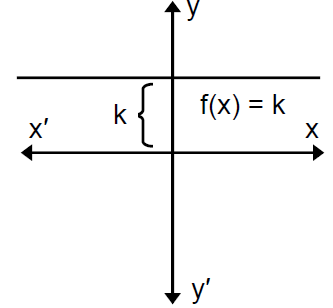
Constant Function
f(x)= k
Domain: R
Range: k
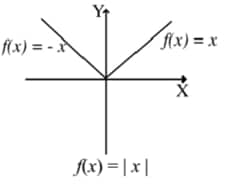
Modulus Function
$f(x) = |x|$
Where:
f(x) = x, if x > 0 and -x if x < 0
Domain: R
Range: Non-negative real numbers
Signum Function
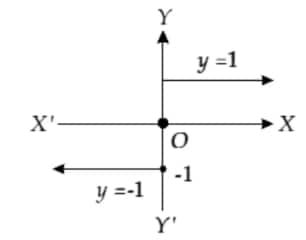
sgn(x) = 1, if x > 0, sgn(x) = 0, if x = 0, and sgn(x) = -1, x < 0
Domain: R
Range: {- 1, 0, 1}
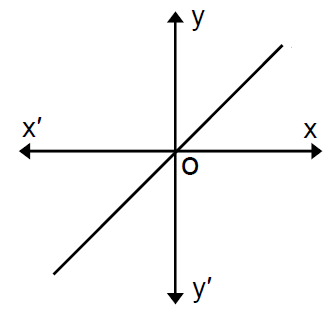
Identity Function
f(x)= x
Domain: R
Range: R
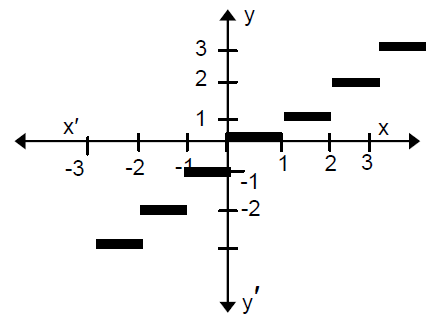
Greatest Integer Function or step function
f(x) = [x]
Domain: R
Range: Integer
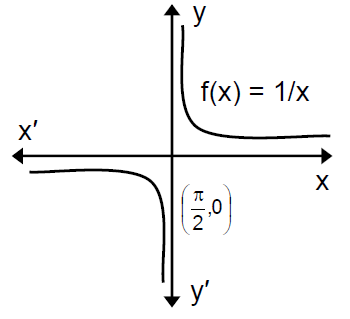
Reciprocal Function
f(x) = 1/x
Domain: R – {0}
Range: R – {0}
Function of a Function (Composite Function)
A composite function is the function of another function. If f is a function from A in to B and g is a function from B in to C, then their composite function denoted by (gof) is a function from A in to C defined by
gof (x) = g[f(x)]
Also, composite function fog (read as "f of g") is defined as:
fog (x) = f[g(x)]
Q.1) A function f maps the set of natural numbers to whole numbers, such that $f(xy)=f(x)f(y)+f(x)+f(y)$ for all x,y and $f(p)=1$ for every prime number p. Then, the value of $f(160000)$ is
A) 8191
B) 2047
C) 4095
D) 4096
Solution:-
Given: $f(xy)=f(x)f(y)+f(x)+f(y)$ for all x,y∈N And $f(p)=1$ for every prime p
Since $f(p) =1$, So $f(2)=1$ $f(4)=f(2×2)=f(2)f(2)+f(2)+f(2)=1+1+1=3$ $f(8)=f(2×4)=f(2)f(4)+f(2)+f(4)=3+1+3=7$ $f(16)=f(2×8)=f(2)f(8)+f(2)+f(8)=7+1+7=15$ Similarly, $f(2^8)=f(256)=255$
Q.2) For any non-zero real number $x$, let $f(x)+2f(1/x)=3x$. Then, the sum of all possible values of $x$ for which $f(x)=3$, is
A) -2
B) 2
C) -3
D) 3
Solution:-
We are given: $f(x)+2f(1/x)=3x$−−−−−−−−(1) Also, we are told: $f(x)=3$
Substituting into (1): $3+2f(1/x)=3x⇒f(1/x)=(3x−3)/2$−−−−−−−−(2)
Now use (1) again but switch $x$ with $1/x$: $f(1/x)+2f(x)=3x$ Substitute $f(x)=3$: $f(1/x)+6=3x⇒f(1/x)=3x−6$−−−−−−(3)
Equating (2) and (3): $(3x−3)/2=3x−6$
Multiply both sides by 2: $3x−3=6x−12$
Bring all terms to one side: $3x+9−6x=0$
Multiply through by x: $3x^2+9x−6=0$
Divide by 3: $x^2+3x−2=0$
Sum of all possible values of $x=-3$.
Hence, the correct answer is option 3.
Q.3) Let a, b, and c be non-zero real numbers such that $ b^2 <4ac$, and $f(x)=ax^2+bx+c$. If the set S consists of all integers m such that f(m) < 0, then the set S must necessarily be:
A) the set of all positive integers
B) the set of all integers
C) either the empty set or the set of all integers
D) either the empty set or the set of all integers
Solution:-
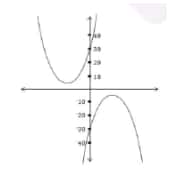
It is given that $f(x)=ax^2+bx+c$ and $b^2<4ac$ This means that f(x) has imaginary roots and therefore, no real roots at all. If a function has no real roots, the graph of the function can never touch the x-axis, because touching the x-axis means, for some real value of x, the value of f(x) is 0. This means that the function has roots in some real value of x. When we graph this quadratic function f(x), we get a parabola that should never touch the x-axis. Such a parabola should be completely above the x-axis or completely below the x-axis.
If it is completely above the x-axis: ● It means that the value of f(x) is always positive for any value of x. The set of values of x that satisfies the condition that f(x) < 0 is an empty set. ● If it is completely below the x-axis: It means that the value of f(x) is always negative for any value of x. The set of values of x that satisfies the condition that f(x) < 0 is the set of all real numbers. Since Set S contains all the integers ‘m’ that satisfy the above conditions, So, set S is either an empty set or the set of all integers. Hence, the correct answer is option (3).
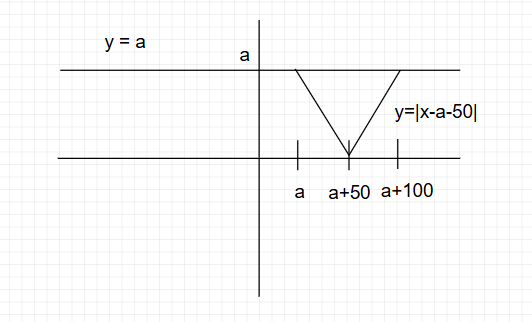
Q.4) Let $0≤a≤x≤100$ and $f(x)=|x−a|+|x−100|+|x−a−50|$. Then the maximum value of f(x) becomes 100 when a is equal to:
A) 25
B) 100
C) 50
D) -50
Solution:-
$x≥a$, so, $|x−a|=x−ax<100$, so $|x−100|=100−xf(x)=(x−a)+(100−x)+|x−a−50|=100⇒|x−a−50|=a$
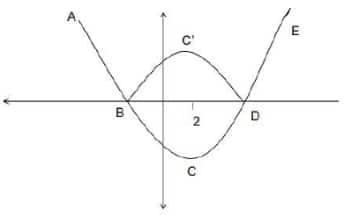
From the graph, we can see that when x = a Then, $|x - a - 50| = a$ $⇒ a = 50$ Similarly when $x = a + 100$ $|x – a - 50|= a$ $⇒ a = 50$ So, the value of a is 50 when f(x) is 100.
Hence, the correct answer is option (3).
High-frequency CAT Algebra problems on polynomials
Questions on Polynomials that are asked in CAT mainly based on following concepts:
Sum of zeros and product of zeros
1. Sum of Zeroes (α and β): For a quadratic polynomial $ ax^2+bx+c$, the sum of its zeroes (roots) is given by $\frac {-b}{a}$.
For a cubic polynomial (zeros α, β and γ) $ ax^3+bx^2+cx+d$, the sum of its zeroes (roots) is given by $\frac {-b}{a}$.
2. Product of Zeroes:
For a quadratic polynomial $ ax^2+bx+c$, the product of its zeroes (roots) is given by $\frac{c}{a}$.
For a cubic polynomial $ ax^3+bx^2+cx+d$, the product of its zeroes (roots) is given by $\frac {-d}{a}$.
Also, for cubic polynomial (zeros α, β and γ)
αβ +βγ + γα = c/a
Questions based on factor theorem:
Factorization (Factor theorem)
If a polynomial P(x) has a factor (x -a), then P(a) = 0 and conversely, if P(a) = 0 then (x -a) is a factor of P(x). This is the factor theorem.
Q.1) $f(x)=(x^2+2x−15)(x^2−7x−18)$ is negative if and only if
A) $−5<x<−2$ or $3<x<9$
B) $−2<x<3$ or $x>9$
C) $x<−5$ or $−2<x<3$
D) $x<−5$ or $−2<x<3$
Solution:-
$f(x)=(x^2+2x−15)(x^2−7x−18)$ $⇒f(x)=(x+5)(x−3)(x−9)(x+2)<0$ We have four inflection points −5,−2,3, and 9 . For $x<−5$, all four terms (x+5),(x−3),(x−9),(x+2) will be negative.
The overall expression will be positive. Similarly, when $x>9$, all four terms will be positive. When x belongs to $(−2,3)$, two terms are negative and two are positive.
The overall expression is positive again. We are left with the range $(−5,−2)$ and $(3,9)$ where the expression will be negative.
Thus, the correct answer is option 1) $−5<x<−2$ or $3<x<9$.
Q.2) The roots $\alpha, \beta$ of the equation $3 x^2+\lambda x-1=0$, satisfy $\frac{1}{\alpha^2}+\frac{1}{\beta^2}=15$. The value of $\left(\alpha^3+\beta^3\right)^2$, is
Q.2) When Rajesh's age was same as the present age of Garima, the ratio of their ages was 3:2. When Garima's age becomes the same as the present age of Rajesh, the ratio of the ages of Rajesh and Garima will become
A) 5:4
B) 4:3
C) 2:1
D) 3:2
Solution:-
Let present ages of Rajesh and Garima be $R$ and $G$ respectively. When Rajesh's age was $G$, the ratio of their ages was $3:2$. So, at that time: $R - G$ years ago, Rajesh's age = $G$, Garima's age = $G - (R - G) = 2G - R$
Now, when Garima's age becomes $R$, the time passed = $R - G = \frac{4G}{3} - G = \frac{G}{3}$ At that time, Rajesh's age = $R + \frac{G}{3} = \frac{4G}{3} + \frac{G}{3} = \frac{5G}{3}$
Required ratio = $\frac{5G/3}{R} = \frac{5G/3}{4G/3} = \frac{5}{4}$
Hence, the correct answer is option 1.
Q.3) A fruit seller has a stock of mangoes, bananas and apples with at least one fruit of each type. At the beginning of a day, the number of mangoes make up 40% of his stock. That day, he sells half of the mangoes, 96 bananas and 40% of the apples. At the end of the day, he ends up selling 50% of the fruits. The smallest possible total number of fruits in the stock at the beginning of the day is
Solution:-
Let the initial number of fruits be $x$ and apples be $y$.
The stock of mangoes is given to be 40% of x, which shows that the number of mangoes will be $\frac{2x}{5}$.
The total number of sold fruits is given by including the selling of all the fruits- mango, apple and banana.
Now, the total no. of fruits sold
$=\frac{2x}{10}+\frac{4y}{10}+96=\frac{x}{2}$
$⇒\frac{x}{5}+\frac{2y}{5}+96=\frac{x}{2}$
On simplifying, we get,
$2x+4y+960=5x$
$⇒x=\frac{960+4y}{3}$
For $x$ to be a positive integer, let us check for values of $y$.
$4y+960$ has to be divisible by $3$, which means $4y$ will also be divisible by $3$.
For $\frac{4y}{10}$ to be an integer, $y$ has to be divisible by $5$.
We can say, that the smallest value of $y$ has to be multiple of both $3$ and $5$, i.e. $15$.
Now, put the value of $y=15$.
We get, $x=\frac{960+4 \times 15}{3}$
$⇒x=\frac{1020}{3}$
$⇒x=340$
So, the smallest possible number of fruits in stock at the starting of the day will be $340$.
Hence, the correct answer is $340$.
Q.4) For natural numbers x, y, and z, if xy + yz = 19 and yz + xz = 51, then the minimum possible value of xyz is:
A) 34
B) 35
C) 36
D) 38
Solution:-
It is given, y(x + z) = 19 y cannot be 19. If y = 19, then x + z = 1 which is not possible when both x and z are natural numbers. Therefore, y = 1 and x + z = 19 It is given, z(x + y) = 51 z can take values 3 and 17. Case 1: If z = 3, y = 1 and x = 16 xyz = 3 × 1 × 16 = 48 Case 2: If z = 17, y = 1 and x = 2 xyz = 17 × 1 × 2 = 34 So, the minimum value xyz can take is 34. Hence, the correct answer is option (1).
Q.5) The number of integer solutions of the equation $\left(x^2-10\right)^{(x^2-3 x-10)}=1$ is:
A) 4
B) 6
C) 3
D) 8
Solution:-
Case 1: When $x^2-3 x-10=0$ and $x^2-10 \neq 0$
$x^2-3 x-10=0$ $ ⇒(x-5)(x+2)=0$ $\therefore x=5 \text { or }-2 $ Case 2: $x^2-10=1$ $⇒ x^2-11=0 $ $\therefore$ No integer solutions
Case 3: $\mathrm{x}^2-10=-1$ and $\mathrm{x}^2-3 \mathrm{x}-10$ is even. $x^2-9=0$ $⇒(x+3)(x-3)=0$ $\therefore\mathrm{x}=-3$ or 3 for $\mathrm{x}=-3$ and $+3$, $\mathrm{x}^2-3 \mathrm{x}-10$ is even.
$\therefore$ In total 4 values of $x$ satisfy the equations.
Hence, the correct answer is option (1).
Algebra Important Topics for CAT 2026 & Beyond
Algebra consists of many topics, as discussed earlier in this article. Based on CAT's previous papers analysis, we have divided these topics into two categories:
High-priority concepts
Lesser Priority concepts
High-priority concepts based on previous CAT 2026 papers
Topic
Important Concepts
Function
Questions based on fog and gof, value of a function, graphs
Polynomials
Relation between zeros, factor theorem
Linear Equations
Word problems, Nature of solutions, solving linear pair of equations, equations involving modulus, equations involving sequence and series, equations involving logarithm
Quadratic Equations
Nature of roots, relation between roots, equations involving sequences and series, equations involving logarithms
Linear Inequalities
Inequalities involving modulus
Lesser-seen but tricky Algebra concept
There are a few topics which are less seen but very tricky and important for the CAT exam
Greatest integer function
Questions based on the signum function
Questions involving higher-order polynomials
Harmonic Progressions
Questions involving even and odd functions
CAT 2026 Algebra Preparation Tips
In this section, we will focus on a few but still important tips to prepare for CAT Algebra.
How to build strong basics in Algebra equations
To build a solid base, first learn the basic concepts from the NCERT classes 11 and 12. Begin with very basic questions, and then increase the difficulty level bit by bit, gradually.
After that, once your basics are in place, try to use those same ideas in CAT-level questions, not just in examples from the book.
Shortcuts and time-saving tricks for CAT Quant
Once you have a strong foundation on the topics, the next step is to pick up shortcuts and time-saving techniques. Here, try learning effective calculation methods, with help from Vedic Maths.
Formula sheet for quick revision
Make a CAT formula sheet covering linear equations, quadratic equations, polynomials, graphs and more, so that you can revise fast, especially before the test.
Best resources & practice material for CAT Algebra
1. Arun Sharma: A Quantitative Approach for CAT (7th Edition) 2. Quantitative Aptitude for CAT by Nishit K Sinha 3. NCERT class 11 and class 12
CAT 2026 Preparation Resources by Careers360
The candidates can download the various CAT preparation resources that Careers360 made, using the links given below.
eBook Title
Download Links
CAT 2026 Arithmetic Important Concepts and Practice Questions
A common mistake when prepping for CAT Algebra is not really paying attention to the basics, like fundamentals, then you move ahead too fast, you end up skipping practice on the more tricky problems too. Also, mismanaging time is a big one, because you suddenly spend too much on one question, and then the rest looks messier. People also tend to overlook shortcuts, even when they are there, and that can reduce both accuracy and speed in the exam.
Common mistakes
How to Rectify?
Ignoring the Basics while preparing
Learn fundamentals from NCERT
Solving the modulus inappropriately
Practice more questions and do not avoid any possible case.
Over-dependencies on formulas
Try to solve conceptually
Ignoring domain and restrictions
Solve the questions within specifies domain
Values within square roots should be non-negative
The square root of negative values is not defined. So, you should better take care of it
Poor time management
Prepare a proper timetable
Do not checking the previous year’s pattern
You should check at least the previous 5 years' papers to know the pattern of the question
How to Practice Repeated Algebra Questions in CAT for High Percentile
Since CAT tends to work in a pattern based way, a lot of algebra question types show up again, year after year, with only slight variations. Practising these recurring Algebra questions strategically can really boost your precision, velocity and confidence for CAT 2026.
Just follow this proven four-step approach, to get a strong hold on repeated Algebra questions in CAT.
Step 1: Analyze CAT Previous Year Papers to Identify Algebra Patterns
First, take a look at the last 4 to 5 years of CAT question papers, like closely, not just a casual read. Then, sort out the Algebra part, see what really comes up again and again. You can notice stuff like linear equations, quadratic equations, inequalities, functions and modulus, though sometimes it shows up as “absolute value” type thinking, you know.
Next, identify the frequently asked Algebra topics such as linear equations, quadratic equations, inequalities, functions, and modulus, and try to note where they appear most.
Then categorise the questions concept-wise, not just by chapter name, but by what the question is actually testing. Like, do they want formula application, reasoning steps, or simplification tricks?
After that, observe repetition in question structures, even the way they are phrased, and also the difficulty level it sits at. Sometimes the numerical style changes, but the pattern stays.
Finally, create a concept-wise list of high-frequency Algebra question types, so you can focus your practice smarter.
Step 2: Strengthen Algebra Basics and Learn Smart Shortcuts
Strong basics are the backbone for CAT Algebra preparation.
Go through and revise all the basic formulas and identities again
Make sure you memorize the key notions and the common standard result.
Then learn CAT specific tricks and also the quick time saving shortcuts
Try to focus on understanding and clarity more than simple rote learning
It all adds up and helps you gain speed and also lowers silly calculation mistakes during the real exam , right.
Step 3: Practice with CAT-Specific Algebra Resources
Use mainly CAT oriented study material for best results.
Solve the previous year CAT algebra questions
Attempt sectional tests that focus on algebra only.
Take good quality mock tests and do topic wise practice sets as well
Practice under time constraints to better simulate the real exam pressure
This is what helps keep your preparation exam focused, and result driven .
Step 4: Evaluate Performance and Improve Weak Areas
Evaluation is perhaps the most important step for improvement, like really. You start it, then you do the rest. Analyse every wrong answer, even the ones that feel “close”. Identify conceptual gaps and any calculation mistakes, not just the obvious ones. Revise weak Algebra topics regularly, because some pieces just don't stick.
Frequently Asked Questions (FAQs)
Q: With which books should I start preparing for Algebra?
A:
If you are a beginner,
Start with NCERT classes 11 and 12. After learning the basics, follow Arun Sharma for Quantitative Aptitude for CAT.
Q: How much time should I give to prepare for Algebra?
A:
Algebra is very vast having numerous concepts. It will require a lot of time to practice depending upon your capabilities and previous conceptual knowledge. What I suggest is, prepare a proper time table including all subjects and topics. If you do well in only one section, it will not help you to get into IIMs. So, manage your time and prepare well for all sections.
Q: What kind of questions are asked from Algebra in CAT?
A:
In CAT, questions are generally framed by involving two or more concepts in a single question like:
Sequence and series with log
Inequality with modulus
Equations involving log, surds, and indices etc
Q: Which Algebra topics are most frequently repeated in CAT?
A:
The most repeated Algebra topics in CAT include linear equations, quadratic equations, inequalities, modulus functions, and functions and graphs. These areas form the core of CAT Algebra preparation.
Q: Can I score high in CAT Quant if my Arithmetic is weak but Algebra is strong?
A:
Yes, a strong command over Algebra can compensate for weaker areas in Arithmetic. Many high-percentile scorers rely on Algebra and DILR to balance their overall Quant performance.
Your question is incomplete because the name of the app or platform is not mentioned.
Please tell me which CAT online batch or app you are referring to. Then I can tell you whether the classes are conducted through the app, website, or both.
If by B-category you mean management/private quota MBBS seats, the cutoff is very different from government-quota MBBS.
In Tamil Nadu, management-quota MBBS seats are available in self-financing/private medical colleges through the state counselling process. The closing rank varies significantly between colleges and counselling rounds. The 2025 counselling data shows that
With a CAT 2025 percentile of 98.25, you have a good chance of receiving calls from several IIMs, particularly newer IIMs. However,
IIM Ahmedabad
,
Bangalore
,
Calcutta
, and
Lucknow
generally require higher percentiles for General-category candidates. Calls also depend on sectional percentiles, academics, work experience, and
Yes, you can access CAT preparation resources, including mock tests, practice questions, previous-year papers, and study material. Explore the CAT preparation resources and test series using the link below:
If you mean the CAT (
Common Admission Test)
EWS certificate, the important point is whether the certificate is valid and issued in the prescribed format, rather than simply the language used on it.
Yes, a Hindi EWS certificate can generally be accepted for CAT, provided it
M/s Deloitte Touche Tohmatsu Limited, one of the top four audit and accounting firms in the world with headquarters at London, UK, and with an operational presence in 153 countries, hires Management Trainees (MT) from all the premier management institutes of India thrice every year, in
Two friends Moloy and Niloy passed out from the Purulia Institute of Science and Technology with B.Tech degrees in Mechanical Engineering, but even after a year placement was hard to find. So they decided to take the challenge head-on, came down to Kolkata, rented a garage space
Six sticks of equal lengths were kept in the vertical position in an empty flower-vase, to be arranged at the six corners of a regular hexagon. The two ends of each of the sticks were of different colours.
Two friends Moloy and Niloy passed out from the Purulia Institute of Science and Technology with B.Tech degrees in Mechanical Engineering, but even after a year placement was hard to find. So they decided to take the challenge head-on, came down to Kolkata, rented a garage space
Two friends Moloy and Niloy passed out from the Purulia Institute of Science and Technology with B.Tech degrees in Mechanical Engineering, but even after a year placement was hard to find. So they decided to take the challenge head-on, came down to Kolkata, rented a garage space
Two friends Moloy and Niloy passed out from the Purulia Institute of Science and Technology with B.Tech degrees in Mechanical Engineering, but even after a year placement was hard to find. So they decided to take the challenge head-on, came down to Kolkata, rented a garage space
Two friends Moloy and Niloy passed out from the Purulia Institute of Science and Technology with B.Tech degrees in Mechanical Engineering, but even after a year placement was hard to find. So they decided to take the challenge head-on, came down to Kolkata, rented a garage space
Two friends Moloy and Niloy passed out from the Purulia Institute of Science and Technology with B.Tech degrees in Mechanical Engineering, but even after a year placement was hard to find. So they decided to take the challenge head-on, came down to Kolkata, rented a garage space
The bar-graph given below shows the foreign exchange reserves of Nepal (in million Rupees) from 2014 to 2021. Answer the following questions based on the graph :
Question:
What was the percentage increase (rounded to the nearest integer, if deemed necessary) in the foreign exchange reserves in
The Jadavpur University’s Prince Anwar Shah Road hostel consists of two large separate buildings, one for the ladies and the other for the gents, while having a common kitchen and dining hall. It is the hostel of the CS and the EEC department of engineering students of
Test centres are available in 70+ cities across India | 75,000+ aspirants apply for the NMAT exam | Accepted by 58+ institutions like NMIMS, KJSIM, ISB, SPJIMR and Great Lakes.
A career as Marketing Director is also known as a marketing expert who is responsible for the overall marketing aspect of the company. He or she oversees plans and develops the company's budget. The marketing Director collaborates with the business team to plan and develop the marketing and branding strategies for the company's products or services.
A Business Development Executive identifies and pursues new business opportunities to drive company growth. They generate leads, build client relationships, develop sales strategies, and analyse market trends. Collaborating with internal teams, they aim to meet sales targets. With experience, they can advance to managerial roles, playing a key role in expanding the company’s market presence and revenue.
Content Marketing Specialists are also known as Content Specialists. They are responsible for crafting content, editing and developing it to meet the requirements of digital marketing campaigns. To ensure that the material created is consistent with the overall aims of a digital marketing campaign, content marketing specialists work closely with SEO and digital marketing professionals.
A Sales Manager leads a sales team to meet targets, formulates strategies, analyses performance, and monitors market trends. They typically hold a degree in management or related fields, with an MBA offering added value. The role often demands over 40 hours a week. Strong leadership, planning, and analytical skills are essential for success in this career.
A marketing manager is a person who oversees a company or product marketing. He or she can be in charge of multiple programmes or goods or can be in charge of one product. He or she is enthusiastic, organised, and very diligent in meeting financial constraints. He or she works with other team members to produce advertising campaigns and decides if a new product or service is marketable.
A Marketing manager plans and executes marketing initiatives to create demand for goods and services and increase consumer awareness of them. A marketing manager prevents unauthorised statements and informs the public that the business is doing everything to investigate and fix the line of products. Students can pursue an MBA in Marketing Management courses to become marketing managers.
An SEO Analyst is a web professional who is proficient in the implementation of SEO strategies to target more keywords to improve the reach of the content on search engines. He or she provides support to acquire the goals and success of the client’s campaigns.
Digital marketing is growing, diverse, and is covering a wide variety of career paths. Each job function aids in the development of effective digital marketing strategies and techniques. The aims and objectives of the individuals who opt for a career as a digital marketing executive are similar to those of a marketing professional: to build brand awareness, promote company services or products, and increase conversions. Individuals who opt for a career as Digital Marketing Executives, unlike traditional marketing companies, communicate effectively through suitable technology platforms.
Individuals who opt for a career as a business analyst look at how a company operates. He or she conducts research and analyses data to improve his or her knowledge about the company. This is required so that an individual can suggest the company strategies for improving their operations and processes.
In a business analyst job role a lot of analysis is done, things are learned from past mistakes and the successful strategies are enhanced further. A business analyst goes through real-world data in order to provide the most feasible solutions to an organisation. Students can pursue Business Analytics to become Business Analysts.
2 Jobs Available
Never miss CAT update
Get timely CAT updates directly to your inbox. Stay informed!