Great Lakes - PGDM & PGPM Admissions 2027
Globally Recognized by AACSB (US) & AMBA (UK) | 18 LPA Avg. CTC for PGPM 2026


This is the right time to think about preparing for CAT – 2026 if you are a final year grad student or if, unfortunately, you couldn’t make it in CAT – 2025. If you have appeared in previous years CAT exam then you must have an idea of Common Aptitude Test (CAT) patterns and this year you should not repeat the mistakes which were previously done or if you are thinking to appear in CAT-2026 for the first time then this article is completely for you to get an idea about the syllabus, CAT Quant preparation 2026, pattern of the exam and how to crack the CAT - 2026 with a 99+ percentile.
This Story also Contains

It demands not just hard work, but smart, structured preparation — especially in Quantitative Ability (QA). This section is going to test logic, number sense, fundamentals, and speed. In this article, you will find a comprehensive, topic-wise CAT 2026 quant strategy that will help you excel in Quant and maximize your score. The official syllabus for CAT 2026 and notification are expected to be announced in the month of July 2026.
The CAT 2026 Quant Syllabus is vast and typically divided into 5 sections or modules. In the CAT quant section, 22 questions are expected to be solved in 40 minutes. Based on the previous five years’ analysis, we can summarize all five modules in terms of their weightage and difficulty level as follows:
Module | Weightage | Difficulty level |
Arithmetic | 35% to 40% | Easy to moderately difficult |
Algebra | 30% to 35% | Moderately difficult |
Geometry and mensuration | 10% to 15% | Easy to moderately difficult |
Number System | 15% to 20% | Easy to Moderate |
Modern Maths | 10% to 15% | Easy to Moderate |
Previous years’ analysis suggests that the difficulty ranges from easy to high-difficulty, with logical reasoning and multi-concept questions becoming increasingly common. What you require to achieve 99+ in CAT quant is accuracy above 90%, a CAT QA strategy for CAT 2026, and strong time management.
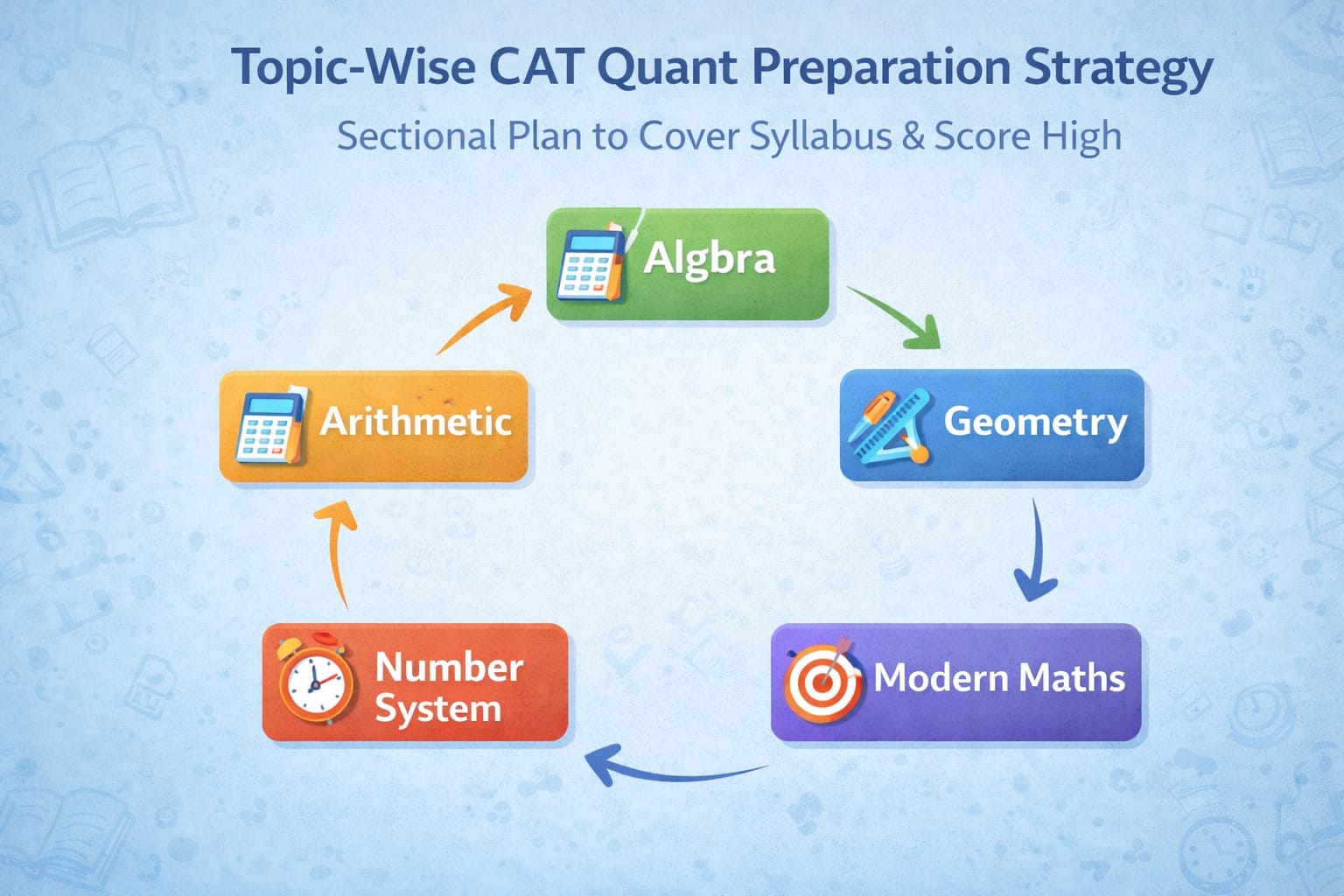
This section provides a clear topic-wise CAT Quant preparation strategy, helping you break the syllabus into manageable parts like Arithmetic, Algebra, Geometry, Number System, and Modern Maths.
Module | Topics | Strategy | Practice Goal |
Arithmetic (High-yield and Scoring) | Simple Interest & Compound Interest | ✔ Master formulas with conceptual clarity ✔ Practice previous year CAT questions | 1) 60–80 questions from varied difficulty levels for each topic 2) Accuracy above 90% |
Algebra (Moderate to High Difficulty) | Inequalities Functions Logarithms Sequences & Series (especially AP/GP) | ✔ Build strong fundamentals ✔ For equations and inequalities, practice sign charts and elimination | 1) 40–50 mixed difficulty questions from each topic |
Number System (Strong but tricky) | Factors and Multiples Primes, Co-primes Digit-based questions | ✔ Understand core properties (e.g., remainder theorems) | 1) 30–40 questions from each topic |
Geometry & Mensuration (Visual and analytical) | Circles 3D geometry (rare but high yield) Area and Perimeter Volume & Surface Area | ✔ Learn theorems (e.g., Pythagoras, circle properties) properly | 50–70 questions with diagrams |
Modern Math (Can be high scoring) | Permutations & Combinations Sets & Venn Diagrams Coordinate Geometry Basic Trigonometry | ✔ P&C and Probability need focused practice | 40–60 questions with a conceptual mix |
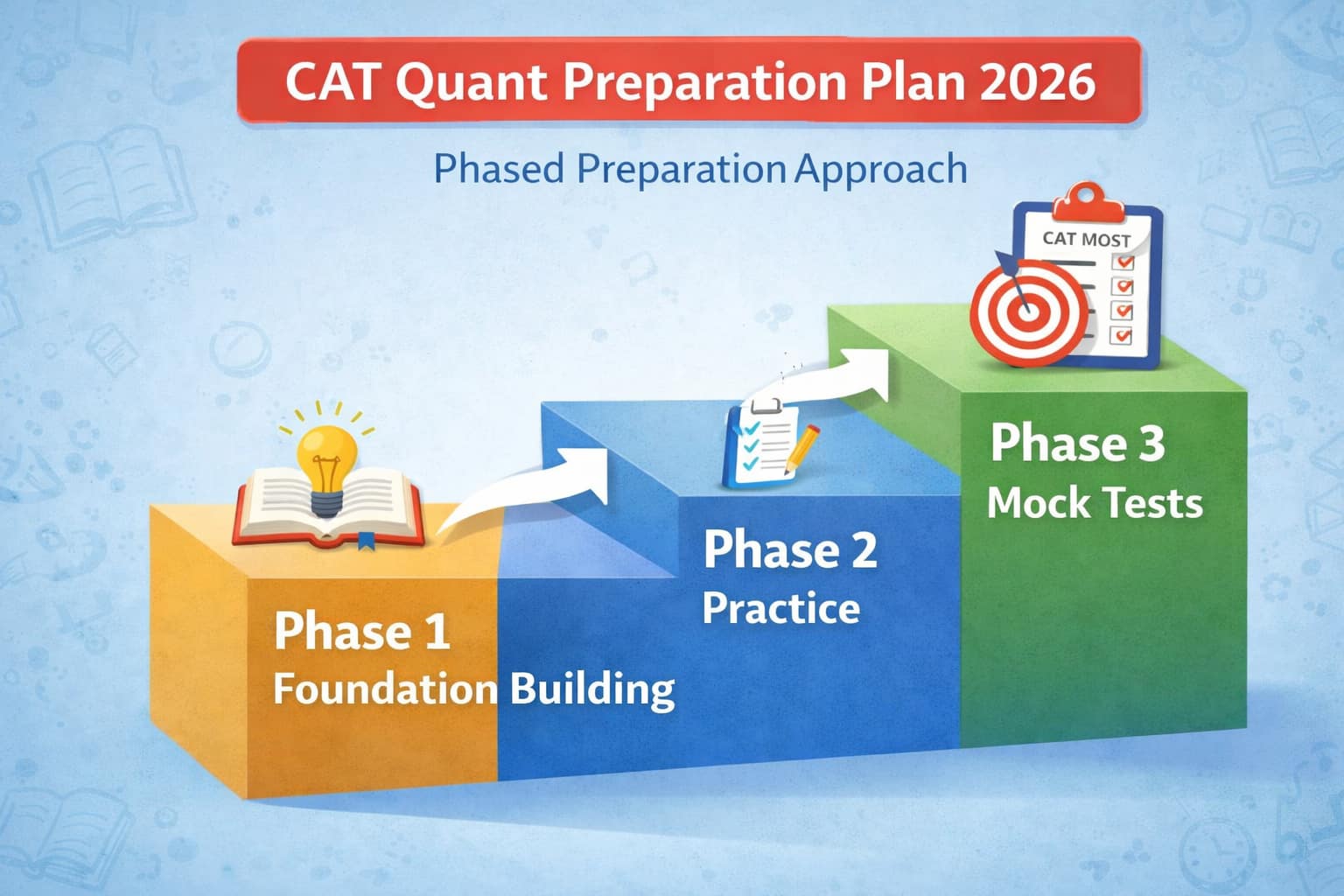
We would suggest dividing the preparation into three phases: foundation building, Practice, and mock tests.
This is where everything starts. If your basics are weak, even 100 mock tests won’t help. So slow down here and focus on understanding, not speed.
Cover the complete Quant syllabus topic-by-topic (Arithmetic, Algebra, Geometry, Number System, Modern Maths)
Learn formulas, concepts, and standard methods
Solve basic to moderate-level questions first
Maintain a formula notebook for quick revision
Watch concept videos or read theory before jumping into problems
Study 2–3 hours daily with consistency
Clear fundamentals
Concept clarity
Comfort with basic questions
Time suggestion: 2–3 months
Test centres are available in 70+ cities across India | 75,000+ aspirants apply for the NMAT exam | Accepted by 58+ institutions like NMIMS, KJSIM, ISB, SPJIMR and Great Lakes.
AACSB Accredited | 40 LPA-Highest CTC | Scholarships worth 10 CR
Now that you understand concepts, it’s time to apply them. This phase is all about question-solving and time management.
Here you move from “I know the concept” → “I can solve quickly”.
Solve topic-wise and mixed practice sets daily
Attempt sectional tests every week
Practice under time limits
Focus on shortcuts and faster calculation techniques
Identify weak topics and revise them regularly
Increase question volume (40–60 questions per day)
Start solving the previous year's CAT questions
Improve speed
Increase accuracy
Build exam confidence
Time suggestion: 2–3 months
This is the most important stage. Mocks are where your real preparation happens. They train your brain for pressure, timing, and smart question selection.
Treat every mock like the actual CAT exam.
Attempt 2–3 full-length mock tests per week
Take tests in a distraction-free environment
Analyze every mock carefully (this is more important than giving the test)
Track weak areas and work on them
Practice question selection strategy (easy first, tough later)
Revise formulas and notes regularly
Avoid learning completely new topics
Exam temperament
Better time management
Maximum score optimization
Time suggestion: Last 1–2 months before the exam
To summarize, you should plan:
Phase 1 -> Learn concepts
Phase 2 -> Practice questions
Phase 3 -> Test yourself with mocks
Simple rule: Learn → Practice → Test → Improve → Repeat
This section covers practical and proven CAT Quant practice techniques to help you solve questions faster, reduce mistakes, and maximize your score. You’ll learn how to structure daily practice, use sectional tests and mock papers effectively, track performance, and apply smart strategies that improve both speed and accuracy. If you are worried about “How to score 99 percentile in CAT Quant”, here are a few smart practice techniques that can boost your preparation:
Shortcuts or tricks without conceptual knowledge may hurt you. In CAT quant, questions are more logical, which require a deep understanding of concepts to avoid silly errors.
Yes, you should learn short tricks, but with conceptual clarity.
It is very important to maintain a mistake log to track your errors during practice and identify patterns in mistakes. It will help you to find out your weak areas at an early stage, and you will get plenty of time to rectify them. To improve
Taking mocks is the best way to learn time management. You should plan each mock test of 20 to 22 questions in 40 minutes. In mocks:
First 10 mins — easy questions
Next 10 mins — moderate ones
Next 10 mins — great difficulty
Last 10 mins — Review and attempt the questions that were skipped in 1st attempt
Re-arrange the first 30 minutes based on comfort.
Aspirants generally try to attempt everything. Trust me, they are making a mistake by doing so in exams like CAT. You don’t need to attempt everything. A high-accuracy attempt is far better than a serious attempt with low accuracy.
This section provides a sample weekly study timetable to help you organize daily practice, cover all topics systematically, and balance revision with mock tests for steady progress. Here is a suggested weekly study plan, but you can change it as per your convenience or betterment.
Day | Focus Area | Number of Hours | Preparation Tips |
Day 1 | Arithmetic (Choose one topic, e.g, Percentage) | 2 to 3 hours | Learn all basic concepts, learn to apply logic rather than formulas |
Day 2 | Practice on Day 1 topic | 2 to 3 hours | Apply the logic and formula (If necessary) to solve the questions. Make an error log. |
Day 3 | Algebra (Take any one topic of algebra) + Practice set | 2 to 3 hours | Focus on basic concepts, develop the approach of solving by graphs |
Day 4 | Geometry and Mensuration (Take any one topic) + Practice set | 2 to 3 hours | Learn all basic formulas, develop a habit of drawing diagrams |
Day 5 | Number System and Modern Maths (Take any one topic) | 2 to 3 hours | Focus on the concepts that are asked during the 5 to 6 years |
Day 6 | Full Mock test on the topics of the current week | 3 to 4 hours | Create exam like environment |
Day 7 | Review and mistake log clean up | 2 hours | Review all mistakes of the current week and rectify them |
Your performance on exam day depends not only on preparation but also on smart question selection, time management, and staying calm under pressure. A clear strategy helps you attempt more questions accurately, avoid panic, and reach your target percentile with confidence. Follow these practical exam-day tips to perform at your best in the CAT Quant section.
Start with easy and familiar Quant questions to build confidence and secure quick marks
Avoid spending more than 2–3 minutes on any question in the first attempt
Focus on reaching your target score first, rather than solving every question
Skip lengthy or difficult problems and return to them only if time permits
Stay calm, composed, and trust your preparation throughout the test
These preparation habits can significantly improve your speed, accuracy, and overall percentile:
Master the arithmetic topics first, as they carry high weightage and are relatively scoring
Maintain the right balance between speed and accuracy while solving questions
Practice with a timer to simulate real exam conditions
Dedicate daily time to quality practice instead of random studying
Attempt regular mock tests and analyze your performance carefully
Identify repeated mistakes and work actively to eliminate them
Revise formulas and shortcuts regularly for faster calculations
Choosing the right study material is just as important as your study plan. Using trusted CAT Quantitative Aptitude books, practice sets, and online mock test platforms helps you build strong concepts, practice a variety of questions, and improve speed and accuracy. Below is a curated list of the best books for CAT and online resources recommended by toppers and experts for effective CAT Quant preparation.
CAT Quant Preparation Books & Online Resources
Resource Type | Book | Author | Best For | Why It’s Helpful |
Book | Quantitative Aptitude for CAT | Arun Sharma | Concept building + practice | Covers basics to advanced level with solved examples and LOD questions |
Book | How to Prepare for Quantitative Aptitude for CAT | Sarvesh Kumar Verma | Practice & difficulty progression | Great for medium to high-level questions with detailed solutions |
Book | Quantitative Aptitude Quantum CAT | Sarvesh Kumar Verma | Advanced practice | Ideal for 99+ percentile aspirants and challenging problems |
Book | Fast Track Objective Arithmetic | Rajesh Verma | Arithmetic mastery | Excellent for strengthening high-weightage arithmetic topics |
Book | CAT Quant by Nishit Sinha | Nishit Sinha | CAT-specific strategies & practice | Focused strategy insights with balanced question sets |
Explore CAT 2026 ebooks, including expert study guides, mock tests, and practice materials, which are designed to help you strengthen concepts, track progress, and boost your overall percentile. The candidates can download the various CAT preparation resources designed by Careers360 using the links given below.
eBook Title | Download Links |
CAT 2026 Arithmetic Important Concepts and Practice Questions | |
CAT 2026 Algebra Important Concepts and Practice Questions | |
CAT 2026 Number System - Important Concepts & Practice Questions | |
CAT 2026 Exam's High Scoring Chapters and Topics | |
CAT Mock Test Series - 20 Sets, Questions with Solutions By Experts | |
Mastering CAT Exam: VARC, DILR, and Quant MCQs & Weightages | |
CAT 2026 Mastery: Chapter-wise MCQs for Success for VARC, DILR, Quant | |
CAT 2026 Quantitative Aptitude Questions with Answers | |
CAT 2026 Important Formulas | |
Past 10 years CAT Question Papers with Answers | |
CAT 2026 Quantitative Aptitude Study Material PDF - Geometry and Mensuration |
Frequently Asked Questions (FAQs)
If you are confident with accuracy, 12- 14 questions are enough for a 99+ percentile. Do not attempt a question in which you have doubt.
Previous years' analysis suggests that Arithmetic is high yielding section. In this section, you can start with Percentages, ratios, Averages, Time & Work, and TSD.
Next is Algebra (Linear & Quadratic Equations, Function, Maxima and Minima)
Number System (Basics + LCM/HCF, Remainders)
No. CAT is not about completeness—it’s about selective mastery. For 99+, it’s enough to be strong in 70–75% of the syllabus and avoid weak areas intelligently during the exam.
Initial phase: 1.5–2 hours/day
Practice phase: 2–3 hours/day
Mock phase: 3–4 hours once a week
Accuracy comes first. Speed develops naturally with practice.
A candidate with a 99+ score usually attempts fewer questions with high accuracy, avoiding negative marks.

On Question asked by student community
If by B-category you mean management/private quota MBBS seats, the cutoff is very different from government-quota MBBS.
In Tamil Nadu, management-quota MBBS seats are available in self-financing/private medical colleges through the state counselling process. The closing rank varies significantly between colleges and counselling rounds. The 2025 counselling data shows that
Hello Student,
With a CAT 2025 percentile of 98.25, you have a good chance of receiving calls from several IIMs, particularly newer IIMs. However, IIM Ahmedabad , Bangalore , Calcutta , and Lucknow generally require higher percentiles for General-category candidates. Calls also depend on sectional percentiles, academics, work experience, and
Hello Aspirant,
Yes, you can access CAT preparation resources, including mock tests, practice questions, previous-year papers, and study material. Explore the CAT preparation resources and test series using the link below:
https://bschool.careers360.com/download/ebooks-and-sample-papers?exam=45
Hope this Helps!
Hello CAT Aspirant!
If you mean the CAT ( Common Admission Test) EWS certificate, the important point is whether the certificate is valid and issued in the prescribed format, rather than simply the language used on it.
Yes, a Hindi EWS certificate can generally be accepted for CAT, provided it
Directions for question:
The bar-graph given below shows the foreign exchange reserves of Nepal (in million Rupees) from 2014 to 2021. Answer the following questions based on the graph :

Question:
What was the percentage increase (rounded to the nearest integer, if deemed necessary) in the foreign exchange reserves in

Globally Recognized by AACSB (US) & AMBA (UK) | 18 LPA Avg. CTC for PGPM 2026
75+ years of legacy | #1 Entrance Exam | Score accepted by 250+ BSchools
6-Hour Masterclass to help you score 99+ percentile in CAT 2026
Test centres are available in 70+ cities across India | 75,000+ aspirants apply for the NMAT exam | Accepted by 58+ institutions like NMIMS, KJSIM, ISB, SPJIMR and Great Lakes.
Registration Start: 3 August 2026 | Last Date to Apply: 15 September 2026 (till 5 PM)
AACSB Accredited | 40 LPA-Highest CTC | Scholarships worth 10 CR