Great Lakes - PGDM & PGPM Admissions 2027
Globally Recognized by AACSB (US) & AMBA (UK) | 18 LPA Avg. CTC for PGPM 2026


CAT 2026 Test Taking Strategy is a crucial part of preparation for aspirants aiming for top percentiles in the Common Admission Test. With increasing competition, success depends not only on syllabus coverage but also on how tests are taken, analysed, and improved over time. A well-planned CAT 2026 test-taking strategy focuses on mock test planning, question selection and accuracy control across VARC, DILR, and Quantitative Aptitude. Regular analysis of mock tests helps reduce mistakes, improve decision-making, and build confidence for the final CAT exam.
This Story also Contains

In this article, we will discuss about:
CAT 30 days test taking strategies
Important CAT 2026 topics
Psychological traps to avoid in CAT 2026
.Preparing for CAT over one year demands a test-centric, analytics-led preparation model rather than content-heavy studying. CAT Mock tests are not evaluation tools alone; they help in decision making and also optimise the accuracy level. Know more about the CAT 2026 test taking strategies below.
Prioritise cat sectional tests and topic-level assessments to build a statistically reliable baseline of accuracy, average solving time per question, and comfort zones.
Conduct deep post-test analysis, identifying error patterns across conceptual gaps, misinterpretation, calculation lapses, and guessing behaviour.
Avoid chasing CAT 2026 mock scores; instead, track input metrics such as reading speed in VARC, set-selection time in DILR, and formula deployment efficiency in QA.
Build an error log database to tag repeated mistakes and prevent error recurrence.
Introduce full-length CAT mocks at a controlled frequency to test stamina and section transition behaviour.
Develop a clear attempt framework, how many questions to target per section, an ideal mix of MCQs vs TITA, and pre-defined skip triggers.
Analyse time distribution vs score output, refining question selection and eliminating low ROI questions.
Monitor the CAT 99 percentile trajectory vs raw score stability to evaluate competitiveness at an All-India level.
Increase CAT mock frequency to reduce anxiety-induced performance drops.
Lock section-wise execution plans, including opening sequence, fallback options, and time buffers.
Focus on CAT DILR set triage, QA question ordering, and VARC passage elimination tactics.
Minimise score volatility by improving accuracy under timed, fatigue-prone conditions.
Take only high-quality, CAT-level mocks at consistent exam-like time slots.
Shift focus from learning to decision discipline, emotional control, and attention consistency.
Avoid CAT structural strategy changes; concentrate on micro-level refinements such as faster skips, cleaner calculations, and calmer passage handling.
Aim for a high CAT score, where mock scores remain within a narrow performance band.
Test centres are available in 70+ cities across India | 75,000+ aspirants apply for the NMAT exam | Accepted by 58+ institutions like NMIMS, KJSIM, ISB, SPJIMR and Great Lakes.
AACSB Accredited | 40 LPA-Highest CTC | Scholarships worth 10 CR
With only 30 days left, strategic focus is critical. Candidates should prioritise topics that consistently carry high weight in the exam, allowing maximum scoring in minimum time. The goal is to strengthen high-yield areas, improve speed, and minimise mistakes while maintaining coverage across all sections.
Focus on high-frequency topics like Arithmetic, Algebra, Number Systems, and Geometry. Practice shortcuts and formula-based problem solving. Probability, Permutations, and Mensuration can be attempted selectively. Prioritising these ensures high accuracy, faster calculations, and better attempt rate in the last 30 days.
Arithmetic: Percentages, Profit & Loss, Ratio & Proportion, Time-Speed-Distance, and Work form the backbone of CAT QA. Practising these ensures quick and accurate attempts.
Algebra: Linear & Quadratic Equations, Inequalities, and Functions are regularly tested. Mastering shortcuts and standard approaches can save time.
Number Systems & Geometry: Questions on number properties, coordinate geometry, triangles, and circles appear often. Quick formula recall is essential.
Selective Topics: Probability, Permutations & Combinations, and Mensuration appear less often but are scoring if accuracy is maintained.
Prioritise Tables, Seating Arrangements, Graphs, and Puzzle/Tournament sets. Practice data extraction, stepwise placement, and multi-step reasoning. Familiarity with recurring patterns improves speed and reduces errors, making DILR a high-scoring section for well-prepared candidates.
Tables and Caselets: Appear almost every year. Accuracy is key; avoid overcomplicating calculations.
Seating Arrangements: Linear and circular arrangements recur frequently. Stepwise placement and diagrammatic reasoning help solve faster.
Graphs and Charts: Line graphs, bar charts, and scatter plots are predictable. Practise extracting trends quickly.
Puzzles & Tournament Questions: These challenge deduction skills. Focus on multi-step reasoning and pattern recognition.
Focus on Reading Comprehension, Para Jumbles, Summaries, and Critical Reasoning. Practise inference, theme identification, and logical sequencing. Grammar-based questions can be revised quickly for easy marks.
Reading Comprehension (RC): 60–70% of VARC questions. Focus on inference, tone, main idea, and fact-based questions. Practice 2–3 passages daily.
Para Jumbles & Summary: High-yield topics for quick marks. Concentrate on logical sentence sequencing and theme identification.
Critical Reasoning: Small portion but can be attempted quickly. Focus on assumptions, conclusions, and cause-effect reasoning.
Grammar-based Questions: Sentence correction and fillers appear occasionally. Quick review of key rules can ensure error-free attempts.
Preparing for CAT 2026 with only 60 days left is not about learning new topics but about mastering test-taking strategies. At this stage, you need to focus on mocks, analysis, sectional balance, and exam temperament. Below is a step-by-step 60-day CAT test-taking strategy that goes beyond generic advice and gives you technical, actionable methods to maximise your score.
In the last two months, mocks are your biggest weapon.
Take 18–20 mocks in 60 days → 3 per week in the first 4 weeks, 2 per week in the last 4 weeks.
Track three critical metrics for each mock:
Attempt Rate (AR): Questions attempted ÷ total questions.
Accuracy (AC): Correct ÷ attempted.
Score Efficiency (SE): Marks scored ÷ maximum possible from attempted.
Ideal benchmarks:
AR of 70–80% in VARC, 60–65% in Quant, 50–55% in DILR.
Maintain accuracy above 75%.
This ensures you balance both attempts and precision, a must for CAT percentile growth.
Managing 40 minutes per section is all about time slicing.
VARC (40 min):
0–25 min → Attempt 3 Reading Comprehension passages.
25–35 min → Solve VA (Para Jumbles, Odd-One-Out).
35–40 min → Revisit skipped RC questions
DILR (40 min):
0–4 min → Scan all sets, mark them Easy/Moderate/Hard.
4–32 min → Solve 2 Easy + 1 Moderate set.
32–40 min → Return to remaining questions.
Quant (40 min):
0–15 min → Arithmetic & Algebra (highest ROI topics).
15–30 min → Geometry, Numbers, Functions.
30–40 min → Quick revisit of flagged problems.
This time-slicing method builds rhythm and prevents over-investment in one question.
Most CAT aspirants take mocks but never convert mistakes into learnings. A Mistake Bank ensures you don’t repeat the same error twice. Here’s how to build and use it:
Open Google Sheets or Excel.
Columns should include
Date of mock/test
Section (VARC/DILR/Quant)
Question ID / Screenshot Link
Error Code (C1–C4)
Correct Approach (what you should have done)
Time Taken (in seconds/minutes)
Notes for Revision
C1: Conceptual Gap – e.g., not knowing how to apply logarithm properties in Quant, or misunderstanding a DI set. Fix → Revise theory, solve 5 similar questions next day.
C2: Misread/Interpretation Mistake – e.g., missing “not” in a VARC question, or misreading percentages in a DI table. Fix → Slow down reading, underline keywords in practice sets.
C3: Calculation/Approximation Slip – e.g., multiplying incorrectly, misplacing decimal. Fix → Daily 10-min calculation drills (percentages, ratios, approximations).
C4: Wrong Question Selection – e.g., spending 6 minutes on a tough geometry question and missing 2 easier ones. Fix → Improve scanning technique, set a strict cut-off time per question.
Every Sunday, spend 1 hour reviewing your mistake sheet.
Identify patterns:
Are C1 errors clustering in Algebra or Geometry?
Do C2 errors happen more in long RC passages?
Are C3 slips frequent in speed-based DI sets?
Is C4 happening because of poor scanning or panic in the last 10 minutes?
Based on patterns, plan micro-drills for the coming week.
Example:
If 60% of errors are C1 in Algebra, spend 2 days revising only Algebra formulas + solving 20 problems.
If C3 errors dominate, add a daily 10-minute speed-math session (fractions, approximations, tables).
If C4 is frequent, do “3-minute scanning drills” on DI sets daily.
Create a chart/graph inside the sheet to track the weekly frequency of each error type:
C1 should drop gradually as revision covers gaps.
C2 should reduce after consistent reading practice.
C3 and C4 must fall sharply within 4–5 weeks because they are completely avoidable.
Don’t waste time chasing low-weight chapters. Focus on high-return areas:
Quant: Arithmetic (TSD, Work, Percentages), Algebra (Equations, Progressions), Geometry basics → together form over 60% of the section.
DILR: Ratio/proportion sets, scheduling, games & tournaments, past 5-year caselets.
VARC: Inference-based RCs and tricky para-jumbles daily.
Revise only formulas, shortcuts, and previous mistakes—no new topics now.
Break your last 60 days into three phases:
Days 1–20 (Foundation Sprint):
Build rhythm with 3 mocks/week, heavy sectional tests, and establish baseline performance metrics.
Days 21–40 (Peak Build):
Push limits—experiment with RC-first vs VA-first in VARC, aggressive question selection in Quant, and smarter set selection in DILR.
Days 41–60 (Taper & Polish):
Reduce mocks to 2/week. Focus on mistake log, revision, stamina, and accuracy stability.
Create exam conditions to avoid surprises:
Take a CAT mock test in your actual slot timing (morning or afternoon) to train your body clock.
Do a weekly stamina drill: 2 mocks back-to-back with a 15-minute break to build focus endurance.
In the last 10 days, take mocks only in the official CAT interface for familiarity.
Question Skipping Rule: In VARC/Quant, skip any question taking more than 90 seconds. In DILR, skip sets that take more than 8 minutes without progress.
Heat Map Analysis: After each mock, create a time-based heat map to spot when you make the most errors (early rush or late fatigue). Adjust pacing.
Sleep Calibration: In the final 2 weeks, align your sleep cycle with the exam slot. If your exam is in the morning, avoid late-night study.
Over the past few years, CAT trends have clearly shown that you don’t need to attempt all questions, or even most questions, to hit the 99 percentile mark. For example, in CAT 2023, candidates who scored around 97–105 marks out of 198 often secured a CAT 99 percentile overall. That translates to answering just 32–36 questions correctly out of a total of 66. In CAT 2022, a raw score of about 95–100 was enough for the 99 percentile.
This suggests that accuracy is far more critical than high attempts. If you aim to attempt 40–45 questions across all sections with 85–90% accuracy, you stand a strong chance of reaching the CAT 99 percentile mark. Section-wise, solving 10–12 questions correctly in each section can be sufficient.
For instance, in VARC, even 8–9 correct answers out of 24 may push you above 90 percentile in that section. So, you don’t need to chase 100% attempts.
Instead, your CAT test taking strategy should be to focus on identifying the right 50–60% of the paper, solving it with high precision, and avoiding guesswork.
While the older IIMs like Ahmedabad, Bangalore, and Calcutta are known for their extremely high cut-offs (often above 99.5 percentile), the newer IIMs, such as IIM Udaipur, Trichy, Kashipur, Ranchi, Raipur, and Nagpur offer excellent MBA programs with comparatively lower percentile requirements, especially for candidates with diverse profiles. However, there’s a significant variation depending on your gender, academic background, and work experience.
Male candidates from engineering backgrounds, especially freshers—tend to face stiffer competition due to the high volume of similar applicants. For them, even newer IIMs may require above 95 percentile to get shortlisted, and often higher in the general category. On the other hand, female candidates or non-engineers may receive calls from the same IIMs with percentiles in the 85–92 range, due to diversity factors considered in the shortlisting process.
Know about the CAT percentile trends for last four years from 2021 to 2024 in the table below.
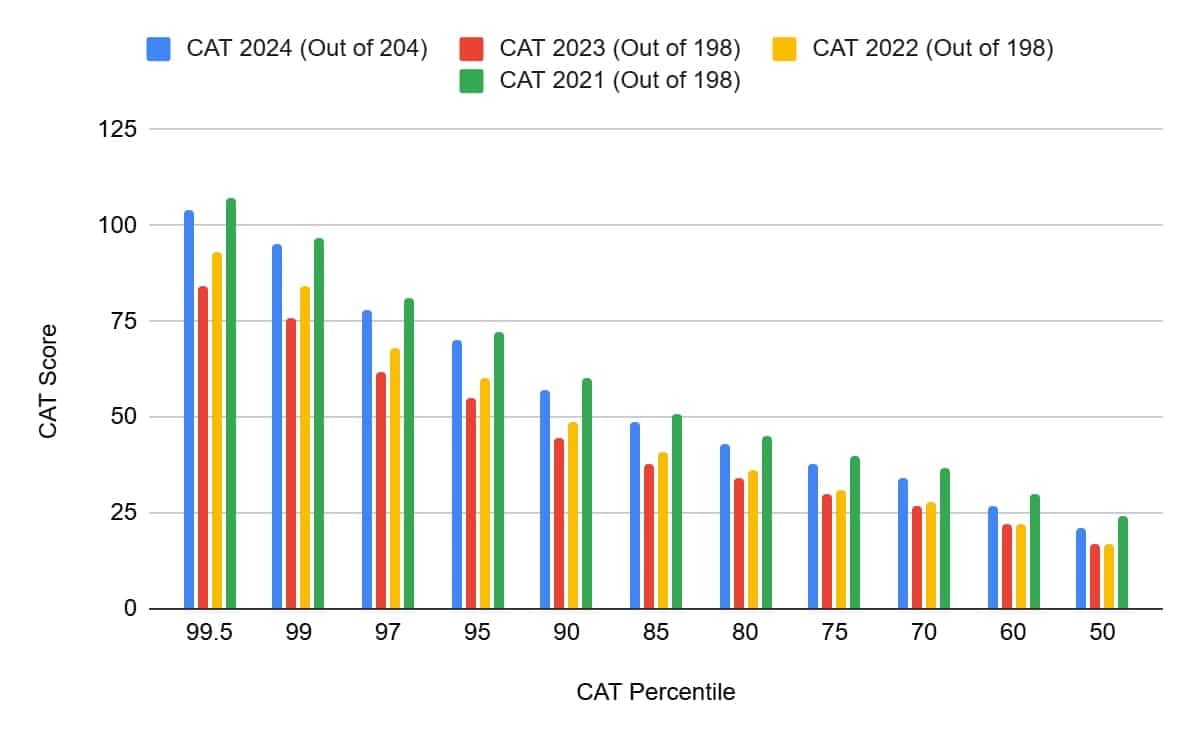
Percentile | CAT 2024 (Out of 204) | CAT 2023 (Out of 198) | CAT 2022 (Out of 198) | CAT 2021 (Out of 198) |
99.5 | 104 | 84.5 | 93 | 107 |
99 | 95 | 76 | 84 | 97 |
97 | 78 | 62 | 68 | 81 |
95 | 70 | 55 | 60 | 72 |
90 | 57 | 44.5 | 49 | 60 |
85 | 49 | 38 | 41 | 51 |
80 | 43 | 34 | 36 | 45 |
75 | 38 | 30 | 31 | 40 |
70 | 34 | 27 | 28 | 37 |
60 | 27 | 22 | 22 | 30 |
50 | 21 | 17 | 17 | 24 |
An effective CAT test taking strategy involves balancing attempts with accuracy. Data shows that as the number of questions attempted increases, accuracy tends to drop, even if the net score remains stable. Understanding this trend helps aspirants prioritise accuracy over blind attempts, improving overall performance in the CAT exam.
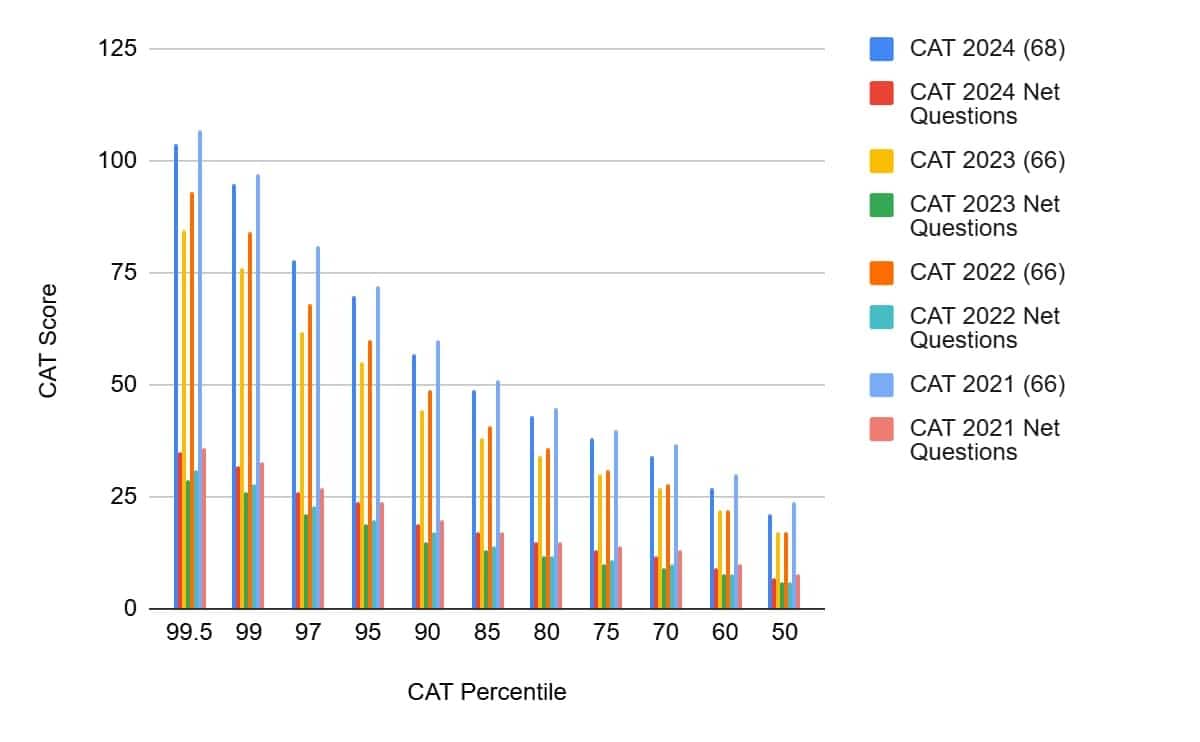
Percentile | CAT 2024 (68) | CAT 2023 (66) | CAT 2022 (66) | CAT 2021 (66) | ||||
Out of 204 | Net Qns | Out of 198 | Net Qns | Out of 198 | Net Qns | Out of 198 | Net Qns | |
99.5 | 104 | 35 | 84.5 | 29 | 93 | 31 | 107 | 36 |
99 | 95 | 32 | 76 | 26 | 84 | 28 | 97 | 33 |
97 | 78 | 26 | 62 | 21 | 68 | 23 | 81 | 27 |
95 | 70 | 24 | 55 | 19 | 60 | 20 | 72 | 24 |
90 | 57 | 19 | 44.5 | 15 | 49 | 17 | 60 | 20 |
85 | 49 | 17 | 38 | 13 | 41 | 14 | 51 | 17 |
80 | 43 | 15 | 34 | 12 | 36 | 12 | 45 | 15 |
75 | 38 | 13 | 30 | 10 | 31 | 11 | 40 | 14 |
70 | 34 | 12 | 27 | 9 | 28 | 10 | 37 | 13 |
60 | 27 | 9 | 22 | 8 | 22 | 8 | 30 | 10 |
50 | 21 | 7 | 17 | 6 | 17 | 6 | 24 | 8 |
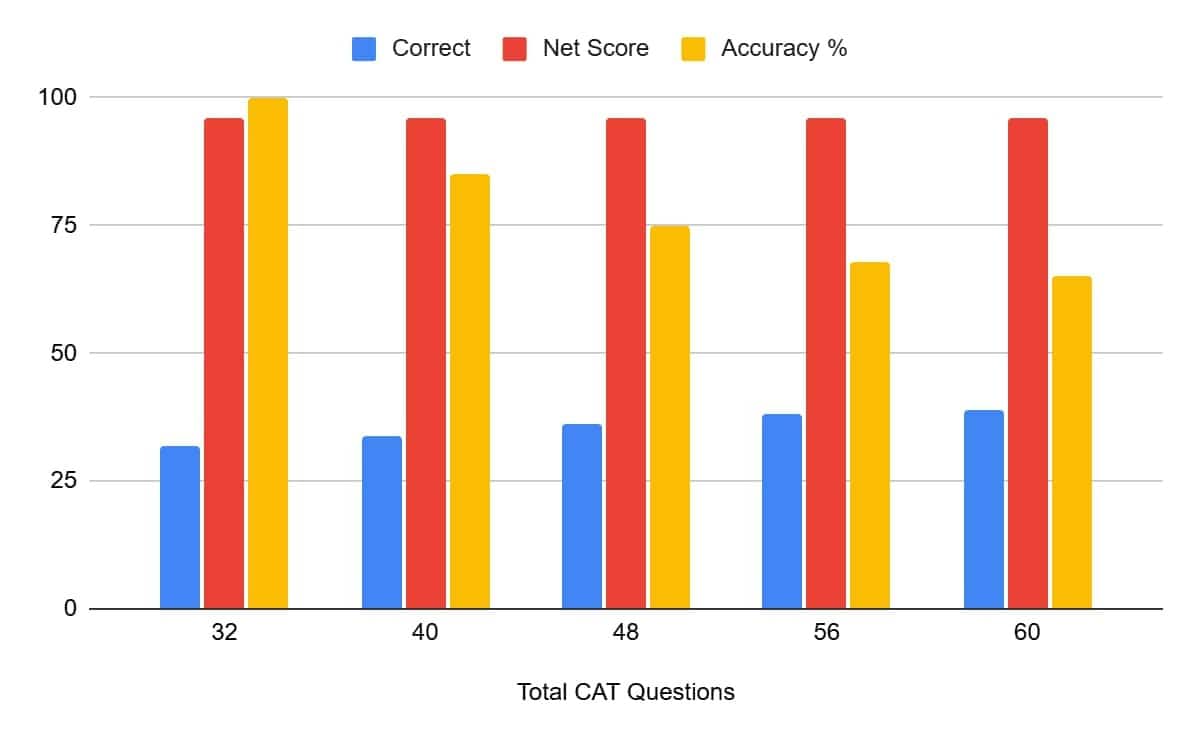
Attempt | Correct | Net Score | Accuracy % |
32 | 32 | 96 | 100 |
40 | 34 | 96 | 85 |
48 | 36 | 96 | 75 |
56 | 38 | 96 | 68 |
60 | 39 | 96 | 65 |
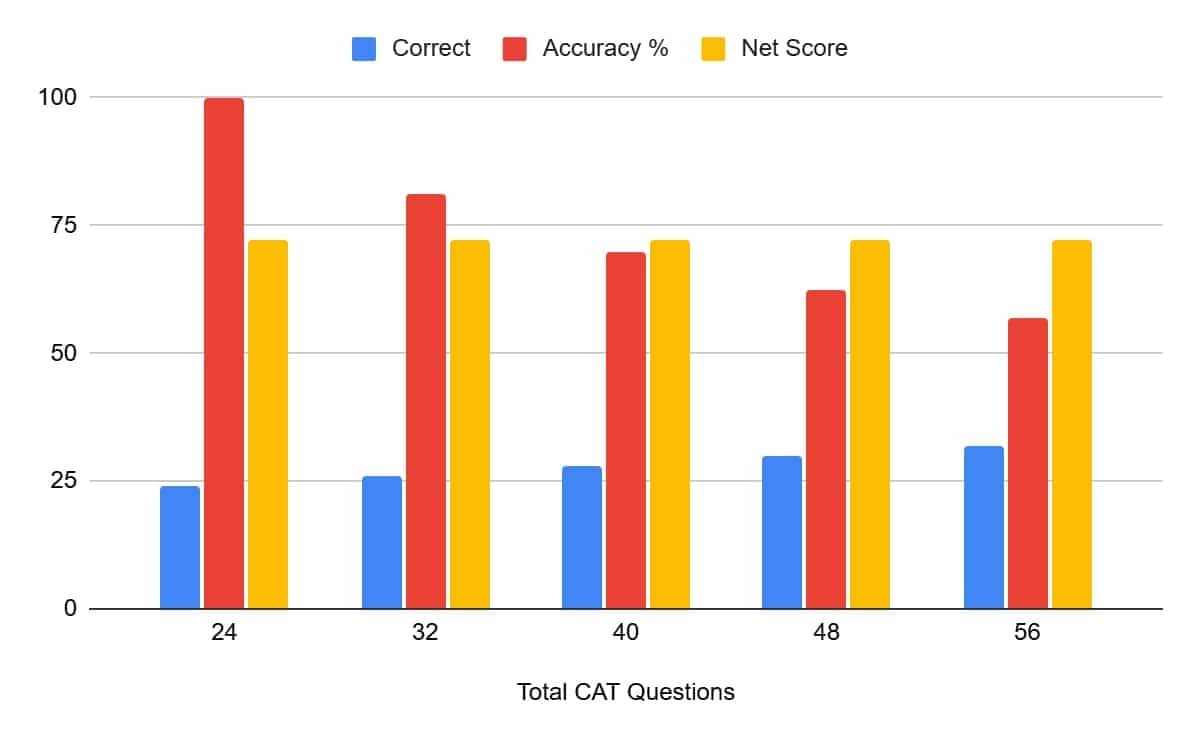
Question Attempt | Correct | Accuracy % | Net Score |
24 | 24 | 100 | 72 |
32 | 26 | 81 | 72 |
40 | 28 | 70 | 72 |
48 | 30 | 62.5 | 72 |
56 | 32 | 57 | 72 |
The VARC section in CAT has 24 questions, so you must use your time smartly. One effective method is to split the section based on question type. Spend about 30 minutes on CAT Reading Comprehension (RC) and 10 minutes on Verbal Ability (VA). Stick to this time limit, even if you don’t finish everything. While solving RC, give around 7 minutes to each passage. Begin with para summary questions, then move to sentence rearrangement and other types.
Start with RC. Tackle 4 passages in about 28 to 30 minutes. Stay focused and avoid overthinking any one passage. If you're running behind, stop at the 30-minute mark, no exceptions.
Move to VA. Begin with the high-accuracy, low-effort questions like Para Summary, Sentence Completion, and Odd One Out.
Use your remaining time wisely. If you still have a few minutes left, try solving Para Jumbles. If time is too short, make smart guesses rather than leaving them blank.
If any passage feels too long or confusing, skip it and return later if time allows. Another smart method is to start with VA. Use 6 to 7 minutes to solve para summary, odd sentence out, and sequencing questions. Then move to RC and tackle as many passages as possible. If you finish early, go back and attempt any leftover VA questions.
Spend the first 6 minutes on quick, high-accuracy questions like:
– Para Summary
– Sentence Completion
– Odd One Out
Don’t spend more than 7 minutes here, even if you're mid-way. Aim to finish at least 5 VA questions.
Spend the next 30 minutes solving all 4 Reading Comprehension passages. Stay focused, and don’t jump back to VA during this time.
If time allows, go back and attempt Para Jumbles. If not, make quick guesses rather than leaving them blank.
For the DILR section in CAT, you get 40 minutes to solve around 4 sets. Your performance here depends entirely on set selection and time management. If you waste 8-9 minutes on one tough set that doesn’t crack, you may lose the entire section. So, a right CAT test-taking strategy is to start by scanning all five sets quickly.
Spend 2 minutes on each set to quickly judge whether it's solvable.
If it looks doable, spend 8–10 more minutes on it.
If not, move on to the next set without wasting time.
This way, you’ll get to look at all 5 sets and aim to solve 3 to 4 of them efficiently.
Set 1 | Set 2 | Set 3 | Set 4 | Set 5 | |
Initial Scan (min) | 2 | 2 | 2 | 2 | 2 |
Solving Time (min) | 9 | – | 8 | 10 | 10 |
Total Time (min) | 11 | 2 | 10 | 12 | 12 |
Questions Attempted | 3–4 | – | 3–5 | 3–5 | 3–5 |
Often, solving 3 out of 4 questions from a set with high accuracy gives a better score than struggling through all of them. If a question takes too long, leave it and move to the next. Another smart CAT 2026 preparation strategy is to mark 2–3 solvable sets based on their core method, like arrangement, calculation, or grouping. Understand the base logic, plan your attempt order, and aim for quality over quantity. Accuracy and calm decision-making are the real game changers in Data Interpretation and Logical Reasoning.
Spend 6-7 minutes reviewing all 5 sets in DILR.
Choose the sets you will solve based on your familiarity with the topic and the complexity of the set.
Select 2-3 sets, depending on your ability.
Implement a 'stop loss' of around 4 minutes for each set.
Set 1 | Set 2 | Set 3 | Set 4 | Set 5 | |
Time | 12 | 0 | 10 | 0 | 10 |
Qns | 3-4 | 0 | 3-5 | 0 | 3-5 |
For the Quantitative Aptitude section in CAT, where 40 minutes are allotted for around 22 questions, a round-wise attempt strategy can help you maximise your score. Begin with Round 1, where you spend about 26 minutes scanning and attempting all the easiest questions. Your CAT test taking strategy here is to solve 8 to 9 questions with high speed and accuracy. Don’t get stuck. If a question looks time-consuming, skip it. In Round 2, use the next 12–14 minutes to tackle 3 to 4 moderate-level questions, focusing entirely on accuracy.
Time Allocation: Divide your time into two rounds:
Round 1: 26 minutes
Round 2: 12 minutes
First Round:
Solve all easy questions.
Mark other questions that you believe are solvable.
Second Round:
Solve the questions that you marked in the first round.
Review your answers.
Another way to manage this is by dividing the section into 4 short rounds of about 10 minutes each, aiming to solve around 5 to 6 questions per round. This keeps you alert, focused, and prevents burnout. The key is to read every question carefully and quickly decide whether you can solve it. Don’t blindly guess, CAT Quant rewards smart filtering over brute speed. Your target should be to attempt at least 10 to 11 questions with above 90–94% accuracy. Even this can push your percentile above 97 if you choose wisely.
Time Allotment | No. of questions to Target | No. of questions to Solve |
10 minutes | 6 | 2-4 |
10 minutes | 6 | 3-5 |
10 minutes | 5 | 3-4 |
10 minutes | 5 | 2-4 |
40 minutes | 22 | 10-17 |
Stress management during the CAT exam is crucial for optimal performance. High pressure can impair focus and decision-making, but with the right approach, you can maintain calm and confidence. Effective stress control helps maximise accuracy and speed, directly influencing your CAT percentile and admission prospects. Know about the go to CAT test-taking strategy below.
Allocate time wisely across sections to avoid last-minute rush and stress.
Consistent daily planning keeps you on track, reducing anxiety about an incomplete syllabus.
Regular practice of mock exams builds familiarity, alleviating exam day nervousness and boosting confidence.
Avoid negative thoughts; believe in your preparation to overcome exam phobia and stress.
Use deep breathing and short meditation breaks during the exam to stay calm and focused.
Maintain good sleep, nutrition, and regular exercise to keep stress levels low and energy high.
Trust your preparation and avoid second-guessing answers during the exam to reduce unnecessary stress.
CAT mock tests are essential resources for aspirants aiming to excel in the CAT exam. They simulate the actual test environment, allowing candidates to familiarise themselves with the exam format, question types, and time constraints. Taking CAT 2026 mock tests helps identify strengths and weaknesses and helps in exam preparation. Additionally, they build confidence and reduce anxiety by providing a realistic experience of the exam day. Know the complete CAT test taking strategy for mock test analysis below.
Create a study timetable that includes specific dates for taking mock tests. Ensure that you allocate time for both preparation and revision before each test.
Select a reputable CAT mock test series that closely resembles the actual CAT exam in terms of difficulty and format. This will provide a more accurate assessment of your readiness.
When taking a CAT 2026 mock test, replicate the actual exam environment as closely as possible. Find a quiet space, limit distractions, and adhere to the time limits strictly.
After completing each mock test, take time to review the questions you found challenging. Focus on revising those topics to strengthen your understanding.
Calculate your CAT score and analyse your performance in each section. Identify areas where you performed well and those that need improvement.
Review the questions you answered incorrectly. Understand the reasoning behind the correct answers and identify any patterns in your mistakes, such as careless errors or conceptual misunderstandings.
Analyse how you managed your time during the test. Note if you spent too long on certain questions or sections, and adjust your CAT preparation strategy accordingly for future tests.
Maintain a record of your scores and performance trends over time. This will help you gauge your improvement and adjust your CAT study plan as needed.
If possible, discuss your performance with peers or mentors. They can provide valuable insights and tips for improvement based on their experiences if you are preparing for CAT without coaching.
Cracking CAT 2026 is not just about solving questions; it’s about planning, discipline, and smart execution. With lakhs of aspirants competing, standing out requires a structured approach that balances accuracy, speed, and confidence. Here are six powerful strategies to help you prepare effectively and aim for a top percentile.
Many aspirants jump directly into mock tests and shortcuts, but without strong basics, speed won’t help. Focus first on strengthening fundamentals in Quant (algebra, arithmetic, geometry), DILR (logical patterns, data sets), and VARC (reading comprehension, grammar). Once concepts are solid, speed-building techniques will come naturally.
Each section of CAT demands a unique approach. For VARC, practice daily reading from diverse sources like editorials, science articles, and opinion pieces. For DILR, work on identifying solvable sets quickly, rather than attempting all. For Quant, categorise topics into strong, moderate, and weak zones and plan attempts accordingly.
A high number of attempts with poor accuracy drags percentile down due to negative marking. Instead, target 75–80% accuracy. Learn to skip overly time-consuming or confusing questions. Smart selection improves scores far more than blind attempts.
Mock tests are not just practice; they are helpful resource. After each mock, spend at least twice the time analysing as you did writing it. Identify question types you regularly miss, note timing issues, and track whether you lose marks due to careless errors or conceptual gaps.
With only 40 minutes per section, time is your biggest asset. Practice sectional tests to improve pacing. Allocate time blocks, for instance, 25 minutes to solve selected questions and 15 minutes to review/attempt pending ones. Learning when to move on from a stuck question can save vital minutes.
Every aspirant has different strengths, but the key to CAT 2026 success lies in creating a balanced strategy for all three sections. You can’t rely only on one area; the exam requires steady performance across VARC, DILR, and Quant. Here are six smart ways to approach each section effectively.
VARC is all about comprehension and interpretation. Regular reading from newspapers, magazines, and online articles helps expand vocabulary and improves speed. Don’t just read—practice identifying the author’s tone, main idea, and hidden assumptions. This sharpens your ability to handle even unfamiliar passages with ease.
Many VARC questions are tricky because multiple answers appear correct. Train yourself to eliminate options by spotting extreme wording, factual errors, or choices that go beyond the passage. This method not only saves time but also improves accuracy in Reading Comprehension and Verbal Ability.
In the DILR section, the first step is to quickly identify which sets are solvable within time. Regular practice makes you familiar with patterns like seating arrangements, data tables, and puzzles. Develop the habit of scanning all sets first and then picking the ones that appear structured and less time-heavy.
Instead of rushing through data sets, break them into smaller steps. Write down clues, organise information, and create simple charts or tables on the rough sheet. This prevents confusion and ensures clarity. With practice, your solving speed improves without compromising accuracy.
Arithmetic (percentages, ratios, time-speed-distance) and Algebra form the backbone of Quant. These topics contribute heavily to the exam and are easier to master compared to higher-level geometry or permutations. Build strong basics here first, as they can help you secure dependable marks and boost confidence.
Not every question in Quant is worth attempting. Some are deliberately time-consuming. Train yourself to spot the easier ones quickly, short calculations, direct applications of formulae, or familiar patterns. Building this judgement through practice ensures you don’t waste time and energy on unsolvable problems.
Many aspirants preparing for CAT 2026 reach a stage where their CAT 2026 percentile stops improving. This plateau is not due to lack of effort, but often because their CAT test-taking strategy is repetitive, unfocused, or fails to address weak areas. Simply solving more questions without analysing patterns, adjusting approaches, or improving speed rarely increases your percentile.
A plateau becomes visible when mock test scores stagnate despite consistent practice. Aspirants often continue with the same study routine, ignoring mistakes, sectional imbalances, or time management issues. A strong CAT 2026 exam preparation strategy requires identifying these bottlenecks to break through and increase percentile.
Focusing only on overall scores can be misleading. Analyse each mock test section-wise, noting recurring errors. Perhaps you consistently struggle with Data Interpretation in DILR or miss comprehension questions in VARC. Recognising these patterns is essential for refining your question selection strategy and targeting improvement effectively.
After pinpointing weak areas, integrate targeted practice into your daily routine. Adjust your CAT 2026 exam preparation strategy by prioritising high-impact sections and question types. Even focused 30–45 minute sessions on challenging topics can yield significant percentile gains over time.
Treat mock tests as diagnostic tools, not just practice. Analyse time per question, accuracy, and attempt patterns. By refining your mock test strategy for CAT 2026, you can enhance your speed, accuracy, and decision-making skills. Continuous analysis ensures that every practice session contributes to breaking through the plateau.
Psychological barriers often reinforce plateaus. Avoid frustration and focus on improvement rather than raw scores. High scorers use each mock and practice session to optimise their CAT test taking strategy, which steadily increases confidence and improves CAT 2026 percentile.
A crucial part of any CAT test-taking strategy is knowing which questions to attempt first. Many aspirants jump randomly across the paper, which often reduces their CAT 2026 percentile. Strategic question selection saves time, increases accuracy, and builds confidence during the exam.
Identify your strongest sections first. For instance, if you excel in QA or DILR, begin there to secure marks early. In the VARC section of CAT 2026, skim passages and answer the questions you feel most confident about. Starting with strengths helps you gain points quickly and reduces early exam anxiety.
Divide CAT questions into easy, medium, and hard based on your comfort level. Easy questions should be attempted first since they offer maximum marks with minimal time. Medium-difficulty questions can follow, and hard questions should be tackled last or only if time allows. This ensures efficiency and prevents stress from wasting time on tough questions.
Time management is key to a high CAT 2026 percentile. Allocate roughly 2–3 minutes for easy questions and 4–5 minutes for medium ones. Use a watch or an on-screen timer to maintain pace. This methodical approach is a critical component of time management for the CAT exam and prevents rushed mistakes.
High-impact question selection is not just about attempting questions quickly; it’s about maximising marks while avoiding errors. Answering in a logical order, combined with careful time management, helps you attempt more questions correctly and keeps confidence levels high throughout the exam.
Practising this approach in mock tests helps refine your CAT test-taking strategy. Analyse which types of questions you handle efficiently, note recurring patterns, and adjust your selection plan accordingly. By doing so, you enter the CAT 2026 exam fully prepared to prioritise questions effectively.
Many aspirants struggle to score their best in CAT 2026, not because of knowledge gaps, but due to psychological traps that silently lower their percentile. A smart CAT test-taking strategy recognises these traps and provides simple ways to overcome them. By avoiding these pitfalls, you can maximise your accuracy, speed, and overall score.
1. Overthinking Questions
One of the most common issues in CAT preparation is overthinking questions. Spending too much time on a tricky problem can eat into your overall exam time, leaving less room for other questions. Students aiming to maximise their CAT 2026 percentile often waste minutes perfecting a single answer, which increases stress and lowers accuracy. The most effective CAT exam strategy is to limit yourself to 2–3 minutes per question. If the solution isn’t clear, mark it for review and move on. This approach ensures you maintain momentum and secure marks efficiently.
2. Panicking During Difficult Sections
Stress and panic can significantly impact your performance in the CAT exam. When faced with challenging questions, many aspirants start doubting answers they have already attempted or rush through sections without thinking clearly. To score high in CAT 2026, develop a calm exam-day mindset as part of your CAT test taking strategy. Pause for a few deep breaths, visualise your preparation, and approach each question with a fresh perspective. Staying calm helps you maintain accuracy and improves your chances of maximising your percentile.
3. Ignoring Strengths and Weaknesses
Another trap is attempting all sections or question types randomly. Many aspirants waste valuable time on their weaker areas and leave questions they could solve easily unanswered. A strong CAT 2026 exam preparation strategy focuses on your strengths first. Start with the sections you are confident in, secure marks early, and then move to tougher questions. This ensures efficient time allocation and maximises your overall CAT percentile.
4. Comparing Yourself to Others
Peer comparison is a subtle but damaging psychological trap. Observing mock test ranks or preparation progress of others can lead to unnecessary stress or overconfidence. To truly boost your CAT 2026 percentile, concentrate solely on your own preparation and planned strategy. Let your practice results guide improvements, but avoid letting others’ performance influence your exam-day decisions. A focused mindset is a key component of any high-performing CAT test taking strategy.
5. Poor Time Awareness
Time management is critical for achieving a top percentile in CAT 2026. Losing track of time often results in rushed answers and careless mistakes toward the end of a section. Integrating a time management strategy for CAT is essential. Divide each section into smaller blocks, for example, 30–45 minutes per segment, and use a watch or timer to monitor progress. This methodical approach helps you attempt the maximum number of questions accurately and confidently.
The CAT 2026 eBooks by Careers360 are a great CAT test-taking strategy for serious aspirants. These free PDFs cover everything from the updated CAT 2026 syllabus and high-scoring topics to previous year papers and important formulas. Each eBook is designed to simplify your preparation and help you focus on what matters. Whether you’re revising concepts or practising question patterns, these downloadable PDFs are a smart addition to your CAT 2026 study plan.
eBook Title | Download Links |
3000+ Most Important Words - Vocabulary Builder | |
500+ Most Important Idioms and Phrases | |
300+ Most Important Phrasal Verbs | |
Permutation & Combination - Video Lectures and Practice Questions | |
Boost your CAT preparation with a comprehensive 60-day study material by Experts | |
Mastering DILR Questions with Expert Solutions | |
CAT 2026 Exam's High Scoring Chapters and Topics | |
CAT Mock Test Series - 20 Sets, Questions with Solutions By Experts | |
Mastering CAT Exam: VARC, DILR, and Quant MCQs & Weightages | |
CAT 2026 Mastery: Chapter-wise MCQs for Success for VARC, DILR, Quant | |
CAT 2026 Quantitative Aptitude Questions with Answers | |
CAT DILR Questions with Solution, Download LRDI Questions for CAT |
Frequently Asked Questions (FAQs)
A proper CAT 2026 test taking strategy helps improve time management, question selection, and accuracy. It allows aspirants to maximise attempts in VARC, DILR, and Quantitative Aptitude while avoiding low-score and time-consuming questions.
CAT aspirants should start with sectional tests, then move to full-length mock tests. Ideally, 30–40 quality CAT mocks with detailed analysis are enough for strong percentile improvement.
CAT Mock analysis helps identify repeated mistakes, weak topics, calculation errors, and time traps. Improving these factors is more important than raw mock scores for percentile growth.
Yes, each CAT section requires a separate execution strategy. VARC needs reading speed and accuracy, DILR needs smart set selection, and QA needs fast calculations and correct question order.
Quickly prioritise questions you can answer confidently. Make educated guesses if time allows, but avoid lingering on difficult questions. Practice pacing in mock tests to improve time management.
The final CAT exam strategy should be locked 8–10 weeks before the exam, allowing time to build consistency, confidence, and score in the exam.
Begin with your strongest section in CAT (VARC, LRDI, or Quant). It boosts accuracy, builds confidence, and leaves more time for tougher areas.
Scan all questions before attempting the questions in CAT 2025. Identify high-confidence, low-computation questions first, then moderate-difficulty questions. Leave high-complexity or unfamiliar questions for the end, ensuring maximum correct attempts within the section time.
An effective strategy balances speed, accuracy, and question selection across QA, DILR, and VARC. It involves prioritising high-weightage topics, attempting easier questions first, and managing time per section
Allocate time based on section difficulty and personal strengths. Start with questions you can solve quickly and save complex or unfamiliar questions for later. Track time per question and per section to avoid spending excessive minutes on low-return problems.

On Question asked by student community
Hello CAT Aspirant!
If you mean the CAT ( Common Admission Test) EWS certificate, the important point is whether the certificate is valid and issued in the prescribed format, rather than simply the language used on it.
Yes, a Hindi EWS certificate can generally be accepted for CAT, provided it
If you have already received your final MA result and have technically completed the degree , but you are only waiting for the revaluation outcome, you would generally be considered a graduate rather than someone whose master's degree is still completely in progress. However, CAT has specific instructions about qualification
If you mean CAT (Common Admission Test) preparation, you can practise with previous-year CAT papers. IIM has a collection of CAT papers from 2017 to 2025, covering VARC, DILR and Quant across different slots, along with solutions and explanations. Solving the recent papers first can help you understand the current
Hello Student,
Yes, you can apply for CAT with an EWS certificate issued in Hindi, provided it is issued by the competent authority and follows the required format. However, CAT applicants need a Central-level EWS certificate, not merely a state-level EWS certificate. Since you are from Uttar Pradesh, ensure your
Hey there,
If you mean your MBA counselling seat-allotment letter, the exact download process depends on the counselling authority.
Usually:
Directions for question:
The bar-graph given below shows the foreign exchange reserves of Nepal (in million Rupees) from 2014 to 2021. Answer the following questions based on the graph :

Question:
What was the percentage increase (rounded to the nearest integer, if deemed necessary) in the foreign exchange reserves in

Globally Recognized by AACSB (US) & AMBA (UK) | 18 LPA Avg. CTC for PGPM 2026
75+ years of legacy | #1 Entrance Exam | Score accepted by 250+ BSchools
6-Hour Masterclass to help you score 99+ percentile in CAT 2026
Test centres are available in 70+ cities across India | 75,000+ aspirants apply for the NMAT exam | Accepted by 58+ institutions like NMIMS, KJSIM, ISB, SPJIMR and Great Lakes.
Registration Start: 3 August 2026 | Last Date to Apply: 15 September 2026 (till 5 PM)
AACSB Accredited | 40 LPA-Highest CTC | Scholarships worth 10 CR