Great Lakes - PGDM & PGPM Admissions 2027
Globally Recognized by AACSB (US) & AMBA (UK) | 18 LPA Avg. CTC for PGPM 2026


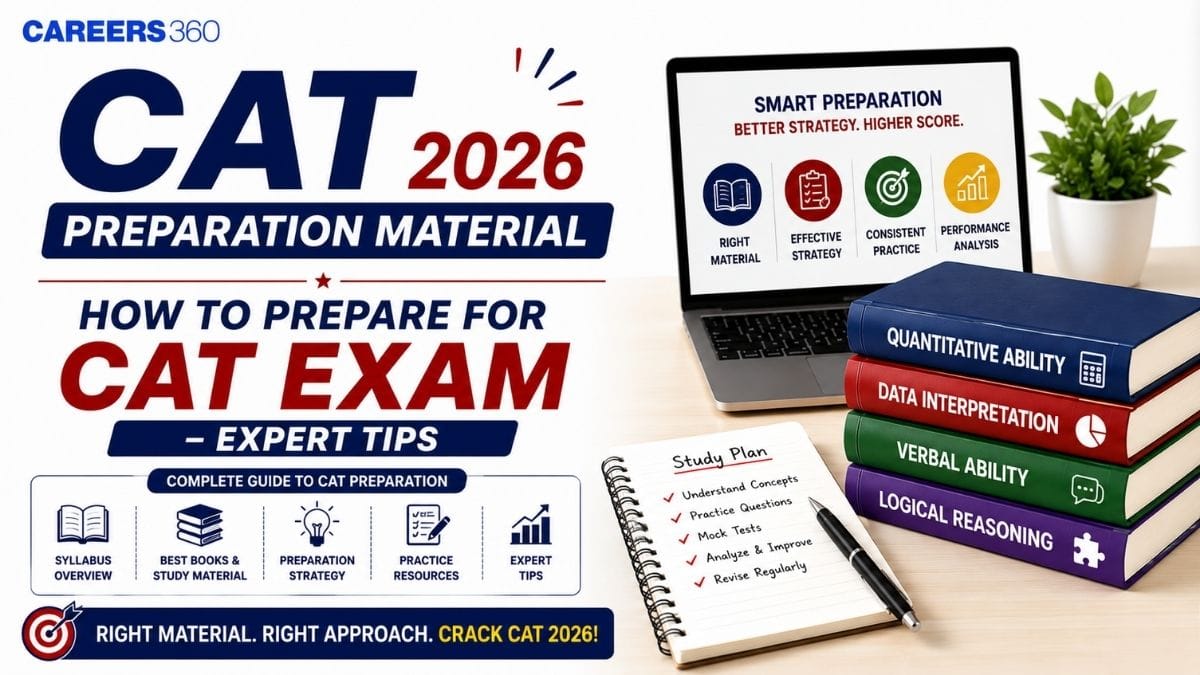
Choosing the right CAT preparation material for 2026 is one of the most important steps towards securing a high percentile in the Common Admission Test (CAT). Conducted by one of the Indian Institutes of Management (IIMs), CAT tests candidates on Verbal Ability & Reading Comprehension (VARC), Data Interpretation & Logical Reasoning (DILR), and Quantitative Aptitude (QA). Using high-quality preparation material, along with regular mock tests, previous year question papers, and a structured study plan, helps candidates build conceptual clarity, improve accuracy, and develop the speed required to excel in the examination. In this article, you will find the best CAT preparation material for 2026, including section-wise study resources, books, notes, mock tests, previous year papers, online learning resources, and expert preparation tips to help you prepare effectively and maximise your CAT 2026 score.
This Story also Contains
Attempt Now: CAT 2026 Mock Test to help you understand your level of preparation.
Selecting the right CAT preparation material for 2026 is one of the most important steps in your preparation journey. Since the CAT exam evaluates candidates on conceptual understanding, analytical ability, and time management, using high-quality study resources can make your preparation more structured and effective. Instead of referring to multiple books and notes, candidates should focus on a few reliable resources that comprehensively cover the syllabus and provide sufficient practice questions.
Well-designed study material helps candidates understand concepts clearly and practise questions that closely resemble the actual CAT examination.
Some key benefits include:
Build strong conceptual fundamentals.
Cover the complete CAT syllabus systematically.
Improve problem-solving speed and accuracy.
Practise a variety of question types.
Prepare according to the latest CAT exam pattern.
Build confidence through regular practice.
The ideal preparation material depends on your current preparation level and learning style. Before selecting books or study resources, make sure they offer conceptual explanations, practice questions, and updated content.
Choose preparation material that:
Covers the latest CAT syllabus.
Explains concepts with solved examples.
Includes topic-wise and sectional practice.
Provides previous year questions or similar exercises.
Offers mock tests and performance analysis.
Matches your current preparation level.
Avoid collecting too many resources. Revising a few quality books multiple times is generally more effective than studying from several different sources.
Understanding the CAT 2026 exam pattern helps candidates prepare according to the actual examination format. Although the official CAT 2026 notification is yet to be released, aspirants can refer to the latest exam pattern while planning their preparation.
| Particular | Details* |
|---|---|
| Exam Name | Common Admission Test (CAT) |
| Conducting Body | Indian Institute of Management (IIM) |
| Exam Mode | Computer-Based Test (CBT) |
| Duration | 120 Minutes |
| Number of Sections | 3 |
| Question Types | MCQs & TITA (Type In The Answer) |
| Total Questions | Around 68 |
| Negative Marking | Applicable for MCQs only |
Test centres are available in 70+ cities across India | 75,000+ aspirants apply for the NMAT exam | Accepted by 58+ institutions like NMIMS, KJSIM, ISB, SPJIMR and Great Lakes.
AACSB Accredited | 40 LPA-Highest CTC | Scholarships worth 10 CR
The above pattern is based on the latest CAT examination. Any official changes for CAT 2026 will be updated after the notification is released.
The CAT examination consists of three sections, each designed to assess different aptitude and analytical skills.
| Section | Expected Questions | Time Limit |
|---|---|---|
| Verbal Ability & Reading Comprehension (VARC) | 24 | 40 Minutes |
| Data Interpretation & Logical Reasoning (DILR) | 22 | 40 Minutes |
| Quantitative Aptitude (QA) | 22 | 40 Minutes |
| Total | 68 | 120 Minutes |
Candidates should prepare all three sections equally, as many MBA colleges also consider sectional performance during admissions.
Understanding the marking scheme helps candidates develop an effective exam strategy and minimise unnecessary negative marking.
| Response | Marks |
|---|---|
| Correct Answer | +3 |
| Incorrect MCQ | -1 |
| Incorrect TITA | No Negative Marking |
| Unattempted Question | 0 |
Candidates should avoid random guessing in MCQs while confidently attempting TITA questions whenever possible.
CAT is generally considered one of the most competitive MBA entrance examinations in India. While the syllabus is based largely on school-level concepts, the application-based questions and strict time limits increase the overall difficulty.
| Section | Expected Difficulty |
|---|---|
| VARC | Moderate |
| DILR | Moderate to Difficult |
| Quantitative Aptitude | Moderate |
| Overall | Moderate to Difficult |
Consistent practice and regular mock tests are the most effective ways to prepare for this level of difficulty.
As of now, no major changes have been officially announced for CAT 2026. Candidates should continue their preparation based on the latest available exam pattern while regularly checking official notifications for any updates related to:
Exam pattern.
Number of questions.
Marking scheme.
Exam duration.
Section-wise changes.
The CAT syllabus broadly covers three sections: Verbal Ability & Reading Comprehension (VARC), Data Interpretation & Logical Reasoning (DILR), and Quantitative Aptitude (QA). Although there is no officially prescribed syllabus, the topics below are commonly tested every year.
The VARC section evaluates a candidate's reading ability, comprehension skills, grammar, and verbal reasoning.
Important topics include:
Reading Comprehension
Para Jumbles
Para Summary
Odd One Out
Sentence Completion
Vocabulary
Grammar
Verbal Reasoning
Candidates should develop a daily reading habit to improve comprehension speed and accuracy.
The DILR section assesses analytical thinking, logical reasoning, and data interpretation skills through caselet-based questions and puzzles.
Frequently tested topics include:
Seating Arrangement
Puzzles
Venn Diagrams
Blood Relations
Games and Tournaments
Scheduling
Logical Reasoning Sets
Tables and Charts
Regular practice is essential to improve question selection and time management in this section.
The Quantitative Aptitude section tests mathematical concepts and their application in problem-solving.
Major topics include:
Arithmetic
Algebra
Geometry
Number System
Modern Mathematics
Permutation and Combination
Probability
Functions
Logarithms
Progressions
Candidates should first strengthen their conceptual understanding before practising advanced-level questions and timed exercises.
Candidates who are well-prepared for the CAT 2026 will have a better chance of scoring well. Candidates who prepare with coaching institutions may find it easier to get excellent material. However, such applicants must not be comfortable with minimal resources like the CAT 2026 books. However, candidates can also prepare for CAT without coaching using self-study.
Well, for all those candidates who are preparing for CAT for the first time, it might be difficult to figure out what books they should purchase. From where can I get sample papers? Should they rely on the self-preparation of notes or buy them from online/offline sources? Well, wait, all these things that we discussed just now are all part of your CAT 2026 preparation material. Let's take a look at each component carefully.
The richness of Content: Preparation material that is rich in content will only be good for the CAT. The preparation material’s information must be according to the reader’s requirements. Complete details related to the topics that help in understanding the syllabus content easily and accurately will be considered good material
Author’s Credibility: Before picking any preparation material, applicants should ensure it is reputable enough to be referred to. CAT 2026. Preparation materials are reasonably priced on the market. Some are first-time writers attempting to give appropriate preparation material, while others are seasoned authors who will provide excellent CAT 2026 preparation material. As a result, before picking CAT 2026 important topics for preparation, applicants ought to examine the author and consider using them as a CAT preparation guide.
Best books for CAT preparation
CAT question papers
Mock test of CAT entrance exam
CAT sample papers
E-Books of cat
Let’s see each component one by one in the descriptive form:
After analysing the syllabus for CAT 2026, it is most likely that all candidates will find books that cover the overall topics. Getting the best books for CAT may be complicated and hectic if you do not know where to find them. Some of the books based on each section are given below.
For the Quantitative Ability Section:
| S.No | Book Name | Author / Publisher | Why It’s Useful for CAT 2026 |
|---|---|---|---|
| 1 | How to Prepare for Quantitative Aptitude for CAT | Arun Sharma | Comprehensive coverage of all QA topics, with step-by-step methods and practice questions. |
| 2 | Quantitative Aptitude Quantum CAT | Sarvesh K. Verma | Offers advanced-level problems, shortcut techniques, and past CAT questions for practice. |
| 3 | Quantitative Aptitude for CAT | Nishit K. Sinha | Provides topic-wise practice, detailed solutions, and tricks to improve speed and accuracy. |
| 4 | Fast Track Objective Arithmetic | Rajesh Verma | Covers all important arithmetic concepts, with solved examples and shortcut methods. |
To boost your understanding and conceptual usage of Quant Formula, you can download the CAT 2026 important Formulae.
For Verbal Ability & Reading Comprehension Section
| S.No | Book Name | Author / Publisher | Why It’s Useful for CAT 2026 |
|---|---|---|---|
| 1 | How to Prepare for Verbal Ability and Reading Comprehension for CAT | Arun Sharma & Meenakshi Upadhyay | Comprehensive coverage of RC, grammar, vocabulary, and verbal reasoning exercises. |
| 2 | Word Power Made Easy | Norman Lewis | Helps build strong vocabulary with contextual usage, essential for RC and verbal sections. |
| 3 | High School English Grammar & Composition | Wren & Martin | Classic guide for grammar, sentence correction, and usage questions in CAT VARC. |
| 4 | Logical & Analytical Reasoning for CAT | Nishit K. Sinha | Focuses on comprehension-based reasoning and analytical passages. |
| 5 | Objective English for Competitive Exams | Hari Mohan Prasad | Offers practice in grammar, vocabulary, and RC questions with detailed explanations. |
Note that for this section, reading and improving vocabulary is the key. Read newspapers like The Hindu, The Economist, Business Standard etc.,
For the Logical Reasoning and Data Interpretation Section
| S.No | Book Name | Author / Publisher | Why It’s Useful for CAT 2026 |
|---|---|---|---|
| 1 | How to Prepare for Data Interpretation for CAT | Arun Sharma | Covers all types of DI sets, step-by-step methods, and practice questions for speed and accuracy. |
| 2 | How to Prepare for Logical Reasoning for CAT | Arun Sharma | Offers diverse reasoning problems, tricks, and shortcut techniques to improve problem-solving skills. |
| 3 | Logical Reasoning & Data Interpretation for CAT | Nishit K. Sinha | Includes sectional strategies, practice exercises, and detailed explanations for quick learning. |
| 4 | Quantum CAT | Sarvesh K. Verma | Provides advanced-level reasoning and DI sets, past CAT questions, and time-saving techniques. |
| 5 | Data Interpretation & Logical Reasoning for CAT | Nishit K. Sinha | Focused approach for mixed sets, puzzle-type questions, and sectional mock tests for practice. |
Topper of CAT, Vishesh Garg, said that he solved question papers for CAT entrance exams to know what kind of questions came. He practised the question papers of CAT to make his time management skills strong while solving all the questions. Hence, the toppers of CAT suggest that solving previous years' CAT papers or CAT sample papers helps a lot.
Practice Now with the Past 10 years' CAT Question Papers with Solutions
The Indian Institute of Management administers the CAT and will offer students a CAT mock test 2026 to simulate the actual exam day atmosphere. Mock tests may assist applicants in understanding how much time they need to finish each question and how to navigate between various parts based on the difficulty level of the CAT.
You can practice for CAT 2026 with the CAT 2026 Mock Test Series - 20 Sets, Questions with Solutions by Experts
The wording or arrangement of questions may change; however, the basic structure of the question remains the same. Solving previous year question papers gives an added advantage to candidates.
Practice Now with CAT 2026 Sample Papers with Solutions
CAT 2026 preparation e-books provide focused digital study material for Quantitative Aptitude, Verbal Ability, and DILR sections. They include structured content, practice questions, and detailed solutions to help aspirants revise efficiently. These e-books allow flexible study anytime, making CAT preparation 2026 more organised and effective.
eBook Title | Download Links |
3000+ Most Important Words - Vocabulary Builder | |
500+ Most Important Idioms and Phrases | |
300+ Most Important Phrasal Verbs | |
CAT 2026 Verbal Ability and Reading Comprehension (VARC) Study Material | |
Permutation & Combination - Video Lectures and Practice Questions | |
Mastering DILR Questions with Expert Solutions | |
CAT 2026 Exam's High Scoring Chapters and Topics | |
Mastering CAT Exam: VARC, DILR, and Quant MCQs & Weightages | |
CAT 2026 Mastery: Chapter-wise MCQs for Success for VARC, DILR, Quant | |
CAT 2026 Quantitative Aptitude Questions with Answers | |
CAT DILR Questions with Solution, Download LRDI Questions for CAT |
Scoring the 99th percentile in CAT 2026 requires a strategic, high-performance approach that goes beyond basic preparation. Here are some go-to tips that will help you outperform the competition across all three sections.
Focus on passages from business, science, and philosophy; these make up ~60% of RC questions in past 5 CAT papers.
Practice skimming techniques to identify main ideas and tone quickly.
Solve 3-5 RC passages daily to maintain 80-90% accuracy under time pressure.
Para jumbles contribute ~10-15% of VARC marks; practice sequencing 15-20 per day.
Summarisation questions appear in 5-8% of CAT VARC; focus on capturing core meaning without details.
Use past 3 years’ papers to identify recurring patterns in question framing.
Learn 400 high-frequency words; they cover ~70% of vocabulary-based questions.
Focus on idioms, phrases, and commonly confused words.
Practice grammar-based questions for sentence correction accuracy; they account for 5-8% of VARC questions.
Bar charts, line graphs, and tables appear in ~50% of DI questions.
Prioritize these to improve accuracy and save time for complex sets.
Solve 5-6 DI sets daily from previous CAT papers to build speed.
Seating arrangements, blood relations, and grid-based puzzles make up ~40% of LR questions.
Practice pattern recognition to attempt questions in under 4-5 minutes each.
Track recurring puzzle types from last 3-4 years to focus efforts efficiently.
Track attempt vs. accuracy ratio; 80-85% accuracy is typical for top scorers.
Identify weak puzzle types and dedicate 1-2 daily sessions for improvement.
Time sectional mocks to replicate exam conditions and refine pacing.
Arithmetic (~30%), Algebra (~20%), Geometry (~15%) account for ~65-70% of QA marks.
Focused practice of these areas increases accuracy and confidence.
Solve 150-200 targeted questions per week to master patterns.
Top percentile scorers solve ~28-30 QA questions in 60 minutes with 90%+ accuracy.
Use sectional timed tests to simulate CAT exam conditions.
Prioritize easier questions first to maximize score within limited time.
Track mistakes by topic; consistent analysis improves score by ~10-15 percentile points.
Revise weak topics weekly and integrate short daily practice sessions.
Focus on problem-solving shortcuts and elimination strategies to reduce errors.
Top CAT 2026 scorers don’t just study harder—they study smarter. They follow a structured approach, carefully selecting the right CAT preparation books, e-resources, and mock tests, while keeping track of trends from previous exams. By focusing on accuracy, speed, and consistent revision, these toppers consistently achieve 99+ percentile scores.
Successful candidates focus on topics that carry the most marks. In Quantitative Ability (QA), sections like arithmetic, algebra, and geometry make up a large portion of the exam. For Verbal Ability & Reading Comprehension (VARC), reading comprehension passages on business, science, and philosophy dominate the scoring. By targeting these high-frequency topics, aspirants improve both efficiency and overall CAT 2026 scoring potential.
Top scorers attempt 4-6 full-length CAT 2026 mock tests weekly under timed conditions. Sectional mocks help improve accuracy and manage time effectively. Practising mocks regularly trains aspirants to tackle tricky questions, maintain a consistent pace, and boost performance across all three sections.
CAT toppers spend time studying 5-7 years of previous CAT papers to identify recurring patterns. For instance, grid-based puzzles often appear in Logical Reasoning sets. Analysing past papers allows aspirants to prioritise frequently tested topics and anticipate question difficulty, making targeted preparation for CAT 2026 more effective.
Around 70% of toppers use a mix of traditional books for conceptual clarity and digital resources like PDFs, apps, and online question banks. E-resources provide instant solutions, detailed explanations, and adaptive quizzes, helping aspirants track progress and increase learning efficiency for CAT 2026 preparation.
High scorers dedicate time daily to topics where mistakes occur frequently. By reviewing mock test results, they gradually reduce errors in QA, VARC, and DILR, ensuring weak areas improve without neglecting strong sections. This targeted approach is key for boosting overall CAT 2026 scores.
Disciplined revision sets CAT toppers apart. Revisiting solved questions weekly and practising 3-4 hours daily over several months strengthens shortcuts, formulas, and concepts. Consistent revision combined with mock tests is one of the most reliable ways to reach 99+ percentile in CAT 2026.
Having access to the best CAT preparation material is only the first step. Candidates should use these resources strategically to maximise their preparation. A disciplined approach that combines conceptual learning, regular practice, revision, and mock test analysis can significantly improve your chances of securing a high percentile in CAT 2026.
Many aspirants make the mistake of referring to multiple books for the same topic. This often leads to confusion and incomplete preparation.
Instead:
Choose one reliable resource for each section.
Complete it thoroughly before moving to another book.
Refer to additional material only for advanced practice.
This approach helps build conceptual clarity while avoiding unnecessary repetition.
Preparing concise notes during your study sessions makes revision much easier during the final months before the examination.
Your notes should include:
Important formulas.
Shortcut techniques.
Vocabulary and grammar rules.
Frequently made mistakes.
Key concepts from mock tests.
Short notes allow quick revision without revisiting entire books.
Daily practice is essential for improving speed, accuracy, and problem-solving ability.
Try to include:
Reading Comprehension passages.
DILR sets.
Quantitative Aptitude questions.
Mixed practice exercises.
Consistent practice helps strengthen concepts and builds confidence over time.
Revision ensures that previously learned concepts remain fresh and improves long-term retention.
A weekly revision schedule may include:
Revising formulas.
Reviewing short notes.
Solving previously incorrect questions.
Revisiting difficult chapters.
Practising important concepts.
Regular revision reduces last-minute pressure before the examination.
Mock tests should always be followed by detailed analysis. Simply attempting mock tests without reviewing your performance limits their effectiveness.
After every mock test:
Calculate your overall score.
Analyse section-wise accuracy.
Identify weak areas.
Review incorrect and skipped questions.
Improve your time management strategy.
The insights gained from mock test analysis help candidates continuously refine their preparation.
Many CAT aspirants wonder whether self-study resources are sufficient or if coaching material is necessary. Both options have their advantages, and the right choice depends on your learning style, preparation level, and study discipline.
The following comparison highlights the key differences between self-study material and coaching notes.
| Parameter | Self-Study Resources | Coaching Material |
|---|---|---|
| Flexibility | Learn at your own pace | Structured classroom approach |
| Cost | Generally more affordable | Usually more expensive |
| Study Schedule | Self-managed | Guided by coaching institute |
| Mock Tests | Available through online platforms and books | Usually included in coaching programmes |
| Best For | Self-motivated learners | Candidates who prefer structured guidance |
Both resources can be effective if used consistently and combined with regular practice.
The choice between self-study material and coaching notes depends on your individual preparation needs.
Choose self-study resources if you:
Can follow a disciplined study schedule.
Prefer learning at your own pace.
Are comfortable studying independently.
Have access to quality books and mock tests.
Choose coaching material if you:
Prefer structured guidance.
Need regular mentoring.
Want classroom-based learning.
Benefit from scheduled tests and expert feedback.
Regardless of the approach you choose, success in CAT 2026 ultimately depends on consistent preparation, conceptual clarity, regular mock tests, and thorough performance analysis rather than the source of your study material alone.
Frequently Asked Questions (FAQs)
Yes, online mocks simulate actual CAT conditions, helping aspirants manage time and exam pressure. Data shows toppers attempt 4-6 full-length mocks weekly for best results. They also allow instant performance tracking and topic-wise error analysis.
Previous papers reveal recurring question types, topic weightage, and exam patterns. Analysing them helps aspirants identify high-scoring areas and design focused practice. Regular practice with past papers also improves speed and accuracy under timed conditions.
Top-recommended books include Arun Sharma for QA & DILR, Nishit K Sinha for LR, and Wren & Martin for VARC grammar. These books provide concept clarity, practice questions, and previous year insights. Choosing books aligned with your weak areas improves efficiency.
Ideally, you should begin studying 8 to 10 months prior to your exam to completely cover every topic and devote enough time for revision and sample examinations.
Mock test is important because it helps us to analyse our mistakes, understand the level of preparation for CAT Exam and the exam pattern
Begin your preparations at least 8-10 months before the test to provide adequate time to cover the topics and practice.

On Question asked by student community
If by B-category you mean management/private quota MBBS seats, the cutoff is very different from government-quota MBBS.
In Tamil Nadu, management-quota MBBS seats are available in self-financing/private medical colleges through the state counselling process. The closing rank varies significantly between colleges and counselling rounds. The 2025 counselling data shows that
Hello Student,
With a CAT 2025 percentile of 98.25, you have a good chance of receiving calls from several IIMs, particularly newer IIMs. However, IIM Ahmedabad , Bangalore , Calcutta , and Lucknow generally require higher percentiles for General-category candidates. Calls also depend on sectional percentiles, academics, work experience, and
Hello Aspirant,
Yes, you can access CAT preparation resources, including mock tests, practice questions, previous-year papers, and study material. Explore the CAT preparation resources and test series using the link below:
https://bschool.careers360.com/download/ebooks-and-sample-papers?exam=45
Hope this Helps!
Hello CAT Aspirant!
If you mean the CAT ( Common Admission Test) EWS certificate, the important point is whether the certificate is valid and issued in the prescribed format, rather than simply the language used on it.
Yes, a Hindi EWS certificate can generally be accepted for CAT, provided it
Directions for question:
The bar-graph given below shows the foreign exchange reserves of Nepal (in million Rupees) from 2014 to 2021. Answer the following questions based on the graph :

Question:
What was the percentage increase (rounded to the nearest integer, if deemed necessary) in the foreign exchange reserves in

Globally Recognized by AACSB (US) & AMBA (UK) | 18 LPA Avg. CTC for PGPM 2026
75+ years of legacy | #1 Entrance Exam | Score accepted by 250+ BSchools
6-Hour Masterclass to help you score 99+ percentile in CAT 2026
400+ Recruiters | Highest CTC 25 LPA | Average CTC 8 LPA | 92% Placements in 2025 | Ranked as Platinum Institute | Awarded Best Business School of the Year
Test centres are available in 70+ cities across India | 75,000+ aspirants apply for the NMAT exam | Accepted by 58+ institutions like NMIMS, KJSIM, ISB, SPJIMR and Great Lakes.
Registration Start: 3 August 2026 | Last Date to Apply: 15 September 2026 (till 5 PM)