Ahmedabad University | MTech Admissions 2026
Applications Closing Soon | Interdisciplinary, innovative, impactful & viable solutions to real business problems | Industry-Ready | International Immersion


The Karnataka Post Graduate Common Entrance Test (PGCET) MBA 2026 is one of the most competitive state-level MBA entrance exams in India, conducted by the Karnataka Examinations Authority (KEA), where English Proficiency and Verbal Ability play a decisive role in differentiating candidates. In this comprehensive guide, we will cover everything you need to know about the PGCET MBA 2026 English proficiency section, in which aspirants make, and a smart preparation strategy to maximise your score in the Karnataka PGCET MBA 2026 English Proficiency.
This Story also Contains
According to the Karnataka PGCET MBA Exam Pattern 2026, a total of 100 questions worth 100 marks are to be attempted in 2 hours, and the English Proficiency section typically carries 20 questions, making it one of the highest-weighted sections.
Section | Total Questions |
|---|---|
Computer Awareness | 20 |
General Knowledge & Current Affairs | 20 |
English Proficiency & Verbal Ability | 20 |
Quantitative Ability & Data Interpretation | 20 |
Management Aptitude & Logical Reasoning | 20 |
Within English Proficiency, the sub-topics are:
Grammar (Error Detection, Sentence Correction) — 8–12 questions
Reading Comprehension — 5–8 questions
Vocabulary & Fill in the Blanks — 5–8 questions
Active/Passive Voice, Direct/Indirect Speech — 3–5 questions
Each question carries 1 mark, and there is no negative marking, which means you should attempt maximum question.
Karnataka PGCET MBA English Grammar Topics is something that one has to keep in mind while preparing for the test. The level of difficulty is generally between easy and difficult but candidates must look to at least score the Karnataka PGCET MBA safe score to qualify the section with high marks.
Subject-verb agreement is the single most tested grammar concept in PGCET English.
Rule 1 — Collective Nouns take singular verbs:
Correct: The committee has submitted its report.
Wrong: The committee have submitted their report.
Applications Closing Soon | Interdisciplinary, innovative, impactful & viable solutions to real business problems | Industry-Ready | International Immersion
Last Date to Apply: 20th August | Ranked #45 Among Universities in India by NIRF | 1950+ Students Placed 91% Placement, 800+ Recruiters
Rule 2 — Either/Or and Neither/Nor: When two subjects are joined by either... or/neither...nor, the verb agrees with the nearer subject.
Neither the manager nor the employees were present. ✓
Neither the employees nor the manager was present. ✓
Rule 3 — Indefinite Pronouns: Words like everyone, nobody, each, either, neither, and someone always take singular verbs.
Everyone in the three departments is expected to attend. ✓
Rule 4 — Titles, amounts, distances: When referring to a single unit, even plural-looking subjects take singular verbs.
Ten kilometres is a long distance to walk. ✓
Twenty thousand rupees was the prize money. ✓
Present Perfect vs. Simple Past: Use Present Perfect when the time is unspecified, or the action has present relevance; use Simple Past when a specific past time is mentioned.
She has visited Mysuru. (time not specified) ✓
She visited Mysuru last year. ✓
Wrong: She has visited Mysuru last year.
Sequence of Tenses: In complex sentences, the tense of the subordinate clause follows the tense of the main clause.
He said that he was tired. (Not: He said that he is tired.)
She told me that she had completed the assignment. ✓
Common Trap — "Since" and "For":
Since is used with a point of time: He has been working here since 2019.
For is used with a period of time: He has been working here for five years.
Articles are one of the most repeated topics that form the core of the Karnataka PGCET MBA Error Detection Questions.
Rules to memorise:
Use a before consonant sounds, an before vowel sounds: an MBA degree, a university (since 'university' begins with a 'yoo' sound).
Use the with unique nouns, superlatives, and previously mentioned nouns.
No article before uncountable nouns used in general sense: Honesty is the best policy. (Not: The honesty is...)
Typical PGCET error pattern:
Wrong: She is best student in class.
Correct: She is the best student in the class.
Commonly tested preposition rules:
Married to (not married with): She is married to a doctor.
Differ from (comparing things), differ with (disagreeing with a person)
Cope with (not cope up with): He could not cope with the pressure.
Discuss takes no preposition: We discussed the matter. (not discussed about)
Comprise takes no preposition: The committee comprises five members. (not comprises of)
Pronoun-Antecedent Agreement: A pronoun must agree with its antecedent in number, gender, and person.
Wrong: Every student must bring their book. (strictly, 'every student' is singular)
Correct: Every student must bring his or her book.
Case of Pronouns:
After prepositions, use objective case: between you and me (not between you and I)
After than in comparisons: She is taller than I (meaning: than I am)
Relative Pronouns:
Who — for persons; which — for things; that — for both in restrictive clauses
Whose — for possession: The student whose book was lost came to me.
Reflexive Pronouns: Used when subject and object are the same, or for emphasis. They cannot stand alone as a subject.
Wrong: Myself and Ramesh went to Bengaluru.
Correct: Ramesh and I went to Bengaluru.
The following represent the types and patterns of questions that have appeared in Karnataka PGCET MBA in the past two years. These are presented to illustrate the format and concepts tested.
In these questions, a sentence is divided into four parts (A, B, C, D). You must identify the part that contains a grammatical error.
Pattern 1 — Subject-Verb Agreement Error
Find the error: (A) The quality of / (B) the mangoes / (C) were not / (D) up to the mark.
Answer: (C) — "The quality" is the subject (singular), so the verb should be was, not were.
Pattern 2 — Tense Error
(A) She said that / (B) she has been / (C) waiting for him / (D) since morning.
Answer: (B) — In indirect speech after a past reporting verb (said), the verb changes to had been. Correct: she had been waiting.
Pattern 3 — Preposition Error
(A) The new policy / (B) was discussed / (C) about in / (D) the board meeting.
Answer: (C) — Discuss does not take a preposition. Correct: was discussed in.
Pattern 4 — Pronoun Error
(A) Each of the / (B) candidates must submit / (C) their application / (D) by Friday.
Answer: (C) — Each is singular; it should be his or her application.
Pattern 5 — Article Error
(A) He is / (B) an university / (C) professor who / (D) teaches economics.
Answer: (B) — University begins with a 'yoo' consonant sound, so a university is correct, not an university.
A sentence is given with one underlined part. You must choose the option that best corrects the underlined portion. Candidates can check out the different types of Karnataka PGCET MBA Sentence Correction asked in the exam.
Type 1 — Parallelism
She enjoys reading, to write, and painting.
Options:
(A) reading, writing, and painting ✓
(B) to read, to write, and painting
(C) reading, to write, and to paint
(D) No error
Answer: (A) — All items in a list must be in the same grammatical form (gerunds).
Type 2 — Modifier Error
Walking down the road, the trees were beautiful.
Options:
(A) Walking down the road, we found the trees beautiful.
(B) The trees, walking down the road, were beautiful.
(C) As we walked down the road, the trees were beautiful. ✓
(D) Walking down the road, beautiful trees were seen.
Answer: (C) — A dangling modifier must logically attach to the subject. Trees cannot walk.
Type 3 — Comparative Degree Error
Ravi is more smarter than his brother.
Options:
(A) more smart than
(B) smarter than ✓
(C) most smarter than
(D) No correction needed
Answer: (B) — Smarter is already comparative; more is redundant.
Type 4 — Conditional Sentence Error
If she would have studied harder, she would have passed.
Options:
(A) If she studied harder
(B) If she had studied harder ✓
(C) If she studies harder
(D) No correction needed
Answer: (B) — In Type 3 conditionals (unreal past), the if clause uses had + past participle.
Pattern 1 — Preposition-based
He insisted ________ seeing the manager personally.
(A) for (B) to (C) on ✓ (D) about
Answer: (C) — Insist on is the correct collocation.
Pattern 2 — Confusing Word Pairs
The new regulation will ________ the company to adopt cleaner practices.
(A) affect (B) effect (C) compel ✓ (D) imply
Answer: (C)
Pattern 3 — Tense-based blank
By the time the results are announced, she ________ her project.
(A) will complete (B) will have completed ✓ (C) completes (D) has completed
Answer: (B) — Future Perfect is used for an action completed before a future point in time.
Pattern 4 — Idiom-based
After the merger, the CEO decided to take the bull by the ________ and restructure the entire organisation.
(A) tail (B) horns ✓ (C) legs (D) neck
Answer: (B) — Take the bull by the horns means to deal with a difficult situation directly.
Rule Summary:
Active | Passive |
|---|---|
Simple Present: writes | is written |
Simple Past: wrote | was written |
Present Continuous: is writing | is being written |
Present Perfect: has written | has been written |
Future Simple: will write | will be written |
Modals: can write | can be written |
Sample Question:
The manager approved the proposal. → Passive:
(A) The proposal was approved by the manager. ✓ (B) The proposal has been approved by the manager. (C) The proposal is approved by the manager. (D) The proposal had been approved by the manager.
Answer: (A)
Key Change Rules:
Direct Speech | Indirect Speech |
|---|---|
Simple Present | Simple Past |
Present Continuous | Past Continuous |
Present Perfect | Past Perfect |
Simple Past | Past Perfect |
will | would |
can | could |
may | might |
here | there |
now | then |
today | that day |
yesterday | the previous day |
tomorrow | the next day / the following day |
Sample Question:
She said, "I am preparing for the exam."
(A) She said that she is preparing for the exam. (B) She said that she was preparing for the exam. ✓ (C) She said that she has been preparing for the exam. (D) She said that she had prepared for the exam.
Answer: (B)
Interrogative Sentence (Question) to Indirect:
He asked, "Where do you live?"
(A) He asked where I lived. ✓ (B) He asked where do I live. (C) He asked where did I live. (D) He asked where I live.
Answer: (A) — In indirect questions, the word order becomes statement order (subject + verb), and the question mark is dropped.
RC passages in Karnataka PGCET MBA are typically 200–300 words in length, with 4–5 questions each. Topics usually include business, social issues, environment, or technology.
Approach:
Read the questions first to know what to look for.
Skim the passage for the main idea (first and last sentences of each paragraph).
For vocabulary-in-context questions, re-read the two lines surrounding the word.
Use grammar to eliminate wrong options — a choice that is grammatically inconsistent with the sentence stem can be ruled out even without understanding the passage fully.
Common RC question types in PGCET:
Main idea / central theme of the passage
Meaning of a word/phrase as used in the passage
Inference questions ("It can be inferred from the passage that...")
Author's tone (critical, appreciative, neutral, sarcastic)
Title suggestion
Many aspirants translate native language sentence structures directly into English, leading to errors like:
Wrong: I am having a doubt. → Correct: I have a doubt.
Wrong: He is knowing the answer. → Correct: He knows the answer. (Stative verbs like know, have, believe, understand are not used in continuous tenses.)
Much — with uncountable nouns: much water, much progress
Many — with countable nouns: many books, many students
Wrong: She doesn't have much friends. → Correct: She doesn't have many friends.
Fewer — for countable items: fewer students
Less — for uncountable items: less water
Type 1 (possible): If it rains, I will stay home.
Type 2 (hypothetical): If it rained, I would stay home.
Type 3 (unreal past): If it had rained, I would have stayed home. Never mix: Wrong: If it would rain, I would stay home.
Any time a sentence lists items connected by and, but, or, nor, all items must be in the same grammatical form:
Wrong: The plan involves recruiting new staff, to train existing employees, and a review of policies.
Correct: The plan involves recruiting new staff, training existing employees, and reviewing policies.
Frequently tested confusing word pairs:
Affect (verb) vs. Effect (noun): The drought affected crops. The effect was severe.
Principle (rule/belief) vs. Principal (head/main): The principal applied a new principle.
Complement (completes) vs. Compliment (praise)
Eminent (famous) vs. Imminent (about to happen)
Stationary (not moving) vs. Stationery (writing materials)
Discreet (careful, tactful) vs. Discrete (separate, distinct)
Idioms and Phrases commonly tested:
Burn the midnight oil — to work late into the night
Hit the nail on the head — to be exactly right
Bite the bullet — to endure a painful situation
Beat around the bush — to avoid the main topic
Break the ice — to initiate conversation in an awkward situation
Kick the bucket — to die (informal)
Let the cat out of the bag — to reveal a secret accidentally
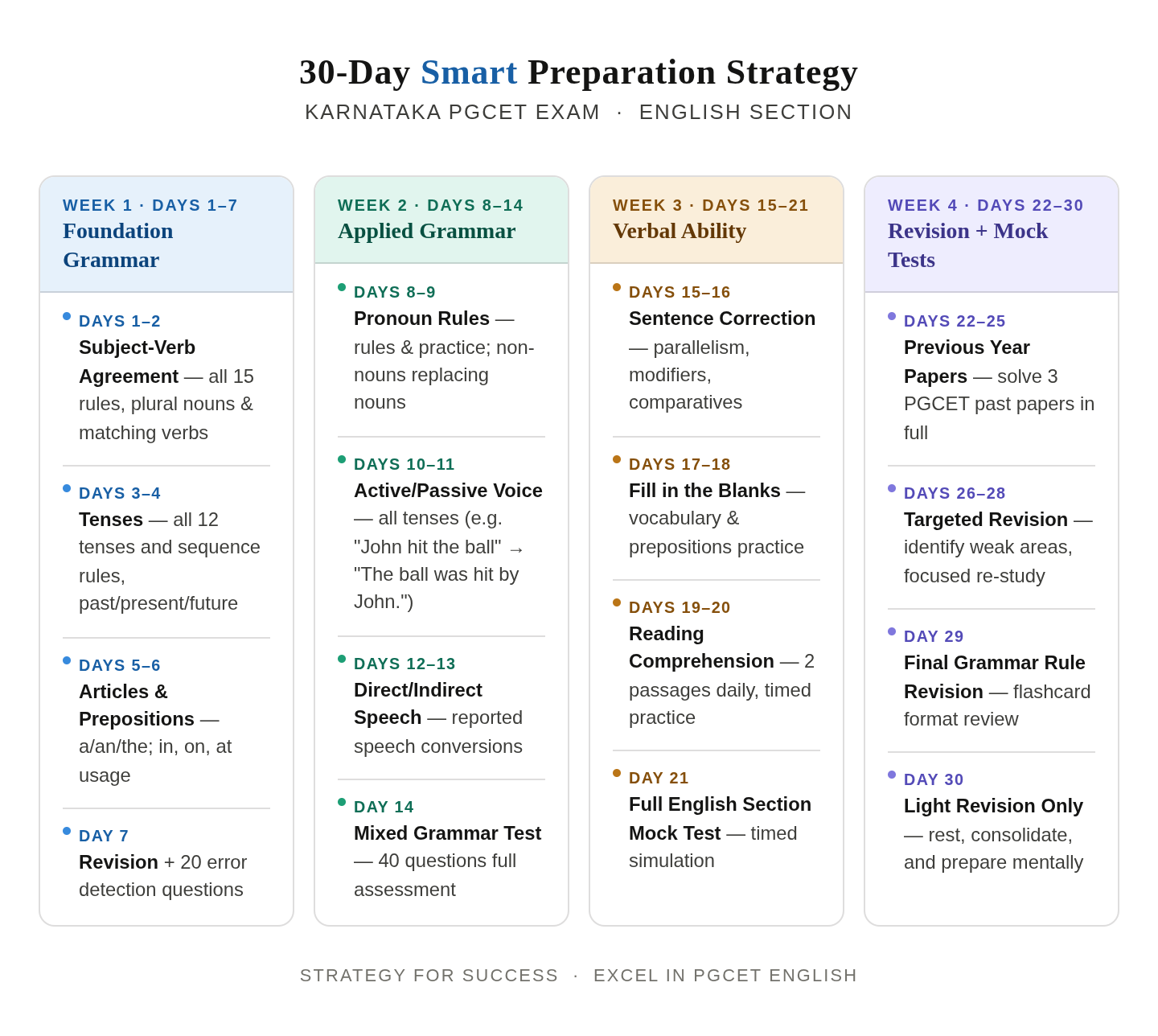
Check Here, Karnataka PGCET MBA 30 Days Strategy
Day 1–2: Subject-Verb Agreement (all 15 rules)
Day 3–4: Tenses (all 12 tenses + sequence rules)
Day 5–6: Articles, Prepositions
Day 7: Revision + 20 error detection questions
Day 8–9: Pronoun rules + practice
Day 10–11: Active/Passive Voice (all tenses)
Day 12–13: Direct/Indirect Speech
Day 14: Mixed grammar test (40 questions)
Day 15–16: Sentence Correction (parallelism, modifiers, comparatives)
Day 17–18: Fill in the Blanks (vocabulary + prepositions)
Day 19–20: Reading Comprehension (2 passages daily)
Day 21: Full English section mock test
Day 22–25: Solve 3 previous year PGCET papers
Day 26–28: Identify weak areas, targeted revision
Day 29: Final grammar rule revision (flashcard format)
Day 30: Light revision only; rest and preparation
Revise rules, not just examples — Make a one-page cheat sheet with the 20 most important grammar rules.
Attempt all questions — No negative marking means every blank is an opportunity.
Trust the "ear test" for grammar — Read the sentence aloud in your mind. Native-sounding options are usually correct.
In RC, eliminate extreme options — PGCET passages rarely support extreme author tone (like "contemptuous" or "fanatical"). Prefer moderate descriptors.
Manage time — Allocate no more than 45 seconds per grammar question. If stuck, mark and move on.
The Karnataka PGCET MBA English ebooks help candidates to ace their exam with high marks. These ebooks consist of study material that helps in exam preparation. Candidates can find the download links of Karnakata PGCET ebooks below:
Karnataka PGCET MBA Ebooks | Download Link |
Karnataka PGCET MBA 2026 Syllabus | |
Karnataka PGCET 2026 MBA Preparation Tips: Study Plan, Time Management & Section Strategy | |
Karnataka PGCET 2026 GK Most Expected Questions From Feb–March–April | |
Karnataka PGCET 2026 Computer Awareness Rapid Revision PDF |
Frequently Asked Questions (FAQs)
Approximately 20 questions out of 100 are from English Proficiency and Verbal Ability.
No. There is no negative marking in the Karnataka PGCET.
Subject-Verb Agreement, Tenses, Articles, Prepositions, and Sentence Correction (parallelism, modifiers) are the most frequently asked topics.
Focus on grammar, vocabulary, reading comprehension, and previous year questions. Regular practice and mock tests can improve speed and accuracy.
Usually, around 8–12 questions may come from grammar topics such as tenses, articles, prepositions, sentence correction, and error spotting.

On Question asked by student community
Hi Akash,
Sorry, dear, we do not cover the PGCET Pharmacy preparation module.
Hello Dear Student,
With 40 marks in the Karnataka PGCET MBA exam , your expected rank is likely to fall in the range of 7,500 to 15,000 .
Estimated Rank vs Marks Analysis
Based on previous years' trends, a score of 40 marks generally corresponds to the following rank range:
Hi Student,
You can get the Karnataka PGCET MCQ question paper from our website.
Kindly check the link attached below.
Hello Deepthi,
The Karnataka PGCET 2026 syllabus and sample paper will be updated soon. You can check the previous year’s sample paper and syllabus from the link below.
Link: https://engineering.careers360.com/articles/karnataka-pgcet-sample-papers
https://engineering.careers360.com/articles/karnataka-pgcet-syllabus
Here you can get PYQs of Karnataka PGCET Civil Engineering which help you to enhance your study with different PYQs -- Check Here

Among top 100 Universities Globally in the Times Higher Education (THE) Interdisciplinary Science Rankings 2026
Recognized as Category-1 Deemed to be University by UGC | 41,000 + Alumni Imprints Globally | Students from over 20+ countries
NAAC A+ Accredited | Among top 2% Universities Globally (QS World University Rankings 2026)
NAAC A+ Accredited | Highest CTC 45 LPA | Scholarships Available
Campuses in Ropar, Agartala, Aizawl, Ajmer, Aurangabad, Calicut, Imphal, Itanagar, Kohima, Gorakhpur, Patna & Srinagar
100+ Recruiters | 100+ Placements of 2026 Batch | NBA & NAAC Accredited | Highest CTC 37 LPA