
Search Colleges, Exams, Schools & more


Login
IBSAT Verbal Ability Most Repeated Question Types - IBSAT 2026 is scheduled for December 2026, and the online registrations are presently underway. The examination consists of 140 questions, out of which 50 questions are asked from the Verbal Ability section. This makes Verbal Ability an important part of the IBSAT 2026 examination. Knowing which areas are repeatedly tested can help candidates plan their preparation and practise the right questions.
This Story also Contains
- IBSAT 2026 Exam Pattern
- IBSAT Verbal Ability Topics 2026
- IBSAT Verbal Ability Most Repeated Question Types
- IBSAT Previous Year Questions: Topic-Wise Analysis
- Which IBSAT English Questions Should You Practise First?
- IBSAT Verbal Ability 30-Day Preparation Plan
- Common Mistakes to Avoid in IBSAT Verbal Ability
- How to Prepare for IBSAT Verbal Ability 2026
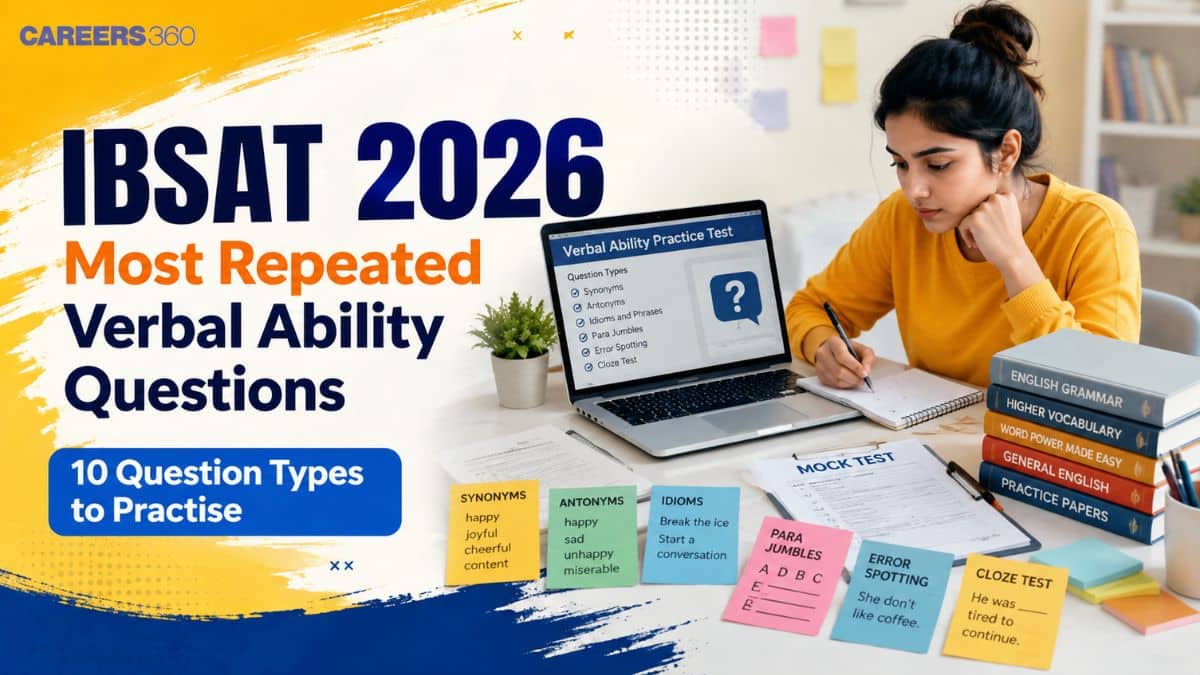
In this article, we have discussed the most frequently repeated question types, as they help in gaining easy scores.
IBSAT 2026 Exam Pattern
Candidates can check out the IBSAT exam pattern from the table below.
Particulars | Details |
Total number of questions in IBSAT 2026 | 140 questions |
Marking Scheme of IBSAT 2026 | +1 mark for every correct answer; No negative marking |
Total number of sections | Four |
Exam Duration | 2 hours (120 minutes) |
Total Marks | 140 |
Type of Questions | Multiple Choice Questions (MCQs) |
Medium of Exam | English only |
Sectional Time Limit | No sectional time limit |
Sectional Order | Candidates can attempt sections in any order |
IBSAT Verbal Ability Topics 2026
Here we have specified the details of the topics-wise IBSAT Syllabus 2026. The sections in which questions will be asked in IBSAT are Verbal Ability, Reading Comprehension, Quantitative Ability, the IBS Aptitude Test syllabus, and Data Adequacy and Data Interpretation. Based on the previous year's IBS Hyderabad MBA syllabus, we maintained a table from which candidates can find all the relevant topics pertaining to it.
IBSAT Section Name | Topics in IBSAT |
Verbal Ability |
|
Reading Comprehension | This section will contain a passage in which a total of 30 questions will be asked |
IBSAT Verbal Ability Most Repeated Question Types
Candidates can check out the most repeated question types that are relevant for the IBSAT Verbal Ability sections:
Synonyms
Concept: Questions ask you to identify a word that has the same or nearly the same meaning as the given word.
Example: Choose the synonym of “Abundant”.
Answer: Plentiful
Antonyms
Concept: Questions ask you to identify a word that has the opposite meaning of the given word.
Example: Choose the antonym of “Ancient”.
Answer: Modern
Idioms and Phrases
Concept: You have to identify the meaning or correct usage of an expression whose meaning cannot always be understood literally.
Example: What does “break the ice” mean?
Answer: To start a conversation or make people feel comfortable
One-Word Substitution
Concept: A phrase or description is given, and you have to replace it with a single word having the same meaning.
Example: One who cannot read or write is called a:
Answer: Illiterate
Word Analogies
Concept: These questions test the relationship between two words and require you to identify another pair with the same relationship.
Example: Book : Author :: Painting : ?
Answer: Artist
Para Jumbles
Concept: A set of sentences is given in a jumbled order. You have to arrange them to form a logically connected paragraph.
Example:
A. Finally, the plant began to grow.
B. Riya planted a seed in a pot.
C. She watered it every day.
Answer: B → C → A
Fill in the Blanks
Concept: A sentence contains one or more blanks, and you must select the word that fits the meaning and grammatical context.
Example: The manager was ______ with the employee's performance.
Answer: satisfied
Error Spotting
Concept: A sentence is divided into parts, and you have to identify the part containing a grammatical or usage error.
Example: She do not like coffee.
Error: do
Correct sentence: She does not like coffee.
Sentence Correction
Concept: An incorrect or grammatically inappropriate part of a sentence is given with alternatives, and you have to choose the grammatically correct replacement.
Example: He is working here since 2020.
Correct: He has been working here since 2020.
Sentence Completion
Concept: You have to select the option that logically and grammatically completes an incomplete sentence.
Example: The roads were flooded because ______.
Answer: it had been raining heavily
Cloze Test
Concept: A passage contains multiple blanks, and you must choose the word that best fits each blank based on grammar, vocabulary and the overall context.
Example:
Example: “Regular exercise keeps the body ______ and helps reduce the risk of ______.”
Answers: healthy, disease
IBSAT Previous Year Questions: Topic-Wise Analysis
IBSAT Verbal Ability section accounts for 50 questions, which is distributed as mentioned in the table below:
Topic | No. of Questions |
Idioms and Phrases | 5 |
Synonyms | 5 |
One-Word Substitution | 5 |
Para Jumbles | 5 |
Word Analogies | 5 |
Double Fill in the Blanks | 5 |
Sentence Correction / Replacement | 5 |
Error Spotting | 5 |
Antonyms | 5 |
Cloze Test | 5 |
Total | 50 |
Which IBSAT English Questions Should You Practise First?
If you are preparing for IBSAT, do not give equal time to every English question type. Start with the areas that have appeared regularly in recent papers and can be improved with repeated practice.
Priority | Question Type | What You Need to Practise |
1 | Synonyms | Learn commonly tested words and practise choosing the closest meaning. |
2 | Antonyms | Build vocabulary and practise identifying the exact opposite of a word. |
3 | Idioms and Phrases | Learn the meaning and usage of frequently used idioms. |
4 | One-Word Substitution | Revise common words used to replace longer descriptions or phrases. |
5 | Word Analogies | Practise identifying the relationship between two words and applying the same relationship to another pair. |
6 | Error Spotting | Revise common grammar errors involving tenses, articles, prepositions, subject-verb agreement and modifiers. |
7 | Sentence Correction | Practise correcting errors in grammar, word usage and sentence construction. |
8 | Fill in the Blanks | Focus on vocabulary, grammar and the meaning of the complete sentence before selecting an option. |
9 | Para Jumbles | Practise finding the opening sentence, mandatory pairs and the logical sequence of ideas. |
10 | Cloze Test | Practise using the context of the passage to choose words that fit both grammatically and logically. |
IBSAT Verbal Ability 30-Day Preparation Plan
A 30-day plan should cover the major IBSAT Verbal Ability topics first and leave enough time for revision. Start with vocabulary and grammar, then move to para jumbles, fill-in-the-blanks, and cloze tests. Refer to the table to get an IBSAT 30 days plan for verbal ability:
Days | Topics to Cover | Practice Plan |
Day 1–3 | Synonyms and Antonyms | Learn 30–40 new words daily and practise synonym-antonym questions. Revise the words at the end of each day. |
Day 4–5 | Idioms and Phrases | Learn common idioms and their meanings. Practise questions based on meaning and usage. |
Day 6–7 | One-Word Substitution | Revise frequently used one-word substitutions and solve practice questions. |
Day 8–9 | Word Analogies | Learn common word relationships and practise analogy questions of different types. |
Day 10–12 | Error Spotting | Revise subject-verb agreement, tenses, articles, prepositions and pronouns. Solve 30–40 questions daily. |
Day 13–15 | Sentence Correction | Practise questions based on grammar, word usage, sentence structure and modifiers. |
Day 16–18 | Fill in the Blanks | Practise single and double blanks using vocabulary, grammar and sentence context. |
Day 19–21 | Para Jumbles | Practise identifying opening sentences, connected pairs and the correct sequence. |
Day 22–23 | Cloze Test | Solve short passages and focus on vocabulary, grammar and context while choosing each option. |
Day 24–25 | Mixed Verbal Practice | Solve mixed sets covering vocabulary, grammar, para jumbles and fill-in-the-blanks. |
Day 26–27 | IBSAT Previous-Year Questions | Solve previous-year VA questions and note the topics where you make the most mistakes. |
Day 28 | Revision | Revise vocabulary, grammar rules, idioms, one-word substitutions and frequently repeated question types. |
Day 29 | Timed VA Practice | Attempt a 50-question VA set within the actual section time you have allocated during mock practice. Analyse every incorrect answer. |
Day 30 | Full Revision + Mock | Take a complete IBSAT mock, analyse your VA performance and revise weak areas instead of starting new topics. |
Common Mistakes to Avoid in IBSAT Verbal Ability
Read about the common mistakes that you must avoid in the IBSAT Verbal Ability section:
1. Memorising Vocabulary Without Understanding Usage
Learning a list of synonyms and antonyms is not enough. IBSAT always gives closely related options, so knowing only the dictionary meaning may not help. Learn each new word with its meaning, opposite, and an example sentence.
2. Ignoring Grammar Rules in Error Spotting
Do not select an option simply because the sentence sounds correct. Check subject-verb agreement, tense, articles, prepositions and pronouns. For example, “Each of the students have submitted the form” is incorrect; “has submitted” is correct because each takes a singular verb.
3. Spending Too Much Time on Difficult Vocabulary
If you do not know the meaning of a word, repeatedly looking at the options will rarely help. Eliminate options you can rule out and move ahead. Return to the question later if you have time.
4. Ignoring Context in Fill-in-the-Blanks
A word which is grammatically correct but still wrong for the sentence. Read the entire sentence before you check the options. Look for simple clues such as contrast words, cause-and-effect relationships and the overall meaning.
5. Practising Questions Without Analysing Mistakes
Simply solving 50 questions a day will not fix recurring errors. After every practice set, check why you got a question wrong. Try to find out whether it was a vocabulary gap, grammar rule, careless reading or incorrect elimination. Revise that specific area before the next set.
Read Here, How to Prepare IBSAT in One Month
How to Prepare for IBSAT Verbal Ability 2026
The candidates must refer to the following tips to prepare for the IBSAT Verbal Ability section with high marks.
Build a Strong Vocabulary
Do not try to memorise hundreds of words in one sitting. Focus on the vocabulary that appears in IBSAT question types such as synonyms, antonyms, idioms, one-word substitutions and word analogies. Maintain a list of unfamiliar words and revise them every few days. Learn the meaning along with an example sentence so that you understand how the word is used.
Practise Grammar Through Questions
Revise the grammar rules that are directly tested in IBSAT, especially subject-verb agreement, tenses, articles, prepositions, pronouns and modifiers. After revising a rule, solve questions based on it. This makes it easier to recognise an error in a sentence instead of trying to remember rules while solving the paper.
Solve IBSAT Previous Year Questions
Use previous-year questions to understand the type of vocabulary, grammar and verbal reasoning questions asked in the exam. Do not just check your score after completing a paper. Mark questions that took too long or that you got wrong, and identify whether the problem was vocabulary, grammar, interpretation or careless reading.
Practise Para Jumbles Regularly
Start with short sets and learn to identify the opening sentence, connecting words, pronouns and pairs of sentences that naturally belong together. Once you are comfortable with these clues, practise longer sets under a time limit. After every set, check why the correct sequence works rather than memorising the answer.
Take Verbal Ability Sectional Tests
Include timed VA tests in your preparation instead of waiting until the final week. After each test, record your attempts, correct answers, incorrect answers and time taken. This will show whether you are losing marks because of accuracy problems or spending too much time on particular question types.
Frequently Asked Questions (FAQs)
Q: Which question types are most commonly asked in IBSAT Verbal Ability?
A:
Synonyms, antonyms, idioms and phrases, one-word substitution, word analogies, para jumbles, fill in the blanks, error spotting, sentence correction and cloze tests are commonly asked.
Q: How many Verbal Ability questions are asked in IBSAT?
A:
IBSAT has 50 Verbal Ability questions. The exact distribution among individual question types can vary from year to year.
Q: Is vocabulary important for IBSAT Verbal Ability?
A:
Yes. Vocabulary-based questions form a significant part of the section. Prepare synonyms, antonyms, idioms, one-word substitutions and word analogies regularly.
Q: Are grammar questions asked in IBSAT Verbal Ability?
A:
Yes. Questions on error spotting and sentence correction/replacement test areas such as tenses, subject-verb agreement, articles, prepositions and sentence usage.
Q: How should I practise IBSAT Verbal Ability questions?
A:
Start with vocabulary and grammar, then practise para jumbles, fill in the blanks and close tests. Solve previous-year questions and take timed sectional tests to improve accuracy and speed.
Articles
Related Stories
|
Upcoming Bschool Exams

Certifications By Top Providers
Explore Top Universities Across Globe
Popular Courses and Specializations
List of colleges accepting IBSAT
Browse Bschool Colleges by State
Questions related to IBSAT
On Question asked by student community
Have a question related to IBSAT ?
Hello student
Here are some preferred books for IBSAT exam preparation:
*Quantitative Aptitude:*
1. "Quantitative Aptitude for Competitive Examinations" by R.S. Aggarwal
2. "Quantum CAT" by Sarvesh K. Verma
*Data Interpretation and Logical Reasoning:*
1. "Data Interpretation and Logical Reasoning" by Arun Sharma
2. "Logical Reasoning and Data Interpretation" by
Hi,
IBS Aptitude Test is a test to find out your aptitude in the area of IBS. It helps you understand how well you handle stress and anxiety, how much you can cope with pain and discomfort, what are your strengths and weaknesses. The test is designed for people who
Hello,
IBSAT 2021 is scheduled on December 25, 2021 and December 26, 2021. The examination will be conducted in online mode. You do not have to book the slot to attend IBSAT 2021 examination. The examination center, date and time will be allotted to you and it will be given
IBSAT is a home proctored exam and it will held in the last week of December. You should check your admit card and email that whether you have received login credentials or not. In order to give this exam you must have username and password. At the test day they
Hello Aspirant.
Hope you are doing well.
NMAT = The National Medical Admission Test (NMAT) in Philippines is a national level examination pre-requisite by the applicant for entry to any medical school in the Philippines.
MAT = Management Aptitude Test, commonly known as MAT exam is conducted by the All

Study Resources, Applications and Opportunities
Globally Recognized by AACSB (US) & AMBA (UK) | 18 LPA Avg. CTC for PGPM 2026
XAT- Xavier Aptitude Test 2027
Apply75+ years of legacy | #1 Entrance Exam | Score accepted by 250+ BSchools
Career Launcher Race To 99%ile In CAT 2026 - Phase 03
Enquire6-Hour Masterclass to help you score 99+ percentile in CAT 2026
ISBR Business School PGDM Admissions 2027
Apply400+ Recruiters | Highest CTC 25 LPA | Average CTC 8 LPA | 92% Placements in 2025 | Ranked as Platinum Institute | Awarded Best Business School of the Year
NMAT by GMAC 2026
ApplyTest centres are available in 70+ cities across India | 75,000+ aspirants apply for the NMAT exam | Accepted by 58+ institutions like NMIMS, KJSIM, ISB, SPJIMR and Great Lakes.
Common Admission Test 2026 (CAT 2026)
ApplyRegistration Start: 3 August 2026 | Last Date to Apply: 15 September 2026 (till 5 PM)
IBSAT Notifications
Never miss IBSAT update
Get timely IBSAT updates directly to your inbox. Stay informed!