Great Lakes - PGDM & PGPM Admissions 2027
Globally Recognized by AACSB (US) & AMBA (UK) | 18 LPA Avg. CTC for PGPM 2026


A rising mock score can be a little misleading, and a low mock score is not always some straight up warning sign - this is where most TANCET 2027 aspirants tend to misjudge, their preparation. Two students might attempt the same TANCET mock test, but one keeps improving steadily while the other feels stuck, even after solving hundreds of questions. Usually the gap shows up because of a mock test analysis approach, not because of how many tests they attempted in total. As the TANCET 2027 exam comes near, this phase is less about picking up fresh concepts and more about reading your own performance signals: where your accuracy starts slipping, which sections steal extra minutes, which questions should be bypassed quicker, and how your attempt style shifts when pressure builds. A properly arranged TANCET mock test review can raise your score, boost accuracy, sharpen time management, and also reduce the risk of negative marking on the real exam. In this article, we will cover a complete TANCET Mock Test Analysis Strategy 2027, including score improvement techniques, smart attempt planning, the speed vs accuracy compromise, sectional analysis methods, TANCET 2027 common mistakes to avoid, and last-minute preparation tips before exam day.

TANCET MBA mock test not only provides a pool of practice questions but the TANCET MBA mock test strategy also helps you get comfortable with the exam format, manage time better, and improve accuracy.
A well-planned TANCET MBA mock test review strategy co-focuses on analysing mistakes. Additionally, it also helps to identify weak areas, track sectional performance, and improve question selection.
TANCET MBA Mock Test |
Many Student often get confused in "Mock Test Analysis vs Mock Test Quantity", so here is what you need to know:
Many TANCET MBA 2027 aspirants solve multiple mock tests every week but continue getting inconsistent scores. In most cases, the issue is not lack of practice but lack of structured mock analysis.
A good TANCET mock test analysis plan tends to focus on things accuracy percentage, time allocation, and also which questions to pick, because that helps a lot later. You also need to track section-wise performance, including how negative marking patterns behave, and in general attempt efficiency, how quickly you move without getting dragged.
Students who actually analyze mocks carefully usually end up with a few benefits, for example more stable scores, better sectional balance, faster decision-making, improved exam temperament, and better risk control during the actual exam.
Only Attempting Mocks | Proper Mock Test Analysis |
Focuses only on total score | Focuses on score breakdown |
Measures number of attempts | Measures efficiency and accuracy |
Encourages random practice | Encourages strategic preparation |
Repeats the same mistakes | Identifies recurring errors |
Creates inconsistent performance | Builds stable scoring patterns |
Common Signs of Weak Mock Analysis are straightforward but also easy to miss. checking only the last score, and not caring about which questions were actually off, or jumping straight to the next mock without doing any review at all. Many candidates also forget to look at the time spent per section, even if it’s the whole point, and they keep changing strategies every few tries, so nothing becomes consistent. Another big one is missing the easy questions again and again, even though they should be the low effort wins.
Signs of Effective TANCET MBA Mock Analysis look different. Accuracy improves gradually, not overnight, and section wise timing starts getting controlled properly. Easy errors shrink consistently, guesswork decreases over time, and the score fluctuations turn smaller. Eventually the attempt strategy becomes predictable, you already know where to be careful, where to be fast, and where to stay steady.
Lots of students lose marks because the same patterns of errors show up again and again, rather than there being some big conceptual weakness. And yeah, those mistakes tend to stick around across several mocks, because students spend more time attempting the questions than actually reviewing them with care.
Common repeated mistakes
- Taking too much time on the tougher DI sets
- Misreading the Logical Reasoning conditions
- Making avoidable calculation slips in Quantitative Aptitude
- Guessing based on panic, instead of method
- Rushing in those last minutes
- Overlooking the easy questions after getting stuck
Error Type | Common Outcome |
Conceptual errors | Slow solving speed |
Calculation mistakes | Avoidable negative marking |
Time-management errors | Incomplete paper coverage |
Guessing mistakes | Accuracy drop |
Reading errors | Incorrect interpretation |
Accuracy Range | Performance Trend |
Below 60% | Highly inconsistent |
65%-70% | Moderate score range |
75%-80% | Strong competitive position |
Above 85% | High percentile potential |
Mock test analysis helps students see real performance trends before they face the actual TANCET MBA 2027 exam. Instead of only staring at one unusually high, or low score, students can look at consistency across multiple mock tests and get a truer picture.
After every mock test, students should keep an eye on a few things the overall score, their accuracy percentage, the correct vs incorrect ratio, how much time they spent per section, how many “easy” questions they still missed, and the attempt pattern they used under pressure.
Metric | Purpose |
Overall Score | Measures total performance |
Accuracy Percentage | Tracks reliability |
Sectional Timing | Detects imbalance |
Correct vs Incorrect Ratio | Measures risk level |
Easy Questions Missed | Identifies concentration issues |
Guess Frequency | Evaluates attempt quality |
Section-wise review becomes necessary because different sections create different types of pressure during the exam.
Candidates can get a complete overview of the TANCET 2027 exam below:
Parameter | Details |
Full Exam Name | Tamil Nadu Common Entrance Test |
Short Exam Name | TANCET |
Conducting Body | Anna University |
Frequency of Conduct | Once a year |
Exam Level | State Level Exam |
Languages | English |
Mode of Application | Online |
Mode of Exam | Offline |
TANCET MBA Subjects |
|
Exam Duration | 2 Hours |
Reading Comprehension
English Usage
Analytical Ability
Mock test analysis should evaluate:
Which section consumes maximum time
Which section reduces accuracy
Which question types create panic
Whether easy questions are being identified quickly
Whether concentration remains stable throughout the paper
Globally Recognized by AACSB (US) & AMBA (UK) | 18 LPA Avg. CTC for PGPM 2026
Test centres are available in 70+ cities across India | 75,000+ aspirants apply for the NMAT exam | Accepted by 58+ institutions like NMIMS, KJSIM, ISB, SPJIMR and Great Lakes.
TANCET MBA requires balanced aptitude performance rather than isolated strength in one area.
Major Focus Areas for MBA Aspirants :
Logical Reasoning accuracy, and also the ability to not get tangled up mid-question
Reading speed improvement, without loosing control of comprehension in the process
Smart DI set selection, pick the right set first before anything else
Faster elimination techniques, so you don’t waste time checking every option
Balanced time allocation, yes, it matters more than it sounds at first
Controlled risk-taking, but only when you can back it up
Common Traits of High-Scoring TANCET MBA Candidates
Skipping difficult questions early, even if it feels a too soon
Maintaining sectional timing discipline, strict momentum throughout
Avoiding emotional attempts, don’t let one wrong turn spoil the remaining part
Keeping negative marking under control, or else it quietly hurts overall score
Prioritizing accuracy during pressure phases, because “almost correct” is still wrong
Section-Wise Weightage Analysis
Different sections impact performance in their own way. Some sections may eat up large amounts of time, while giving fewer net marks if your attempts were not correct.
Section | Common Problem | Strategic Focus |
Quantitative Aptitude | Slow calculations | Formula shortcuts |
Logical Reasoning | Overthinking | Faster pattern recognition |
Data Interpretation | Time-consuming sets | Smart set selection |
Reading Comprehension | Slow reading | Passage scanning |
English Usage | Careless mistakes | Accuracy improvement |
Students should revise based on their mock performance data, not just return to the topics they feel comfortable with, and even then it can become a of a trap.
TANCET MBA builds continuous time pressure across the paper. A lot of students end up losing marks because of poor decision making, especially when they hit the difficult , and then it becomes hard to recover.
Random guessing
Spending too much time on one question
Refusing to skip difficult problems
Rushing easy questions later
Panic-based attempts
Which questions consumed maximum time?
Which incorrect answers were avoidable?
Which section created the most pressure?
Attempt Style | Expected Result |
Random aggressive attempts | High negative marking |
Balanced selective attempts | Stable accuracy |
Excessive skipping | Lower score ceiling |
Controlled aggressive strategy | Better percentile stability |
There isn’t one fixed “ideal” attempt count for TANCET MBA 2027 because the difficulty does move around from paper to paper. Mock analysis, like it helps students see their own best attempt range, more or less.
In most cases, strong attempt strategies often come with things like trying the easier questions first, then moving ahead, and if a question looks too long just skip it quickly rather than getting stuck. Also, keeping sectional time checkpoints in mind can prevent a messy slowdown later on. Try not to get pulled into emotional guessing either, and just keep accuracy steady across the full paper, even when the pace feels odd.
Student Type | Main Focus Area |
Low Accuracy Students | Reduce risky attempts |
Slow Solvers | Improve question selection |
Over-Attempters | Control negative marking |
Balanced Performers | Increase speed gradually |
The most effective TANCET MBA mock test strategy is usually the one that gives repeatable scores with, controlled accuracy and relatively stable decision making across different mock difficulty levels.
Just checking the final score after a TANCET MBA mock test gives very little view into real exam readiness. A proper mock test analysis plan should break the paper into measurable performance areas, like accuracy percentage sectional timing, attempt quality, question selection and mistake patterns.
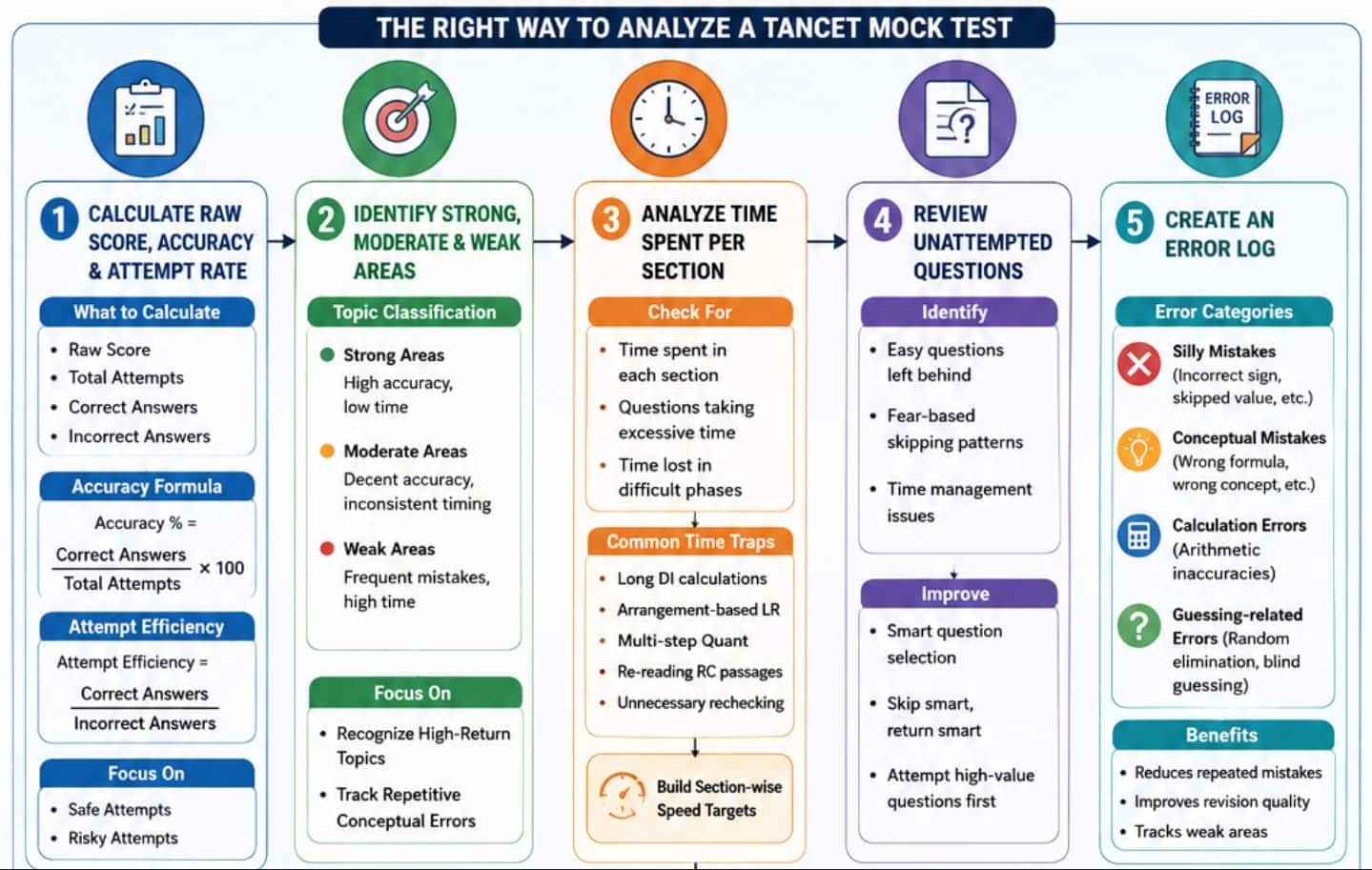
The attempt strategy should evolve based on how the mock tests are going, like by watching performance trends, instead of just copying topper strategies blindly. You know, students are not the same, some have higher accuracy, others go faster, and sectional strengths also shift, so the approach needs to be adapted, accordingly, tailored.
Your attempt order impacts
Confidence level
Time management
Accuracy stability
Pressure handling
Strategy Type | Characteristics |
Strongest Section First | Builds confidence early |
Balanced Rotation | Prevents over-investment in one section |
Weak Section First | Reduces later panic |
Flexible Hybrid Strategy | Adjusts according to paper difficulty |
Lots of higher scorers seem to use the opening minutes like a warm up, to find a steady rhythm through easy questions. They gain confidence fast, then stabilize their speed before the harder parts arrive. It’s less about rushing, more about locking in.
For the tougher sets, students should try to avoid getting stuck on one particular question for too long. If something is unclear, it’s better to skip early rather than overthink it. Also keep a calm mindset during those ugly stretches. And make sure you still save time for later scoring chances, because those do show up.
If you’re dealing with moderate accuracy, and your score tends to jump around, then prioritize stability over aggressive attempts. Basically, keep things controlled, and don’t chase every opportunity like it’s the only one.
- Keeping accuracy in a controlled way
- Cutting down negative marking as much as possible
- Improving question selection, so you choose the best targets
Safe Strategy Component | Purpose |
Selective attempts | Reduce unnecessary risks |
Accuracy-first approach | Improve score consistency |
Controlled guessing | Protect percentile stability |
Balanced timing | Prevent section collapse |
Skip long questions, faster
Avoid random guesses
Try the familiar ideas first
Keep a steady pace per section
Stick to repeatable scoring routines
Try not to overthink anything
Students who are already reaching strong mock scores tend to concentrate on raising the number of attempts, without messing up accuracy.
Increase attempt volume, in a smart way
Boost solving speed
Broaden the “medium risk” tries
Keep pressure steady
High scorers usually:
Solve the straightforward questions quickly
Use elimination methods, cleanly and efficiently
Spot traps early
Move between sections fast when needed
Faster approximation approaches
Fewer calculation steps
Pattern recognition shortcuts
Efficient scanning techniques
Quick elimination plays
Controlled Risk | Uncontrolled Risk |
Educated elimination | Blind guessing |
Moderate-confidence attempts | Emotional attempts |
Time-aware decision-making | Panic solving |
Structured aggression | Random aggression |
The right TANCET MBA 2027 preparation ebooks can help students boost speed, accuracy, concept clarity and mock test results in a structured way. Like from Quantitative Aptitude shortcuts to Logical Reasoning practice, they guide you for score enhancement through focused prep and smart revision, not just random reading. There are also TANCET MBA mock test strategies inside, so you can get used to the time pattern and make fewer avoidable errors. In short it’s about better performance and calmer attempts during the real exam.
Title | Download Link |
TANCET MBA 2027 Complete Preparation: Smart Study Plan, Preparation Tips, Time Management & Topic-Wise Approach | |
TANCET MBA 2025 Question Paper with Solutions | |
TANCET MBA Previous Year Question Papers (2022 - 2025) | |
TANCET MBA 2027 Latest Syllabus: Section-Wise Topics & Exam Pattern Overview | |
TANCET Question Paper 2023 | |
TANCET Question Paper 2022 | |
TANCET MBA Question Paper 2016 | |
TANCET MBA 2016 Question Paper | |
TANCET MBA Question Paper 2015 | |
TANCET MBA Question Paper 2014 | |
TANCET MBA Question Paper 2013 | |
TANCET MBA Question Paper 2012 | |
TANCET MBA Question Paper 2011 | |
TANCET MBA Question Paper 2010 | |
TANCET MBA Question Paper 2009 | |
TANCET MBA Question Paper 2008 | |
TANCET MBA Question Paper 2007 |
Frequently Asked Questions (FAQs)
You should analyse the mock within 24 hours while your thought process is still fresh. Early analysis helps you recall why you chose certain options, making it easier to identify decision-making errors, time mismanagement, and gaps in understanding.
Focus on accuracy rate, number of attempts, time per question, and sectional performance. Also track how many easy questions you missed and how many difficult ones you attempted unnecessarily. These indicators give a clear picture of your strategy efficiency.
Review all incorrect and skipped questions and group them by topic. If a particular topic appears repeatedly in your mistakes across multiple mocks, it is a weak area. Prioritise revising those topics instead of studying everything randomly.
Students should review accuracy percentage, time spent per section, incorrect answers, unattempted questions, and repeated mistakes after every mock test. A proper TANCET mock test analysis should focus on identifying weak areas, improving question selection, and reducing negative marking.
An accuracy range of 75%-85% is generally considered strong for TANCET MBA preparation. Students with controlled attempts and high accuracy usually perform better than those making aggressive low-accuracy attempts.

On Question asked by student community
Hello Student,
If you are seeking admission to the MBA programming at KumaraGuru College of Technology (KCT) coimbatore through TANCET 2026, the approximate tution fee is rupees of 35,000 to 50,000 per year under the government quota. In additional to the tuition fee you may need to pay admission, examination,
Hello Dear Student,
With a TANCET percentile of 96.664, a general rank of 342, and a communal rank of 212, your chances of admission to the MBA program at PSG College of Technology (PSG Tech) are moderate to low, depending on your specific community category.
You can check, find and
Hello Dear Student,
You can check, find and access more information here:
Hi Candidate, please refer to the following links below:
https://bschool.careers360.com/articles/tancet-2026-question-paper-with-solutions-mba-memory-based-questions-answers
https://engineering.careers360.com/articles/ceeta-pg-answer-key
Hello Dear Student,
With a 95.9 percentile in TANCET MBA 2026, securing a regular MBA seat at the University of Madras during the general counselling process is highly challenging, but possible depending on your community category and the specific TANCET cutoff list for the year.
You can check, find and

Globally Recognized by AACSB (US) & AMBA (UK) | 18 LPA Avg. CTC for PGPM 2026
75+ years of legacy | #1 Entrance Exam | Score accepted by 250+ BSchools
6-Hour Masterclass to help you score 99+ percentile in CAT 2026
Test centres are available in 70+ cities across India | 75,000+ aspirants apply for the NMAT exam | Accepted by 58+ institutions like NMIMS, KJSIM, ISB, SPJIMR and Great Lakes.
Registration Start: 3 August 2026 | Last Date to Apply: 15 September 2026 (till 5 PM)
AACSB Accredited | 40 LPA-Highest CTC | Scholarships worth 10 CR