XAT- Xavier Aptitude Test 2027
75+ years of legacy | #1 Entrance Exam | Score accepted by 250+ BSchools


General Knowledge can be one of the most unpredictable yet scoring areas in MBA entrance exams, especially when you are unsure what to study and what to skip. XAT, CMAT 2027 is expected to be conducted in January 2027 making this the right time to build a focused GK strategy instead of trying to cover everything at the last moment. From current affairs and business news to static GK, knowing the right topics and preparation approach can make this section far more manageable for XAT, IIFT, CMAT.
This Story also Contains
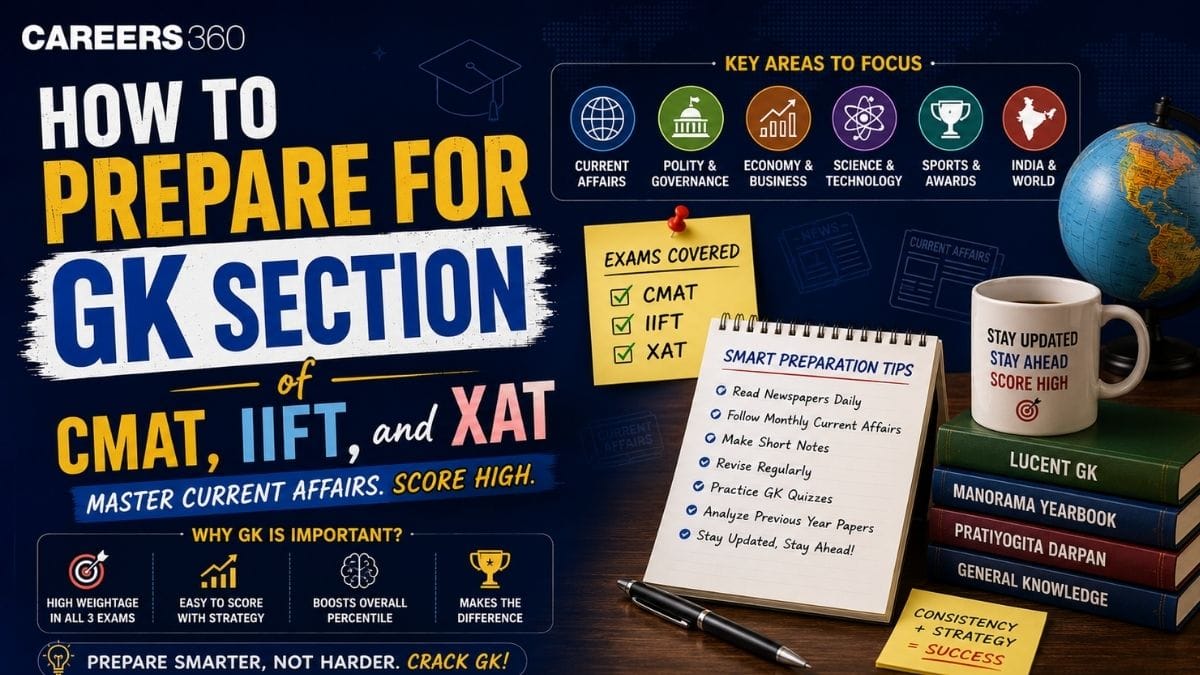
The entrance exam to the International Institute of Foreign Trade, also CMAT and XAT asks at least 15-25 questions in the test.
| Exam | Number of GK Questions |
|---|---|
| CMAT | 20-25 |
| IIFT | 15-18 |
| XAT | 20 (12 Current Affairs and 8 questions from static GK) |
Since the general knowledge section is very wide as huge as an ocean, candidates can strategise their planning by covering the following topics:
To ace the GK section in the CMAT 2027 exam, aspirants must follow a well-planned, analytical approach rather than relying on memorisation alone.
Divide GK preparation into three major areas: static GK, current affairs, and business awareness. Current affairs should focus on the last 12 months.
Study current affairs daily and revise them at the end of each month. Maintaining month-wise notes helps track information systematically.
Create concise revision notes with facts such as dates, numbers, rankings, and organisations. Practise GK questions and analyse mock tests regularly.
Expert-suggested GK books for MBA entrance exams focus on building strong fundamentals in current affairs, static GK, and business awareness.
| Book Name | Author |
| Lucent’s General Knowledge | Dr. Binay Karna |
| Manorama Yearbook | Mammen Mathew (Editor) |
| General Knowledge | Arihant Experts |
| India Year Book | Publications Division, Govt. of India |
| Competition Success Review | Pratiyogita Darpan Group |
Here are some tips which would help the candidates to ace the General Knowledge section in the above-mentioned exams:
GK is broadly divided into two sections, that is, Static GK and Current Affairs. Current affairs include Business & Economy, International Affairs, Government plans and schemes, Awards, and Honours.
Candidates must practice current affairs questions on a daily basis to stay updated. Making notes from the daily newspaper is one of the best ways to prepare.
Business & Economy questions cover economic policies, changes in Corporate and industry, latest business news, Business awards & honors, and company logos.
Some questions in the GK section of CMAT, IIFT, and XAT are asked from prominent international events. Candidates can study from prominent international news sites.
Candidates should practice mock tests based on the General Knowledge section regularly. This will help them analyse how well they have prepared for the entrance test.
Candidates should create as many extra questions as they can from a particular question so that more knowledge could be gained on that topic.
To retain a particular thing in memory for a long time, it is essential to revise again and again. Candidates should revise their notes at the end of every day.
GK preparation for MBA entrance exams should combine current affairs, static GK, business awareness, and regular practice. Candidates can follow these steps:
Read current affairs daily and prepare short notes.
Cover important static GK topics such as history, geography, polity, and science.
Focus on business, economy, awards, appointments, and international events.
Solve previous-year GK questions to understand important topics.
Attempt GK quizzes and mock tests regularly.
Revise weekly and monthly to improve retention.
Ranked among top 10 B-Schools in India by multiple publications | Top Recruiters-Google, MicKinsey, Amazon, BCG & many more.
400+ Recruiters | Highest CTC 25 LPA | Average CTC 8 LPA | 92% Placements in 2025 | Ranked as Platinum Institute | Awarded Best Business School of the Year
Although both CMAT and XAT test General Knowledge, the type and importance of GK questions can differ.
| Particulars | CMAT 2027 | XAT 2027 |
|---|---|---|
| Major Areas | Static GK and Current Affairs | Static GK and Current Affairs |
| Key Focus | General awareness, business, economy, history, polity | Business, economy, national and international affairs |
| Preparation Approach | Broad topic coverage | Current affairs with strong static GK |
| Practice | Previous papers and GK quizzes | Previous XAT GK questions and quizzes |
Candidates should use a combination of standard GK books and current affairs resources rather than depending on a single source.
| Resource | Best For |
|---|---|
| Lucent’s General Knowledge | Static GK |
| Manorama Yearbook | Current events and general awareness |
| India Year Book | Government schemes and national developments |
| Newspapers | Daily current affairs |
| Previous-Year Papers | Understanding exam-level GK questions |
| Mock Tests and Quizzes | Practice and revision |
Candidates do not need to read every newspaper from beginning to end. Focus mainly on exam-relevant national, international, business, economic, and government news.
The Hindu: National and international current affairs
The Indian Express: Government policies and major developments
The Economic Times: Business and economy
Monthly Current Affairs: Revision of important events
Online GK Quizzes: Daily practice and recall
A daily GK routine of around 45–60 minutes can help candidates cover current affairs and static GK consistently.
| Activity | Suggested Time |
|---|---|
| Read Current Affairs | 15–20 Minutes |
| Study Static GK | 15 Minutes |
| Prepare/Revise Notes | 10 Minutes |
| Attempt GK Quiz | 10–15 Minutes |
Instead of covering everything at once, divide the preparation into three clear phases.
| Month | Preparation Focus |
|---|---|
| Month 1 | Build Static GK basics and cover important current affairs |
| Month 2 | Focus on business, economy, international affairs and topic-wise questions |
| Month 3 | Revise notes, solve previous-year questions and attempt GK mock tests |
Candidates should continue revising previous months' current affairs throughout all three phases.
The final month should focus more on revision and question practice than learning too many new topics.
| Days | What to Do |
|---|---|
| Days 1–10 | Revise important current affairs and static GK |
| Days 11–20 | Solve previous-year questions and topic-wise quizzes |
| Days 21–25 | Attempt GK mock tests and identify weak areas |
| Days 26–30 | Revise short notes, important facts, awards, appointments and major events |
During the last few days, avoid collecting too many new resources and concentrate on revising what you have already studied.
To master the GK section of CMAT, IIFT, and XAT, focus on monthly current affairs magazines, reliable newspapers, static GK books, and yearbooks.
Going through previous years’ CMAT question papers helps you understand the actual exam format, section-wise weightage, and difficulty level.
CMAT Previous Year’s Question Papers | Download Link |
|---|---|
CMAT 2024 Slot 1 Question Paper | |
CMAT 2024 Slot 2 Question Paper | |
CMAT 2023 Question Paper | |
CMAT 2022 Question Paper with Answers | |
CMAT 2021 Slot 1 Question Paper with Answers | |
CMAT 2021 Slot 2 Question Paper with Answers | |
CMAT 2020 Question Paper with Answers |
CMAT mock tests simulate the exact exam environment, including timer, difficulty level, and section order. They play a crucial role in improving speed, accuracy, and test-taking strategy.
CMAT Mock Test |
Also download this:
| CMAT 2026: 10 Free Mock Tests PDF with Detailed Solution | Download Now |
CMAT practice sets focus on topic-wise and sectional practice for systematic preparation. They allow aspirants to master individual concepts through repetitive problem-solving.
CMAT 2027 Practice Paper: Download Now
CMAT Ebooks 2027 offer structured, syllabus-aligned content that simplifies complex concepts across all sections. They provide detailed explanations, solved examples, and practice questions for self-paced learning.
| CMAT 2027: Innovation and Entrepreneurship: All Chapters with Sample Questions, with Syllabus PDF | Download Now |
| CMAT 2027 Language Comprehension Questions with Solutions PDF | Download Now |
| CMAT 2027 General Awareness Questions with Answers PDF | Download Now |
| CMAT Logical Reasoning Questions with Answers PDF | Download Now |
| CMAT 2027 Quantitative Techniques & Data Interpretation Questions Answers PDF | Download Now |
| CMAT 2027: Mastering All Sections with 1000+ Expertly Crafted Questions and Detailed Answers | Download Now |
| Ultimate CMAT 2027 MCQs Guide: Master the Exam with Section-wise Practice Questions | Download Now |
| CMAT 2026 Exam Analysis and Memory Based Questions | Download Now |
Frequently Asked Questions (FAQs)
There are 15–25 questions covering both static GK and current events in the GK component of the IIFT, CMAT, and XAT examinations.
For GK preparation, toppers advise reading publications like The Economist, Business Standard, Economic Times, and Manorama Year Book.
GK can be divided into Static GK (e.g., countries, capitals, currencies) and Current Affairs (e.g., business & economy, international events, government schemes).
Read national newspapers daily like The Hindu, follow news websites, and make notes of important events. Watching Doordarshan for government policy updates is also recommended.
You should cover static GK such as history, geography, polity, science, and culture, along with current affairs from the past 8–12 months. Business awareness, government schemes, economic policies, awards, sports, and international events are especially important for IIFT and XAT.
GK should be studied daily in short but consistent sessions of 30–45 minutes. Daily reading helps you stay updated, while weekly and monthly revisions ensure long-term retention of facts.
A combination of standard GK books, a national newspaper, monthly current affairs magazines, and online quizzes works best. Using limited but reliable sources prevents information overload and improves accuracy.
The foundation remains the same, but the focus varies. CMAT emphasises general awareness, IIFT focuses more on business and economic news, while XAT includes deeper static GK and decision-related awareness.

On Question asked by student community
With a Telangana state merit rank of 10,953, admission to MBBS Category A in Hyderabad Muslim minority colleges is generally very difficult. However, you may have a better chance for BDS Category A, depending on the year's cutoff and seat availability.
Hello,
Yes, MBBS and BDS seats are available through Kendriya Sainik Board Secretariat (KSB) for wards of categories of Defence personnel. You can check more at ksb.gov.in/admission-mbbs-bds-colleges.htm.htm
Hello Dear Student,
An SC rank of 82 in a Common Entrance Test (CET) is highly competitive and typically guarantees admission into top-tier state universities, central universities, or highly-ranked private institutions. Whether a specific seat is currently available depends directly on the exact university's counselling schedule. Many institutes require you
If by OC you mean Open Category/General category in India, and you have 95%+ throughout your academics (Class 10, Class 12, and graduation) , then your CAT percentile target depends on the B-schools you're aiming for.
Here's a general guideline:
| Target B-school | Safe CAT Percentile (General Category) |
|---|---|
| Indian Institute of |
Hello Dear Student,
Low-Tier IIIT CSE vs Jadavpur University B.Arch (for MBA Aspirants)
If your primary goal is to pursue an MBA later, switching from CSE at a lower-tier IIIT to B.Arch at Jadavpur University solely for academic diversity is generally not the best strategy.
B.Arch and MBA Preparation
Directions for question:
The bar-graph given below shows the foreign exchange reserves of Nepal (in million Rupees) from 2014 to 2021. Answer the following questions based on the graph :

Question:
What was the percentage increase (rounded to the nearest integer, if deemed necessary) in the foreign exchange reserves in

75+ years of legacy | #1 Entrance Exam | Score accepted by 250+ BSchools
13-hour master class to help you score 99+ percentile in CAT 2026
Registration Start: 3 August 2026 | Last Date to Apply: 15 September 2026 (till 5 PM)
AACSB Accredited | 40 LPA-Highest CTC | Scholarships worth 10 CR
Get Real CAT-like Experience | Attend Mock Test on 8th & 9th August 2026 | Timings: 8:30 AM | 12:30 PM | 4:30 PM
Recognized as Category-1 Deemed to be University by UGC | 41,000 + Alumni Imprints Globally | Students from over 20+ countries