K J Somaiya Institute of Management MBA Admissions 2026
Highest Package 27.25 LPA | Top 100 Average package 16.65 LPA | AACSB Accredited | Ranked 52 by QS International
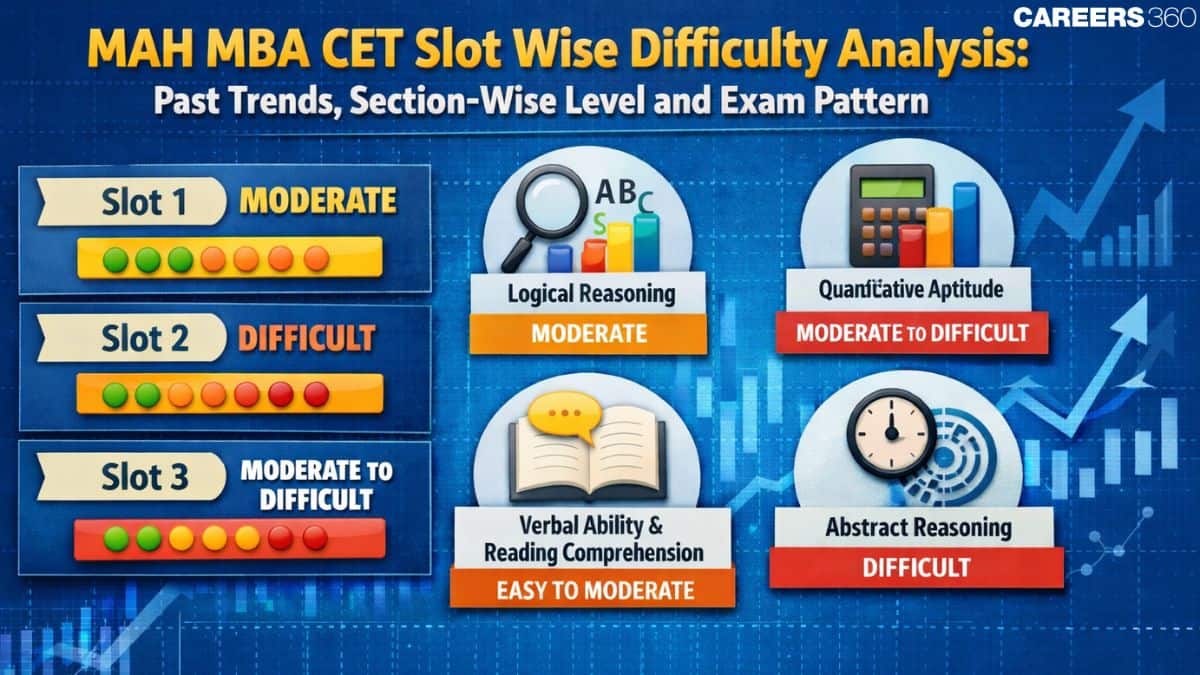
The MAH MBA CET Slot Wise Difficulty Analysis helps candidates understand how the exam difficulty can vary across different sessions. The MAH MBA CET 2026 exam is expected to be conducted in multiple slots across several exam days, similar to previous years, where the test was held in two slots per day. Because each slot may have slight variations in question difficulty, analysing past slot-wise papers helps candidates identify common question patterns, section trends, and expected difficulty levels.
This Story also Contains
In this article, we have discussed the MAH MBA CET slot-wise difficulty level for the last three years and trends that have changed over the years.
The official exam conducting body of the MAH MBA CET, State Common Entrance Test Cell, Maharashtra, has released the official examination pattern of the MAH MBA CET examination.
The detailed MAH MBA CET exam pattern is given below.
Topics | No of Questions | Mark per Question | Maximum Marks | Total Marks |
Logical Reasoning | 75 | 1 | 75 | 200 |
Abstract Reasoning | 25 | 1 | 25 | |
50 | 1 | 50 | ||
Verbal Ability / Reading Comprehension | 50 | 1 | 50 |
Understanding the section-wise weightage is an important part of a smart MAH MBA CET preparation strategy. The table below highlights the expected MAH MBA CET question distribution across different topics in Logical Reasoning & Abstract Reasoning, Quantitative Aptitude, and VARC. Analysing this distribution helps candidates identify high-weightage areas. Know about the subject-wise MAH MBA CET paper pattern analysis.
Topic | 2025 | 2024 | 2023 | 2022 |
Arrangement / Seating / Puzzles (Linear, Circular, Matrix) | 14–22 | 14–19 | 14–16 | 15–20 |
Complex Analytical Sets (Data-based reasoning sets) | 10–18 | 12–19 | 12–15 | 10–18 |
Syllogism & Logical Deductions | 6–9 | 6–8 | 8–9 | 6–9 |
Coding-Decoding / Input-Output | 4–8 | 4–6 | 4–6 | 4–6 |
Series / Analogies / Odd-One-Out | 4–8 | 4–7 | 5–8 | 5–8 |
Blood Relations / Directions | 3–8 | 4–8 | 6–10 | 3–8 |
Misc. Verbal Logical (Statement-Assumption, CR) | 4–7 | 4–8 | 4–7 | 3–7 |
Abstract: Figure Series / Pattern Completion | 8–12 | 8–12 | 8–12 | 8–12 |
Abstract: Mirror / Rotation / Paper Folding | 4–7 | 3–6 | 3–6 | 3–6 |
Abstract: Figure Matrix / Classification | 5–8 | 5–8 | 5–8 | 4–8 |
Topic | 2025 | 2024 | 2023 | 2022 |
Arithmetic (Percentages, Ratio, T&W, T&D, Averages, P&L) | 18–25 | 15–22 | 16–24 | 15–25 |
Algebra (Linear, Quadratic, Inequalities) | 8–12 | 8–12 | 8–12 | 8–12 |
Geometry & Mensuration | 4–8 | 4–8 | 3–7 | 4–8 |
Number System | 3–6 | 3–6 | 3–6 | 3–6 |
Permutation & Combination / Probability | 3–6 | 3–6 | 3–6 | 3–6 |
Modern Math / Miscellaneous | 2–6 | 3–6 | 1–4 | 2–6 |
Topic | 2025 | 2024 | 2023 | 2022 |
Reading Comprehension (1–3 RCs) | 12–22 | 12–20 | 12–20 | 12–20 |
Para-Jumbles / Para-Completion | 6–12 | 6–10 | 6–10 | 6–10 |
Sentence Correction / Grammar | 6–10 | 6–10 | 6–10 | 5–10 |
Fill in the Blanks | 4–6 | 4–6 | 4–6 | 3–6 |
Vocabulary (Synonyms, Antonyms, Odd-One-Out) | 4–6 | 4–6 | 4–6 | 3–6 |
Critical Reasoning (Inference, Bold Face, Assumptions) | 2–6 | 2–6 | 2–6 | 2–6 |
Refer to the table below to get a quick idea of the MAH MBA CET slot-wise difficulty analysis 2025.
As per the MAH MBA CET previous year analysis, the Quantitative Aptitude section included three Data Interpretation sets with around 10 questions. The rest of the questions mainly focused on Arithmetic topics, showing that Arithmetic continues to hold a strong in the exam.
In the Logical Reasoning section, no Critical Reasoning questions were reported. There were a few math-based reasoning questions that also appeared, which is slightly unusual for this section.
The VARC section surprised many candidates. There were 9 Reading Comprehension passages for only 20 questions, which required students to spend more time reading and understanding the passages.
Unlike the previous exam pattern, the Abstract Reasoning section also included questions related to counting and Venn diagrams, indicating slight changes in the MAH MBA CET section-wise weightage across topics.
Section | No. of Questions | Difficulty Level |
Logical Reasoning | 75 | Moderate |
Abstract Reasoning | 25 | Easy |
Quantitative Aptitude | 50 | Easy-Moderate |
Verbal Ability & Reading Comprehension | 50 | Moderate |
Total | 200 | Moderate |
Section | Number of Questions | Level of Difficulty (LOD) |
Quantitative Aptitude | 50 | Moderate |
Logical Reasoning | 75 | Easy-Moderate |
VARC (Verbal Ability & Reading Comprehension) | 50 | Easy-Moderate |
Abstract Reasoning | 25 | Easy-Moderate |
Total | 200 | Easy-Moderate |
Area | Number of Questions | Level of Difficulty |
Quantitative Aptitude | 50 | Moderate |
Logical Reasoning | 75 | Moderate |
VARC | 50 | Easy-Moderate |
Abstract Reasoning | 25 | Easy |
Total | 200 | Moderate |
A clear understanding of the MAH MBA CET paper pattern analysis helps candidates identify how the exam is structured and what type of questions are commonly asked across sections. This analysis also helps candidates plan an effective MAH MBA CET preparation strategy, allowing them to focus on important topics and changing trends.
Section | No. of Questions | Difficulty Level | Key Observations |
Logical Reasoning | 75 | Moderate | Several puzzle-based questions and arrangements made the section time-consuming |
Abstract Reasoning | 25 | Easy | Visual pattern questions were straightforward and scoring |
Quantitative Aptitude | 50 | Moderate | Arithmetic dominated with a few DI sets |
Verbal Ability & RC | 50 | Moderate | Around 9 RC passages with varying lengths |
Overall Paper | 200 | Moderate | The paper was lengthy but manageable with good speed |
Highlights
Logical Reasoning puzzles required careful analysis.
RC passages were longer than in previous years.
The paper tested speed and accuracy more than conceptual difficulty.
Highest Package 27.25 LPA | Top 100 Average package 16.65 LPA | AACSB Accredited | Ranked 52 by QS International
Application Deadline: 10th March | Globally Recognized by AACSB (US) & AMBA (UK) | 17.8 LPA Avg. CTC for PGPM 2025
Section | No. of Questions | Difficulty Level | Key Observations |
|---|---|---|---|
Logical Reasoning | 75 | Moderate–Difficult | Puzzle sets are slightly tougher than Slot 1 |
Abstract Reasoning | 25 | Easy | Mostly standard visual reasoning patterns |
Quantitative Aptitude | 50 | Moderate | Calculation-heavy questions in arithmetic |
Verbal Ability & RC | 50 | Moderate | RC passages are lengthy, and the vocabulary is mixed |
Overall Paper | 200 | Moderate | Slightly tougher than Slot 1 |
Highlights
LR puzzles required more time compared with the morning slot.
Quant involved heavier calculations.
Section | No. of Questions | Difficulty Level | Key Observations |
Logical Reasoning | 75 | Moderate | Mix of puzzles, syllogisms, and logical deductions |
Abstract Reasoning | 25 | Easy | Pattern recognition questions were straightforward |
Quantitative Aptitude | 50 | Easy–Moderate | Arithmetic and DI dominated |
Verbal Ability & RC | 50 | Moderate | RC passages shorter compared to Day 1 |
Overall Paper | 200 | Easy–Moderate | Slightly easier than Day 1 |
Highlights
Students reported this slot as more balanced and easier than Day 1.
Speed remained the main factor for high attempts.
Section | No. of Questions | Difficulty Level | Key Observations |
Logical Reasoning | 75 | Moderate | Puzzle sets remained the main challenge |
Abstract Reasoning | 25 | Easy | Visual reasoning questions similar to previous years |
Quantitative Aptitude | 50 | Moderate | DI and arithmetic questions required calculations |
Verbal Ability & RC | 50 | Moderate | Grammar, vocabulary, and RC mix |
Overall Paper | 200 | Moderate | Balanced difficulty across sections |
Section | No. of Questions | Difficulty Level | Key Observations |
Logical Reasoning | 75 | Moderate | Mix of arrangements, syllogisms, and analytical reasoning |
Abstract Reasoning | 25 | Easy | Mostly pattern-based questions |
Quantitative Aptitude | 50 | Moderate | Arithmetic-heavy questions |
Verbal Ability & RC | 50 | Moderate | RC passages are moderate in length |
Overall Paper | 200 | Easy–Moderate | Similar difficulty to Day 2 |
Section | No. of Questions | Difficulty Level | Key Observations |
Logical Reasoning | 75 | Moderate | Puzzle-based questions remained time-consuming |
Abstract Reasoning | 25 | Easy | Most scoring section |
Quantitative Aptitude | 50 | Moderate | DI and arithmetic questions |
Verbal Ability & RC | 50 | Moderate | Balanced mix of RC and verbal questions |
Overall Paper | 200 | Moderate | Consistent difficulty with other slots |
Section | No. of Questions | Difficulty Level | Key Observations |
Logical Reasoning | 75 | Easy | Questions from arrangements, coding-decoding, syllogism, and analogy |
Abstract Reasoning | 25 | Easy–Moderate | Pattern recognition, odd-one-out, and figure series |
Quantitative Aptitude | 50 | Easy | Arithmetic-based questions with manageable calculations |
Verbal Ability & RC | 50 | Easy | RC passages with grammar and vocabulary questions |
Overall Paper | 200 | Easy | Straightforward questions across most sections |
Highlights
Logical Reasoning had many arrangement-based questions.
Abstract reasoning questions were mainly series and pattern identification.
Most candidates found the overall paper relatively simple compared to previous years.
Section | No. of Questions | Difficulty Level | Key Observations |
Logical Reasoning | 75 | Easy–Moderate | Analytical reasoning and arrangement puzzles |
Abstract Reasoning | 25 | Moderate | Pattern questions slightly tricky |
Quantitative Aptitude | 50 | Moderate | Arithmetic and DI required calculations |
Verbal Ability & RC | 50 | Moderate | RC passages slightly longer |
Overall Paper | 200 | Easy–Moderate | Slightly tougher than Slot 1 |
Section | No. of Questions | Difficulty Level | Key Observations |
Logical Reasoning | 75 | Moderate | Puzzle-based analytical reasoning dominated |
Abstract Reasoning | 25 | Moderate | Visual reasoning and analogy questions |
Quantitative Aptitude | 50 | Moderate | DI and arithmetic questions |
Verbal Ability & RC | 50 | Moderate | Vocabulary and grammar questions |
Overall Paper | 200 | Moderate | Balanced difficulty across sections |
Section | No. of Questions | Difficulty Level | Key Observations |
Logical Reasoning | 75 | Moderate–Difficult | Arrangement puzzles and logical deduction |
Abstract Reasoning | 25 | Difficult | Pattern questions more complex |
Quantitative Aptitude | 50 | Moderate | Calculation-heavy arithmetic questions |
Verbal Ability & RC | 50 | Difficult | RC passages are longer and comprehension-based |
Overall Paper | 200 | Moderate–Difficult | Toughest slot of the exam |
Section | No. of Questions | Difficulty Level | Key Observations |
Logical Reasoning | 75 | Easy–Moderate | Mix of puzzles, coding-decoding, syllogisms |
Abstract Reasoning | 25 | Moderate | Pattern and analogy questions |
Quantitative Aptitude | 50 | Moderate | Arithmetic and number-based questions |
Verbal Ability & RC | 50 | Moderate | RC passages and grammar questions |
Overall Paper | 200 | Moderate | Similar difficulty to Day 2 |
Section | No. of Questions | Difficulty Level | Key Observations |
Logical Reasoning | 75 | Moderate | Analytical reasoning and puzzles |
Abstract Reasoning | 25 | Moderate | Visual reasoning patterns |
Quantitative Aptitude | 50 | Moderate | Arithmetic-focused questions |
Verbal Ability & RC | 50 | Moderate | Vocabulary, grammar, and RC |
Overall Paper | 200 | Moderate | Balanced difficulty |
Section | Approx. No. of Questions | Difficulty Level | Key Observations |
Logical Reasoning | 73–74 | Easy | Questions mainly from arrangements, coding-decoding, syllogism, and blood relations |
Abstract Reasoning | 25 | Easy–Moderate | Pattern-based visual reasoning questions |
Quantitative Aptitude | 45–46 | Easy | Arithmetic-based questions with simple calculations |
Verbal Ability & RC | 54–55 | Easy | RC passages with grammar and vocabulary questions |
Overall Paper | 200 | Easy | The paper was straightforward and manageable |
Highlights
Most sections contained direct and familiar question types.
Candidates reported the exam to be one of the easier CET papers in recent years.
Section | Approx. No. of Questions | Difficulty Level | Key Observations |
Logical Reasoning | 73–74 | Easy | Puzzle-based questions and analytical reasoning |
Abstract Reasoning | 25 | Easy–Moderate | Visual patterns and analogy questions |
Quantitative Aptitude | 45–46 | Easy–Moderate | Arithmetic and basic DI questions |
Verbal Ability & RC | 54–55 | Easy | RC passages with grammar questions |
Overall Paper | 200 | Easy–Moderate | Slightly tougher than Slot 1 |
Section | Approx. No. of Questions | Difficulty Level | Key Observations |
Logical Reasoning | 73–74 | Easy–Moderate | Analytical reasoning and puzzle sets |
Abstract Reasoning | 25 | Moderate | Pattern recognition and figure-based questions |
Quantitative Aptitude | 45–46 | Easy–Moderate | Arithmetic and number-based problems |
Verbal Ability & RC | 54–55 | Easy | RC passages and vocabulary questions |
Overall Paper | 200 | Easy–Moderate | Balanced paper across sections |
Section | Approx. No. of Questions | Difficulty Level | Key Observations |
Logical Reasoning | 73–74 | Easy–Moderate | Mix of puzzles, coding-decoding, and syllogisms |
Abstract Reasoning | 25 | Moderate | Visual reasoning patterns slightly tricky |
Quantitative Aptitude | 45–46 | Moderate | Calculation-based arithmetic questions |
Verbal Ability & RC | 54–55 | Easy | RC passages with grammar questions |
Overall Paper | 200 | Easy–Moderate | Similar difficulty to other slots |
Over the last three years, Logical Reasoning has gradually become more puzzle-oriented. While the section always contained arrangement and analytical reasoning questions, recent papers have included more complex puzzle sets that require careful interpretation. In 2023, the questions were relatively straightforward, but in 2024 and 2025, the number of analytical puzzles increased slightly, making the section more time-consuming even though the overall difficulty remained moderate.
Abstract Reasoning has remained the easiest section of the MAH MBA CET exam over the last three years. Most questions are based on visual patterns, figure series, analogies, and odd-one-out problems. Although a few new variations have appeared recently, the overall difficulty has stayed easy to moderate, making it one of the fastest sections to attempt during the exam.
The Quantitative Aptitude section has increasingly emphasised arithmetic-based questions and quick calculations. Topics such as percentages, ratios and proportions, profit and loss, and time and work have consistently appeared in large numbers. Compared with earlier papers, some recent slots have included more calculation-heavy problems, which can slow down candidates if they are not comfortable with mental math.
Another noticeable trend in recent MAH MBA CET papers is the slightly longer Reading Comprehension passages in the Verbal Ability section. While the overall difficulty has remained moderate, candidates have needed better reading speed to handle multiple passages within the limited time available. Grammar and vocabulary questions have remained common, but comprehension-based questions have become slightly more prominent.
Despite minor variations in question difficulty, the overall exam structure has remained unchanged over the past three years. The test still consists of 200 questions divided among Logical Reasoning, Abstract Reasoning, Quantitative Aptitude, and Verbal Ability & Reading Comprehension. The absence of negative marking and sectional time limits continues to allow candidates to attempt questions in any order.
The biggest challenge in the MAH MBA CET has consistently been the speed required to attempt the large number of questions. With 200 questions to be solved in 150 minutes, even relatively easy questions can become difficult under time pressure. As a result, the exam was increasingly easy for candidates who could quickly identify easy questions and maintain accuracy throughout the test.
The MAH MBA CET score vs percentile trend from previous years helps candidates estimate the marks required to achieve a particular percentile. Since the exam contains 200 questions and has no negative marking, the required score for higher percentiles usually depends on the paper's difficulty and the number of candidates appearing for the exam each year. By analysing past year data, students can set realistic score targets and understand how marks translate into percentiles in the MAH MBA CET exam.
Percentile | CET 2020 | CET 2022 | CET 2023 | CET 2024 | CET 2025 |
50 | 50 | 57 | 66 | 59 | 60 |
60 | 57 | 64 | 71 | 66 | 66 |
70 | 65 | 72 | 76 | 74 | 74 |
80 | 75 | 82 | 86 | 84 | 85 |
90 | 90 | 97 | 99 | 99 | 102 |
92 | — | — | — | — | 110 |
94 | 100 | 107 | 108 | 109 | — |
95 | 106 | 113 | 113 | 115 | 115 |
97 | 110 | 117 | 118 | 119 | 120 |
98 | 115 | 122 | 123 | 124 | — |
99 | 122 | 129 | 131 | 131 | 131 |
99.5 | 128 | 135 | 137 | 137 | — |
99.6 | 131 | 138 | 138 | 140 | 140 |
99.8 | 136 | 143 | 142 | 145 | 145 |
99.93 | 143 | 150 | 150 | 150 | — |
99.94 | — | — | — | — | 152 |
99.96 | — | — | — | — | 155 |
The MAH MBA CET difficulty level has remained mostly moderate over the past few years, though the exact pattern changes each year slightly. The exam usually tests speed and accuracy because of the large number of questions and limited time. Sections like Logical Reasoning and Abstract Reasoning often carry moderate to difficult questions, while Quantitative Aptitude and Verbal Ability are generally moderate. Analysing previous years helps candidates understand the difficulty trend and plan their preparation strategy better.
Year | Logical Reasoning | Abstract Reasoning | Quantitative Aptitude | Verbal Ability & RC | Overall Difficulty |
2025 | Moderate–Difficult | Moderate | Moderate | Moderate | Moderate |
2024 | Moderate | Moderate | Moderate | Easy–Moderate | Moderate |
2023 | Moderate–Difficult | Moderate | Moderate | Moderate | Moderate |
2022 | Moderate | Easy–Moderate | Moderate | Moderate | Moderate |
2021 | Moderate–Difficult | Moderate | Moderate–Difficult | Moderate | Moderate–Difficult |
Frequently Asked Questions (FAQs)
Yes, the difficulty level can vary slightly across different exam slots. Some slots may have tougher Logical Reasoning or Quantitative Aptitude questions, while others may have easier sections. However, the overall level of the exam usually remains similar.
MAH MBA CET Slot-wise analysis helps candidates understand how the difficulty level differed across sessions. It also gives insights into the types of questions asked in each section and helps future aspirants prepare better.
Logical Reasoning is generally the most time-consuming section because it contains many puzzles and analytical reasoning questions. Even when the questions are not very difficult, they can take more time to solve.
Yes, when the exam slot is easier, more candidates are able to attempt a higher number of questions correctly. This can lead to slightly higher score requirements for achieving top percentiles.
Candidates can study slot-wise analysis to identify common question types and difficulty trends. This helps them focus on important topics and practice questions that are frequently asked in the exam.
On Question asked by student community
With a 91.16 percentile in MAH MBA CET 2025, you have a good chance of securing admission in decent MBA colleges in Maharashtra. While top institutes like JBIMS or Sydenham may be out of reach, colleges such as PUMBA, SIES, Chetana’s, MET, and DY Patil are realistic options. Among these,
With 91.16 percentile, you can target top-tier MBA colleges like PUMBA (Pune University), MET Mumbai, SIESCOMS Navi Mumbai, and NL Dalmia. Welingkar and K J Somaiya may be slightly out of reach but possible under lower cutoffs or spot round.
With 42 percentile in MAH MBA CET, it is very difficult to get admission in good or top MBA colleges through CAP rounds. Most of the well-known colleges in Maharashtra like JBIMS, SIMSREE, Welingkar, and PUMBA usually take students who score more than 90 or 99 percentile. Even average colleges
Dear Aspirant,
If you have scored 80 out of 200 in the MAH MBA CET 2025, your expected percentile is likely to be in the range of 60 to 70, depending on the overall performance of candidates and the difficulty level of the exam this year. Based on previous years’
Congratulations on your score! To estimate your percentile for the MAH MBA CET 2025, it depends on the overall difficulty of the exam, the number of students appearing, and how others perform in the exam.
However, based on trends from previous years, here is a rough estimate:
94 marks in
Ranked among top 10 B-Schools in India by multiple publications | Top Recruiters-Google, MicKinsey, Amazon, BCG & many more.
Application Deadline: 10th March | Globally Recognized by AACSB (US) & AMBA (UK) | 17.8 LPA Avg. CTC for PGPM 2025
Industry Internship Training
400+ Company Visits | Highest CTC Offered: 21 LPA | Average CTC Offered: 8.65 LPA | 100% Placement Assurance
NAAC A++ Accredited | Ranked #12 by NIRF
Last Date to Apply: 26th March | Ranked #36 amongst institutions in Management by NIRF | 100% Placement