
Search Colleges, Exams, Schools & more


Login
ATMA Preparation Strategy 2027 for First-Time Test Takers: Study Plan, Books, Tips and Mock Tests
For first-time test takers, an effective ATMA preparation strategy is essential to understand the exam structure and prepare for all sections in a systematic manner. Candidates should begin by familiarising themselves with the ATMA syllabus and identifying their strengths and weaknesses. Regular practice, timed question-solving, and mock test analysis can help improve accuracy and time management. A structured preparation plan also ensures adequate revision and helps candidates approach the ATMA examination with greater confidence.
This Story also Contains
- ATMA Exam Pattern 2027
- ATMA Preparation Strategy for First-Time Test Takers
- How Should Beginners Start ATMA Preparation?
- Best Books for ATMA Exam Preparations
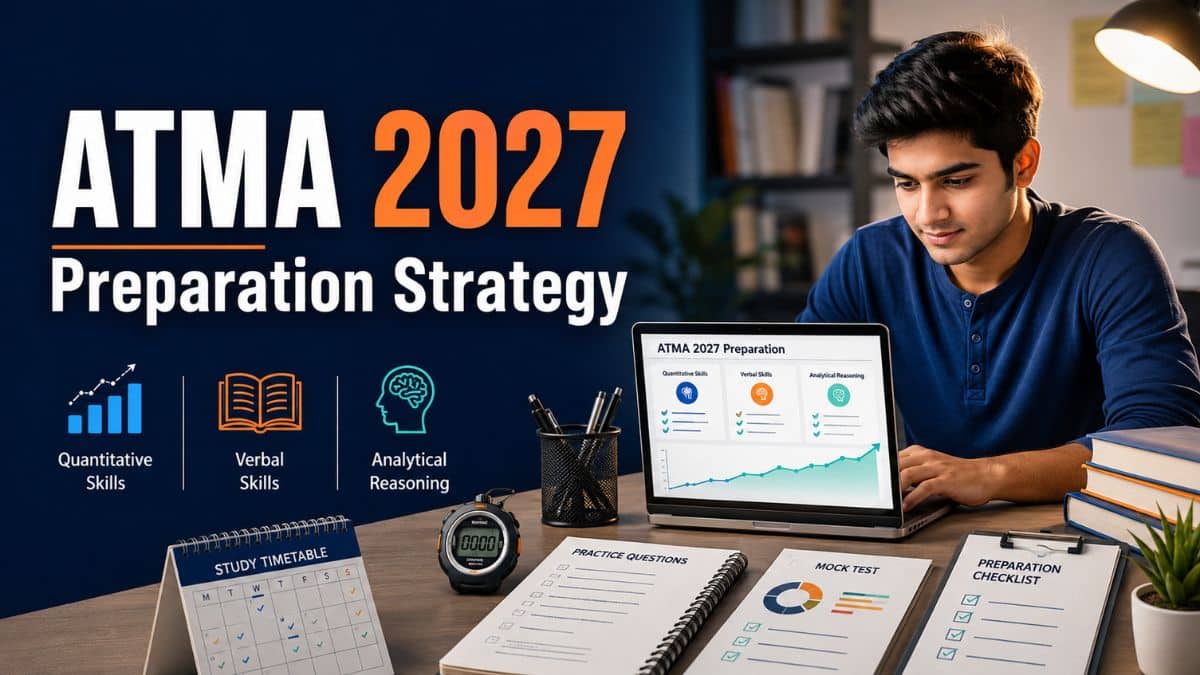
ATMA Exam Pattern 2027
The ATMA Exam Pattern 2027 provides candidates with details about the exam structure, including the number of sections, questions, duration and marking scheme. The examination consists of six sections, with 30 questions in each section and a fixed time limit of 30 minutes per section.
Particulars | ATMA Exam Pattern 2027 Details |
Exam Name | AIMS Test for Management Admissions (ATMA) |
Conducting Body | Association of Indian Management Schools (AIMS) |
Exam Mode | Computer-Based Test (CBT) |
Question Type | Multiple Choice Questions (MCQs) |
Medium | English |
Total Sections | 6 |
Total Questions | 180 |
Questions per Section | 30 |
Total Duration | 3 Hours (180 Minutes) |
Time per Section | 30 Minutes |
Analytical Reasoning Skills | 2 Sections |
Verbal Skills | 2 Sections |
Quantitative Skills | 2 Sections |
Total Marks | 180 |
Marking Scheme | +1 mark for every correct answer |
Negative Marking | -0.25 mark for every incorrect answer |
Marks for Unattempted Questions | 0 |
ATMA Preparation Strategy for First-Time Test Takers
If you are appearing for the ATMA exam for the first time, following a ATMA preparation strategy can help you become familiar with the exam pattern and prepare for all sections effectively. Focus on understanding the concepts, practising different types of questions, and improving your ability to solve questions within the allotted time. Here are five important preparation steps for first-time ATMA test takers.
Understand the ATMA Exam Pattern and Syllabus
Begin your preparation by understanding the ATMA syllabus and exam pattern and marking scheme. Familiarise yourself with the sections and the types of questions asked in each section. This will help you identify the topics you need to study and prepare a focused study plan instead of spending time on irrelevant topics.
Build Strong Fundamentals in Each Section
First-time test takers should strengthen their basics before moving to difficult questions. Revise important concepts and formulas for Quantitative Skills, practise grammar and vocabulary for Verbal Skills, and learn different approaches for Analytical Reasoning questions. Building a strong foundation will help you solve questions more accurately.
Create a Realistic Study Timetable
Prepare a daily or weekly study timetable based on the time available before the ATMA exam. Allocate sufficient time to all three sections while giving extra attention to your weaker areas. Set realistic targets, such as completing a specific number of topics or practice questions, and regularly review your progress.
Practise with Previous Year Questions and Mock Tests
Solving ATMA previous year question papers can help you understand the difficulty level and types of questions asked in the ATMA exam. Take regular mock tests to assess your preparation and identify weak areas. After each test, analyse your mistakes and revise the topics where you are losing marks.
Focus on Time Management and Accuracy
Since candidates need to answer questions within the sectional time limit, practise solving questions under timed conditions. Avoid spending too much time on a single difficult question. Learn to identify questions you can solve quickly and accurately, and skip questions that are likely to consume too much time.
How Should Beginners Start ATMA Preparation?
ATMA beginners should start their preparation by understanding the exam pattern and syllabus before moving on to regular practice. Since the exam tests Analytical Reasoning, Quantitative Skills and Verbal Skills, candidates should follow a structured approach that builds conceptual clarity, improves question-solving speed and helps them track their progress.
Understand the ATMA Exam Pattern and Syllabus
The first step is to understand the ATMA exam structure, including the sections, number of questions and time available. Candidates should also review the complete syllabus to identify the topics they need to study. This will help beginners create a focused preparation strategy instead of studying topics randomly.
Assess Your Current Preparation Level
Before starting intensive preparation, candidates should take a basic practice test or solve questions from each section. This will help them identify their strengths and weaknesses. For example, candidates who struggle with arithmetic or grammar can devote additional time to these areas while maintaining their stronger sections through regular practice.
Build Strong Conceptual Clarity
Beginners should first learn the basic concepts and question-solving methods for every important topic. In Quantitative Skills, focus on areas such as arithmetic, algebra and number systems. For Verbal Skills, work on vocabulary, grammar and reading comprehension. Analytical Reasoning preparation should include regular practice of logical and analytical questions.
Follow a Regular Study Schedule
A daily study schedule can help beginners cover the syllabus systematically. Divide the available preparation time among the three sections and set weekly targets. Initially, focus more on learning concepts and gradually increase the number of questions solved within a fixed time limit.
Start Mock Tests After Basic Preparation
Once the important concepts have been covered, candidates should begin taking ATMA mock tests regularly. Analyse every test to identify incorrect answers, weak topics and time-management issues. Use these observations to improve your preparation strategy and focus on topics that require more practice.
Best Books for ATMA Exam Preparations
Choosing the right ATMA books can help candidates prepare effectively for the ATMA exam. Since the examination includes Analytical Reasoning, Quantitative Skills and Verbal Skills, aspirants should use section-wise books that explain concepts clearly and provide sufficient practice questions. The following books can support a structured ATMA preparation strategy.
ATMA Section | Recommended Books | How It Helps |
Analytical Reasoning Skills | A Modern Approach to Verbal & Non-Verbal Reasoning by R.S. Aggarwal | Covers important reasoning concepts and provides practice questions on different topics. |
Analytical Reasoning Skills | How to Prepare for Logical Reasoning for CAT by Arun Sharma | Useful for practising advanced logical and analytical reasoning questions. |
Quantitative Skills | Quantitative Aptitude for Competitive Examinations by R.S. Aggarwal | Helps build fundamental concepts in arithmetic, algebra, geometry and number systems. |
Quantitative Skills | How to Prepare for Quantitative Aptitude for CAT by Arun Sharma | Provides topic-wise concepts and practice sets of varying difficulty levels. |
Verbal Skills | Word Power Made Easy by Norman Lewis | Helps improve vocabulary and understanding of commonly used English words. |
Verbal Skills | High School English Grammar and Composition by Wren & Martin | Useful for revising grammar rules and improving sentence construction. |
All Sections | ATMA Previous Year Question Papers and Mock Tests | Helps candidates understand the question format and practise completing the exam within the available time. |
Frequently Asked Questions (FAQs)
Q: How should first-time test takers begin ATMA preparation?
A:
Candidates should start by understanding the ATMA exam pattern and syllabus. They should identify their strengths and weaknesses in Analytical Reasoning, Verbal Skills and Quantitative Skills before preparing a structured study plan.
Q: How much time should I spend on each ATMA section?
A:
Since the ATMA exam includes six sections, candidates should divide their preparation time according to their proficiency. Extra time should be devoted to weaker areas while regularly revising strong topics.
Q: Are mock tests important for ATMA preparation?
A:
Yes, mock tests help candidates become familiar with the exam structure and practise answering questions within the available time. Candidates should analyse each mock to identify mistakes and improve weak topics.
Q: How can I improve my speed for the ATMA exam?
A:
Regular timed practice is important. Candidates should solve questions using a stopwatch, avoid spending too long on difficult questions and learn to select questions they can solve accurately.
Q: What is the best revision strategy for first-time ATMA test takers?
A:
Candidates should regularly revise important concepts, formulae and problem-solving methods. In the final weeks, they should focus on mock tests, error analysis and frequently asked question types.
Articles
Related Stories
|
Upcoming Bschool Exams

Certifications By Top Providers
Explore Top Universities Across Globe
Popular Courses and Specializations
List of colleges accepting ATMA
Browse Bschool Colleges by State
Questions related to ATMA
On Question asked by student community
Have a question related to ATMA ?
Hi there,
Atma Ram Sanatan Dharma College (ARSD), part of the University of Delhi, is well-regarded for its BSc Mathematics (Hons) program. It offers a structured curriculum covering algebra, analysis, statistics, and applied mathematics, along with exposure to research opportunities. The faculty is experienced, and the college provides good infrastructure
If you're searching for “Atma Malik Institute of Engineering” under ATMA (AIMS Test for Management Admissions), it won't show up—because ATMA exam is only for MBA/management admissions , and engineering colleges like Atma Malik Institute of Technology & Research aren’t part of that process. The MBA exam ATMA is completely
No, it's not mandatory but if you've those score then your option will be vast. Maximum Universities have their own selection process & own exams. If you have those good score they'll prefer you. But as per AICTE rules you have to have one national or state basis entrance exam
Yes, there will be an ATMA admission exam in 2025. The next ATMA exam will be administered via computer on June 1, 2025. The June session is now accepting registrations, which will end on May 20, 2025. In India, the ATMA test is administered several times a year for admission
Hey Madhura
Yes ATMA is held in July as well. Based on the latest official schedule
July 2025 session of ATMA will be conducted on 27 July 2025 in a centre based online format
Registration opens from 2 June and closes on 15 July 2025
Best wishes for your future.

Study Resources, Applications and Opportunities
Globally Recognized by AACSB (US) & AMBA (UK) | 18 LPA Avg. CTC for PGPM 2026
XAT- Xavier Aptitude Test 2027
Apply75+ years of legacy | #1 Entrance Exam | Score accepted by 250+ BSchools
Career Launcher Race To 99%ile In CAT 2026 - Phase 03
Enquire6-Hour Masterclass to help you score 99+ percentile in CAT 2026
NMAT by GMAC 2026
ApplyTest centres are available in 70+ cities across India | 75,000+ aspirants apply for the NMAT exam | Accepted by 58+ institutions like NMIMS, KJSIM, ISB, SPJIMR and Great Lakes.
Common Admission Test 2026 (CAT 2026)
ApplyRegistration Start: 3 August 2026 | Last Date to Apply: 15 September 2026 (till 5 PM)
IBSAT 2026-ICFAI Business School MBA/PGPM 2027
ApplyAACSB Accredited | 40 LPA-Highest CTC | Scholarships worth 10 CR
ATMA Notifications
Never miss ATMA update
Get timely ATMA updates directly to your inbox. Stay informed!