
Search Colleges, Exams, Schools & more


Login
CMAT 2026 Last 7 Days Strategy, Section-Wise Tips, Common Mistakes
With just 7 days left for CMAT 2026, most aspirants feel confused—revise or practice? Take mocks or rest? This final week is not about studying harder, but about studying smarter. A small shift in strategy now can change your percentile dramatically. The CMAT 2026 Last 7 Days Strategy helps candidates use the final week in a smart and focused way. With the CMAT exam scheduled on January 25, 2026, this time should be spent on revision, practice, and strengthening exam strategy, not learning new topics. The last 7 days are ideal for revising important concepts, analysing mock test mistakes, and improving speed and accuracy. Candidates must adhere to a proper CMAT 2026 exam strategy to ensure better performance in the examination.
This Story also Contains
- Why the Last 7 Days Are Crucial for CMAT Preparation?
- Day-wise CMAT Last 7 Days Preparation Plan
- Section-wise CMAT Last Week Preparation Strategy
- Common Mistakes to Avoid in the Last 7 Days Before CMAT
- Best Resources to Ace CMAT 2026 Exam

Why the Last 7 Days Are Crucial for CMAT Preparation?
The last 7 days before CMAT can realistically decide your final score because this is when marks are gained or lost due to decision-making, not knowledge gaps. By now, most aspirants know the CMAT 2026 syllabus, but few know which questions to attempt, skip, or come back to under pressure.
This week lets you fix recurring errors, lock section-wise time limits, and practise smart selection through mock analysis. Even a small improvement in speed or accuracy during these days can push your percentile significantly higher.
Day-wise CMAT Last 7 Days Preparation Plan
Day 1: Complete CMAT Syllabus Review and Self-Assessment
Begin the final week by doing a quick but thorough CMAT syllabus revision for all sections: Quantitative Aptitude, Data Interpretation, Logical Reasoning, Language Comprehension, General Awareness, and Innovation & Entrepreneurship. Review previous CMAT mock test performance to identify strong areas and weak zones. Note down frequently repeated mistakes, accuracy levels, and time spent per section. This self-assessment helps you set a realistic CMAT last-week strategy and avoid wasting time on low-scoring topics.
Day 2: CMAT Quantitative Techniques and Data Interpretation Strategy
Focus on high-scoring CMAT Quant topics such as percentages, ratios, averages, profit and loss, time and work, and algebra basics. Revise all important CMAT formulas and short tricks. For CMAT Data Interpretation, practise selected sets involving tables, bar graphs, and pie charts. Work on speed calculation and approximation, as DI is time-sensitive. Avoid lengthy or new problem types to maintain accuracy in the CMAT 2026 exam.
Day 3: CMAT Logical Reasoning Focus Plan
Revise important CMAT Logical Reasoning topics like linear and circular arrangements, coding-decoding, blood relations, directions, syllogisms, and input-output questions. Practise mixed LR questions under time-bound conditions to improve decision-making. This day should help you develop a strong CMAT LR question-selection strategy, which is crucial for managing sectional time limits effectively.
Day 4: CMAT Language Comprehension Revision Strategy
Concentrate on CMAT Language Comprehension topics such as vocabulary, grammar rules, sentence correction, error spotting, and para-based questions. Practise short CMAT reading comprehension passages and focus on accuracy rather than speed. Revising commonly tested grammar patterns and vocabulary can help you maximise attempts in this scoring section of the CMAT exam.
Day 5: CMAT General Awareness Last-Minute Preparation
Revise selective CMAT GK topics instead of covering everything. Focus on static GK areas like business awareness, economics basics, awards, books and authors, and important personalities. For CMAT current affairs, revise major national and international events from the last 6–8 months. Use compact CMAT GK notes or PDFs for quick revision and better retention.
Day 6: CMAT Full-Length Mock Test and Analysis
Attempt one full-length CMAT mock test in a real exam-like environment. Follow the CMAT exam pattern and sectional time strategy strictly. After the mock, do a detailed CMAT mock analysis by checking incorrect answers, time traps, and skipped questions. Fine-tune your CMAT time management strategy and lock your section order for the actual CMAT 2026 exam.
Day 7: Final CMAT Revision and Exam-Day Readiness
On the final day, revise only essential CMAT formulas, important vocabulary, key GK facts, and short notes. Avoid taking new CMAT mocks or learning fresh topics. Prepare all CMAT exam-day requirements, such as admit card, ID proof, and travel plans. Proper sleep, calm revision, and mental readiness are key to delivering a confident performance in the CMAT exam.
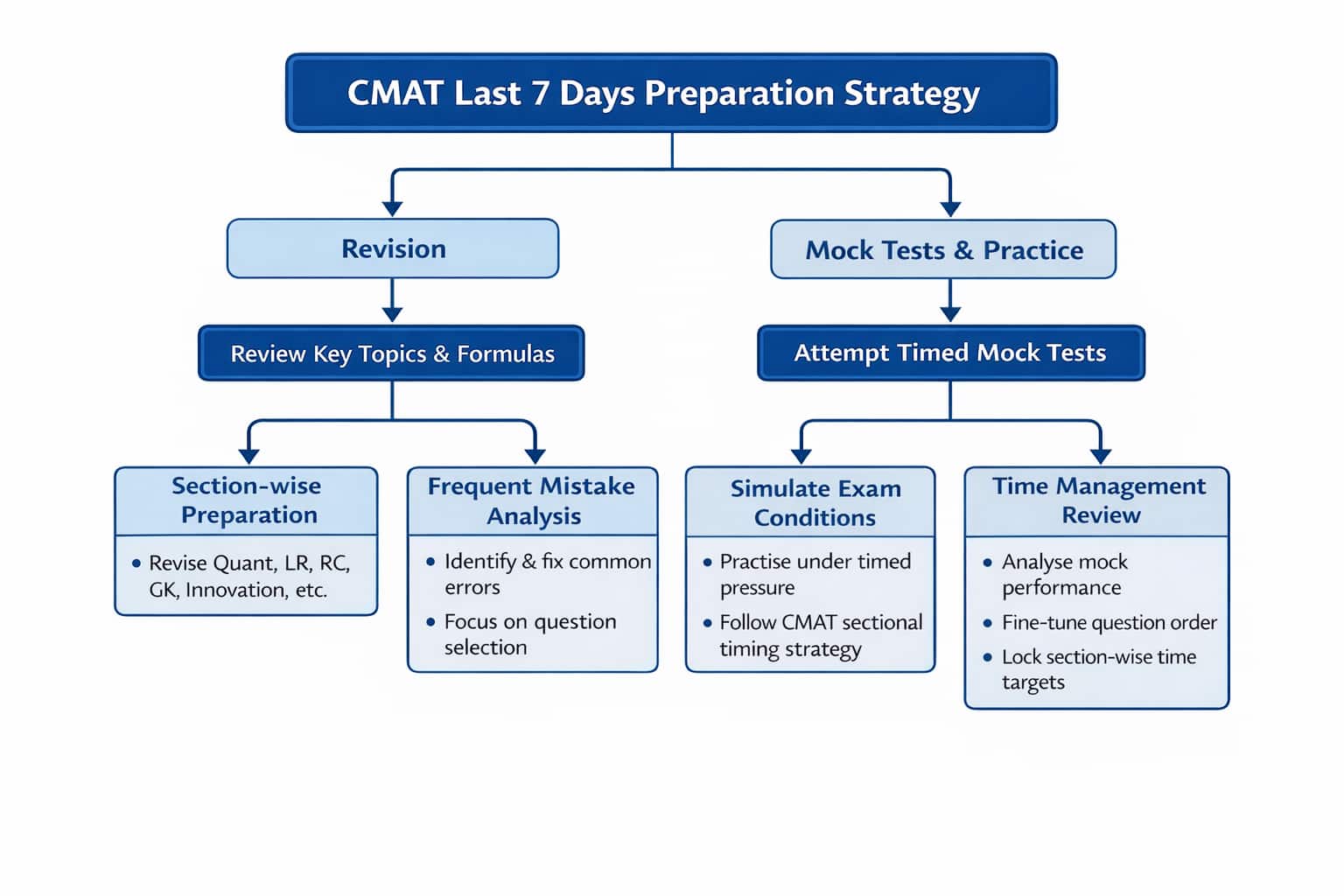
Section-wise CMAT Last Week Preparation Strategy
In the last week before CMAT, preparation should move away from random practice and become clearly subject-centric. Each section has a different scoring potential and risk level, so treating them separately helps candidates decide where to invest time and where to stay cautious. A focused, section-wise strategy improves accuracy, prevents time loss, and builds confidence for the actual exam.
Quantitative Aptitude
In the final week, focus only on high-yield topics that you are already comfortable with. Arithmetic areas such as percentages, ratios, averages, time & work, and profit & loss usually form a major chunk of the section and are quicker to solve. Revise all essential formulas daily and practise a limited number of questions to maintain speed. Avoid learning new concepts or attempting lengthy calculation-based problems, as they can affect accuracy and confidence.
Data Interpretation
DI should be approached with strict question selection. Practise sets involving tables, bar graphs, and simple pie charts, as these are more calculation-friendly. Work on improving mental calculations and approximation to save time. In the last week, focus on solving fewer sets with high accuracy rather than forcing multiple attempts. Knowing when to leave a set is just as important as knowing how to solve one.
Logical Reasoning
Logical Reasoning requires a balance between clarity and speed. Revise common topics such as arrangements, directions, coding–decoding, blood relations, syllogisms, and input–output. During practice, train yourself to identify solvable questions within the first few seconds. If a question feels complex or unfamiliar, skipping it quickly can help you save crucial time for easier attempts later in the section.
Language Comprehension
This section can be a strong scoring area in the last week if approached calmly. Focus on vocabulary revision, grammar rules, sentence correction, and error spotting based on previous CMAT trends. Practise short reading comprehension passages daily and work on eliminating incorrect options logically. Accuracy matters more than speed here, as many questions are direct and less time-consuming.
General Awareness
For General Awareness, restrict your preparation to selective and reliable topics. Revise static GK such as economics basics, business awareness, awards, books, and important personalities. For current affairs, concentrate on major national and international events from the last 6–8 months. Use concise notes or GK capsules for quick revision instead of reading multiple sources at this stage.
Innovation & Entrepreneurship
This section is largely concept-based and can be scored well with a basic understanding. Revise fundamental entrepreneurship terms, startup-related concepts, government initiatives, and commonly used business models. Since questions are usually direct, focus on clarity rather than in-depth theory. A quick daily revision is enough to remain comfortable with this section in the final week.
Common Mistakes to Avoid in the Last 7 Days Before CMAT
The final week before CMAT demands calm thinking and disciplined preparation. Many candidates underperform not due to lack of knowledge, but because of avoidable last-minute mistakes. Being aware of these errors and consciously avoiding them can help you stay focused and maximise your score.
Starting New Topics
Beginning fresh topics in the last week often leads to confusion and unnecessary stress. New concepts usually require time and repeated practice, which is not available at this stage. Instead, candidates should strengthen well-prepared areas and revise familiar question patterns.
Taking Too Many Mock Tests
Cognitive exhaustion can result from taking too many practice exams without conducting adequate analysis. Only when you thoroughly examine your errors, recognise time traps, and refine your question choices will mocks be helpful. In the latter days, quality is more important than quantity.
Completely Ignoring Weak Sections
Some candidates completely steer clear of weak areas out of concern for their accuracy. However, this method may cause simple, straightforward queries to be overlooked. A quick review of the fundamentals can assist ensure safe attempts without raising the stakes.
Lack of Time Management Practice
Practising questions without tracking time often causes panic during the exam. A clear sectional time plan and mock-based execution practice are essential to maintain control and balance across all sections.
Neglecting Health and Sleep
Anxiousness, inconsistent eating schedules, and inadequate sleep all impair concentration and decision-making skills. For the CMAT, it's essential to have a clear head, especially when it comes to speed-based parts.
Switching Study Resources at the Last Minute
Changing books, notes, or platforms in the final week disrupts consistency and creates self-doubt. Sticking to familiar resources helps maintain confidence and improves recall on exam day.
Best Resources to Ace CMAT 2026 Exam
The CMAT 2026 examination is just seven days away. Therefore, candidates must try to practice CMAT resources to maximise their marks. Know more about the best CMAT resources to ace their preparations before the exam.
CMAT Question Paper
Practising previous years’ CMAT question papers helps you see how the exam actually looks and feels. You understand the paper pattern, section-wise marks distribution, and the level of difficulty more clearly. It also shows which topics are asked repeatedly and what type of questions CMAT prefers. When you analyse these papers regularly, you learn how much time each section needs and where students usually make mistakes.
CMAT Previous Year’s Question Papers | Download Link |
CMAT 2024 Slot 1 Question Paper | |
CMAT 2024 Slot 2 Question Paper | |
CMAT 2023 Question Paper | |
CMAT 2022 Question Paper with Answers | |
CMAT 2021 Slot 1 Question Paper with Answers | |
CMAT 2021 Slot 2 Question Paper with Answers | |
CMAT 2020 Question Paper with Answers |
CMAT Mock Test
CMAT mock tests help you experience the real exam setting with a timer, section sequence, and question difficulty similar to the actual paper. They train you to solve questions within time limits and improve both speed and accuracy. More importantly, analysing mock tests shows where you lose marks, which questions to skip, and how to manage time better across sections. Try to attempt 6 to 8 mock tests before the CMAT Mock Test 2026.
CMAT Mock Test |
CMAT Ebooks 2026
CMAT Ebooks 2026 provide well-organised, syllabus-based content that makes even difficult concepts easy to understand. They include clear explanations, solved examples, and practice questions for each section, allowing candidates to study at their own pace. Ebooks are very helpful for both concept clarity and quick revision, as they can be accessed anytime on phones, tablets, or laptops.
CMAT 2026 Innovation and Entrepreneurship | |
CMAT 2026 MCQ Guides | |
CMAT 2026 General Awareness Questions with Answers PDF | |
CMAT 2026 Logical Reasoning Questions with Answers PDF | |
CMAT 2026 Quantitative Aptitude Questions with Answers PDF |
Frequently Asked Questions (FAQs)
Q: Can CMAT be cracked in the last 7 days?
A:
Yes, CMAT can be improved significantly in the last 7 days if your basics are already clear. This period should be used for revision, mock analysis, and strategy building rather than learning new topics. Smart question selection and time management can boost your score quickly.
Q: How many CMAT mock tests should I take in the final week?
A:
Ideally, 1–2 full-length CMAT mock tests are enough in the last 7 days. The focus should be on detailed analysis—understanding mistakes, identifying weak areas, and improving time allocation—rather than attempting too many mocks.
Q: Should I study new topics during the last 7 days of CMAT preparation?
A:
No, starting new topics in the final week is not recommended. It can create confusion and affect confidence. Instead, revise familiar topics and strengthen sections where you already score well.
Q: How should I manage time during the CMAT exam?
A:
Fix a section-wise time limit based on your strengths. Attempt easy and familiar questions first and avoid getting stuck on difficult ones. Practising timed mocks in the last week helps finalise your CMAT time management strategy.
Q: What should I focus on one day before the CMAT exam?
A:
On the final day, focus only on light revision, such as formulas, vocabulary, and key GK facts. Avoid mocks or heavy practice. Ensure proper sleep, arrange exam documents, and stay mentally calm for optimal performance.
Articles
Related Stories
|
Upcoming Bschool Exams

Certifications By Top Providers
Explore Top Universities Across Globe
Popular Courses and Specializations
List of colleges accepting CMAT
Browse Bschool Colleges by State
Questions related to CMAT
On Question asked by student community
Have a question related to CMAT ?
Hello Sanya
Please check the link given below for the best books for CMAT preparation:
https://bschool.careers360.com/articles/best-books-for-cmat-preparation
Hope it helps.
Hello Dear Student,
Yes, Utkal University in Bhubaneswar accepts the CMAT score for admission to its regular MBA in Financial Management. You must hold a bachelor’s degree with a minimum of 50% marks (45% for SC/ST candidates) and present a valid score in exams like CMAT, CAT, MAT, or XAT.
Hello Dear Student,
With an 89 CMAT percentile and an interest in Finance , you can target several good AICTE-approved MBA/PGDM colleges outside Mumbai and Pune.
Recommended Colleges
-
IFMR Graduate School of Business
- Strong Finance curriculum.
- Good focus on analytics, banking, and financial markets.
-
Birla Institute of Management Technology
- Known
Hello Dear Student,
For SC category candidates aiming for top-tier MBA programs through CMAT and SNAP, a safe percentile typically ranges from 75 to 85. The exact cutoff required to get a shortlist depends on the specific institute’s prestige, as detailed below.
You can check, find and access more information
Yes, you can get a seat in the Institute of Management Studies DAVV with a CMAT score of 170. An expected percentile of 80 improves the chances of admission in the college in a course of your choice.
For safety, we advise you to check the cutoffs released by the

Study Resources, Applications and Opportunities
Globally Recognized by AACSB (US) & AMBA (UK) | 18 LPA Avg. CTC for PGPM 2026
XAT- Xavier Aptitude Test 2027
Apply75+ years of legacy | #1 Entrance Exam | Score accepted by 250+ BSchools
Career Launcher Race To 99%ile In CAT 2026 - Phase 03
Enquire6-Hour Masterclass to help you score 99+ percentile in CAT 2026
NMAT by GMAC 2026
ApplyTest centres are available in 70+ cities across India | 75,000+ aspirants apply for the NMAT exam | Accepted by 58+ institutions like NMIMS, KJSIM, ISB, SPJIMR and Great Lakes.
Common Admission Test 2026 (CAT 2026)
ApplyRegistration Start: 3 August 2026 | Last Date to Apply: 15 September 2026 (till 5 PM)
IBSAT 2026-ICFAI Business School MBA/PGPM 2027
ApplyAACSB Accredited | 40 LPA-Highest CTC | Scholarships worth 10 CR
CMAT Notifications
Never miss CMAT update
Get timely CMAT updates directly to your inbox. Stay informed!