Great Lakes - PGDM & PGPM Admissions 2027
Globally Recognized by AACSB (US) & AMBA (UK) | 18 LPA Avg. CTC for PGPM 2026


Are you aware of the Quant syllabus for AP ICET?
Do you know how important formulas are for AP ICET?
If you are preparing for AP ICET 2026, a strong command of key formulas is necessary to score high in the Mathematical Ability section. What you need to do first is to go through the complete mathematical syllabus, types of questions asked previously, most important topics, etc. This article will help you understand the AP ICET preparation strategies and provide a complete list of AP ICET 2026 Important Formulas, covering Arithmetic, Algebra, and Geometry for quick and effective revision. This comprehensive AP ICET 2026 formula sheet is very helpful for:
Last-minute revision
Building basics
Without knowing the importance of formulas in AP ICET, you will not develop an interest to learn these. So, first, you need to understand why Quant Formulas are important. The Quantitative Aptitude section in AP ICET tests speed, accuracy, and conceptual clarity. Mugging the formulas without knowing their applications and importance is not going to help. Along with memorising, you must understand the concept behind it and applying the right AP ICET Quantitative Aptitude Formulas will help you in certain ways as discussed below:
Save time by minimising the calculations
Direct application of formulas will help to avoid long approaches to solving the questions
Reduces the chances of making errors (Improves accuracy)
Work as a confidence booster
Reduce complexity
Important Tip:
Revise formulas regularly and keep practising questions on these formulas for effective AP ICET 2026 Maths Preparation.
Arithmetic consists of topics like percentage, profit and loss, time and work, TSD, etc which form a major portion of AP ICET Mathematical Ability Formulas.
Concept | Formulas | |
1. | To find the $x$% of $y$ | $\frac{xy}{100}$ |
2. | To find $x$ is what % of $y$ | $\frac{x}{y} \times 100$% |
3. | To find the percentage change in $x$ | $\frac{\text{Change in value of x}}{x} \times 100$% |
4. | Successive Change: If the value of $x$ is increased by $R_1$% first and again increased by $R_2$%, then the net percentage change is given by | $(R_1+R_2+\frac{(R_1 R_2)}{100}$% |
5. | If a number increases by $x$% and decreases by $x$%, the net percentage change is | $-\frac{x^2}{100}$% |
Example 1:
A number is increased by 25% and then decreased by 20%. Find the net percentage change.
Net change $= 25 - 20 + \frac{25 \times (-20)}{100} = 0%$
So, there is no net change.
Example 2:
A’s salary is 20% more than B’s salary. By what percentage is B’s salary less than A’s?
Required % $= \frac{20}{120} \times 100 = 16.67%$
Example 3:
The population of a town increases by 10% every year. Find the total percentage increase in 2 years.
Population after 2 years $= 100(1.1)^2 = 121$
Increase $= 21%$
Concept | Formulas | |
1. | Relating Cost Price, Selling Price, and Profit /Loss | Profit = SP – CP; Loss = CP – SP |
2. | To find the profit or Loss percentage | $\frac{\text{Profit or Loss}}{\text{Cost Price}} \times 100$% |
3. | Relating Discount, Marked Price, and Selling Price | Discount = MP – SP |
4. | To find the discount percentage | $\frac{\text{Discount}}{\text{Marked Price}} \times 100$% |
5. | Successive Discount: If the two successive discounts of $R_1$% and $R_2$% are given, then the net discount percentage is given by | $(R_1+R_2-\frac{(R_1 R_2)}{100}$% |
Example 1:
A shopkeeper marks an article 40% above cost price and allows a discount of 20%. Find his profit percentage.
Effective SP $= 1.4 \times 0.8 = 1.12$ of CP
Profit $= 12%$
Example 2:
A person sells two articles at ₹1000 each. On one, he gains 20% and on the other, he loses 20%. Find the overall profit or loss percentage.
Net loss $= \frac{20^2}{100} = 4%$
Example 3:
An article is marked at ₹1200 and sold at a discount of 25%. If the cost price is ₹800, find the profit percentage.
SP $= 1200 \times 0.75 = 900$
Profit $= \frac{100}{800} \times 100 = 12.5%$
Concept | Formulas | |
1. | Formula relating SI, Principal (P), Rate of interest (R) and Time (T): | SI = $\frac{PRT}{100}$ % |
2. | Compound Interest (Cl) refers to the interest that accumulates on both the initial principal and the accumulated interest from previous periods. | Amount after T years, $A = P(1 + \frac{R}{100})^T$ |
3. | Difference between SI and CI for 2 years | $P(\frac{R}{100})^2$ |
4. | Difference between SI and CI for 3 years | $P(3+\frac{R}{100})(\frac{R}{100})^2$ |
Example 1:
Find the compound interest on ₹2000 at 10% per annum for 2 years.
$A = 2000(1.1)^2 = 2420$
CI $= 2420 - 2000 = 420$
Example 2:
Find the difference between CI and SI on ₹2000 at 10% for 2 years.
Difference $= P(\frac{R}{100})^2 = 2000(0.1)^2 = 20$
Example 3:
At what rate will a sum double itself in 5 years under compound interest?
$2 = (1 + \frac{R}{100})^5$
$R \approx 14.87%$
1. In the ratio $a:b$, Proportion of $a = \frac{a}{a+b}$, and Proportion of $b = \frac{b}{a+b}$.
2. Duplicate Ratio: The duplicate ratio of $a:b$ is $a^2:b^2$.
3. Triplicate Ratio: The triplicate ratio of $a:b$ is $a^3:b^3$.
4. Sub Duplicate Ratio: The sub duplicate ratio of $a:b$ is $\sqrt{a}: \sqrt{b}$.
6. Sub Triplicate Ratio: The sub triplicate ratio of a:b is ∛a ∶ ∛b.
7. If y varies directly as $x$, then $\frac{ y_1}{ y_2} = \frac{x_1}{x_2}$.
8. If y inversely proportional as x, then $\frac{ y_1}{ y_2} = \frac{x_2}{x_1}$.
9. If A, B, and C are entering into a partnership for a duration, then
$P_A:P_B: P_C=I_A T_A: I_B T_B: I_C T_C$ where P represents share in profit, I represent investment amount and T represents duration of investment.
Example 1:
Divide ₹840 among A, B, and C in the ratio 3 : 5 : 6.
Total ratio $= 14$
Shares $= 180, 300, 360$
Example 2:
If $a : b = 2 : 3$ and $b : c = 4 : 5$, find $a : b : c$.
$= 8 : 12 : 15$
Example 3:
The incomes of A and B are in the ratio 4 : 5 and their expenditures are in the ratio 3 : 4. If both save ₹100, find their incomes.
Incomes = ₹400 and ₹500
There are several key formulas applied to a sequence of natural numbers that are listed here:
Sum | Average | ||
1. | First $n$ natural numbers | $\frac{n(n+1)}{2}$ | $\frac{(n+1)}{2}$ |
2. | Square of the first $n$ natural numbers | $\frac{n(n+1)(2n+1)}{6}$ | $\frac{(n+1)(2n+1)}{6}$ |
3. | Cube of the first $n$ natural numbers | $[\frac{n(n+1)}{2}]^2$ | $\frac{n(n+1)^2}{4}$ |
Average:
(i) Average of $n$ observations is given by $\frac{\text{Sum of observations}}{n}$.
(ii) Weighted Average: If average of $n_1$ observations is $A_1$, & average of $n_2$ observations is $A_2$, then Average of $(n_1 + n_2)$ is $\frac{(n_1 A_1+n_2 A_2)}{(n_1+n_2)}$.
If the average of some observations is x and a is added to each observation, then the new average is (x + a).
(iii) If a person travels two equal distances at speeds of $x$ km/h and $y$ km/h, then average speed = $\frac{2xy}{x+y}$ km/h.
Example 1:
The average of 10 numbers is 20. One number is replaced by 40, and the new average becomes 22. Find the replaced number.
Total increase $= 20$
Replaced number = 20
Example 2:
The average age of a class is 60 years. When a teacher aged 70 joins, the average becomes 61. Find the number of students.
Number of students $= 10$
Example 3:
A person travels equal distances at speeds of 30 km/h, 60 km/h, and 90 km/h. Find the average speed.
Average speed $= \frac{3xyz}{xy+yz+zx} = 49.09$ km/h
Mixture and Alligations:
Below is the concept of Mixture and Alligation
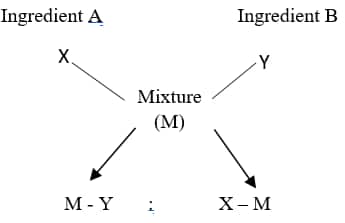
When two ingredients with values $X$ and $Y$ are mixed in a particular ratio so that their mean value becomes $M$, then the ratio of mixing of A and B is given by $(M-Y):(X-M)$.
1. If A and B alone can do a work in $x$ and $y$ days respectively, then the time taken $(T)$ by them to complete the work (working together) will be calculated as
$\frac{1}{T}=\frac{1}{x}+\frac{1}{y}$
2. If A and B alone can do a work in $a$ and $b$ days respectively, while C can destroy (negative work) the whole work in $c$ days, then the time taken $(T)$ by them to complete the work (working together) will be calculated as
$\frac{1}{T}=\frac{1}{a}+\frac{1}{b}-\frac{1}{c}$.
This concept is very useful in the questions of pipes and cisterns.
3. $\frac{(M_1 D_1 H_1)}{W_1} = \frac{(M_2 D_2 H_2)}{W_2}$
Where $M$ & $D$ are the number of men or persons of similar kind and the number of days, respectively.
$H$ is the number of working hours per day (Working Rate), and $W$ is the amount of work done.
Example 1:
A can complete a work in 12 days and B in 18 days. Find the time taken if they work together.
$\frac{1}{T} = \frac{1}{12} + \frac{1}{18} = \frac{5}{36}$
$T = 7.2$ days
Example 2:
A can do a work in 10 days and B in 15 days. After working together for 2 days, A leaves. Find total time to complete the work.
Work done $= \frac{1}{3}$
Remaining work = $\frac{2}{3}$
Time taken = 10 days
Total = 12 days
Example 3:
A can complete work in 20 days, B in 30 days, and C can destroy it in 60 days. Find time taken if all work together.
$\frac{1}{T} = \frac{1}{20} + \frac{1}{30} - \frac{1}{60} = \frac{1}{15}$
$T = 15$ days
1. Speed = $\frac{\text{Distance}}{\text{Time}}$
2. 1 km/hr = $\frac{5}{18}$ m/s
3. Average Speed = $\frac{\text{Total Distance Covered}}{\text{Total Time Taken}}$
If two equal distances are covered at speeds S1 and S2, then the average speed = $\frac{2S_1S_2}{S_1+S_2}$.
4. Trains:
Concept | Formulas | |
1. | Time to cross a moving object by a train (moving in the opposite direction) | $\frac{L_1+L_2}{S_1+S_2}$; Length of train is $L_1$, Length of object $L_2$, $S_1$ is the speed of train, $S_2$ is the speed of moving object. |
2. | Time to cross a moving object by a train (moving in the same direction) | $\frac{L_1+L_2}{S_1-S_2}$; Length of train is $L_1$, Length of object $L_2$, $S_1$ is the speed of train, $S_2$ is the speed of moving object. |
3. | Time taken by a train crossing a platform, bridge, or tunnel. | $\frac{L_1+L_2}{S}$; Length of train is $L_1$, Length of tunnel $L_2$, $S$ is the speed of train. |
Example 1:
A train of length 120 m crosses a pole in 6 seconds. Find its speed.
Speed $= 20$ m/s = 72 km/h
Example 2:
Two trains of lengths 100 m and 150 m move in opposite directions at speeds of 36 km/h and 54 km/h. Find the time taken to cross each other.
Time $= 10$ seconds
Example 3:
A man travels the same distance at 5 km/h and returns at 3 km/h. Find the average speed.
Average speed $= 3.75$ km/h
Tip to Remember: When two trains start simultaneously, meet, and then reach their destinations, the ratio of their speeds is the inverse of the ratio of the square roots of the times they take to reach their destinations after the meeting point.
5. Boats:
Concept | Formulas | |
1. | Effective speed of the boat in upstream (SU) | Speed of boat (SB) - Speed of stream (SR) |
2. | Effective speed of the boat in downstream (SD) | Speed of boat (SB) + Speed of stream (SR) |
3. | Speed of the boat in still water | $\frac{S_U+S_D}{2}$ |
4. | Speed of stream | $\frac{S_U-S_D}{2}$ |
Example 1:
A boat moves upstream at 8 km/h and downstream at 12 km/h. Find the speed of the stream.
Stream speed $= 2$ km/h
Example 2:
A boat travels 30 km downstream in 2 hours and upstream in 3 hours. Find the speed of the boat in still water.
Boat speed $= 12$ km/h
Example 3:
Find the time taken to travel 24 km upstream if boat speed = 10 km/h and stream speed = 2 km/h.
Upstream speed = 8 km/h
Time = 3 hours
6. Circular Motion: If A and B are moving in a circular track with speeds $u$ and $v$ respectively. Length of circular track is $L$. Taking $u:v$ into it’s reduced form as $a:b$:
Concept | Moving in same direction | Moving in opposite direction | |
1. | Number of distinct meeting points | (a – b) or (b – a) | (a + b) |
2. | The time required to meet at the starting point for the first time | LCM of $\frac{L}{u}$ and $\frac{L}{v}$ | LCM of $\frac{L}{u}$ and $\frac{L}{v}$ |
3. | The time required to meet for the first time | $\frac{L}{u-v}$ | $\frac{L}{u+v}$ |
Algebra questions are frequent in AP ICET. Here are the must-know AP ICET Algebra Formulas:
$(a+b)^2=a^2+2ab+b^2$ | $(a-b)^2=a^2-2ab+b^2$ |
$a^3+b^3=(a+b)(a^2-ab+b^2 )$ | $a^3-b^3=(a-b)(a^2+ab+b^2 )$ |
$(a-b)^3=a^3-3a^2 b+3ab^2-b^3$ | $(a+b)^3=a^3+3a^2 b+3ab^2+b^3$ |
$a^2-b^2=(a+b)(a-b)$ | $(a + b + c)^2= a^2+ b^2+ c^2+ 2ab + 2bc + 2ca$ |
$a^3+b^3+c^3-3abc=(a+b+c)(a^2+b^2+c^2-ab-bc-ca)$. If $(a + b + c)= 0$, then $a^3+b^3+c^3=3abc$. |
1.
Polynomial | Sum of zeros | Product of zeros | Sum of zeros taken two at a time |
$ax^2+bx+ c$ | $-\frac{b}{a}$ | $\frac{c}{a}$ | ---- |
$ax^3+bx^2+ cx+d$ | $-\frac{b}{a}$ | $-\frac{d}{a}$ | $\frac{c}{a}$ |
2. For any quadratic equation $ax^2+bx+c=0$ where $a, b$ and $c$ are all real and a is not equal to 0.
Discriminant of a quadratic equation:
D = $(b^2 - 4ac)$ is the discriminant of the quadratic equation.
Nature of roots of a quadratic equation:
(a) If D < 0 (i.e. the discriminant is negative) then the equation has no real roots.
(b) If D > 0, (i.e. the discriminant is positive) then the equation has two distinct roots.
(c) If D = 0, then the quadratic equation has equal roots.
3. Nature of Solutions of a Linear Equation:
A system of linear equations
$a_1 x + b_1 y + c_1= 0$,
and $a_2 x + b_2 y + c_2= 0$
If $\frac{a_1}{a_2} \neq \frac{b_1}{b_2}$, solutions are unique.
If $\frac{a_1}{a_2} = \frac{b_1}{b_2} \neq \frac{c_1}{c_2}$, solutions do not exist.
If $\frac{a_1}{a_2} = \frac{b_1}{b_2} = \frac{c_1}{c_2}$, solutions are infinite.
Example 1 (Using Identities)
If $a + b = 12$ and $ab = 27$, find the value of $a^2 + b^2$.
We know,
$a^2 + b^2 = (a + b)^2 - 2ab$
Substitute values:
$= 12^2 - 2 \times 27 = 144 - 54 = 90$
So, $a^2 + b^2 = 90$
Example 2 (Higher Identity Application)
If $x - \frac{1}{x} = 4$, find the value of $x^2 + \frac{1}{x^2}$.
Using identity:
$x^2 + \frac{1}{x^2} = \left(x - \frac{1}{x}\right)^2 + 2$
Substitute:
$= 4^2 + 2 = 16 + 2 = 18$
Example 3 (Cubic Identity Concept)
If $a + b + c = 0$, find the value of $a^3 + b^3 + c^3$.
Using identity:
$a^3 + b^3 + c^3 = 3abc$
So, answer = $3abc$
Example 4 (Quadratic Roots Concept)
For the equation $x^2 - 7x + 10 = 0$, find the roots.
Factorise:
$x^2 - 7x + 10 = (x - 5)(x - 2)$
Roots = 5, 2
Example 5 (Discriminant-Based Question)
Find the value of $k$ such that the equation $x^2 + kx + 9 = 0$ has equal roots.
Condition for equal roots:
$D = b^2 - 4ac = 0$
So,
$k^2 - 36 = 0$
$k = ±6$
Example 6 (Forming Equation from Roots)
Find the quadratic equation whose roots are 3 and 4.
Sum of roots $= 7$
Product of roots $= 12$
Equation:
$x^2 - 7x + 12 = 0$
Example 7 (Mixed Algebra Concept)
If $a + b = 8$ and $a^2 + b^2 = 40$, find the value of $ab$.
Using:
$a^2 + b^2 = (a + b)^2 - 2ab$
So,
$40 = 64 - 2ab$
$2ab = 24$
$ab = 12$
Example 8 (Advanced Identity Application)
If $x + \frac{1}{x} = 5$, find $x^3 + \frac{1}{x^3}$.
First,
$x^2 + \frac{1}{x^2} = 25 - 2 = 23$
Then,
$x^3 + \frac{1}{x^3} = (x + \frac{1}{x})(x^2 + \frac{1}{x^2} - 1)$
$= 5(23 - 1) = 5 \times 22 = 110$
Geometry is a very crucial topic in the mathematical ability section for AP ICET. Revise the following AP ICET Geometry Formulas carefully:
Area | Perimeter/Circumference | ||
1. | Rectangle | Product of length and Breadth | Twice of sum of length and Breadth |
2. | Triangle | $\frac12 \times \text{Breadth} \times \text{Height}$ | Sum of all sides |
3. | Square | Square of side | 4 times of side |
4. | Circle | $\pi r^2$ | $2\pi r$ where $r$ is the radius of circle |
$a^2+b^2=c^2$ where $a$ and $b$ are the perpendicular sides and $c$ is the hypotenuse.
For 3D figures:
Lateral Surface area | Total Surface Area | Volume | ||
1. | Cube (side = $a$) | $4a^2$ | $6a^2$ | $a^3$ |
2. | Cuboid (Length $L$, Breadth $b$, Height $h$) | $2h(l+b)$ | $2(hl+bh+lb)$ | $lbh$ |
3. | Cylinder (Base radius $r$, Height $h$) | $2\pi rh$ | $2\pi r(h+r)$ | $\pi r^2h$ |
4. | Cone (Base radius $r$, Height $h$, slant height ($l=\sqrt{h^2+r^2}$ ) | $\pi rl$ | $\pi r(l+r)$ | $\frac13 \pi r^2h$ |
5. | Hemisphere (Base radius $r$) | $2\pi r^2$ | $3 \pi r^2$ | $\frac23 \pi r^3$ |
6. | Sphere (Base radius $r$) | --- | $4 \pi r^2$ | $\frac43 \pi r^3$ |
Example 1 (Circle – Percentage Change)
The radius of a circle is increased by 20%. Find the percentage increase in its area.
Area ∝ $r^2$
New area factor $= (1.2)^2 = 1.44$
Increase $= 44%$
Example 2 (Rectangle – Combined Change)
The length of a rectangle is increased by 25%, and the breadth is decreased by 20%. Find the percentage change in area.
New area factor $= 1.25 \times 0.8 = 1$
So, no change in area
Net change $= 0%$
Example 3 (Triangle – Pythagoras Application)
In a right-angled triangle, the base is 9 cm, and the height is 12 cm. Find the hypotenuse.
Using:
$c = \sqrt{9^2 + 12^2} = \sqrt{81 + 144} = \sqrt{225} = 15$
Hypotenuse = 15 cm
Example 4 (Circle – Sector Concept)
Find the area of a sector of a circle of radius 7 cm with central angle $60^\circ$.
Area of sector $= \frac{60}{360} \times \pi r^2$
$= \frac{1}{6} \times \pi \times 49$
$= \frac{49\pi}{6}$
Example 5 (Mensuration – Cylinder)
Find the volume of a cylinder with radius 7 cm and height 10 cm.
Volume $= \pi r^2 h = \pi \times 49 \times 10 = 490\pi$
Example 6 (Sphere – Percentage Change)
The radius of a sphere is increased by 50%. Find the percentage increase in volume.
Volume ∝ $r^3$
New volume factor $= (1.5)^3 = 3.375$
Increase $= 237.5%$
Example 7 (Cube – Dimensional Change)
The side of a cube is doubled. Find the percentage increase in volume.
New volume factor $= 2^3 = 8$
Increase $= 700%$
Example 8 (Combination of Shapes)
A wire of length 44 cm is bent to form a circle. Find the area of the circle.
Circumference $= 44 = 2\pi r$
$r = \frac{44}{2\pi} = 7$
Area $= \pi r^2 = 49\pi$
Example 9 (Rectangle Diagonal Concept)
Find the diagonal of a rectangle with a length of 24 cm and a breadth of 7 cm.
Diagonal $= \sqrt{24^2 + 7^2} = \sqrt{576 + 49} = \sqrt{625} = 25$
Example 10 (Cone – Slant Height Concept)
Find the slant height of a cone with radius 5 cm and height 12 cm.
$l = \sqrt{h^2 + r^2} = \sqrt{144 + 25} = \sqrt{169} = 13$
The above-discussed AP ICET Maths Important Formulas are very crucial during revision.
This section offers access to the Ultimate AP ICET 2026 Mock Test eBook, featuring a wide range of practice questions with detailed solutions and comprehensive explanations. Designed to simulate the actual AP ICET exam pattern, this resource helps candidates improve speed, accuracy, and problem-solving skills.
Download Now: AP ICET: 2026 Mock Test
Why is this formula sheet important?
Yes, for last-minute revision, it plays an important role in certain ways.
Remember:
Topic | Formula | Use Case / Concept |
$\frac{x}{100} \times y$ | Find x% of a number | |
$\frac{\text{Change}}{\text{Original}} \times 100$ | Percentage change | |
$-\frac{x^2}{100}$ | Successive increase & decrease | |
Profit = SP – CP | Calculate profit | |
Loss = CP – SP | Calculate loss | |
$\frac{\text{Profit}}{\text{CP}} \times 100$ | Profit % | |
$\frac{\text{Loss}}{\text{CP}} \times 100$ | Loss % | |
$SI = \frac{PRT}{100}$ | Interest calculation | |
$A = P(1 + \frac{R}{100})^T$ | Amount after time | |
$\frac{a}{b} = \frac{c}{d}$ | Comparison of ratios | |
$\frac{\text{Sum of values}}{n}$ | Mean calculation | |
$\frac{2xy}{x+y}$ | Average speed (equal distance) | |
$\frac{1}{T} = \frac{1}{x} + \frac{1}{y}$ | Combined work | |
Speed=$\frac{\text{Distance}}{\text{Time}}$ | Basic relation | |
$\frac{2S_1S_2}{S_1+S_2}$ | Average speed | |
$S_U = S_B - S_R$ | Upstream speed | |
$S_D = S_B + S_R$ | Downstream speed | |
Algebra (Identities) | $(a+b)^2 = a^2 + 2ab + b^2$ | Expansion |
$a^2 - b^2 = (a+b)(a-b)$ | Factorisation | |
$D = b^2 - 4ac$ | Discriminant | |
Geometry (Circle) | $\pi r^2$ | Area of a circle |
$2\pi r$ | Circumference | |
Mensuration (3D) | Volume of cube = $a^3$ | Cube volume |
Volume of cylinder = $\pi r^2 h$ | Cylinder volume | |
Pythagoras Theorem | $a^2 + b^2 = c^2$ | Right triangle |
This compact and well-structured AP ICET 2026 important formulas list is especially useful for:
Quick revision before mock tests and the final exam
Strengthening core concepts in Arithmetic, Algebra, and Geometry
Improving speed and accuracy in problem-solving
Reducing calculation time using direct formula application
Boosting confidence during exam preparation
Globally Recognized by AACSB (US) & AMBA (UK) | 18 LPA Avg. CTC for PGPM 2026
Test centres are available in 70+ cities across India | 75,000+ aspirants apply for the NMAT exam | Accepted by 58+ institutions like NMIMS, KJSIM, ISB, SPJIMR and Great Lakes.
By regularly revising this AP ICET quantitative aptitude formula sheet, candidates can enhance their performance and attempt more questions within the given time.
The main focus is to solve any question in under a minute. This compact AP ICET Quick Revision Formulas list will certainly help you to achieve this feat.
This section provides a complete, comprehensive guide to the AP ICET 2026 syllabus, exam pattern and preparation strategy and tips in the PDF format. Candidates can access a detailed breakdown of all topics covered in the exam, understand the latest exam pattern, marking scheme, section-wise weightage and follow a smart preparation plan to maximise scores.
Download Now: AP ICET 2026: Complete Syllabus, Preparation Strategy PDF
Using formulas effectively is a skill. Here, we are going to discuss how to use these AP ICET Quant Formulas.
1. Creating a personal AP ICET 2026 formula sheet (Preferably topic-wise).
2. Revise Daily and practice a few questions on each formula. (15 to 20 problems on each formula)
3. Identify weak areas and focus on those.
4. Key topics to focus on: Arithmetic and Algebra.
5. Improve Shortcut Techniques.
Mastering the AP ICET 2026 important formulas is key to scoring well in the Mathematical Ability section. Regular revision, consistent practice, and proper application of formulas will help improve both speed and accuracy. Keep this AP ICET formula sheet handy for quick revision before mock tests and on the final day of the exam.
Frequently Asked Questions (FAQs)
The important topics are:
Arithmetic: Percentage, Profit and Loss, Simple Interest
Algebra: Identities, Equations, Polynomials
Geometry and Mensuration: Area, Perimeter, Volume
There is no fixed number, but candidates should focus on mastering all essential formulas from core topics like Arithmetic, Algebra, and Geometry. Instead of memorising too many formulas, it is better to learn commonly used AP ICET quantitative aptitude formulas and practice their application regularly.
Formulas to calculate areas, perimeter, LSA, TSA, and Volume. All are important.
Make a one-page formula sheet
Focus on high-weightage topics
Revise shortcuts
In AP ICET 2026 Mathematical Ability, Arithmetic carries the highest weightage (around 40–50%), followed by Algebra (20–25%) and Geometry & Mensuration (10–15%). Topics like Percentage, Profit & Loss, Time and Work, and Averages are especially important and should be prioritised during preparation.

On Question asked by student community
Hello Dear Student,
The AP ICET 2026 counselling for MBA admissions is currently underway, with certificate verification and registration processes actively ongoing
You can check, find and access more information here:
Hello, if you belong to the OC category and are applying under the EWS category, you will need to submit your EWS certificate during AP ICET counselling. A caste certificate is usually not required for OC candidates, as it is mainly needed for candidates applying under BC, SC, or ST
Hello Mavuluru,
Here are the links to the AP DEECET previous year question papers:
Hello Dear Student,
Yes, with a rank of 1639 in the BC-D female category, you have a solid chance of securing a seat in Andhra University (AU) and JNTU, though Sri Venkateswara University (SVU) might be slightly difficult.
You can check, find and access more information here:
https://bschool.careers360.com/articles/ap-icet-colleges-list-2026-rank-wise-caste-wise-cutoff
Hope it
Hello Dear Student,
With an AP ICET rank of 4,184 , you are in a good position for admission into many reputed MBA/MCA colleges in Andhra Pradesh.
At this rank, you can get good chances in:
through Category B or Category C admissions.

Globally Recognized by AACSB (US) & AMBA (UK) | 18 LPA Avg. CTC for PGPM 2026
75+ years of legacy | #1 Entrance Exam | Score accepted by 250+ BSchools
6-Hour Masterclass to help you score 99+ percentile in CAT 2026
Test centres are available in 70+ cities across India | 75,000+ aspirants apply for the NMAT exam | Accepted by 58+ institutions like NMIMS, KJSIM, ISB, SPJIMR and Great Lakes.
Registration Start: 3 August 2026 | Last Date to Apply: 15 September 2026 (till 5 PM)
AACSB Accredited | 40 LPA-Highest CTC | Scholarships worth 10 CR