Great Lakes - PGDM & PGPM Admissions 2027
Globally Recognized by AACSB (US) & AMBA (UK) | 18 LPA Avg. CTC for PGPM 2026


Running out of time before IPMAT 2026 and still unsure about Time, Speed and Distance? That is exactly where many aspirants get stuck. The topic looks simple at first, but in the actual exam, it is your speed of thinking, not just formulas, that decides your score. With IPMAT Indore scheduled for May 4, 2026 and IPMAT Rohtak on May 10, 2026, this is the right time to move from just learning concepts to focusing on shortcuts, patterns, and smart question selection. The good part is that if you prepare this topic properly, it can become one of the fastest-scoring areas in the Quant section. In this article, you will find all the important Time, Speed and Distance formulas for IPMAT 2026, easy tricks to solve questions quickly, commonly tested concepts, and practice questions with solutions to help you revise effectively in the final days before the exam.
This Story also Contains

Time, Speed and Distance is one of the most scoring and predictable topics in IPMAT 2026 Quantitative Ability, especially during the final phase of preparation. Instead of trying to cover too many new topics, focusing on areas like this can help you maximize marks with relatively less effort. The advantage of this topic is that questions are formula-based, pattern-driven, and frequently repeated, which makes it suitable for quick revision and improving accuracy.
With the right approach, this topic can help you increase your attempts, manage time better during the exam, and reduce calculation errors.
In IPMAT, Time, Speed and Distance is a core arithmetic topic that tests how effectively you can apply basic concepts to different types of problems. Questions are not usually direct, so you need to interpret the situation and decide the correct method quickly.
Common question types include:
Trains and platforms
Boats and streams
Relative speed problems
Average speed concepts
Globally Recognized by AACSB (US) & AMBA (UK) | 18 LPA Avg. CTC for PGPM 2026
Test centres are available in 70+ cities across India | 75,000+ aspirants apply for the NMAT exam | Accepted by 58+ institutions like NMIMS, KJSIM, ISB, SPJIMR and Great Lakes.
The focus is on understanding patterns, applying the right formula, and solving questions efficiently under time pressure.
Many students ask:
What is the importance of Time, Speed and Distance in IPMAT 2026?
“Time, Speed and Distance is one of the most important arithmetic topics in IPMAT Quantitative Ability. It is frequently asked and offers easy to moderate questions, making it a reliable scoring area for improving overall marks.”
The exact number of questions may vary, but based on past trends, Time, Speed, and Distance has a consistent presence in the arithmetic section.
Questions are generally moderate in difficulty
Often requires both logic and calculation
Emphasis on speed and concept application
Questions are more direct and formula-based
Slightly easier but still time-bound
Good opportunity to score quickly
On average, you can expect around 2 to 4 questions from this topic, making it a high-impact area for improving your score.
Want to check and compare the detailed syllabus?
Download: IPMAT Indore & Rohtak 2026: Latest Syllabus with High-Weightage Topics, Exam Pattern
Speed is the rate of distance covered in one hour. The relationship among time, speed, and distance is given by $\boxed{\text{Distance = Speed} \times {\text{Time}}}$
Having a clear grip on formulas is essential, but the real advantage comes when you can recall and apply them instantly during the exam. The table below includes all the important formulas used in Time, Speed and Distance questions for IPMAT.
|
Concept |
Formula |
Description |
|
Basic Relation |
$D = S \times T$ |
Distance is obtained by multiplying speed and time. |
|
Speed |
$S = \frac{D}{T}$ |
Speed is calculated as distance covered per unit time. |
|
Time |
$T = \frac{D}{S}$ |
Time is calculated by dividing distance by speed. |
|
Concept |
Formula |
Description |
|
m/s to km/hr |
$1 \text{ m/s} = \frac{18}{5} \text{ km/hr}$ |
Multiply by 18/5 to convert meters per second into km/hr. |
|
km/hr to m/s |
$1 \text{ km/hr} = \frac{5}{18} \text{ m/s}$ |
Multiply by 5/18 to convert km/hr into meters per second. |
|
Concept |
Formula |
Description |
|
General Case |
$\text{Average Speed} = \frac{\text{Total Distance}}{\text{Total Time}}$ |
Used when distances and times vary across the journey. |
|
Equal Distance |
$\text{Average Speed} = \frac{2xy}{x + y}$ |
Used when equal distances are covered at different speeds. |
|
Equal Time |
$\text{Average Speed} = \frac{x + y}{2}$ |
Used when equal time intervals are spent at different speeds. |
|
Concept |
Formula |
Description |
|
Same Direction |
$x - y$ |
Relative speed is the difference of speeds when moving in the same direction. |
|
Opposite Direction |
$x + y$ |
Relative speed is the sum of speeds when moving towards each other. |
|
Concept |
Formula |
Description |
|
Crossing Pole/Person |
$T = \frac{l}{s}$ |
Time taken by a train to cross a stationary point depends only on its length and speed. |
|
Crossing Platform/Tunnel |
$T = \frac{l + d}{s}$ |
Total distance includes both train length and platform length. |
|
Two Trains (Same Direction) |
$T = \frac{l_1 + l_2}{s_1 - s_2}$ |
Use difference of speeds when trains move in the same direction. |
|
Two Trains (Opposite Direction) |
$T = \frac{l_1 + l_2}{s_1 + s_2}$ |
Use sum of speeds when trains move towards each other. |
|
Concept |
Formula |
Description |
|
Downstream Speed |
$v_d = u + v$ |
Boat speed increases when moving with the stream. |
|
Upstream Speed |
$v_u = u - v$ |
Boat speed decreases when moving against the stream. |
|
Speed in Still Water |
$u = \frac{v_d + v_u}{2}$ |
Average of upstream and downstream speeds gives still water speed. |
|
Speed of Stream |
$v = \frac{v_d - v_u}{2}$ |
Half the difference between downstream and upstream speeds gives stream speed. |
|
Distance Downstream |
$D = (x + y)\times t$ |
Distance is calculated using combined speed in downstream motion. |
|
Distance Upstream |
$D = (x - y)\times t$ |
Distance is calculated using reduced speed in upstream motion. |
|
Concept |
Formula |
Description |
|
First Meeting (Same Direction) |
$t = \frac{D}{a - b}$ |
Time depends on combined speed when moving in same directions. |
|
First Meeting (Opposite Direction) |
$t = \frac{D}{a + b}$ |
Time depends on combined speed when moving in opposite directions. |
|
Meeting at Starting Point |
$t = \text{LCM}\left(\frac{D}{a}, \frac{D}{b}\right)$ |
Time when both complete whole laps and return to start together. |
|
Meeting Points (Same Direction) |
$x-y$ |
Meeting Points (Same Direction) |
|
Meeting Points (Opposite Direction) |
$x + y$ |
Meeting Points (Opposite Direction) |
|
Concept |
Formula |
Description |
|
Speed of Hour Hand |
$0.5^\circ$/minute |
Hour hand moves half a degree per minute. |
|
Speed of Minute Hand |
$6^\circ$/minute |
Minute hand moves six degrees per minute. |
|
Angle Between Hands |
$\theta = \left| \frac{11}{2}M - 30H \right|$ |
Angle Between Hands |
Now, here comes a common question:
Is Time, Speed and Distance easy for IPMAT?
The topic is considered easy to moderate. With proper understanding of formulas, shortcuts, and regular practice, most questions can be solved quickly and accurately.
Time, speed, and distance questions can be solved using the formulas discussed above directly. But with help of smart techniques that we are going to discuss in this section, you will be able to solve IPMAT TSD questions in more effective ways:
1. Using Ratio and Proportion:
The method is to use ratio and proportion.
Speed is indirectly proportional to distance which gives
$\boxed{\frac{S_1}{S_2}=\frac{T_2}{T_1}}$
Example: If speed gets four times, time becomes one fourth keeping the distance the same.
2. Finding change in time using percentage:
Percentage decrease in Time taken $= \frac{x}{100 + x} \times 100$ when speed increases by $x \%$
Percentage increase in Time taken $= \frac{x}{100 - x} \times 100$ when speed decreases by $x \%$
Using the concept of percentage and ratio, IPMAT TSD questions can be solved in minimum time with accuracy. To understand how to solve TSD for IPMAT 2026, following points will be useful:
Identify the given parameters in the question and what needs to be calculated.
Use the appropriate formula.
Check the units of distance, speed, and time. For instance, if distance is given in metres then speed should be taken in metres per second.
Avoid calculation mistakes.
Use estimation and elimination.
This structured approach will boost your confidence in IPMAT Time speed and distance questions.
While preparing TSD for IPMAT, divide questions in two categories: Basic and Advanced. Start preparing with basic questions to build fundamentals. Below are some IPMAT TSD important questions with solutions.
Question 1: A car travels 270 km in 5 hours. What is its speed in metres per second?
Solution:
Speed $= \frac{\text{Distance}}{\text{Time}}$
$= \frac{270}{5}$ km/hr
$= 54$ km/hr
Convert km/hr to m/s:
$54 \times \frac{5}{18}$
$= \frac{54 \times 5}{18}$
$= \frac{270}{18}$
$= 15$ m/s
Answer: 15 m/s
Question 2: A train 150 m long crosses another train in 10 seconds. Find the length of the other train if both are approaching each other with speeds of 36 km/hr and 72 km/hr.
Solution:
$s_1 = 36 \times \frac{5}{18} = 10$ m/s
$s_2 = 72 \times \frac{5}{18} = 20$ m/s
Relative speed $= 10 + 20 = 30$ m/s
$10 = \frac{150 + l_2}{30}$
$10 \times 30 = 150 + l_2$
$300 = 150 + l_2$
$l_2 = 300 - 150$
$l_2 = 150$ m
Answer: 150 m
Question 3: A boat goes 40 km downstream in 2.5 hours and returns upstream in 4 hours. Find the speed of the boat in still water and the stream.
Solution:
Downstream speed $= \frac{40}{2.5}$
$= 16$ km/hr
Upstream speed $= \frac{40}{4}$
$= 10$ km/hr
Speed of boat in still water $= \frac{16 + 10}{2}$
$= \frac{26}{2}$
$= 13$ km/hr
Speed of stream $= \frac{16 - 10}{2}$
$= \frac{6}{2}$
$= 3$ km/hr
Answer: Boat speed = 13 km/hr, Stream speed = 3 km/hr
Question 4: A car covers a certain distance at 62 km/hr and returns at 38 km/hr. Find the average speed of the car over the entire journey.
Solution:
Average speed for equal distances $= \frac{2 s_1 s_2}{s_1 + s_2}$
$= \frac{2 \times 62 \times 38}{62 + 38}$
$= \frac{2 \times 62 \times 38}{100}$
$= \frac{4712}{100}$
$= 47.12$ km/hr
Answer: 47.12 km/hr
Question 5: If the speed of a car is increased by 40%, by what percentage will the time taken by the car be reduced?
Solution:
Percentage decrease in time $= \frac{x}{100 + x} \times 100$
$= \frac{40}{140} \times 100$
$= \frac{4000}{140}$
$= 28.57%$
Answer: 28.57%
Question 6: Two persons start from the same point and move in the same direction at 13 km/hr and 9 km/hr at the same time. How much time will the faster person take to be 3200 metres ahead of the slower person?
Solution:
Relative speed $= 13 - 9$
$= 4$ km/hr
Distance $= 3200$ m
$= 3.2$ km
Time $= \frac{3.2}{4}$
$= 0.8$ hours
Convert to minutes:
$0.8 \times 60$
$= 48$ minutes
Answer: 0.8 hours or 48 minutes
Question 7: A man travels a distance of 120 km at a speed of 40 km/hr and returns at a speed of 60 km/hr. Find his average speed for the whole journey.
Solution:
Average speed for equal distances $= \frac{2 s_1 s_2}{s_1 + s_2}$
$= \frac{2 \times 40 \times 60}{40 + 60}$
$= \frac{2 \times 40 \times 60}{100}$
$= \frac{4800}{100}$
$= 48$ km/hr
Answer: 48 km/hr
Question 8: Two trains of lengths 150 m and 100 m are moving in opposite directions at speeds of 45 km/hr and 55 km/hr respectively. In how much time will they cross each other?
Solution:
Total length $= 150 + 100$
$= 250$ m
Relative speed $= 45 + 55$
$= 100$ km/hr
Convert to m/s:
$100 \times \frac{5}{18}$
$= \frac{500}{18}$ m/s
Time $= \frac{\text{Total Length}}{\text{Relative Speed}}$
$= \frac{250}{500/18}$
$= \frac{250 \times 18}{500}$
$= \frac{4500}{500}$
$= 9$ seconds
Answer: 9 seconds
Question 9: A boat goes 30 km downstream in 2 hours and returns upstream in 3 hours. Find the speed of the boat in still water.
Solution:
Downstream speed $= \frac{30}{2}$
$= 15$ km/hr
Upstream speed $= \frac{30}{3}$
$= 10$ km/hr
Speed in still water $= \frac{15 + 10}{2}$
$= \frac{25}{2}$
$= 12.5$ km/hr
Answer: 12.5 km/hr
Question 10: A car increases its speed by 25% and takes 2 hours less to cover a certain distance. Find the original time taken.
Solution:
Let original time $= T$
Original speed $= S$
New speed $= 1.25S = \frac{5}{4}S$
Time is inversely proportional to speed
New time $= \frac{4}{5}T$
$T - \frac{4}{5}T = 2$
$\frac{1}{5}T = 2$
$T = 2 \times 5$
$T = 10$ hours
Answer: 10 hours
Question 11: Two persons start from the same point in the same direction at speeds of 6 km/hr and 10 km/hr. After how much time will they be 20 km apart?
Solution:
Relative speed $= 10 - 6$
$= 4$ km/hr
Time taken $= \frac{20}{4}$
$= 5$ hours
Answer: 5 hours
Question 12: A train 200 m long crosses a platform 300 m long in 25 seconds. Find the speed of the train.
Solution:
Total distance $= 200 + 300$
$= 500$ m
Speed $= \frac{500}{25}$
$= 20$ m/s
Convert to km/hr:
$20 \times \frac{18}{5}$
$= \frac{360}{5}$
$= 72$ km/hr
Answer: 72 km/hr
Question 13: A person travels one-third of a distance at 30 km/hr and the remaining distance at 60 km/hr. Find the average speed.
Solution:
Let total distance $= 3d$
First part distance $= d$
Second part distance $= 2d$
Time for first part $= \frac{d}{30}$
Time for second part $= \frac{2d}{60}$
$= \frac{d}{30}$
Total time $= \frac{d}{30} + \frac{d}{30}$
$= \frac{2d}{30}$
$= \frac{d}{15}$
Average speed $= \frac{\text{Total Distance}}{\text{Total Time}}$
$= \frac{3d}{d/15}$
$= 3d \times \frac{15}{d}$
$= 45$ km/hr
Answer: 45 km/hr
Question 14: If the speed of a car is increased by 40%, by what percentage will the time taken by the car be reduced?
Solution:
Percentage decrease in time $= \frac{x}{100 + x} \times 100$
$= \frac{40}{140} \times 100$
$= \frac{4000}{140}$
$= 28.57%$
Answer: 28.57%
Question 8: A man walks at 5 km/hr and is 10 minutes late. If he walks at 6 km/hr, he is 5 minutes early. Find the distance he has to cover.
Solution: Let distance $= D$
Time difference $= 10 + 5 = 15$ minutes $= \frac{1}{4}$ hour
$\frac{D}{5} - \frac{D}{6} = \frac{1}{4}$
Taking LCM:
$\frac{6D - 5D}{30} = \frac{1}{4}$
$\frac{D}{30} = \frac{1}{4}$
$D = \frac{30}{4} = 7.5$ km
Answer: 7.5 km
Here are more IPMAT 2026 TSD questions and answers for self-practice.
Question 1: A cyclist covers 90 km in 3 hours. Find his speed in m/s.
Answer: $\frac{25}{3}$ m/s
Question 2: A train moving at 54 km/hr crosses a man standing on a platform in 13 seconds. Find the length of the train.
Answer: 117 metres
Question 3: Two cars are 240 km apart and move in the same direction. The slower car is ahead initially. After how much time will the faster car be 20 km ahead of the slower car if their speeds are 50 km/hr and 40 km/hr?
Answer: 26 hours
Question 4: A person reduces his speed to 60% of his original speed. By what percentage does his travel time increase?
Answer: 37.5%
Question 5: A man travels a certain distance at 30 km/hr and returns at 20 km/hr. If the total time taken for the journey is 10 hours, find the distance.
Answer: 120 km
Question 6: A car covers one-fourth of a journey at 25 km/hr, one-third at 20 km/hr, and the remaining distance at 40 km/hr. Find the average speed of the car for the entire journey.
Answer: 27 km/hr approx
Question 7: A train 200 m long is running at 72 km/hr. In how much time will it cross a platform 300 m long?
Answer: 25 seconds
Question 8: A boat can travel at 12 km/hr in still water. If the speed of the stream is 3 km/hr, find the time taken to go 45 km downstream.
Answer: 3 hours
Question 9: Two trains running in opposite directions at 60 km/hr and 90 km/hr cross each other in 12 seconds. Find the total length of the two trains.
Answer: 500 metres
Question 10: A person walks at 4 km/hr and reaches his destination 15 minutes late. If he walks at 5 km/hr, he reaches 10 minutes early. Find the distance to the destination.
Answer: 5 km
What you need to do:
Practice similar questions first from a good book like Arun Sharma for quantitative aptitude for CAT. After this you need to increase the difficulty level to build confidence in TSD questions.
In IPMAT, solving fast is not about doing more calculations, it is about doing fewer steps with the right approach. Most Time, Speed and Distance questions follow fixed patterns, so if you identify the type early, you can apply shortcuts instead of lengthy formulas.
The idea is to simplify before solving. Instead of directly applying formulas, look for ways to reduce calculation.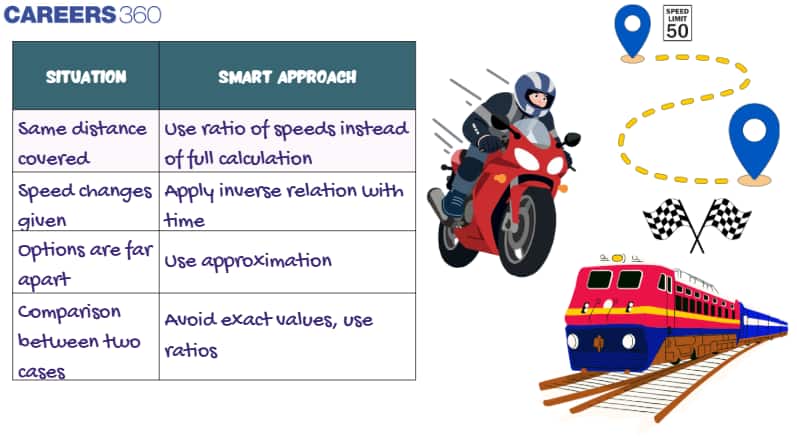 This approach helps you save time and avoid calculation errors.
The ratio method is one of the fastest ways to solve Time, Speed and Distance questions, especially when speed or time is changing.
Key concept:
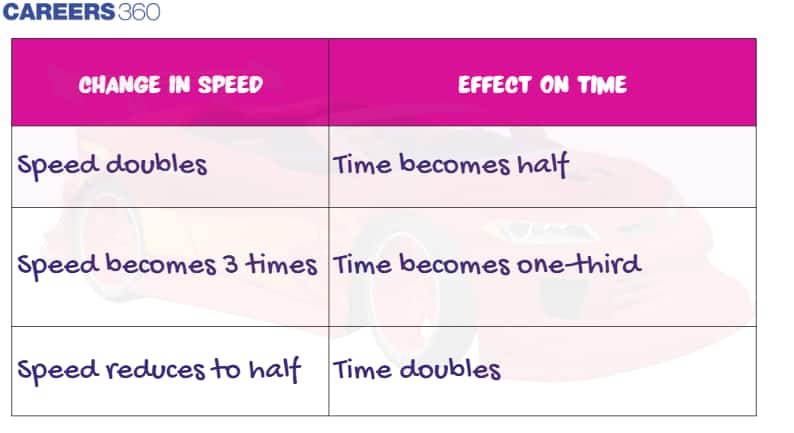
Instead of calculating actual values, just compare ratios.
Where to use:
Same distance problems
Speed comparison questions
Questions with multiple people or journeys
This method is highly effective in IPMAT because many questions are built around proportional relationships.
Percentage-based thinking is useful when questions involve increase or decrease in speed or time.
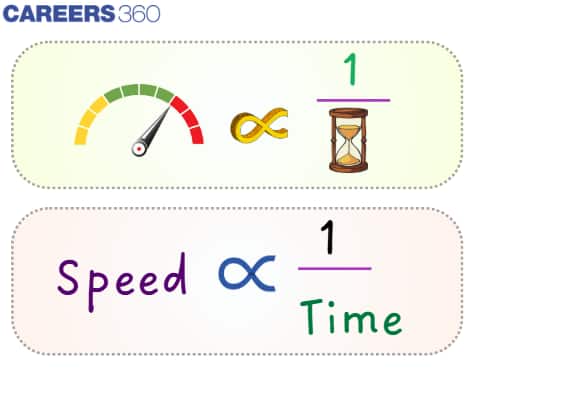
Important insight:
The change is inverse, not direct
Always convert percentage into fraction for faster solving
Example thinking:
If speed increases by 25 percent, convert it to 5/4 and adjust time accordingly instead of doing full calculation.
Where to use:
Speed increase or decrease
Time reduction questions
Efficiency-based problems
Most IPMAT questions are not unique. They follow repeated patterns, and recognizing them can save a lot of time.
|
Question Type |
What to Focus On |
|
Train problems |
Length and relative speed |
|
Two trains crossing |
Sum of speeds |
|
Boats and streams |
Upstream and downstream relation |
|
Relative speed |
Same or opposite direction |
|
Average speed |
Distance or time condition |
These patterns appear regularly with slight variations.
Before solving, spend a few seconds identifying the structure of the question.
|
Clue in Question |
Best Approach |
|
Same distance mentioned |
Use ratio or average speed |
|
Two moving objects |
Use relative speed |
|
Increase or decrease given |
Apply percentage or ratio |
|
Train-related data |
Focus on length and speed |
The key is to recognize first, then solve. This reduces unnecessary steps and helps you attempt more questions within the time limit.
Check out the detailed IPMAT 2026 Preparation Strategy: Study Plan, Time Management and Section-wise preparation tips PDF
Choosing the right books for Time, Speed and Distance can make a noticeable difference in your IPMAT preparation. Instead of using too many resources, it is better to focus on a few high-quality aptitude books that cover concepts clearly, provide exam-level practice, and help build speed. The books listed below are widely used by IPMAT aspirants and are effective for strengthening fundamentals as well as practicing advanced questions.
|
Book Name |
Author |
Why to Use |
|
Quantitative Aptitude for Competitive Examinations |
R.S. Aggarwal |
Best for building basic concepts and practicing a large variety of Time, Speed and Distance questions |
|
Fast Track Objective Arithmetic |
Rajesh Verma |
Useful for shortcut methods, tricks, and faster problem-solving techniques |
|
Quantitative Aptitude Quantum CAT |
Sarvesh K. Verma |
Good for higher-level practice and concept clarity, suitable for IPMAT-level questions |
|
How to Prepare for Quantitative Aptitude for CAT |
Arun Sharma |
Structured approach with difficulty levels, helpful for concept building and exam-oriented practice |
|
NCERT Mathematics (Class 9 and 10) |
NCERT |
Strong foundation for basic concepts, useful for beginners before moving to advanced books |
These books together help in covering concept clarity, shortcut techniques, and exam-level practice, which are essential for improving speed and accuracy in Time, Speed and Distance for IPMAT 2026.
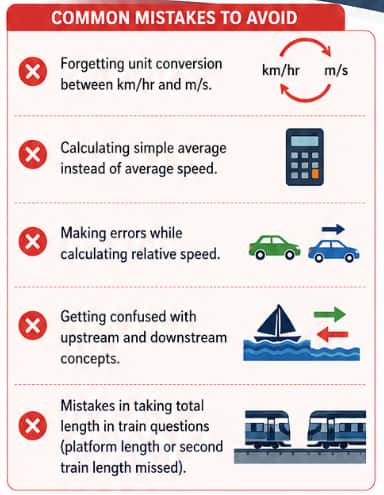
While solving the IPMAT arithmetic questions TSD, students generally make the mistakes discussed below and these mistakes are to be avoided.
Students often forget to consider unit conversion
In the questions of average speed, they calculate the average of speeds in place of average speed.
Do mistakes while calculating relative speed
Getting confused with upstream and downstream concepts
Students often do mistakes in taking the total length in questions of trains
Time speed distance for IPMAT 2026, can be improved with the help of following expert tips:
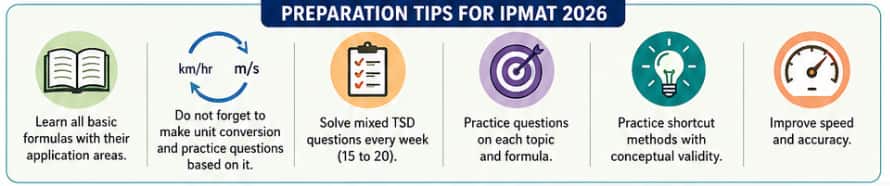
A strong conceptual knowledge with short tricks will improve your speed in time speed distance for IPMAT 2026 and your performance definitely boost up. Follow the guidelines and preparation tips in this article and practice enough IPMAT 2026 TSD questions and answers to build confidence.
Stay tuned for further updates and new articles.
Get exam-ready with our IPMAT 2026 Indore free mock test, designed to match the latest exam pattern and difficulty level. Practice in a real test environment, improve speed and accuracy, and analyze your performance before the actual exam.
Attempt Now: IPMAT Indore 2026 Free Mock Test
You can also download and practice with IPMAT Mock Test Series PDF (5 Sets)
Explore other important Quantitative Aptitude topics that are frequently asked in IPMAT and help build a strong foundation for problem-solving. These topics complement Time, Speed and Distance and are essential for improving overall accuracy and speed in the exam.
|
Quantitative Aptitude Topics | |||

Frequently Asked Questions (FAQs)
Start with basic formulas, then practice topic-wise questions, followed by mixed questions. Focus on speed, accuracy, and applying shortcuts correctly.
NCERT helps in building basic concepts, but for IPMAT level, you should also practice from aptitude books that include higher-level and exam-oriented questions.
Important topics include trains, boats and streams, relative speed, and average speed. These are the most frequently asked areas.
Skipping this topic is not advisable because it is scoring and frequently asked. Even basic preparation can help you secure easy marks in the exam.
Based on previous trends, around 2 to 4 questions can be expected from Time, Speed and Distance in IPMAT. The exact number may vary, but the topic consistently appears in the exam.

On Question asked by student community
Hello Dear Student,
The AP ICET 2026 counselling for MBA admissions is currently underway, with certificate verification and registration processes actively ongoing
You can check, find and access more information here:
Hello, if you belong to the OC category and are applying under the EWS category, you will need to submit your EWS certificate during AP ICET counselling. A caste certificate is usually not required for OC candidates, as it is mainly needed for candidates applying under BC, SC, or ST
Hello Mavuluru,
Here are the links to the AP DEECET previous year question papers:
Hello Dear Student,
Yes, with a rank of 1639 in the BC-D female category, you have a solid chance of securing a seat in Andhra University (AU) and JNTU, though Sri Venkateswara University (SVU) might be slightly difficult.
You can check, find and access more information here:
https://bschool.careers360.com/articles/ap-icet-colleges-list-2026-rank-wise-caste-wise-cutoff
Hope it
Hello Dear Student,
With an AP ICET rank of 4,184 , you are in a good position for admission into many reputed MBA/MCA colleges in Andhra Pradesh.
At this rank, you can get good chances in:
through Category B or Category C admissions.

Globally Recognized by AACSB (US) & AMBA (UK) | 18 LPA Avg. CTC for PGPM 2026
75+ years of legacy | #1 Entrance Exam | Score accepted by 250+ BSchools
6-Hour Masterclass to help you score 99+ percentile in CAT 2026
Test centres are available in 70+ cities across India | 75,000+ aspirants apply for the NMAT exam | Accepted by 58+ institutions like NMIMS, KJSIM, ISB, SPJIMR and Great Lakes.
Registration Start: 3 August 2026 | Last Date to Apply: 15 September 2026 (till 5 PM)
AACSB Accredited | 40 LPA-Highest CTC | Scholarships worth 10 CR