
Search Colleges, Exams, Schools & more


Login
CAT Some Results on Chord and Circle - Practice Questions & MCQ
Edited By admin | Updated on Oct 04, 2023 04:20 PM | #CAT
Quick Facts
-

4 Questions around this concept.
Solve by difficulty
 EASY
EASYTwo chords AB and CD of a circle intersect each other at P outside the circle. If AB = 2 cm, BP = 6 cm, and CP = 2.5 cm. Then PD is:

Concepts Covered - 1
Some Results on Chord and Circle
Result 1: If two chords of a circle intersect each other, then the products of the lengths of their segments are equal.
Let us prove this
Case 1: Let the two chords intersect internally (inside the circle).
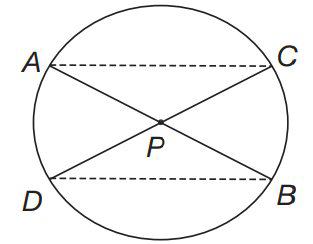
Let AB and CD are two chords intersecting at point P in the circle, and we have to prove (PA) (PB) = (PC) (PD).
Join AC and BD.
In triangles APC and PDB,
∠APC = ∠DPB (Vertically opposite angels)
∠CAP = ∠CDB (Angles made by arc BC in the same segment)
ΔAPC is similar to ΔDPB. (by the AA Similarity Property)
Case 2: Let the two chords intersect externally (outside the circle).
Let two chords BA and CD intersect at point P which lies outside the circle, and we have to prove (PA) (PB) = (PC) (PD).
Join AC and BD.
In triangles PAC and PDB,
∠PAC = ∠PDB
and ∠PCA = ∠PBD
(An external angle of a cyclic quadrilateral is equal to the interior angle at the opposite vertex)
ΔPAC is similar to ΔPDB. (by the AA Similarity Property)
Result 2: The converse of the above Result is also true, i.e., if two line segments AB and CD intersect at P and (PA)(PB) = (PC)(PD), then the four points are concyclic.
Result 3: If one of the secants (say PCD) is rotated around P so that it becomes a tangent, i.e., points C and D say at T, coincide. We get the following result:
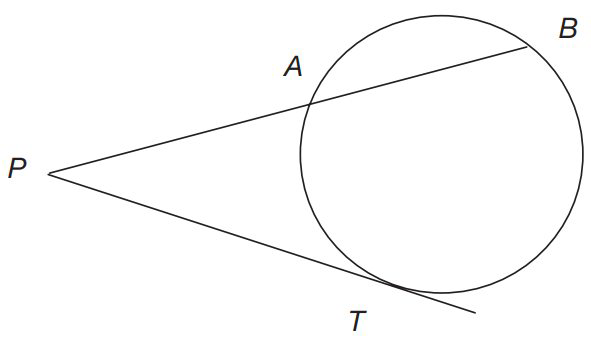
If PAB is a secant to a circle intersecting the circle at A and B and PT is the tangent drawn from P to the circle, then PA · PB = PT2
"Stay in the loop. Receive exam news, study resources, and expert advice!"
Get Answer to all your questions

MBA/PGDM Admissions OPEN
Ranked among top 10 B-Schools in India by multiple publications | Top Recruiters-Google, MicKinsey, Amazon, BCG & many more.
GITAM University Admissions 2026
ApplyAICTE Approved | NAAC A++ | Category 1 University by MHRD | Highest CTC 1.4 Cr LPA from Amazon | Application Deadline: 29th May'26
PP Savani University MBA Admissions 2026
ApplyMBA @ P P Savani University | NAAC A+ Grade | 100% Placement Assistance | Apply Now
N. L. Dalmia Institute of Management, PGDM Admissions 2026
ApplyAICTE Approved | NBA Accredited | NAAC A+(2nd Cycle) Accredited. Highest CTC: 24 LPA | Average CTC: 11.17 LPA
Siva Sivani Institute of Management PGDM Admissions 2026
Apply98.74% Students Placed | 180+ Recruiters on Campus | Average CTC 7.25 LPA
Sharda University Admissions 2026
ApplyNorth India's Largest Educational Group | NIRF Ranked 87 | NAAC A+ Grade | Highest Package 1.6 Cr | Avail 50% Waiver on Application Fee | Last Date: 31st May'26