
Search Colleges, Exams, Schools & more


Login
CAT Line and Circle - (Part 1) - Practice Questions & MCQ
Edited By admin | Updated on Oct 04, 2023 04:20 PM | #CAT
Quick Facts
-

2 Questions around this concept.
Solve by difficulty
 MEDIUM
The maximum number of common points between a line and a circle is:
A straight line can meet a circle at one point only. (True/False)
Concepts Covered - 1
Line and Circle - (Part 1)
Let us consider a circle and a line AB. There can be three possibilities given
Case 1
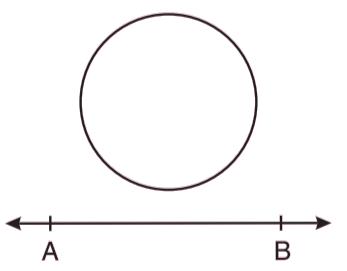
The line AB and the circle have no common point. In this case, AB is called a non-intersecting line with respect to the circle.
Case 2
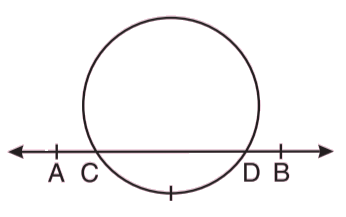
In the above figure there are two common points C and D that the line AB and the circle have. In this case, we call the line AB a secant of the circle.
Case 3
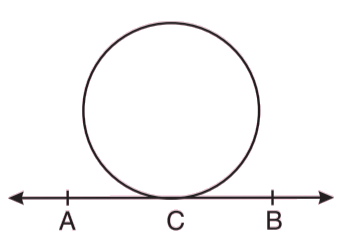
In the above figure there is only one point C which is common to the line AB and the circle. In this case, the line is called a tangent to the circle.
The point C is called the point of contact of line AB with the circle. This point is common to the tangent and the circle.
Basically a tangent to a circle is a line that intersects the circle at only one point.
The word ‘tangent’ comes from the Latin word ‘tangere’, which means to touch and was introduced by the Danish mathematician Thomas Fineke in 1583.
You must have seen the train several times. Have you ever noticed the position of these railway tracks and the wheels of the train? If yes, you might have seen that the railway track is a straight path and the wheels of the train move on these tracks. The wheels are always in contact with the track. Hence, we say that the track is tangent to the wheels of the train.
"Stay in the loop. Receive exam news, study resources, and expert advice!"
Get Answer to all your questions

MBA/PGDM Admissions OPEN
Ranked among top 10 B-Schools in India by multiple publications | Top Recruiters-Google, MicKinsey, Amazon, BCG & many more.
GITAM University Admissions 2026
ApplyAICTE Approved | NAAC A++ | Category 1 University by MHRD | Highest CTC 1.4 Cr LPA from Amazon | Application Deadline: 29th May'26
PP Savani University MBA Admissions 2026
ApplyMBA @ P P Savani University | NAAC A+ Grade | 100% Placement Assistance | Apply Now
N. L. Dalmia Institute of Management, PGDM Admissions 2026
ApplyAICTE Approved | NBA Accredited | NAAC A+(2nd Cycle) Accredited. Highest CTC: 24 LPA | Average CTC: 11.17 LPA
Siva Sivani Institute of Management PGDM Admissions 2026
Apply98.74% Students Placed | 180+ Recruiters on Campus | Average CTC 7.25 LPA
Sharda University Admissions 2026
ApplyNorth India's Largest Educational Group | NIRF Ranked 87 | NAAC A+ Grade | Highest Package 1.6 Cr | Avail 50% Waiver on Application Fee | Last Date: 31st May'26