
Search Colleges, Exams, Schools & more


Login
CAT Introduction to Radian - Practice Questions & MCQ
Edited By admin | Updated on Oct 04, 2023 04:20 PM | #CAT
Quick Facts
-

5 Questions around this concept.
Solve by difficulty
 MEDIUM
π is the ratio of the diameter of any circle to its circumference. (True/False)
The circumference of a circle C = $2\pi d$, where $d$ = diameter of a circle. (True/False)
One radian is the measure of the central angle of a circle that intercepts an arc equal in length to the radius of that circle. (True/False)
Latest: CAT 2025 College Predictor
Don't Miss: IIM -A Comprehensive Guide
CAT 2025 QP's & Solutions: Slot 1 | Slot 2 | Slot 3 | All Slot
Also See: Best Private MBA Colleges in India
1-radian measures 600. (True/False)
Which of the following is true:
Concepts Covered - 1
Introduction to Radian
In the previous classes or chapters, we have studied measure of angle in degree (º) only. In this concept, we will learn about new measure of angle, which is radian.
Before that let's first study defination of π.
The Defination of π
It is no doubt that you know the value for the famous irrational number π = 3.14..but that is not its definition.
π is the ratio of the circumference of any circle to the diameter of that circle. This is the defination of π.
Now, think of the process of drawing a circle. Imagine that you stop before the circle is completed. The portion that you drew is referred to as an arc. An arc may be a portion of a full circle, a full circle, or more than a full circle, represented by more than one full rotation. The length of the arc around an entire circle is called the circumference of that circle.
As we know that the circumference of a circle, C = 2πr. If we divide both sides of this equation by r, we create the ratio of the circumference, which is always 2π, to the radius, regardless of the length of the radius. So the circumference of any circle is 2π = 6.28... times the length of the radius. That means that if we took a string as long as the radius and used it to measure consecutive lengths around the circumference, there would be room for six full string-lengths and a little more as shown in the figure below.
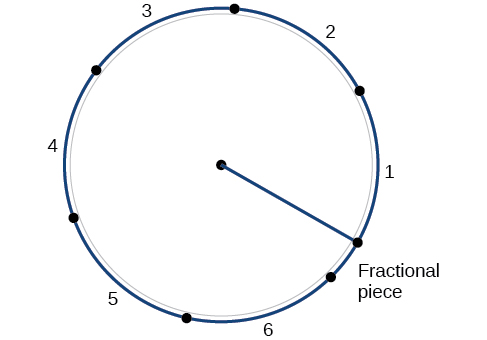
This brings us to our new angle measure. One radian is the measure of a central angle of a circle that intercepts an arc equal in length to the radius of that circle. A central angle is an angle formed at the center of a circle by two radii. Because the total circumference equals 2π times the radius, a full circular rotation is 2π radians.
Also, from above we get
Fact: radian measure is dimensionless, since it is the quotient of a length (circumference) divided by a length (radius) and the length units cancel.
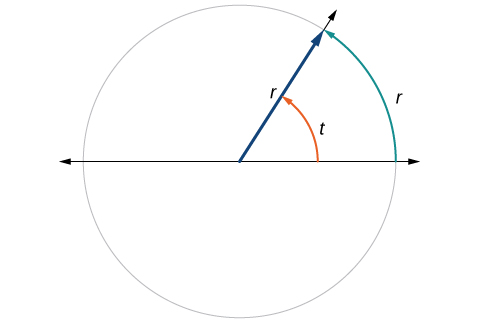
In the above figure, the angle t t sweeps out a measure of one radian. Note that the length of the intercepted arc is the same as the length of the radius of the circle.
"Stay in the loop. Receive exam news, study resources, and expert advice!"
Get Answer to all your questions

MBA/PGDM Admissions OPEN
Ranked among top 10 B-Schools in India by multiple publications | Top Recruiters-Google, MicKinsey, Amazon, BCG & many more.
GITAM University Admissions 2026
ApplyAICTE Approved | NAAC A++ | Category 1 University by MHRD | Highest CTC 1.4 Cr LPA from Amazon | Application Deadline: 29th May'26
PP Savani University MBA Admissions 2026
ApplyMBA @ P P Savani University | NAAC A+ Grade | 100% Placement Assistance | Apply Now
N. L. Dalmia Institute of Management, PGDM Admissions 2026
ApplyAICTE Approved | NBA Accredited | NAAC A+(2nd Cycle) Accredited. Highest CTC: 24 LPA | Average CTC: 11.17 LPA
Siva Sivani Institute of Management PGDM Admissions 2026
Apply98.74% Students Placed | 180+ Recruiters on Campus | Average CTC 7.25 LPA
Sharda University Admissions 2026
ApplyNorth India's Largest Educational Group | NIRF Ranked 87 | NAAC A+ Grade | Highest Package 1.6 Cr | Avail 50% Waiver on Application Fee | Last Date: 31st May'26