
Search Colleges, Exams, Schools & more


Login
CAT Application of Heron’s Formula in Finding Areas of Quadrilaterals - Practice Questions & MCQ
Edited By admin | Updated on Oct 04, 2023 04:20 PM | #CAT
Quick Facts
-

3 Questions around this concept.
Solve by difficulty
 MEDIUM
The area of the given trapezium is: (in cm2)

The area of a quadrilateral ABCD in which AC =17 m, BC = 15 m, CD = 12 m, DA = 9m and $\angle$B = 90º is: (in m2)
The adjacent sides of a parallelogram ABCD are AB = 34 m, BC = 20 m and diagonal AC = 42 m. Then the area of the parallelogram is: (in m2)
Latest: CAT 2025 College Predictor
Don't Miss: IIM -A Comprehensive Guide
CAT 2025 QP's & Solutions: Slot 1 | Slot 2 | Slot 3 | All Slot
Also See: Best Private MBA Colleges in India
Concepts Covered - 1
Application of Heron’s Formula in Finding Areas of Quadrilaterals
Many a time, the figures are in the shape of quadrilaterals. To find the area of quadrilateral, we need to divide the quadrilateral in triangular parts and then use the formula for area of the triangle. Let us look at this problem:
The area of the quadrilateral ABCD in which, AB = 12 cm, BC = 5 cm, CD = 14 cm, DA = 19 cm and ∠ B = 90°.
Let ABCD be the given quadrilateral
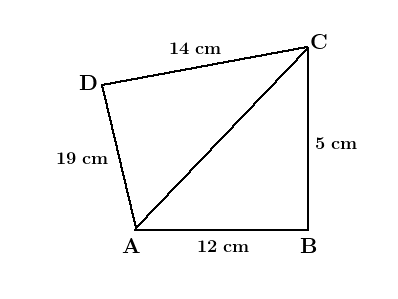
In ∆ ABC, by Pythagoras’ theorem, we have
AC2 = AB2 + BC2
AC2 = 122 + 52 = 144 + 25 = 169
AC = 13
In ∆ ABD, Let a = AC = 13 cm, b = CD = 14 cm and c = AD = 19 cm.
(s - a) = (23 - 13) = 10 cm
(s - b) = (23 - 14) = 9 cm
(s - c) = (23 - 19) = 4 cm
"Stay in the loop. Receive exam news, study resources, and expert advice!"
Get Answer to all your questions

MBA/PGDM Admissions OPEN
Ranked among top 10 B-Schools in India by multiple publications | Top Recruiters-Google, MicKinsey, Amazon, BCG & many more.
GITAM University Admissions 2026
ApplyAICTE Approved | NAAC A++ | Category 1 University by MHRD | Highest CTC 1.4 Cr LPA from Amazon | Application Deadline: 29th May'26
PP Savani University MBA Admissions 2026
ApplyMBA @ P P Savani University | NAAC A+ Grade | 100% Placement Assistance | Apply Now
N. L. Dalmia Institute of Management, PGDM Admissions 2026
ApplyAICTE Approved | NBA Accredited | NAAC A+(2nd Cycle) Accredited. Highest CTC: 24 LPA | Average CTC: 11.17 LPA
Siva Sivani Institute of Management PGDM Admissions 2026
Apply98.74% Students Placed | 180+ Recruiters on Campus | Average CTC 7.25 LPA
Sharda University Admissions 2026
ApplyNorth India's Largest Educational Group | NIRF Ranked 87 | NAAC A+ Grade | Highest Package 1.6 Cr | Avail 50% Waiver on Application Fee | Last Date: 31st May'26