Great Lakes - PGDM & PGPM Admissions 2027
Globally Recognized by AACSB (US) & AMBA (UK) | 18 LPA Avg. CTC for PGPM 2026


Profit and Loss is one of the most important topics in CAT 2026 Quantitative Aptitude, forming a major part of arithmetic-based questions. This topic tests a candidate’s understanding of percentages, ratios, and real-life business scenarios. Questions are often integrated with discounts, successive transactions, and averages, making conceptual clarity essential. With regular practice and the right approach, Profit and Loss becomes a scoring area, helping aspirants improve accuracy and manage time effectively in the CAT exam.
This Story also Contains
In this article, you will find
To understand the topic, you must understand the basic definitions first, like
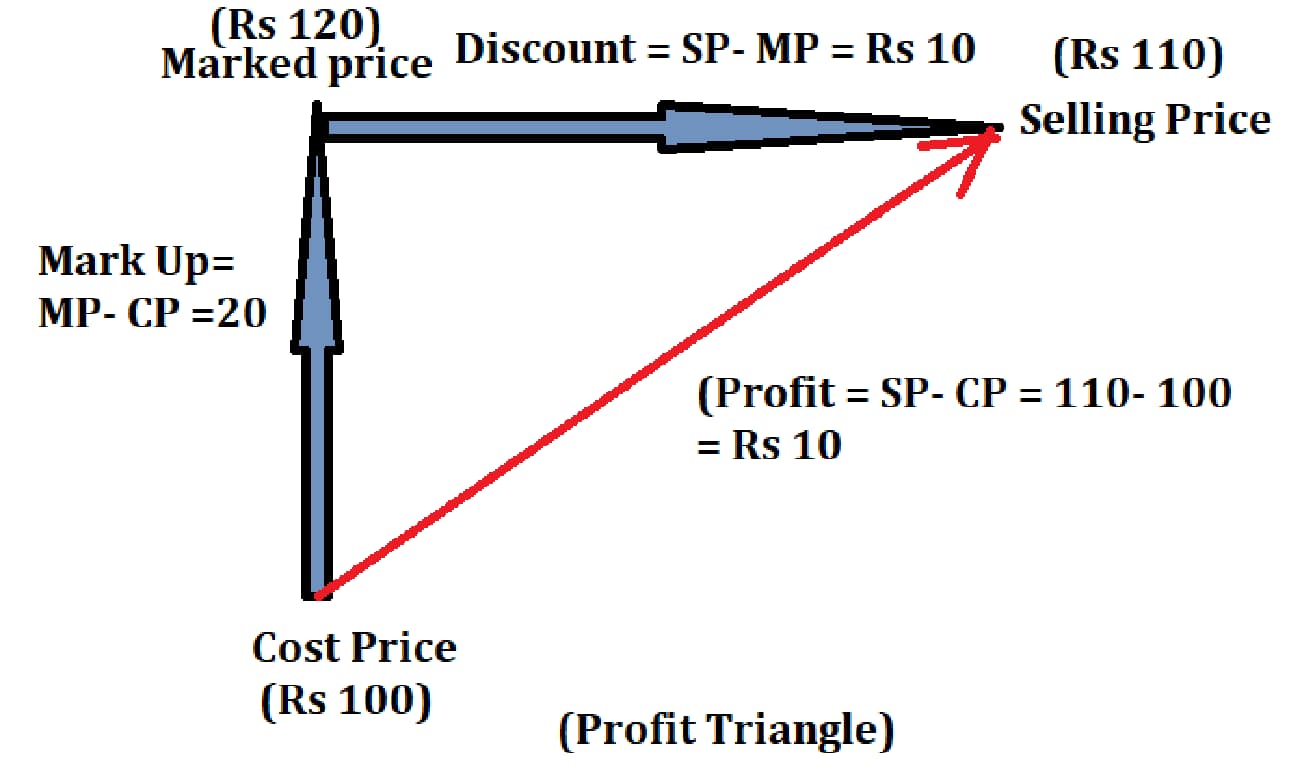
CP (Cost Price): It is the price at which an article is purchased.
SP (Selling Price): It is the price at which an article is sold.
MP (Marked Price or List Price): It is the price marked on the article. Discounts are generally calculated on this price.
Profit or Gain: When SP > CP, the seller makes a profit.
Profit = SP - CP
Loss: When CP > SP, the seller incurs a loss.
Loss = CP - SP
Discount: It's a reduction given on the marked price (MP).
Discount = MP – SP
Also, you should understand the question types that are being asked in the CAT
Questions based on CP, SP, and MP
When CP, discount%, Profit% are given, and other variables like SP, MP, etc need to be calculated.
Questions based on successive discounts
When two or more discounts are given successively, and you have been asked to calculate the SP, MP, or net discount percent.
Questions based on Faulty weight and Adulteration
In these types of questions, the final profit% is asked after adulteration, or sometimes the adulteration percent is asked when the final profit percent is given.
The CAT quant section has one or two questions from this topic every year, ranging in difficulty from medium to high level. So, this topic should be practised more.
From the analysis of CAT previous years' question papers, we noticed that, along with direct questions from Profit and Loss, Caselet Data Interpretation based on this is also asked.
We have analysed the previous 5 years' papers of CAT to find out the weightage and CAT exam pattern of the questions form profit and loss that are asked in the exam. Here is a summary of the weightage of questions of profit and loss year-wise and slot-wise.
|
S. No. |
Year |
Slot |
Number of questions |
|
1 |
2020 |
1 |
1 |
|
2 |
2020 |
2 |
1 |
|
3 |
2020 |
3 |
1 |
|
4 |
2021 |
1 |
1 |
|
5 |
2021 |
2 |
2 |
|
6 |
2021 |
3 |
1 |
|
7 |
2022 |
1 |
2 |
|
8 |
2022 |
2 |
0 |
|
9 |
2022 |
3 |
0 |
|
10 |
2023 |
1 |
1 |
|
11 |
2023 |
2 |
2 |
|
12 |
2023 |
3 |
1 |
|
13 |
2024 |
1 |
1 |
|
14 |
2024 |
2 |
1 |
|
15 |
2024 |
3 |
1 |
It is important to understand the common mistakes in the CAT exam that a student makes while solving the Profit and Loss questions.
|
Common Mistakes |
How to Rectify |
|
Ignoring basic concepts |
Understand all the basic definitions and formulas, and practice questions based on them |
|
Misinterpreting the base |
Usually, students calculate the profit percent on the selling price instead of the cost price. So, it is very important to understand that the profit is always calculated on CP, discount is always calculated on MP. |
|
Mistakes in converting percentages into fractions |
Practice the percentage to fraction conversion and vice versa. |
|
Errors in finding successive discounts |
It is important to understand whether the successive discounts are needed or not. You should focus more and practice more |
|
When questions involve two or more concepts, students often make mistakes |
Practice questions based on the concept amalgam. |
There are 3 basic formulas in profit and loss that need to be understood to solve any question in Profit and loss. The rest are the variations of the questions.
Profit $\% = \frac{\text{Profit}}{\text{CP}} \times 100$, where CP is the cost price.
Loss $\% = \frac{\text{Loss}}{\text{CP}} \times 100$, where CP is the cost price.
Profit $= \text{SP} - \text{CP}$, Loss $= \text{CP} - \text{SP}$
Other Variations of this formula:
$\text{SP} = \text{CP} \times \frac{100 + \text{Profit}\%}{100}$
Key Usage: Basic P&L questions, cost-price/selling-price direct problems.
Example: A shopkeeper buys a book for ₹400 and sells it at ₹460. Find profit %.
Profit = $60$, $CP = 400 \Rightarrow$ Profit $\% = \dfrac{60}{400} \times 100 = 15\%$.
Discount % = $\dfrac{Discount}{MP} \times 100$, where $MP$ is the marked price.
Discount = $MP - SP$
Other Variation:
$SP = MP \times \dfrac{100 - Discount\%}{100}$
Key Usage: Marked price, successive discounts, successive profit/loss.
Example: A shopkeeper gives two successive discounts of $40\%$ and $30\%$ respectively. Find the effective discount %.
Let $MP = 100$. After 1st discount, price $= 60$. After second discount of $30\%$, final $SP = 60 \times 0.7 = 42$.
Net Discount% $= \dfrac{100 - 42}{100} \times 100 = 58\%$.
Alternate solution (Trick):
Net discount% $= 40 + 30 - \dfrac{40 \times 30}{100} = 70 - 12 = 58\%$
Markup% = $\dfrac{Markup\ value}{CP} \times 100$
Other Variation:
$SP = MP \times \dfrac{100 - Discount\%}{100}$
Key Usage: Marked price, hike in the price of value, successive increase in the price.
Example: A man marked up the price on one article by $20\%$ and lost $10\%$ on the marked price while selling. Find net % gain/loss.
Let $CP = 100$. After increase of $20\%$, price $= 120$. After second transaction, final $SP = 120 \times 0.9 = 108$.
Net gain% $= \dfrac{108 - 100}{100} \times 100 = 8\%$.
A few points must be remembered before solving questions using these 3 formulas
1. Profit or loss percent is always calculated on the cost price.
2. Discount percent is always calculated on the marked price.
3. The markup percent is always calculated on the cost price.
Also, there are some prerequisite conditions:
Hands-on percentage to fraction conversion and vice versa.
Consider the following example:
Question: A man buys 35 kg of sugar and sets a marked price in order to make a 20% profit. He sells 5 kg at this price, and 15 kg at a 10% discount. Accidentally, 3 kg of sugar is wasted. He sells the remaining sugar by raising the marked price by p percent so as to make an overall profit of 15%. Then p is nearest to: [CAT 2024]
Solution:
Step 1: First, understand the problem statement and the information given in the question.
In this question, the markup percent is to be calculated.
Given:
Targeted Profit % = 20%
Sold 5 kg at the targeted price.
Sold 15 Kg at a discount of 10%.
3 kg of sugar is wasted.
Now, we need to find the percentage increase in the price of the remaining sugar so that the total profit is 15%.
Step 2: Identify the concept required to solve the question.
Formula 1 should be used in between
Profit/Loss % = $\dfrac{Profit\ or\ Loss}{CP} \times 100\%$, where $CP$ is the cost price.
Formula 2 (used in between):
Discount % = $\dfrac{Discount}{MP} \times 100\%$, where $MP$ is the marked price.
Formula 3 (used in the end):
Markup % = $\dfrac{Markup\ Value}{CP} \times 100\%$, where $CP$ is the cost price.
Step 3: Apply the concept/formula to find the unknown.
Final Solution:
Let the cost price of 1kg of sugar = Rs 100
The total cost price of 35 kg = Rs 3500
Marked price per kg = Rs 120
Given, the final profit is 15%. So, Final SP of 35 kg = 3500 × 1.15 = Rs 4025
First 5 kg's are sold at 20% marked-up price, SP1 = 5 × 100 × 1.2 = Rs 600
Next 15 kg are sold after giving 10% discount, SP2 = 15 × 100 × 1.2 × 0.9 = Rs. 1620
3 kg of sugar got wasted
$\Rightarrow 23 \text{ kg of sugar was sold at } Rs.\ (600 + 1620) = Rs.\ 2220$
The remaining $12 \text{ kg}$ should be sold at $Rs.\ (4025 - 2220) = Rs.\ 1805$
$\Rightarrow SP \text{ of 1 kg } = \dfrac{1805}{12} \approx Rs.\ 150$
Hence, the seller should further mark up by
$\dfrac{150 - 120}{120} \times 100 = 25\%$
Here are a few shortcuts that can be helpful to solve the questions effectively and save time during the exam.
|
Concept |
Shortcut |
|
To find the net profit or loss percent if the cost price of n articles is the same. |
Average of all profit and loss percentages. Profit percentages are taken as positive, while loss percentage is taken as negative. |
|
To find the net profit or loss percent if the selling price of 2 articles is the same and the profit % (x%) and loss % (x%) are the same. |
$\text{Net Loss %} = \dfrac{x^2}{100}$ |
|
Net discount if there are two successive discounts of $R_1\%$ and $R_2\%$. |
$\text{Net } \% = R_1 + R_2 - \dfrac{R_1 R_2}{100}$ |
Q.1) Bina incurs 19% loss when she sells a product at Rs. 4860 to Shyam, who in turn sells this product to Hari. If Bina would have sold this product to Shyam at the purchase price of Hari, she would have obtained 17% profit. Then, the profit, in rupees, made by Shyam is
Solution:- [Expected time to be taken: 45 to 60 seconds, Level of Difficulty: Moderate]
Let the cost price for Bina be $x$.
Bina sells to Shyam at a 19% loss:
$4860 = x - \frac{19}{100}x = \frac{81}{100}x$
So, $x = \frac{4860 \times 100}{81} = 6000$
Now, let the selling price to Hari be $y$.
If Bina had sold to Shyam at Hari's price and made 17% profit:
$y = x + \frac{17}{100}x = \frac{117}{100} \times 6000 = 7020$
So, Shyam bought at Rs. 4860 and sold at Rs. 7020
Therefore, his profit is: $7020 - 4860 = 2160$
Hence, the correct answer is $2160$.
Q.2) Gopi marks a price on a product in order to make $20 %$ profit. Ravi gets $10 %$ discount on this marked price, and thus saves Rs 15. Then, the profit, in rupees, made by Gopi by selling the product to Ravi, is
A) 15
B) 25
C) 10
D) 10
Solution:- [Expected time to be taken: 45 seconds, Level of Difficulty: Easy]
Let the cost price of the product be $100x$.
Gopi wants to make a $20\%$ profit,
so the marked price (MP) is:
$
\text{MP} = 100x \times \left(1 + \frac{20}{100}\right) = 120x
$
Ravi gets $10$ % discount on the marked price, so the selling price (SP) is:
$
\text{SP} = 120x \times \left(1 - \frac{10}{100}\right) = 120 \times \frac{90}{100} = 108x
$
Now, the discount Ravi gets = $120x - 108x = 12x$
But the question says Ravi saves Rs 15,
So, $12x=15$
$⇒x=\frac{15}{12}=\frac54$
The profit made by Gopi = $108x - 100x = 8x= 10$ rupees.
Hence, the correct answer is option 3.
Q.3) Gita sells two objects A and B at the same price such that she makes a profit of 20% on object A and a loss of 10% on object B. If she increases the selling price such that objects A and B are still sold at an equal price and a profit of 10% is made on object B, then the profit made on object A will be nearest to:
A) 42%
B) 47%
C) 45%
D) 45%
Solution:- [Expected time to be taken: 75 to 90 seconds, Level of Difficulty: Moderate to Hard]
Let the original selling price of both A and B be Rs 100.
So, the cost price of A (Profit of 20%) = $\frac{5}{6} \times 100 = \frac{250}{3}$
And, Cost price of B (Loss of 10%) = $\frac{10}{9} \times 100 = \frac{1000}{9}$
After an increase in the selling price by some value, the profit on object B is 10%.
So, the new selling price = 110% of the cost price of B
= $\frac{1000}{9} \times \frac{110}{100} = \frac{1100}{9}$
Profit of A = $\frac{1100}{9} - \frac{250}{3} = \frac{350}{9}$
Profit percentage of A = $\frac{\frac{350}{9}}{\frac{250}{3}} \times 100 = 46.67$% (Nearest to 47%)
Hence, the correct answer is option (2).
Q.4) Minu purchased a pair of sunglasses for Rs. 1000 and sold them to Kanu for 20% profit. Then, Kanu sells it back to Minu at a 20% loss. Finally, Minu sells the same pair of sunglasses to Tanu. If the total profit made by Minu from all her transactions is Rs. 500, then the percentage of profit made by Minu when she sold the pair of sunglasses to Tanu is
A) 35.42%
B) 31.25%
C) 52%
D) 52%
Solution:- [Expected time to be taken: 60 to 75 seconds, Level of Difficulty: Moderate]
Initial Cost Price for Minu = 1000
Cost Price to Kanu = 120% of 1000 = 1200
Profit made by Minu = 1200 – 1000 = 200
Again Minu purchased at 80% of 1200 = 960
The total profit made by Manu is 500. So, profit made when she sold it to Tanu = 500 – 200 = 300
Final Selling Price for Minu when sold to Tanu = 960 + 300 = 1260
Profit percent = $\frac{300}{960}$ $\times$ 100 = 31.25%
Hence, the correct answer is option (2).
Q.5) Ankita buys 4 kg cashews, 14 kg peanuts and 6 kg almonds when the cost of 7 kg cashews is the same as that of 30 kg peanuts or 9 kg almonds. She mixes all the three nuts and marks a price for the mixture in order to make a profit of Rs. 1752. She sells 4 kg of the mixture at this marked price and the remaining at a 20% discount on the marked price, thus making a total profit of Rs. 744. Then the amount, in rupees, that she had spent in buying almonds is:
A) 1680
B) 1176
C) 2520
D) 2520
Solution:- [Expected time to be taken: 90 to 120 seconds, Level of Difficulty: Hard]
It is given, $7C = 30P = 9A$ and Ankita bought 4C, 14P and 6A.
Let $7C = 30P = 9A = 630k$
$⇒C = 90k, P = 21k$, and $A = 70k$
Cost price of 4C, 14P and 6A $= 4(90k)+14(21k)+6(70k) = 1074k$
Marked up price $= 1074k + 1752$
So,
$\begin{aligned} & \text { S.P }=\frac{1}{6}(1074 k+1752)+\left(\frac{4}{5}\right)\left(\frac{5}{6}\right)(1074 k+1752)=\frac{5}{6}(1074 k+1752) \\ & ⇒\text { S.P-C.P }=\text { profit } \\ & ⇒1460-\frac{1074 k}{6}=744 \\ & ⇒\frac{1074 k}{6}=716\end{aligned}$
$⇒k = 4$
Money spent on buying almonds = 420k = 420 × 4 = Rs 1680
The correct answer is Rs. 1680.
Q.6) Amal buys 110 kg of syrup and 120 kg of juice, syrup being 20% less costly than juice, per kg. He sells 10 kg of syrup at 10% profit and 20 kg of juice at 20% profit. Mixing the remaining juice and syrup, Amal sells the mixture at Rs 308.32 per kg and makes an overall profit of 64%. Then, Amal’s cost price for syrup, in rupees per kg, is:
A) 160
B) 180
C) 220
D) 220
Solution:- [Expected time to be taken: 90 to 120 seconds, Level of Difficulty: Hard]
Let the price of juice be Rs. $x$ per kg.
Since the cost price of syrup is 20% less than the cost price of juice, the cost price of syrup is $0.8x$ per kg.
Total cost price of syrup $= 110 × 0.8x = 88x$
Total cost price of juice $= 120 × x = 120x$
Total cost price $= 88x + 120x = 208x$
Since the overall profit percentage is 64%,
Total profit $= 0.64(208x) = 133.12x$
Profit generated by selling 10 kg of syrup which costs
Rs $0.8x$ per kg at 10% profit $= 0.1 ×10 ×0.8x = 0.8x$
Profit generated on selling 20 kg of juice which costs Rs $x$ per kg at 20% profit $= 0.2 ×20x = 4x$
The remaining profit $(133.12x - (0.8x + 4x) = 128.32x)$ is generated by selling 100 kg of syrup and
100 kg of juice at Rs 308.32 per kg.
The total selling price of 100 kg of syrup and 100 kg of juice is 200 × 308.32 = 2×(30832)
The cost price of 100 kg of syrup $= 0.8x ×100 = 80x$
Cost price of 100 kg of juice = $100x$
Total cost price $= 80x + 100x = 180x$
Profit = Selling price – Cost price
⇒ $128.32x = 2×(30832) - 180x$
⇒ $308.32x = 2×(30832)$
⇒ $x = 200$
Cost price of syrup per kg = 0.8 × (200) = Rs 160
Hence, the correct answer is option (1).
The most important CAT quantitative aptitude topics, along with the CAT quantitative aptitude practice questions, are provided in the table below. The candidates are encouraged to practice CAT quantitative aptitude questions from these topics as they have a high probability of being asked in the CAT examination.
|
Section |
Title |
Download Link |
|
Arithmetic |
Time, Speed and Distance | |
|
Ratio and Proportion | ||
|
Time and Work | ||
|
Percentages | ||
|
Algebra |
Surds and Indices | |
|
Logarithms | ||
|
Linear and Quadratic Equations and Mixtures and Alligations | ||
|
Sequence and Series | ||
|
Geometry |
Triangles | |
|
Circle | ||
|
Modern Maths |
Permutations and Combinations | |
|
Number Systems |
Remainders | |
|
Coordinate Geometry |
Profit and Loss questions in CAT 2026 Quantitative Aptitude focus on conceptual understanding, percentage application, and logical structuring rather than lengthy calculations. These problems are often combined with discounts, successive transactions, ratios, or averages. A keyword-focused, methodical approach helps aspirants solve questions faster, avoid common traps, and improve accuracy under time pressure.
Always determine whether profit or loss is calculated on cost price (CP) or selling price (SP). CAT frequently designs questions where the base is hidden. Misidentifying the base leads to incorrect percentage values even if the math is right.
Represent profit or loss as a percentage of CP early in the solution. Percentage conversion simplifies comparison, helps handle chained profit–loss scenarios, and reduces confusion in multi-layered CAT questions.
Instead of assuming CP as 100 mechanically, convert CP and SP into ratios. The ratio method makes calculations faster, especially in CAT questions involving successive profit, loss, or discount conditions.
For multiple transactions involving profit, loss, or discount, apply changes step by step, not by adding percentages. CAT tests understanding of successive percentage change, where compounding logic matters.
Use alligation when multiple items with different cost prices are sold at the same selling price or when overall profit is given. This technique efficiently finds individual CPs without long equations.
In calculation-heavy questions, CAT allows approximation-based elimination. Estimating logically saves time and helps reject incorrect options quickly without solving completely.
The candidates can download the various CAT preparation resources designed by Careers360 using the links given below.
| ebook Title | Download Links |
|---|---|
|
CAT 2026 Arithmetic Important Concepts and Practice Questions | |
|
CAT 2026 Algebra Important Concepts and Practice Questions | |
|
CAT 2026 Number System - Important Concepts & Practice Questions | |
|
CAT 2026 Exam's High Scoring Chapters and Topics | |
|
CAT Mock Test Series - 20 Sets, Questions with Solutions By Experts | |
|
Mastering CAT Exam: VARC, DILR, and Quant MCQs & Weightages | |
|
CAT 2026 Mastery: Chapter-wise MCQs for Success for VARC, DILR, Quant | |
|
CAT 2026 Quantitative Aptitude Questions with Answers | |
|
CAT 2026 Important Formulas | |
|
Past 10 years CAT Question Papers with Answers | |
|
CAT 2026 Quantitative Aptitude Study Material PDF - Geometry and Mensuration |
Frequently Asked Questions (FAQs)
Profit and Loss questions are frequently asked in CAT and test a candidate’s ability to apply basic arithmetic concepts quickly. These questions are usually formula-based and scoring if approached correctly.
Candidates should focus on cost price, selling price, profit percentage, loss percentage, marked price, discount, and successive discounts, as these form the base of most CAT questions.
In this case, one will always incur a loss which is equal to the square of the loss% divided by 100.
Here, loss% = 6.25%.
Most questions are of easy to moderate level but are often combined with logical reasoning or percentages, requiring careful reading and quick calculations.
Regular practice, memorising standard formulas, and learning percentage-to-fraction conversions help improve calculation speed and accuracy.
Yes, shortcuts and smart approximation techniques are extremely helpful, especially under time pressure, as long as the concepts behind them are clearly understood.

On Question asked by student community
Hello Student,
With a CAT 2025 percentile of 98.25, you have a good chance of receiving calls from several IIMs, particularly newer IIMs. However, IIM Ahmedabad , Bangalore , Calcutta , and Lucknow generally require higher percentiles for General-category candidates. Calls also depend on sectional percentiles, academics, work experience, and
Hello CAT Aspirant!
If you mean the CAT ( Common Admission Test) EWS certificate, the important point is whether the certificate is valid and issued in the prescribed format, rather than simply the language used on it.
Yes, a Hindi EWS certificate can generally be accepted for CAT, provided it
If you have already received your final MA result and have technically completed the degree , but you are only waiting for the revaluation outcome, you would generally be considered a graduate rather than someone whose master's degree is still completely in progress. However, CAT has specific instructions about qualification
If you mean CAT (Common Admission Test) preparation, you can practise with previous-year CAT papers. IIM has a collection of CAT papers from 2017 to 2025, covering VARC, DILR and Quant across different slots, along with solutions and explanations. Solving the recent papers first can help you understand the current
Hello Student,
Yes, you can apply for CAT with an EWS certificate issued in Hindi, provided it is issued by the competent authority and follows the required format. However, CAT applicants need a Central-level EWS certificate, not merely a state-level EWS certificate. Since you are from Uttar Pradesh, ensure your
Directions for question:
The bar-graph given below shows the foreign exchange reserves of Nepal (in million Rupees) from 2014 to 2021. Answer the following questions based on the graph :

Question:
What was the percentage increase (rounded to the nearest integer, if deemed necessary) in the foreign exchange reserves in

Globally Recognized by AACSB (US) & AMBA (UK) | 18 LPA Avg. CTC for PGPM 2026
75+ years of legacy | #1 Entrance Exam | Score accepted by 250+ BSchools
6-Hour Masterclass to help you score 99+ percentile in CAT 2026
Test centres are available in 70+ cities across India | 75,000+ aspirants apply for the NMAT exam | Accepted by 58+ institutions like NMIMS, KJSIM, ISB, SPJIMR and Great Lakes.
Registration Start: 3 August 2026 | Last Date to Apply: 15 September 2026 (till 5 PM)
AACSB Accredited | 40 LPA-Highest CTC | Scholarships worth 10 CR